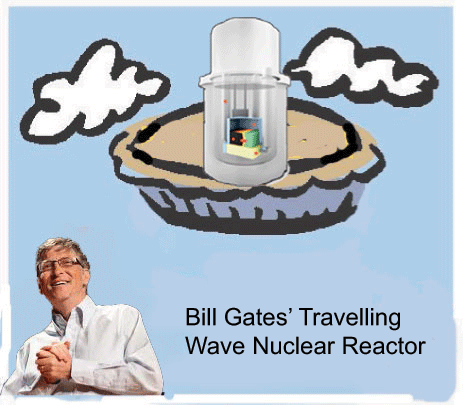
A losing bet – Bill Gates’ gamble on nuclear power?
Arjun Makhijani, president of the Institute for Energy and Environmental Research, told VICE News that companies have spent $100 billion worldwide trying to commercialize breeder reactors without success.
“So now you’re telling me that this combination of reactors has $1.3 billion scattered over more than a dozen technologies?” he said. “Bill Gates’ investment … is hopeless.”
Tech Titans Like Bill Gates Are Gambling on Nuclear Power — But It Looks to Be a Losing Bet, VICE News, By Laura Dattaro July 4, 2015 Nearly 50 American and Canadian tech companies, including heavy hitters like Bill Gates, have invested over a billion dollars in next-generation nuclear technologies in the last 10 years, according to the think tank Third Way.
Despite declining public trust in nukes, especially since the Fukushima Daiichi meltdown in Japan in March 2011, proponents argue that nuclear is key — some say the key — to providing reliable energy while at the same time helping to rid the world of fossil fuels.
“We were compelled by a mission to get involved in a very pressing energy challenge …. Marcia Burkey, chief financial officer of TerraPower, told VICE News. Bellingham, Washington-based TerraPower was founded by Bill Gates and is developing new nuclear reactor technologies.
But critics of nuclear power say this rosy picture does not match the realities of the industry, and that the technologies are too far from being scaled up commercially to meet the urgency of lowering emissions. What’s more, they say, the money behind the current push for more advanced reactors is paltry compared to the costs associated with developing, licensing, and constructing even a single nuclear plant.
“You can’t really in good faith put forward a technology that we don’t know how to do, and have no real prospect of knowing how to do in the next couple of decades. The solution needs to be underway already or to be capable of beginning tomorrow,” Peter Bradford, a professor at Vermont Law School and former member of the US Nuclear Regulatory Commission (NRC), told VICE News. “That’s really not true of any of those designs mentioned in the [Third Way] report.”
At the turn of the millennium, before Fukushima and the boom in cheap, domestically produced natural gas, nuclear power was on the verge of something of a renaissance, Bradford said. Energy demand was growing, renewables like solar and wind were expensive compared to fossil fuels, and the political environment seemed poised to put a price on carbon, making nuclear a viable energy choice.
Since then, however, renewables have taken off, while electricity demand in the US has remained relatively stable. Utilities are turning to cheap, abundant supplies of natural gas, and the price of solar and wind generation has plummeted.
Together those factors make building a large fleet of new reactors “unrealistic,” said Edwin Lyman, a nuclear expert with the Union of Concerned Scientists (UCS).
“Utilities lost interest and the nuclear renaissance flopped,” he said. “Now a narrative, I think, is being driven by some kind of entrepreneurial types who think they can do anything as long as you approach it with the right spirit. I think they look at the energy problems and say, ‘Why can’t we just innovate our way into a new energy future?’”
That ethos, while far from achieving delivery of a new generation of nuclear facilities, is churning out many new designs and technologies. The Third Way report points to several that could make nukes cheap to build and more efficient. For example, small modular reactors (SMRs) provide less electricity than older nuclear plants, but could cut construction time by up to four and a half years. And new types of so-called breeder reactors produce more fissile material than they consume.
Arjun Makhijani, president of the Institute for Energy and Environmental Research, told VICE News that companies have spent $100 billion worldwide trying to commercialize breeder reactors without success.
“So now you’re telling me that this combination of reactors has $1.3 billion scattered over more than a dozen technologies?” he said. “Bill Gates’ investment … is hopeless.”
Even if nuclear can overcome its technological hurdles, the question remains or who is going to pay for bringing the next generation on line. Third Way’s Brinton predicts that as development begins to move forward, investor money “will increase exponentially” to support construction of prototypes — a sentiment echoed by Doug McCuistion, chief operating officer of X-energy, a Maryland company working on SMRs…….
But nuclear plants have big price tags. Building an advanced nuclear plant costs more than $12 billion, according to the EIA — and the public foots much of that bill. Private investors, for example, benefit from state laws that shield them from paying for cost overruns during construction. They’re also backed by federal insurance if an accident occurs.
A Vermont Law School report found that construction delays on a South Carolina nuclear plant will likely cost the state and its electricity customers nearly $10 billion. And two new reactors in Georgia, with an estimated total cost of $14 billion, are already more than three years behind schedule. The costs from delays alone are inching toward $2 billion.
“Nuclear power is just a technology with so many challenges to make it safe and secure and competitive,” Lyman told VICE News, “that even [for] the masters of the universe, it’s going to take a lot more than they’ve been willing to put into it so far.” https://news.vice.com/article/tech-titans-like-bill-gates-are-gambling-on-nuclear-power-but-it-looks-to-be-a-losing-bet
No comments yet.
1 This Month

of the week – Shut Down Drone Warfare!


Tell the Ukrainian Government to Drop Prosecution of Peace Activist Yurii Sheliazhenko

Petition to revoke the licensing of the Near Surface Nuclear Disposal Facility (NSDF) at Chalk River. https://www.ourcommons.ca/petitions/en/Petition/Details?Petition=e-7247
To see nuclear-related stories in greater depth and intensity – go to https://nuclearinformation.wordpress.com
-
Archives
- March 2026 (251)
- February 2026 (268)
- January 2026 (308)
- December 2025 (358)
- November 2025 (359)
- October 2025 (376)
- September 2025 (257)
- August 2025 (319)
- July 2025 (230)
- June 2025 (348)
- May 2025 (261)
- April 2025 (305)
-
Categories
- 1
- 1 NUCLEAR ISSUES
- business and costs
- climate change
- culture and arts
- ENERGY
- environment
- health
- history
- indigenous issues
- Legal
- marketing of nuclear
- media
- opposition to nuclear
- PERSONAL STORIES
- politics
- politics international
- Religion and ethics
- safety
- secrets,lies and civil liberties
- spinbuster
- technology
- Uranium
- wastes
- weapons and war
- Women
- 2 WORLD
- ACTION
- AFRICA
- Atrocities
- AUSTRALIA
- Christina's notes
- Christina's themes
- culture and arts
- Events
- Fuk 2022
- Fuk 2023
- Fukushima 2017
- Fukushima 2018
- fukushima 2019
- Fukushima 2020
- Fukushima 2021
- general
- global warming
- Humour (God we need it)
- Nuclear
- RARE EARTHS
- Reference
- resources – print
- Resources -audiovicual
- Weekly Newsletter
- World
- World Nuclear
- YouTube
-
RSS
Entries RSS
Comments RSS
 nuclear-news
Leave a comment