Firefighters working around the clock as wildfires rage near Chernobyl nuclear site
 Wildfires Once Again Rage Nearby the Chernobyl Nuclear Site https://news.vice.com/article/wildfires-once-again-rage-nearby-the-chernobyl-nuclear-site By VICE News July 1, 2015 A fire is raging across half a square mile of drought-stricken land surrounding the remains of the Chernobyl nuclear power plant in Ukraine, the site of one of the worst nuclear disasters in history. It’s the second fire to hit the area since late April. After a reactor exploded at the plant in 1986, authorities established an 18-mile exclusion zone that remains off-limits to most people today. Some parts of the zone remain highly contaminated.
Ukraine’s State Emergency Situations Service reported early Tuesday that the fire was within the exclusion zone, according to the Ukrainian news service Interfax. But the country’s Minister of Ecology and Natural Resources later told reporters the fire is burning outside of the zone. He added that the blaze started due to drought.
The fire started Monday night and was still burning Tuesday morning, the Associated Pressreported.
Firefighters are working 24 hours a day amidst strong winds, according to a post on the emergency service’s Facebook page. Radiation levels are within normal, the agency said.
In late April, the largest forest fire in Ukraine since 1992 came within 12 miles of the Chernobyl plant.
In February, researchers warned that fires nearby Chernobyl “pose a high risk of redistributing radioactivity.” And, say scientists, wildfires in the area could become more frequent and more intense due to climate change.
Fukushima nuclear facility under control – no way!
Fukushima Not Even Close To Being Under Control Oil Price, By ZeroHedge , 28 June 2015 “……….In late 2014, Helen Caldicott, M.D. gave a speech about Fukushima at Seattle Town Hall. Pirate Television recorded her speech
Dr. Helen Caldicott is co-founder of Physicians for Social Responsibility, and she is author/editor of Crisis Without End: The Medical and Ecological Consequences of the Fukushima Nuclear Catastrophe, The New Press, September 2014. For over four decades Dr. Caldicott has been the embodiment of the anti-nuclear banner, and as such, many people around the world classify her as a “national treasure”. She’s truthful and honest and knowledgeable.
Fukushima is literally a time bomb in quiescence. Another powerful quake and all hell could break loose. Also, it is not even close to being under control. Rather, it is totally out of control. According to Dr. Caldicott, “It’s still possible that Tokyo may have to be evacuated, depending upon how things go.” Imagine that!
Fukushima- The Real Story
According to Japan Times as of March 11, 2015: “There have been quite a few accidents and problems at the Fukushima plant in the past year, and we need to face the reality that they are causing anxiety and anger among people in Fukushima, as explained by Shunichi Tanaka at the Nuclear Regulation Authority. Furthermore, Mr. Tanaka said, there are numerous risks that could cause various accidents and problems.”
Even more ominously, Seiichi Mizuno, a former member of Japan’s House of Councillors (Upper House of Parliament, 1995-2001) in March 2015 said: “The biggest problem is the melt-through of reactor cores… We have groundwater contamination… The idea that the contaminated water is somehow blocked in the harbor is especially absurd. It is leaking directly into the ocean. There’s evidence of more than 40 known hotspot areas where extremely contaminated water is flowing directly into the ocean… We face huge problems with no prospect of solution.”
At Fukushima, each reactor required one million gallons of water per minute for cooling, but when the tsunami hit, the backup diesel generators were drowned. Units 1, 2, and 3 had meltdowns within days. There were four hydrogen explosions. Thereafter, the melting cores burrowed into the container vessels, maybe into the earth……http://oilprice.com/Latest-Energy-News/World-News/Fukushima-Not-Even-Close-To-Being-Under-Control.htm
Study of over 300.000 nuclear workers confirms increased health risks from low dose radiation
 Researchers pin down risks of low-dose radiation Large study of nuclear workers shows that even tiny doses slightly boost risk of leukaemia. http://www.nature.com/news/researchers-pin-down-risks-of-low-
 dose-radiation-1.17876 Alison Abbott 30 June 2015 For decades, researchers have been trying to quantify the risks of very low doses of ionizing radiation — the kind that might be received from a medical scan, or from living within a few tens of kilometres of the damaged Fukushima nuclear reactors in Japan. So small are the effects on health — if they exist at all — that they seem barely possible to detect. A landmark international study has now provided the strongest support yet for the idea that long-term exposure to low-dose radiation increases the risk of leukaemia, although the rise is only minuscule (K. Leuraud et al. Lancet Haematol. http://doi.org/5s4; 2015).
The finding will not change existing guidelines on exposure limits for workers in the nuclear and medical industries, because those policies already assume that each additional exposure to low-dose radiation brings with it a slight increase in risk of cancer. But it scuppers the popular idea that there might be a threshold dose below which radiation is harmless — and provides scientists with some hard numbers to quantify the risks of everyday exposures.
“The health risk of low-dose radiation is really very tiny, but the public is very concerned,” says Bill Morgan, who heads a systems-biology programme in low-dose radiation at the Pacific Northwest National Laboratory in Richland, Washington, and chairs the committee on radiation effects at the International Commission on Radiological Protection (ICRP) in Ottawa, Canada. That concern has driven a lot of investment in programmes trying to quantify the risk, he says. The European Commission, for example, has a 20-year road map to assess the problem. “We don’t do a very good job of explaining ourselves to the public, which finds it hard to put radiation risks in context — some people go to radon spas to treat their rheumatism while others won’t board planes for fear of cosmic rays,” he adds.
Radiation risks
Ionizing radiation — the kind that can pull electrons from atoms and molecules and break DNA bonds — has long been known to raise the risks of cancer; the higher the accumulated dose, the greater the damage. But it has proved extremely difficult to determine whether this relationship holds at low doses, because any increase in risk is so small that to detect it requires studies of large numbers of people for whom the dose received is known. A study of more than 300,000 nuclear-industry workers in France, the United States and the United Kingdom, all of whom wore dosimeter badges, has provided exactly these data. A consortium of researchers coordinated by the International Agency for Research on Cancer (IARC) in Lyon, France, examined causes of death in the workers (one-fifth of whom had died by the time of the study) and correlated this with exposure records, some of which went back 60 years. Continue reading
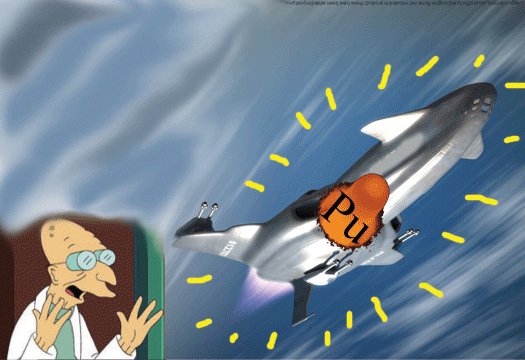
NASA cancelling solar space missions, favouring plutonium fuelled space flights
Debate over future of nuclear power systems in space, Enformable, Karl Grossman 29 Jun 2015NASA has released a study claiming there is a need for continued use of plutonium-energized power systems for future space flights. It also says the use of actual nuclear reactors in space “has promise” but “currently” there is no need for them.
The space plutonium systems—called radioisotope thermoelectric generators (RTGS)—use the heat from the decay of plutonium to generate electricity in contrast to nuclear reactors, usually using uranium, in which fission or atom-splitting takes place.
The “Nuclear Power Assessment Study” describes itself as being done as a “collaboration” involving “NASA centers,” among them Johnson Space Center, Kennedy Space Center and the Jet Propulsion Laboratory, “the Department of Energy and its laboratories including Los Alamos National Laboratory, Idaho National Laboratory, Sandia National Laboratories,” and the Johns Hopkins University Applied Physics Laboratory.
The study, released this month, comes as major breakthroughs have been happening in the use of solar and other benign sources of power in space. The situation parallels that on Earth as solar and wind power and other clean, safe technologies compete with nuclear, oil, coal and other problematic energy sources and the interests behind them. Examples of the use of benign power in space include the successful flight in May of a solar-powered spacecraft named LightSail in a mission funded by members of the Planetary Society. Astronomer Carl Sagan, a founder of the society, was among those who have postulating having a spacecraft with a sail propelled through the vacuum of space by the pressure of photons emitted by the sun. LightSail demonstrates his vision.
Yet, meanwhile, NASA cancelled its own solar sail mission scheduled for this year. Continue reading
UK government and EDF anxious about Austria’s lawsuit against state aid for Hinkley Point nuclear station

 Government and EDF in talks over liabilities if Austria wins nuclear state aid appeal, Telegraph, Energy giant and Government yet to agree what would happen if Austrian challenge against state aid for Hinkley Point C is successful By Emily Gosden, Energy Editor 30 Jun 2015 The Government and EDF are in talks over who will pick up the costs if Austria wins its appeal against the proposed Hinkley Point C nuclear plant once construction has begun.
Plans for the £16bn Hinkley Point plant received state aid clearance from the European Commission last year but Austria has vowed to challenge this, alleging that subsidies for the project constitute illegal state aid.
Although the Government and EDF both insist the appeal, expected to be lodged this week, has no merit, it is understood they are yet to agree on what would happen in the unlikely event Austria does win.Andrea Leadsom, the new energy minister, said on Tuesday she was “confident that the key investment decision on Hinkley C will happen soon, which will enable construction to start”.
But speaking on the fringes of the Nuclear Industry Association’s annual conference, Ms Leadsom also confirmed that the Government was “looking very closely” at the issue of how the project could go ahead with a state aid challenge ongoing.Austria’s state aid appeal is likely to hang over the project for at least a year and potentially as long as six years – during which time billions of pounds would be spent on construction.
The Government and EDF are believed to be targeting a final investment decision by October.A series of issues remain outstanding including EDF’s takeover of reactor-maker Areva’s nuclear business, deals with Chinese investors, and finalising contracts with the Government.
• Hinkley Point new nuclear power plant: the story so far………
Writing on legal website Lexology, lawyers at Shearman and Sterling LLP wrote: “While the prospect of success is low, even a small chance of success creates additional risk for project financiers.
“In a worst-case scenario, where the Commission makes an adverse decision, the UK Government’s support scheme – including the strike price and guarantee – would be ruled unlawful and unenforceable, with any aid already received having to be repaid. A competitor or other party with standing could apply to the UK national court to enforce this.
“While this outcome is the least likely, it may have a severely adverse impact on investors in the Hinkley Point C project.”
They added that “investors may find insuring themselves contractually (e.g., via indemnities or similar means) difficult” and that “any provision seeking protection from the UK Government for such an eventuality could itself risk being struck down as unlawful State aid”…..http://www.telegraph.co.uk/finance/newsbysector/energy/11709083/Government-and-EDF-in-talks-over-liabilities-if-Austria-wins-nuclear-state-aid-appeal.html
‘Scorpion’ robot to help develop new robots that could go deeper into Fukushima nuclear reactor unit 2
Officials hope the robot can see the fuel in the pressure vessel in the middle of the reactor. The fuel hasn’t been located exactly and studied because of the high radiation levels.
The difficult work of decommissioning the Fukushima plant damaged by the 2011 earthquake and tsunami will take decades. The scorpion robot is the second to enter a primary containment vessel, after “snake” robots were sent in April inside the worst-hit Unit 1. One of the two robots used in that reactor became stuck and had to be left behind, and neither was able to spot the melted fuel debris.
This time, the scorpion crawler, which is 54 centimeters (21 inches) long when it is extended, will enter through a duct designed as a passageway for fuel rods. Toshiba has no back up machine……….
Toshiba officials said they hope the robot can capture images of deeper areas of the vessel, though the primary focus is the platform area, so they can design suitable robots that can go deeper into the vessel……
The robot’s entry is just the beginning of the reactor investigation required before the most challenging task of removing the melted fuel.: http://phys.org/news/2015-06-small-robot-interior-fukushima-daiichi.html#jCp
Poor health of Fukushima radiation refugees
Nonprofit Group: “Every single person” we hosted from Japan has had health problems… Blood stains found in almost all of their beds — Japanese Mom: Most mothers I’ve met from Tokyo and Fukushima are suffering thyroid problems, eye problems, nose bleeds… It’s been very surprising (VIDEO) http://enenews.com/video-mothers-ive-met-tokyo-fukushima-suffering-thyroid-problems-eye-problems-nose-bleeds-very-surprising-nonprofit-group-every-single-person-weve-hosted-japan-health-problems-found-blood-stains-ev?utm_source=feedburner&utm_medium=email&utm_campaign=Feed%3A+ENENews+%28Energy+News%29
Interview with Vicki Nelson, founder of Fukushima Friends (nonprofit organization which facilitates trips to Hawaii for Fukushima radiation refugees), Nuclear Hotseat hosted by Libbe HaLevy, Jun 9, 2015 (at 16:30 in):
- Vicki Nelson, founder of Fukushima Friends (emphasis added): We have a home that’s open for them to come and experience some time of respite and eat different food. What we’ve been experiencing also is that every single person that comes has reaction to the change as soon as they come here. There’s been people who have vomited, they’ve been having nosebleeds, they’ve been dizzy, they’ve been very ashen in color.
- Libbe HaLevy, host: This is once they have left Japan? In other words, it is the lack of the radiation that allows them to then have these reactions?
- Nelson: It’s like it is expelling from their body. There’s diarrhea, there’s nosebleeds— almost every single person has had nosebleeds on their pillow. I find blood, andthey don’t want to tell me that they have these reactions, they’re embarrassed. Tokiko’s son [from Koriyama, Fukushima] vomited the whole first week practically, and diarrhea. We actually took him to the hospital because we felt that he was dehydrated. They did run tests, and they said yes he was dehydrated. So he was kept overnight at the Hilo hospital on the big island and cared for.
Meeting hosted by Andrew Cash, member of Canadian parliament, Dec 2012 — Japanese mother (at 2:12:30 in): “My home town is Sapporo [northernmost island in Japan]… In my city, no one thinks about radiation. I found a group of escaped mothers from Tokyo and the Fukushima area, and I was very surprised… Most of them had thyroid problems, or eye problems, or nose bleeds… They are very worried about it. In Japan we knew about the meltdowns two months after the meltdowns happened, so we can have no information about radiation. Now the government is telling us to eat food from Fukushima. We can’t rely on government. The TV said Fukushima is safe, no problem… Fukushima is good to live. They want to invite a lot of tourists to Fukushima.
Full interview with Nelson here | Watch the meeting in Canada here
Canada’s last shipment of weapons grade uranium. Medical radioisotopes to be made in cyclotron, not nuclear reactor
The Chalk River reactor, which began operating in 1957, is one of five major producers of molybdenum-99, which decays into the technetium-99m isotope used in 85 per cent of nuclear medicine procedures such as bone scans and other diagnostic tests.
 Other sources, such as a cyclotron operated by TRIUMF, Canada’s national nuclear laboratory for particle and nuclear physics at the University of British Columbia, are in the works.
Final shipment of weapons-grade uranium due at Ontario facility this year http://www.thestar.com/news/canada/2015/06/29/final-shipment-of-weapons-grade-uranium-due-at-ontario-facility-this-year.html By: Joanna Smith Ottawa Bureau reporter, Jun 29 2015
OTTAWA—The United States has approved what is expected to be the last shipment of weapons-grade uranium to be sent to Canada for the production of medical isotopes. The U.S. Nuclear Regulatory Commission signed an export licence June 23 to transport 8.1 kilograms of highly enriched uranium from Oak Ridge, Tenn., along a secret route to Chalk River, Ont., by the end of this year.
There, for what is expected to be the last time, the uranium will be used to produce target material for the aging National Research Universal (NRU) reactor to irradiate in order to produce medical isotopes used in nuclear medicine.
“The game is over for Canada’s unnecessary and irresponsible use of bomb-grade uranium to produce medical isotopes. Better late than never,” Alan Kuperman, coordinator of the Nuclear Proliferation Prevention Project at the University of Texas at Austin, said in a statement Monday.
THE LAST SHIPMENT Kuperman has long been tracking the controversial U.S. exports of highly enriched uranium to Canada. The Conservative government has committed to shutting down the routine production of medical isotopes at the NRU by Oct. 31, 2016, with the possibility of the NRU retaining licences to operate until March 2018 in case of unexpected shortages. The isotope has a very short lifespan, causing it to disappear within a day of being generated and so it cannot be stockpiled.
In France, nuclear power has lost its glow

 France Loses Enthusiasm for Nuclear Power, Scientific American, Nuclear’s share of electricty will drop from 75 percent to 50 percent by 2025 due to loss of know-how and requirements for more renewable sources By Umair Irfan and ClimateWire | June 29, 2015“……..
A ‘once formidable institution’ declines….nuclear plants, by their nature, are big bets and take years to build. Laponche explained that the French nuclear industry anticipated 1,000 TWh of demand, but domestic needs have yet to top 600 TWh, leaving an oversupply. With the economic downturn and increasing energy efficiency, French electricity demand has remained level or declined in some instances.
Now, some of France’s reactors are showing wrinkles—France’s oldest reactor, Fessenheim 1, started operations in 1977—and officials need to decide whether to invest in costly safety upgrades to keep them operating or to decommission them, another expensive prospect that leaves open the possibility that fossil fuels may rise to meet the shortfall.
New reactors also are struggling. Areva’s third-generation nuclear reactor, EPR, is now under construction at four sites: two in China, one in France and one in Finland. All four are behind schedule, and the French and Finnish reactors have seen their costs more than double, suffering from quality control and management problems.
“The cost of construction of new nuclear is extraordinarily expensive,” said Antony Frogatt, a senior research fellow at Chatham House, an international affairs think tank. He observed that there are ways to extend the lives of existing reactors, but upgrades get progressively more expensive, and certain components, like reactor pressure vessels, cannot be replaced, so renewed operating licenses are only prolonging the inevitable.
And while France has reduced nuclear waste, it hasn’t eliminated the need to dispose of it. No country with nuclear power has a viable underground repository for waste, and proposed sites in France face public opposition, despite more widespread support for nuclear power.
On the other hand, France is the second largest renewable energy producer and consumer in Europe. Wavering solar and wind power don’t play well with baseload nuclear plants that prefer to run at full blast, so the French must find a way to cope with this imbalance if they are to meet the European Union’s directive to generate 20 percent of their electricity from renewables by 2020…….
To sum up, it’s a shrinking client base [for nuclear power] and a competitive market,” said Mycle Schneider, an independent international energy consultant. “The financial and economic situation is devastatingly bad.”
The New York Times reported that Areva hasn’t been profitable since 2010, accrued €4.8 billion in losses in 2014 and may lay off up to 6,000 workers. EDF may take over parts of Areva’s business…….
AREVA to sell its U.S. nuclear radiation measurement business
Areva puts U.S. nuclear radiation business Canberra up for sale PARIS, JUNE 29 French state-owned nuclear group Areva has begun the sale process for the planned disposal of its U.S. nuclear radiation measurement business Canberra, it said in a statement on Monday.
The sale of Canberra is part of a revamp of loss-making Areva, with utility EDF poised to buy its nuclear reactor business. (Reporting by Michel Rose; Editing by David Goodman) http://www.reuters.com/article/2015/06/29/areva-canberra-idUSL5N0ZF0H220150629
Radiation effects on Fukushima’s birds are getting worse
Mousseau said the reason comes down to the long-term impact of the radiation. “It takes multiple generations for the effects of mutations to be expressed in natural populations,” he said
 Near site of Fukushima disaster, birds still in peril, By MICHAEL CASEY CBS NEWS April 16, 2015, Four years after the Fukushima disaster, birds are becoming a rarity around the damaged nuclear site.
A study in the Journal of Ornithology found that half the populations of 57 bird species had suffered declines. Studying birds over three years at 400 sites, University of South Carolina biologist Tim Mousseau and his colleagues found that the numbers continue to decline over time – even as the radiation threat drops.
“There are dramatic reductions in the number of birds that should be there based on the overall patterns,” Mousseau told CBS News. “In terms of barn swallows in Fukushima, there had been hundreds if not thousands in many of these towns where we were working. Now we are seeing a few dozen of them left. It’s just an enormous decline.”
In addition to barn swallows, the great reed warbler, Japanese bush warbler and the meadow bunting have been the hardest hit………
Mousseau also has been among researchers leading a project that compares the environmental impact of Fukushima to that of Chernobyl, the scene in 1986 of the worst accident at a nuclear plant. As the director of the Chernobyl + Fukushima Research Initiative, he looked at the impact of birds in both places.
In a second paper in the Journal of Ornithology this month, Mousseau and his longtime collaborator Anders Moller of the French National Centre for Scientific Research found that migratory birds appear to fare worse around Chernobyl than year-round residents. The opposite is true in Fukushima…….
Around Fukushima, Mousseau predicts the worst may not be over.
“The relationship between radiation and numbers started off negative the first summer, but the strength of the relationship has actually increased each year,” Mousseau says. “So now we see this really striking drop-off in numbers of birds as well as numbers of species of birds. So both the biodiversity and the abundance are showing dramatic impacts in these areas with higher radiation levels, even as the levels are declining.”
Mousseau said the reason comes down to the long-term impact of the radiation.
“It takes multiple generations for the effects of mutations to be expressed in natural populations,” he said, referring to effects such as shorter life spans and reduced fertility. “At some point, there will be a balance of the negative effects of mutations and immigration of fresh, new birds. We just don’t know enough to say when a balance will be reached.” http://www.cbsnews.com/news/fukushima-disaster-taking-a-toll-on-birds/
Court orders TEPCO to pay over suicide linked to nuclear evacuation
 Tepco ordered to pay over suicide linked to nuclear evacuation, Japan Times, FUKUSHIMA 30 June 15 – Tokyo Electric Power Co. on Tuesday was again held responsible for a suicide linked to the 2011 nuclear crisis and ordered to pay damages.
The Fukushima District Court ordered Tepco to pay ¥27 million to the family of 67-year-old Kiichi Isozaki, who committed suicide in July 2011 after being forced out of his home near the Fukushima No. 1 nuclear plant and fell into depression.
It is the second time that a court has determined there was a link between the nuclear disaster and a suicide, and ordered the utility to pay damages.
In the latest ruling, presiding Judge Naoyuki Shiomi said the severe experiences Isozaki had gone through made him depressed and led to his suicide. But Shiomi said the disaster had a “60 percent” impact on the man’s decision to take his own life, given that he had diabetes, which may also have played a role.
Isozaki’s wife, Eiko, 66, and two other relatives had sought ¥87 million.
“The ruling aside, I really want Tepco to apologize,” Eiko Isozaki said after the decision.
Tepco issued a statement saying it will “thoroughly examine the ruling and handle the case sincerely.”………
Last August, the same district court ordered the utility to pay ¥49 million in damages to the family of a 58-year-old woman who burned herself to death after she was forced to evacuate from her home in a Fukushima town contaminated by the nuclear disaster.
Although more than four years have passed since the powerful earthquake and tsunami of March 11, 2011, triggered the country’s worst nuclear crisis, suicides linked to the event continue as more than 100,000 people remain evacuated in and around Fukushima.
Sixty-nine suicides in Fukushima Prefecture committed by the end of May have been deemed linked to the earthquake-tsunami or nuclear disasters, according to the Cabinet Office. http://www.japantimes.co.jp/news/2015/06/30/national/crime-legal/tepco-ordered-pay-suicide-linked-nuclear-evacuation/#.VZMNYBuqpHx
Continuing cover-up of the seriousness of the Fukushima and Chernobyl nuclear catastrophes
 Fukushima Not Even Close To Being Under Control Oil Price, By ZeroHedge , 28 June 2015 Fukushima’s still radiating, self-perpetuating, immeasurable, and limitless, like a horrible incorrigible Doctor Who monster encounter in deep space.
Fukushima will likely go down in history as the biggest cover-up of the 21st Century. Governments and corporations are not leveling with citizens about the risks and dangers; similarly, truth itself, as an ethical standard, is at risk of going to shambles as the glue that holds together the trust and belief in society’s institutions. Ultimately, this is an example of how societies fail.
Tens of thousands of Fukushima residents remain in temporary housing more than four years after the horrific disaster of March 2011. Some areas on the outskirts of Fukushima have officially reopened to former residents, but many of those former residents are reluctant to return home because of widespread distrust of government claims that it is okay and safe.
Part of this reluctance has to do with radiation’s symptoms. It is insidious because it cannot be detected by human senses. People are not biologically equipped to feel its power, or see, or hear, touch or smell it (Caldicott). Not only that, it slowly accumulates over time in a dastardly fashion that serves to hide its effects until it is too late.
Chernobyl’s Destruction Mirrors Fukushima’s Future As an example of how media fails to deal with disaster blowback, here are some Chernobyl facts that have not received enough widespread news coverage: Over one million (1,000,000) people have already died from Chernobyl’s fallout.
Additionally, the Rechitsa Orphanage in Belarus has been caring for a very large population of deathly sick and deformed children. Children are 10 to 20 times more sensitive to radiation than adults.
Zhuravichi Children’s Home is another institution, among many, for the Chernobyl-stricken: “The home is hidden deep in the countryside and, even today, the majority of people in Belarus are not aware of the existence of such institutions” (Source: Chernobyl Children’s Project-UK).
One million (1,000,000) is a lot of dead people. But, how many more will die? Approximately seven million (7,000,000) people in the Chernobyl vicinity were hit with one of the most potent exposures to radiation in the history of the Atomic Age.
The exclusion zone around Chernobyl is known as “Death Valley.” It has been increased from 30 to 70 square kilometres. No humans will ever be able to live in the zone again. It is a permanent “dead zone.”
Additionally, over 25,000 died and 70,000 disabled because of exposure to extremely dangerous levels of radiation in order to help contain Chernobyl. Twenty percent of those deaths were suicides, as the slow agonizing “death march of radiation exposure” was too much to endure……http://oilprice.com/Latest-Energy-News/World-News/Fukushima-Not-Even-Close-To-Being-Under-Control.html
Radiation legacy of atomic bomb research
LAST SECRET OF THE ATOM BOMB, Who What Why, 30 June 15 In August 2005, the New York Police Department, with the Department of Energy, conducted an anti-terrorism radiation flyover survey. The survey was intended to provide a baseline of radiological activity, in order to catch a suspicious construction of a dirty bomb.
They didn’t find a dirty bomb—but there was plenty of radiological activity. Surveyors found 80 radioactive locations in the city—one of them being Great Kills Park in Staten Island, one of the city’s five boroughs. The Park is a popular place near a suburban enclave inhabited by cops, firefighters and other unsuspecting residents. The Park, more than 500 acres of woods surrounding softball and soccer fields and a marina, was constructed from garbage dumped in the bay between 1944 and 1946. Unregulated and illegal dumping has a long history in New York City.
Children Are Especially Vulnerable Continue reading
Renewable energy goes ahead – Brazil, USA, India, Ethiopia
Brazil announces massive reforestation and renewable energy plan …The Guardian, 30 June 15 Brazil will need to double its production of clean energy. … Brazil also plans to expand renewable energy sources other than hydropower to …
Reuters-30 June 15
Washington Times-7 hours ago
US states shoot high with renewable energy targets Business Spectator 29 June 15 Hawaii’s previous RPS required 40% renewable energy by the end of 2030. The new policy, H.B. 623, includes interim requirements of 30% by …
Utility Dive-30 June 15
The Australian Financial Review-
The wind blows hard over Adama, a range of rocky hills in Ethiopia’s highlands that provide the perfect location for one of the continent’s largest wind farms.
http://thepeninsulaqatar.com/business/international-business/346509/ethiopia-harnesses-wind-power &http://www.dailyclimate.org/t/-952389322928303858
1 This Month

of the week – Shut Down Drone Warfare!


Tell the Ukrainian Government to Drop Prosecution of Peace Activist Yurii Sheliazhenko

Petition to revoke the licensing of the Near Surface Nuclear Disposal Facility (NSDF) at Chalk River. https://www.ourcommons.ca/petitions/en/Petition/Details?Petition=e-7247
To see nuclear-related stories in greater depth and intensity – go to https://nuclearinformation.wordpress.com
-
Archives
- April 2026 (68)
- March 2026 (251)
- February 2026 (268)
- January 2026 (308)
- December 2025 (358)
- November 2025 (359)
- October 2025 (376)
- September 2025 (257)
- August 2025 (319)
- July 2025 (230)
- June 2025 (348)
- May 2025 (261)
-
Categories
- 1
- 1 NUCLEAR ISSUES
- business and costs
- climate change
- culture and arts
- ENERGY
- environment
- health
- history
- indigenous issues
- Legal
- marketing of nuclear
- media
- opposition to nuclear
- PERSONAL STORIES
- politics
- politics international
- Religion and ethics
- safety
- secrets,lies and civil liberties
- spinbuster
- technology
- Uranium
- wastes
- weapons and war
- Women
- 2 WORLD
- ACTION
- AFRICA
- Atrocities
- AUSTRALIA
- Christina's notes
- Christina's themes
- culture and arts
- Events
- Fuk 2022
- Fuk 2023
- Fukushima 2017
- Fukushima 2018
- fukushima 2019
- Fukushima 2020
- Fukushima 2021
- general
- global warming
- Humour (God we need it)
- Nuclear
- RARE EARTHS
- Reference
- resources – print
- Resources -audiovicual
- Weekly Newsletter
- World
- World Nuclear
- YouTube
-
RSS
Entries RSS
Comments RSS
 nuclear-news