Japan – no idea what to do with its nuclear trash now stored in France

they should just stop making radioactive trash
Japan faces dilemma over 16 tonnes of plutonium stored in France http://www.timeslive.co.za/world/2015/06/18/Japan-faces-dilemma-over-16-tonnes-of-plutonium-stored-in-France Reuters | 18 June, 2015
Still dealing with the huge clean up after the Fukushima crisis and debating its future use of atomic energy, Japan now faces another nuclear conundrum – what to do with 16 tonnes of its plutonium sitting in France after being reprocessed there. The question will be among the issues that come under the spotlight on Thursday and Friday as nuclear proliferation experts meet with legislators and government officials in Tokyo.
With its reactor fleet shut down in the wake of Fukushima, Japan is unable to take fuel made from the plutonium at the moment and could be forced to find other countries to use it.
The matter has taken on greater urgency as Areva, the French nuclear company that owns the La Hague reprocessing facility holding the plutonium in western Normandy, faces billions of dollars of losses.
“In this whole mess (at Areva) we have a huge amount of Japanese plutonium,” said Mycle Schneider, an independent energy consultant, adding Japan would need to resolve the problem sooner rather than later.
An Areva spokesman said the company had long-standing contracts with Japanese utilities to take nuclear fuel made from the plutonium. Frank von Hippel, one of the founders of the International Panel on Fissile Materials (IPFM), a group of arms-control and proliferation experts, will discuss Japan’s stock of plutonium in France when he meets with Japanese legislators, according to a draft of a presentation he will give that has been seen by Reuters.
The group argues the world’s growing inventory of plutonium from civilian use is a “clear and present danger” as it could be used in so-called dirty bombs. apanese government officials did not immediately respond to requests for comment.
 Schneider, who is a contributor to a soon to be released IPFM report on plutonium separation in nuclear power programmes, said the alternative to taking back the plutonium would be to pay other countries to use it in their reactors.
He said that France would be one option, but that the cost would likely be high, especially as that country has its own stockpile to deplete. He did not give an exact cost.
“Giving its plutonium away and paying for it would expose the Japanese to the reality of plutonium as a liability rather than an asset,” said Schneider.
A precedent for that kind of deal could be set in Britain, where the government has offered to take ownership of 20 tonnes of Japanese plutonium stored at the Sellafield processing plant, according to the IPFM.
“This is a kind of win-win deal,” said Tatsujiro Suzuki, a former vice chairman of the Japan Atomic Energy Commission, who will join Von Hippel in meeting with legislators on Thursday.
“The British side would make money and the Japanese would lose less,” said Suzuki.
USA government anticipates rise in thyroid cancer, due to Fukushima radiation

 Government Emails Reveal Fukushima Radiation Could Cause Thyroid Cancer to Skyrocket in Americans By J. D. Heyes Global Research, June 19, 2015 Censored and heavily redacted emails [PDF] from U.S. government scientists and officials reveal that there were major concerns among American policymakers shortly after the devastating Fukushima nuclear power plant disaster in March 2011 that there would be widespread radiological contamination and spikes in thyroid cancer rates. Continue reading
How the West brought about the Ukraine crisis, and what to do about it
 Why the Ukraine Crisis Is the West’s Fault The Liberal Delusions That Provoked Putin MULTUM NON MULTA By John J. Mearsheimer , 19 June 15 According to the prevailing wisdom in the West, the Ukraine crisis can be blamed almost entirely on Russian aggression. Russian President Vladimir Putin, the argument goes, annexed Crimea out of a long-standing desire to resuscitate the Soviet empire, and he may eventually go after the rest of Ukraine, as well as other countries in eastern Europe. In this view, the ouster of Ukrainian President Viktor Yanukovych in February 2014 merely provided a pretext for Putin’s decision to order Russian forces to seize part of Ukraine.
But this account is wrong: the United States and its European allies share most of the responsibility for the crisis. The taproot of the trouble is NATO enlargement, the central element of a larger strategy to move Ukraine out of Russia’s orbit and integrate it into the West…………….
The West’s triple package of policies — NATO enlargement, EU expansion, and democracy promotion — added fuel to a fire waiting to ignite……….
To achieve this end, the United States and its allies should publicly rule out NATO’s expansion into both Georgia and Ukraine. The West should also help fashion an economic rescue plan for Ukraine funded jointly by the EU, the International Monetary Fund, Russia, and the United States — a proposal that Moscow should welcome, given its interest in having a prosperous and stable Ukraine on its western flank. And the West should considerably limit its social-engineering efforts inside Ukraine. It is time to put an end to Western support for another Orange Revolution. Nevertheless, U.S. and European leaders should encourage Ukraine to respect minority rights, especially the language rights of its Russian speakers.
Some may argue that changing policy toward Ukraine at this late date would seriously damage U.S. credibility around the world. There would undoubtedly be certain costs, but the costs of continuing a misguided strategy would be much greater. Furthermore, other countries are likely to respect a state that learns from its mistakes and ultimately devises a policy that deals effectively with the problem at hand. That option is clearly open to the United States…….
Investor-State Dispute Settlement (I.S.D.S.) provisions should be removed from the Trans Pacific Partnership
 Investor-State Dispute Settlement (I.S.D.S.)-style provisions may once have made sense. But they’re now outdated and unnecessary. And including them in trade agreements undermines the broader case for free trade, by making it look like exactly what people fear—a system designed to put corporate interests above public ones.
Trade-Agreement Troubles, MULTUM NON MULTA BY JAMES SUROWIECKI, 19 June 15, In 2012, Australia implemented tough anti-tobacco regulations, requiring that all cigarettes be sold in plain, logo-free brown packages dominated by health warnings. Philip Morris Asia filed suit, claiming that this violated its intellectual-property rights and would damage its investments. The company sued Australia in domestic court and lost. But it had another card to play. In 1993, Australia had signed a free-trade agreement with Hong Kong, where Philip Morris Asia is based. That agreement included provisions protecting foreign investors from unfair treatment. So the company sued under that deal, claiming that the new law violated the investor-protection provisions. It asked for the regulations to be discontinued, and for billions in compensation.
The case has yet to be decided, but the concerns it raises help explain President Obama’s embarrassing setback last week, when the House failed to give him fast-track authority over one of two big trade agreements that had been envisaged as a key part of his legacy. Both agreements—the Trans-Pacific Partnership, with eleven Asian and Pacific countries, and an agreement with Europe called the Transatlantic Trade and Investment Partnership—include provisions very like the ones at the heart of Australia’s fight with Big Tobacco. Known as Investor-State Dispute Settlement (or I.S.D.S.) provisions, they typically allow foreign investors to sue governments when they feel they have not received “fair or equitable treatment,” and to have their cases heard not by a domestic court but by an international arbitration tribunal made up of three lawyers.
These provisions have been opposed by an unusual coalition of progressives and conservatives, who contend that they will let multinationals override government policy, and, as Senator Elizabeth Warren put it, “undermine U.S. sovereignty.”………. Continue reading
Marshall Islander Darlene Keju honoured for her fight for nuclear test victims
 Marshall Islands advocate for nuclear test victims honoured in Taiwan Overseas Territories Review, 20 June 15 Pacific Scoop:Report – By Pacific Media Watch
 It’s wearing thin: the pretense that the uranium market is healthy
Uranium Energy Corporation: The Bad News Buried In The Recent Sale [excellent graphs and chart] CNA Finance 19 Jun e15 Uranium mining company Uranium Energy Corp (UEC) is digging all the love it’s getting from the market right now. But after we mined into company documents, we couldn’t resist humming the cowboy song, “You Done Tore Out My Heart and Stomped That Sucker Flat.”
Uranium Energy looks ready to do just that to investors.
The company has not responded to TheStreetSweeper’s request for comment but investors may find other viewpoints here. Meanwhile, we’ve leaned on some ol’ country songs to help us croon out the risks.
*”If The Jukebox Took Teardrops,” Or Market’s Feeling The Pain
While UEC stock is up, the company’s peers are all down. The reason the sector’s performance remains so terrible is because uranium spot prices of about $36 are at a five-year low,
So these factors indicate that UEC’s recent price performance is unsustainable because the fundamentals of the company (more on that below) and the sector have not improved. We expect the stock will collapse as it follows the path set by peers.
*UEC is “Busted”
UEC reports zero sales in the past seven quarters from its sole producer, the Palangana Mine. UEC and other uranium companies were hurt after the Fukushima nuclear disaster hit in March 2011. Public pressure mounted and the negative effects have lingered and lower oil and gas prices have made the situation worse as of late for uranium companies. During its spotty history, UEC generated “no revenues from the sale of U3O8 generated during Fiscal 2014 or prior to Fiscal 2012.”
No surprise, then, that UEC shareholders have endured a long history of horrid earnings:………http://cnafinance.com/uranium-energy-corporation-the-bad-news-buried-in-the-recent-sale/4088
Japan will now allow India to reprocess spent nuclear fuel from Japanese-made reactors
Japan eases fuel rules for India nuclear deal, Japan Times KYODO, JUN 19, 2015 Japan has given in to India’s demand that it be allowed to reprocess spent nuclear fuel from Japanese-made reactors, negotiation sources said, marking a major shift in Japan’s stance against proliferation.
India, a nuclear power that conducted its first weapons test in 1974 using reprocessed plutonium, has not joined the Nuclear Non-Proliferation Treaty.
Japan has been seeking measures to guarantee India will not divert extracted plutonium — which could be used to build nuclear weapons — for military use, but no agreement has been reached on the issue, the sources said Thursday…..http://www.japantimes.co.jp/news/2015/06/19/national/japan-eases-fuel-rules-for-india-nuclear-deal/#.VYSSFfmqpHw
Germany closes a nuclear power plant, moves ahead on renewable energy
 ‘Green superpower’ Germany plots the way to a low-carbon world by closing Grafenrheinfeld nuclear power plant, SMH, June 20, 2015 Peter Hannam Environment Editor, The Sydney Morning Herald
Leaving nuclear is not without its critics, especially among big utilities: Sweden’s Vattenfall is reportedly suing the German government for €4.7 billion ($6.9 billion) to compensate for its losses.
And yet, German policymakers seem determined to stick to an ambitious – and unilateral – goal of slashing greenhouse gas emissions by 40 per cent on 1990 levels, even if that means shutting near zero-carbon nuclear plants along the way. The cuts deepen to 55 per cent by 2030 and 80-95 per cent by 2050.
The country is also betting big that renewable energy mainly from wind, solar and hydro power will continue to surge beyond its current share of about 28 per cent of total supply…….
The dramatic plunge in renewable energy prices – with solar panels becoming about 20 per cent cheaper for every doubling of output – has undermined whatever business case existed for nuclear energy, Kraemer says.
“Solar is competitive with new coal and new nuclear [power plants], and even with old coal if you price the carbon emissions properly,” Kraemer says. [Andreas Kraemer, founder and director emeritus of the Ecologic Institute, a Berlin-based think tank.]
Germans freely admit that overly generous feed-in tariffs paid to those supplying renewable energy to the grid meant the country paid billions of euros too much to install solar panels on the roofs of some 3.5 million homes and small businesses in a country not known for its bounteous sunshine. Sunshine hours in Berlin, a relatively northern city, peak at an average of eight hours a day in May-July, but drop to just one hour by December, according to a local tourist guide.
The levy now costs users 6.17 euro cents (9¢) per kilowatt-hour, boosting residents’ costs for power to about 26 euro cents/KW-hour. [By contrast, this correspondent pays about 31¢ in Sydney for 100 per cent renewable power.]
The subsidies underpin Germany’s Energiewende, or energy transition, a policy which is gaining international attention. The word is apparently the most commonly searched-for German word, eclipsing angst and blitzkrieg, according to one local supporter.
Renewable energy’s share of the country’s total electricity supply has almost quadrupled. Nuclear’s share has roughly halved over the same period from 27 per cent to about 14 per cent………http://www.smh.com.au/environment/climate-change/green-superpower-germany-plots-the-way-to-a-lowcarbon-world-by-closing-grafenrheinfeld-nuclear-power-plant-20150619-ghpbcf.html
Plunging uranium prices bring fall in UEC share price
 Uranium Energy (UEC) Stock Declines on Falling Uranium Prices, Low Inventory, The Street, By Tony Owusu 06/19/15 NEW YORK –– Uranium Energy (UEC)shares are down 31.29% to $1.66 in morning trading on Friday, just two weeks after the company’s shares surged following its sale of 80,000 pounds of finished uranium for $3.08 million…..Other companies in the sector are also suffering as uranium spot prices have fallen to about $36, a five year low.
Some renewable energy headlines
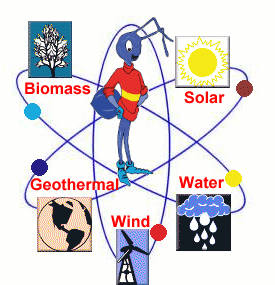 Sorry, I do not have time to seek out all the developments – so many – going on in renewable energy
Calculating your renewable energy potential? There’s an app for that GreenBiz-19 Jun e1q5 Businesses and individuals can make use of a free smartphone app to calculate the renewable energy generation potential of a given location.
Town Topics 20 June15
An electric taxi has taken to the streets of Singapore in a bid to make the already green city more eco-friendly — and it’s tailored to the tropics.
http://www.environmentalhealthnews.org/t/7758846716712517570
USA Department of Energy investigates radiation leaks, and exposure to workers at nuclear sites
DOE probes worker radiation exposure at test site By STEVE TETREAULT REVIEW-JOURNAL WASHINGTON BUREAU WASHINGTON, 19 June 15 — The Department of Energy has launched investigations into two incidents over the past year where workers at the Nevada National Security Site were exposed to potential contamination while conducting nuclear weapons activities.
The episodes took place on June 16, 2014, and Oct. 21, 2014, at the National Criticality Experiments Research Center, the laboratory where the government maintains a substantial stockpile of nuclear material used for research and training.
The department is looking into the circumstances surrounding “losses of contamination control of highly enriched uranium” at the lab, according to Steven Simonson, director of the DOE Office of Enforcement…….
The incidents that prompted the investigation were the latest disclosed missteps by Los Alamos and other outposts in the weapons complex that have come under close scrutiny within DOE and on Capitol Hill.
In May, the Energy Department proposed to fine the operator of the Los Alamos National Laboratory $247,500 after it lost track of classified material that was supposed to have been shipped to the Nevada National Security Site in 2007, but never arrived. The mistake was not detected until five years later.
The New Mexico laboratory also has been faulted in the 2014 release of radiation from the Waste Isolation Pilot Plant that contaminated nearly two dozen workers with low levels of radiation and forced the nuclear waste site to close.
Investigations uncovered violations at the laboratory in how transuranic waste destined for WIPP was packaged and managed……..http://www.reviewjournal.com/news/nevada/doe-probes-worker-radiation-exposure-test-site
Peach Bottom Atomic Power Station radiation leak – source is found
Exelon locates source of radiation leak at Peach Bottom, YDR.com Officials say the tritium posed no health risk By Brett Sholtis bsholtis@ydr.com @BrettSholtis on Twitter 06/19/2015
Peach Bottom Atomic Power Station. On April 17, 2015, Exelon detected a level of tritium in excess of the EPA-recommended guidelines. Exelon has located the source of the leak and is taking steps to correct the problem. The Nuclear Regulatory Commission said the tritium poses no health or environmental risk. (FILE — YORK DAILY RECORD/SUNDAY NEWS)
Exelon Corporation has located the source of a water leak that led to elevated levels of tritium in a groundwater well at Peach Bottom Atomic Power Station. Peach Bottom spokeswoman Krista Connelly declined to specify the source of the leak, but confirmed that they have located it………
Paul Gunter, a director at public interest group Beyond Nuclear, said the tritium points to a larger problem of recurring leaks, which the industry doesn’t take seriously. “This is a one-off measurement in one well,” Gunter said. “It doesn’t say how much got out. This is what they detected at that one point.”….http://www.ydr.com/local/ci_28347377/exelon-locates-source-radiation-leak-at-peach-bottom
1 This Month



Tell the Ukrainian Government to Drop Prosecution of Peace Activist Yurii Sheliazhenko

Petition to revoke the licensing of the Near Surface Nuclear Disposal Facility (NSDF) at Chalk River. https://www.ourcommons.ca/petitions/en/Petition/Details?Petition=e-7247


of the week – STOP SMALL MODULAR REACTORS IN CANADA
To see nuclear-related stories in greater depth and intensity – go to https://nuclearinformation.wordpress.com
-
Archives
- March 2026 (222)
- February 2026 (268)
- January 2026 (308)
- December 2025 (358)
- November 2025 (359)
- October 2025 (376)
- September 2025 (258)
- August 2025 (319)
- July 2025 (230)
- June 2025 (348)
- May 2025 (261)
- April 2025 (305)
-
Categories
- 1
- 1 NUCLEAR ISSUES
- business and costs
- climate change
- culture and arts
- ENERGY
- environment
- health
- history
- indigenous issues
- Legal
- marketing of nuclear
- media
- opposition to nuclear
- PERSONAL STORIES
- politics
- politics international
- Religion and ethics
- safety
- secrets,lies and civil liberties
- spinbuster
- technology
- Uranium
- wastes
- weapons and war
- Women
- 2 WORLD
- ACTION
- AFRICA
- Atrocities
- AUSTRALIA
- Christina's notes
- Christina's themes
- culture and arts
- Events
- Fuk 2022
- Fuk 2023
- Fukushima 2017
- Fukushima 2018
- fukushima 2019
- Fukushima 2020
- Fukushima 2021
- general
- global warming
- Humour (God we need it)
- Nuclear
- RARE EARTHS
- Reference
- resources – print
- Resources -audiovicual
- Weekly Newsletter
- World
- World Nuclear
- YouTube
-
RSS
Entries RSS
Comments RSS
 nuclear-news