Pentagon’s arms provider, and billionaires Bill Gates and Paul Allen in propaganda push for Small Nuclear Reactors
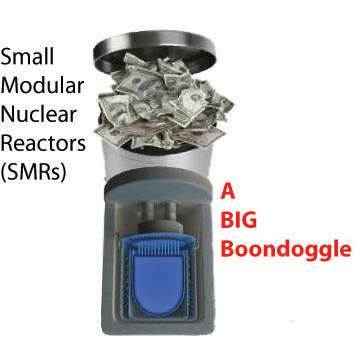 Planet Ark 16-Jun-15 USA Timothy Gardner The Pentagon’s top arms provider and firms partly funded by Silicon Valley billionaires Bill Gates and Paul Allen are among dozens of companies collectively betting more than $1.3 billion that a new wave of nuclear power can be a force to fight climate change.
Advanced nuclear power plants, which will employ techniques such as using fuels other than uranium and coolants other than water, have attracted private investments from more than 40 companies from Florida to Washington state, the Third Way think tank says in the first report specifying the number of firms and total money invested in the technologies……..
Companies expressing faith in advanced nuclear power range from Lockheed Martin, the Pentagon’s largest supplier, to Holtec International, which is building a $260 million technology campus in economically depressed Camden, New Jersey.
Gates has partially funded TerraPower, a company that aims to build reactors cooled by liquid metal, and Allen has partially funded TriAlpha, a company that plans to make nuclear fusion plants……
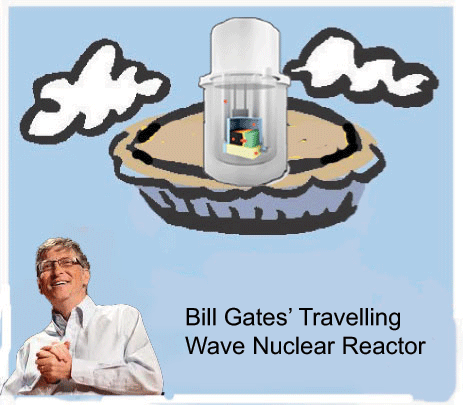
Critics of advanced nuclear say companies have yet to make small reactors economically viable despite decades of development by energy companies and the U.S. military. Advanced reactors using new fuels, such as thorium, and new cooling systems, such as molten salt, are also difficult to make economically viable, they say.
The nuclear industry has also been weakened by a political backlash following radioactive leaks at Japan’s Fukushima power plant in 2011. And the U.S. natural gas boom has slashed the cost of that fuel, making it harder for nuclear power to compete.
The Third Way report was not funded by the nuclear industry. But the think tank has received financial support from The Nuclear Energy Institute, the industry’s lobby group, and Babcock & Wilcox, a company hoping to build small nuclear reactors…….http://planetark.org/enviro-news/item/73313
India’s new nuclear insurance pool will not cover its research reactors
 India’s research reactors not under nuclear insurance pool— By IANS | Jun 18, 2015 http://www.freepressjournal.in/indias-research-reactors-not-under-nuclear-insurance-pool/ Chennai: India’s research reactors will not be covered under the newly set-up nuclear insurance pool as they are owned by the union government, a top official of the Bhabha Atomic Research Centre (BARC) has said.
“The Rs.1,500 crore ($234 million) India Nuclear Insurance Pool is mainly for power plants operated by Nuclear Power Corporation of India Ltd (NPCIL). The reactors operated by research institutions do not come under the insurance pool,” BARC director Sekhar Basu told IANS. Basu is also a member of the Atomic Energy Commission and a director in NPCIL.
“The research reactors are very small. Further the research institutions are owned by the central government. And governments do not generally take out an insurance policy on its properties,” Basu added.
BARC’s two operational test reactors are the 100 MW and a very low-power Advanced Heavy Water Reactor (AHWR).
Basu said what is applicable to BARC applies equally to the research reactors operated by the Indira Gandhi Centre for Atomic Research (IGCAR) at Kalpakkam, around 80 km from here.
The IGCAR operates two small research reactors – fast breeder test reactor (FBTR) and Kamini.
According to Basu, the upcoming 500 MW prototype fast breeder reactor (PFBR) expected to go on stream this year would come under the insurance cover once it starts the nuclear fission process.
The government-owned Bharatiya Nabhikiya Vidyut Nigam Ltd (BHAVINI) is setting up the country’s first indigenously designed 500 MW PFBR at Kalpakkam.
A breeder reactor is one that breeds more material for a nuclear fission reaction than it consumes. The PFBR will be fuelled by a blend of plutonium and uranium oxide, called MOX fuel.
The central government recently announced the setting up of the Rs.1,500-crore India Nuclear Insurance Pool to be managed by national reinsurer GIC Re.
The GIC Re, four government-owned general insurers and also some private general insurers have provided the capacity to insure the risks to the tune of around Rs.1,000 crore and the balance Rs.500 crore capacity has been obtained from the British Nuclear Insurance Pool.
The losses or profits in the pool would be shared by the insurers in the ratio of their agreed risk capacity.
Foreign nuclear plant suppliers were reluctant to sell their plants to India citing the provisions of Civil Liability for Nuclear Damage Act (CLND) 2010 that provides the right of recourse to NPCIL against the vendors under certain circumstances for compensation in case of an accident.
The insurance pool was formed as a risk transfer mode for the suppliers and also NPCIL.
All the 21 operating nuclear power plants in India owned and operated by NPCIL are expected to come under public liability insurance cover from next month onwards, a senior official of New India Assurance Company Ltd told IANS, preferring anonymity.
The insurance cover would also extend to the 1,000 MW nuclear power plant at Kudankulam in Tamil Nadu built with Russian equipment.
“We are planning to issue a single policy covering all the 21 nuclear power units of NPCIL including the one in Kudankulam. The premium will be paid by NPCIL and the policy will be issued in its name,” he said.
According to him, the final premium has not been arrived at but it will be between Rs.100 crore and Rs.150 crore.
He said the proposed policy would cover the liability towards public as a consequence of any nuclear accident in the plants covered under the policy and also the right of recourse of NPCIL against the equipment suppliers.
Nuclear power industry cannot be saved by EPA Clean Power Plan
Report says EPA Clean Power Plan cannot save nuclear http://www.fierceenergy.com/story/report-says-epa-clean-power-plan-cannot-save-nuclear/2015-06-18 By Barbara Vergetis Lundin
The 20th Century model of large baseload electricity generation, including nuclear reactors, is in an irreversible decline in the face of the emerging 21st Century decentralized power model relying on renewables, energy efficiency, and technology-based demand management, says Mark Cooper, senior fellow for economic analysis, Institute for Energy and the Environment, Vermont Law School, in a new report.
For policymakers and ratepayers, Cooper’s stark conclusion means that “last-ditch efforts to prop-up nuclear power with amendments to the EPA Clean Power Plan (CPP), state-level subsidies (e.g., Exelon’s “nuclear blackmail” threat of Illinois lawmakers over five reactors in that state and FirstEnergy’s bailout scheme involving the Davis-Besse reactor in Ohio), attacks in Indiana, Ohio, Nevada, North Carolina and other states on renewable energy standards, and preferential rate-setting arrangements (e.g., Exelon’s Ginna reactor at Rochester, New York) are costly detours on the road to a much more consumer friendly, reliable and sustainable low carbon electricity sector.”
Cooper said: “Nuclear reactors old and new are far from a necessary part of a low-carbon solution. Nuclear power, with its war against the transformation of the electricity system, is part of the problem, not the solution. Following a path toward a 21st century electricity system poses no serious threat to reliability up to a 30-40 percent level. Beyond that, we already know the specific actions that can carry the system to much higher levels of reliance on renewables. Combining these measures which allow the system to operate at high levels of penetration with the implementation of aggressive efficiency measures meets 80 percent of ‘business as usual’ or base case demand. It is no longer a question of if this will happen, only when it will happen.”
 The report concludes that, even with tinkering, the EPA Clean Power Plan will not save nuclear power.
“After decades of claiming to be a low-cost source of power because of low operating costs, aging reactors are no longer cost competitive even in that narrow view of operating cost,” the report says. “Not even the full implementation of the EPA Clean Power Rule would save aging reactors from early retirement, so the owners of those reactors have launched a major campaign to increase revenues with direct subsidies from state and federal policymakers and secure jerry-rigged market pricing rules that undermine alternatives.”
The report further contends that the “Exelon reactor bailout schemes” in New York State and Illinois will not work.
The report says, “Ginna is a New York reactor and Quad Cities is a two-reactor site in Illinois for which Exelon has stated specific revenue increases are needed, although these estimates are shrouded in uncertainty. The operating costs are quite high and total costs are higher still, well above recent market clearing prices…Operating costs alone are almost twice the current market clearing price of electricity and…things are likely to get worse rather than better over time…The frantic push for states to bail out these reactors when a response at the regional level is more appropriate (if a reaction is needed at all) will saddle state ratepayers with much larger burdens.”
The report does contend that more renewables are feasible without creating reliability issues.
“In the mid-term, expansion of renewables to the 30-40 percent range can be easily accommodated with the existing physical assets and management tools with no negative impact on reliability. The electricity system only needs to be operated with policies that allow the renewables to enter. In the long-term, a wide range of measures to support the penetration of alternatives to much higher levels (80 percent or more) has been identified,” the report says. “Building an electricity system on principles of dynamic flexibility requires an institutional transformation and the deployment of supporting physical infrastructure. Given the need to respond to climate change and the cost of the alternatives, the 21st century model for the electricity system is the least-cost approach by a wide margin”.
For more:
– see this report
Climate change and justice: Pope Francis connects these causes, in lead-up to Paris conference
Climate change is the anticipated focus of Francis’ long-awaited papal encyclical on ecology because it merges his vocal concern for the poor and marginalized with condemnation of environmental exploitation. The world’s poor, who contribute the least to climate change, are disproportionately impacted by worsening droughts, rising seas, mega  storms and famine, and they are least able to evade its destructive reach…………
Hopes are high that the pope’s encyclical creates momentum and will for the enactment of a United Nations climate
change accord in Paris this December
With encyclical, Pope Francis elevates environmental justice, The Conversation, Lisa Sideris, 16 June 15 When the former Cardinal Jorge Mario Bergoglio chose Francis as his papal name, he signaled to the world a dual commitment to sustainability and the global poor. His namesake, Saint Francis of Assisi, was a man of poverty and peace who loved nature and animals, and is said to have preached his sermons to birds. Continue reading
1 This Month



Tell the Ukrainian Government to Drop Prosecution of Peace Activist Yurii Sheliazhenko

Petition to revoke the licensing of the Near Surface Nuclear Disposal Facility (NSDF) at Chalk River. https://www.ourcommons.ca/petitions/en/Petition/Details?Petition=e-7247


of the week – STOP SMALL MODULAR REACTORS IN CANADA
To see nuclear-related stories in greater depth and intensity – go to https://nuclearinformation.wordpress.com
-
Archives
- March 2026 (212)
- February 2026 (268)
- January 2026 (308)
- December 2025 (358)
- November 2025 (359)
- October 2025 (376)
- September 2025 (258)
- August 2025 (319)
- July 2025 (230)
- June 2025 (348)
- May 2025 (261)
- April 2025 (305)
-
Categories
- 1
- 1 NUCLEAR ISSUES
- business and costs
- climate change
- culture and arts
- ENERGY
- environment
- health
- history
- indigenous issues
- Legal
- marketing of nuclear
- media
- opposition to nuclear
- PERSONAL STORIES
- politics
- politics international
- Religion and ethics
- safety
- secrets,lies and civil liberties
- spinbuster
- technology
- Uranium
- wastes
- weapons and war
- Women
- 2 WORLD
- ACTION
- AFRICA
- Atrocities
- AUSTRALIA
- Christina's notes
- Christina's themes
- culture and arts
- Events
- Fuk 2022
- Fuk 2023
- Fukushima 2017
- Fukushima 2018
- fukushima 2019
- Fukushima 2020
- Fukushima 2021
- general
- global warming
- Humour (God we need it)
- Nuclear
- RARE EARTHS
- Reference
- resources – print
- Resources -audiovicual
- Weekly Newsletter
- World
- World Nuclear
- YouTube
-
RSS
Entries RSS
Comments RSS
 nuclear-news