Disturbing history of USA’s close calls, dangerous mistakes, with nuclear weapons
Eric Schlosser recounts the United States’ clumsy history with nuclear weapons. And it’s terrifying. Vox.com by Joe Posner and Estelle Caswell on June 16, 2015
Human error is, well, human. Most systems people design break from time to time. Including the United States’ nuclear weapons systems: The shocking stories in the video come from investigative reporter Eric Schlosser’s book Command and Control, in which he uncovered a “litany of errors” that go way, way beyond the official record of 33 serious accidents, known as “broken arrows.” Even the first test, 70 years ago this July 16, flirted perilously close with disaster.
Schlosser spent 6 years “in the most crazy nuclear shit imaginable” – and the revelations in the book about times we almost “destroyed a large part of the Florida coast” are seemingly endless.
Most discussion about nuclear weapons today has to do with a potential deal with Iran promising not to build a weapon. Discussion of the US missiles that were meant to be replaced 30 years ago, aging wiring, and control systems that run on floppy-disks have remained safely on the sidelines of the conversation…….http://www.vox.com/2015/6/16/8785987/schlosser-nuclear-accidents…....http://www.vox.com/2015/6/16/8785987/schlosser-nuclear-accidents
IN 2015 Russia will add 40 ballistic missiles to its nuclear arsenal
 Russia will add 40 ballistic missiles to nuclear arsenal in 2015, Vladimir Putin says, SMH, June 17, 2015 – Moscow: President Vladimir Putin has said Russia will boost its nuclear arsenal by more than 40 intercontinental missiles this year, as a senior defence official accused NATO of seeking to drag Moscow into a new arms race.
Mr Putin made his announcement a day after Russian officials warned that Moscow will retaliateif the United States carries out its plan to store heavy military equipment in eastern Europe.
“This year the size of our nuclear forces will increase by over 40 new intercontinental ballistic missiles that will be able to overcome any, even the most technologically advanced, missile defence systems,” Mr Putin, flanked by army officers, said in a speech at a military and arms fair.
“We will be forced to aim our armed forces … at those territories from where the threat comes,” Putin added…….
he New York Times reported on the weekend that the Pentagon was poised to station heavy weapons for up to 5000 American troops in several Eastern European and Baltic countries to deter Russian aggression.
The proposal, if approved, would be the first time since the end of the Cold War that the US has had heavy military equipment – including battle tanks – in newer NATO members that were once under Moscow’s influence as part of the Soviet Union………
“The feeling is that our colleagues from NATO countries are pushing us into an arms race,” RIA news agency quoted Russian Deputy Defence Minister Anatoly Antonov as saying on the sidelines of the arms fair.
The Chernobyland Fukushima Research Initiative report – no evidence for complacency
Chernobyl is Still Bleeding, Radiation Prevention, 15 June 15 Of the many signs Chernobyl is far from recovery almost 30 years after their single reactor (reactor #4) nuclear disaster, here’s a hand full from the The Chernobyland Fukushima Research Initiative report summary:
Population sizes and numbers of species (i.e. biodiversity) of birds, mammals, insects, and spiders are significantly lower in areas of high contamination in Chernobyl.
For many birds and small mammals, life spans are shorter and fertility is depressed in areas of high contamination.
The bird species that are most likely to show declines in numbers in response to radiation are those that historically have shown increased mutation rates for other reasons possibly related to DNA repair ability or reduced defenses against oxidative stress.
Neurological development is impacted as evidenced by depressed brain size in both birds and rodents and consequent effects on cognitive ability and survival have been demonstrated in birds.
Deleterious effects of radiation exposure seen in natural populations in Chernobyl include increased rates of cataracts, tumors, growth abnormalities, deformed sperm, and albinism.
Tree growth and microbial decomposition in the soil are also depressed in areas of high radiation, reducing food and nutrients for plants and animals
Observations in Fukushima Continue reading
Doubts on costs and safety as USA mulls Small Nuclear Reactors
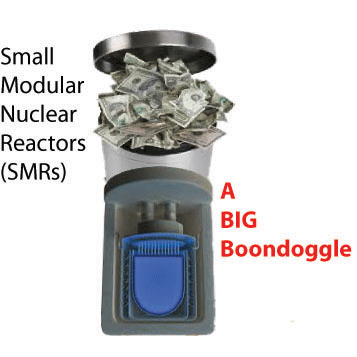 USA considers Small Modular Nuclear Reactors, The Hill, 16 June 15 “……. the same problems that have slowed development of full-size nuclear reactors to nearly a halt — safety and cost — could keep delaying or even kill the potential for small modular reactors to take off……
Edwin Lyman, a senior scientists with the group, said small reactors have no safety or security advantages when compared with larger ones. But since they would produce less power, there is pressure to scale down the requirements.
“The simple fact is that SMRs have a significant cost penalty compared to large reactors on a per-megawatt basis because of diseconomies of scale,” Lyman said.
“No utility will want to buy them unless they can be exempted from a lot of costly regulations that large reactors must meet,” he continued. “But in light of the Fukushima disaster, one must be very wary of the safety claims made by the nuclear industry, especially for reactor designs that have never been built or tested.”
A warning on Fukushima’s radioactive particles entering Pacific Ocean food chain
 Fukushima: Your Days of Eating Pacific Ocean Fish Are Over Tano Buzz
BY R&S ON JUNE 10, 2015 Are you still eating sushi or any seafood from the PacificOcean? Well you might want to reconsider after readingthis article. When it comes to environmental disasters, the nuclear fallout at Fukushima has to be amongst the worst that has happened in the past few decades. Andrew Kishner, founder of www.nuclearcrimes.org has put together a great resource of information that tracks whathas been developing over time in Fukushima as it relates to the nuclear incident. You can check out his research further using the links below.
The following is written by Gary Stamper in regards towhat has been happening with Fukushima. The heart-breaking news from Fukushima continues to get worse -a lot worse. It is, quite simply, an out-of-control flow of death and destruction.
TEPCO is finally admitting that radiation has been leaking to the Pacific Ocean all along and it’s not showing signs of stopping just yet.
It now appears that anywhere from 300 to possibly over 450 tons of contaminated water that contains radioactive iodine, cesium, and strontium-89 and 90, is flooding into the Pacific Ocean from the Fukushima Daichi site everyday. To give you an idea of how bad that actually is, Japanese experts estimate Fukushima’s fallout at 20-30 times as high as as the Hiroshima and Nagasaki nuclear bombings in 1945.
President Obama has scaled back his goals for nuclear security
Obama steps back from sweeping nuclear security goal Centre For Public Integrity, The administration looks for incremental gains in locking up nuclear explosives, rejecting demands by outsiders for a major new international agreement to prevent nuclear terrorism By Douglas Birch
 emailR. Jeffrey Smith 16 June 15 “………….
Over the course of his presidency, Obama has scaled back his goals in this area and settled for what a senior White House official publicly described in 2012 as “the incremental nature of success,” rather than throwing his full weight behind the creation of global security standards for nuclear materials that independent experts say could have a more lasting and significant impact………http://www.publicintegrity.org/2015/06/15/17471/obama-steps-back-sweeping-nuclear-security-goal
Electricity prices likely to drop fast in UK as renewables soar – warning to South Africa against nuclear power
 Why nuclear? Renewables may soon drop UK electricity prices “below zero”, BizNews.com 16 June 15,
We all have dreams. Among mine is those shaping SA’s energy landscape discard their blinkers and focus on how human initiative is transforming the global power equation. Moore’s Law , which annually doubles output at the same price, is hard at work in renewable energy.
SA has been among the global leaders in promoting a much applauded renewables programme, now into its fourth bidding stage and now attracting interest from every relevant renewables player globally. But that great work could be undone by dumb decisions made in the name of “baseload”. Globally respected author and co-founder of Singularity University Peter Diamandis warned in a recent Biznews interview that SA’s proposed trillion rand nuclear power build programme was a “very, very bad idea”. As the UK’s most recent experience documented below illustrates, there is no logical reason to consider this potential millstone for SA taxpayers – outside of pouring more booty into the trough. – Alec Hogg
By Rachel Morison (Bloomberg) — Power prices in the U.K. may fall below zero during some hours before the end of the decade as intermittent renewable energy output is poised to soar, according to National Grid Plc. Negative power prices, already prevalent in markets from Germany to the Nordic region, occur when supply exceeds demand. Having to curb cheap supply from green power is a waste, Duncan Burt, the company’s head of commercial operations, said last week in an interview. To reduce bills and help balance the system, the U.K.’s biggest users should reduce consumption at times of peak demand and take advantage of periods with plenty of green power, he said.
The U.K. government plans to boost the share of energy demand met by renewables to 15 percent in 2020 from 5.3 percent in 2013, potentially boosting price swings. That may give users from factories to supermarkets a greater incentive to adjust consumption more actively, according to Burt……….http://www.biznews.com/transformation/2015/06/15/why-nuclear-renewables-may-soon-drop-uk-electricity-prices-below-zero/
Appeal filed for compensation for 7,000 Tochigi residents affected by Fukuashima nuclear disaster
7,000 Tochigi residents seek compensation over Fukushima nuclear disaster, Japan Times KYODO JUN 15, 2015 UTSUNOMIYA, TOCHIGI PREF. – Some 7,000 people living in Tochigi Prefecture sought compensation Monday worth ¥1.85 billion through an out-of-court settlement with Tepco over the disaster at the Fukushima No. 1 nuclear plant.
In the first collective appeal by residents who have not been compensated by Tokyo Electric Power Co., 7,128 people from Tochigi, located some 100 km from the crippled plant, argue that they should be eligible for compensation even though they were not living in Fukushima at the time of the 2011 nuclear disaster.
The residents, who were living at the time in Otawara, Nasushiobara, and Nasu are also demanding an apology and the establishment of a fund to pay for decontamination work and health checks, their lawyers said. The combined population of the two cities and town stands at around 218,000.
The appeal was filed Monday with the Nuclear Compensation Dispute Resolution Center under an alternative dispute resolution system that enables quicker settlements with the participation of a third party that has expertise.
Obama unveils $4bn project to form clean-energy investment clearinghouse
Obama commits $4bn to form clean-energy investment clearinghouse, Guardian, Brandon Keim 16 June 15 US energy secretary announces new office of technology transitions to help facilitate financing by connecting would-be investors with clean-energy firms With $4bn and a new government office, the White House has unveiled its latest clean energy initiative and cast a subtle new role for the federal government: not only is it a funder of new research, of the latest solar converter or biofuel source, but it is also a market builder.
“One of the real challenges is the gap in financing clean energy,” said Ernest Moniz, US secretary of energy, at a press conference on Monday. “There is a continuing need for new capital investment.”
The new initiative follows on a White House pledge in February to organize mission-driven renewable energy investors, concentrating their impacts and providing information to would-be investors daunted by an unfamiliar clean-energy landscape.
At the press conference on Monday, Moniz and senior advisor Brian Deese fleshed out the details: $4bn in commitments from pension funds, family foundations and other so-called impact investors, and a newly unveiled office of technology transitions that will serve as an all-purpose informational resource for clean-energy investment…….
The initiative represents the latest stage in the Obama administration’s clean-energy policies. In some quarters, these are still synonymous with Solyndra, the California-based solar cell manufacturer that went bankrupt after receiving $535m from the US department of energy.
Yet that reputation is mostly unfair – and not just because the loan program responsible for the Solyndra deal is expected to turn a $5bn profit. The US now leads the world in wind energy production; the price of solar energy has plummeted, and adoption jumped…..http://www.theguardian.com/environment/2015/jun/16/obama-administration-clean-energy-investment-initiative
25 EU countries are expected to meet their 2013/2014 interim renewable energy targets
EU on track to meeting 20% renewable energy target https://ec.europa.eu/energy/en/news/eu-track-meeting-20-renewable-energy-target EU countries are well on the way to meeting the EU’s target for 20% renewable energy in the overall energy supply by 2020, a new report shows.
Presented on 16 June, the European Commission’s renewable energy progress report reveals that 25 EU countries are expected to meet their 2013/2014 interim renewable energy targets. In 2014, the projected share of renewable energy in the gross final energy consumption is 15.3%.
“The report shows once again that Europe is good at renewables, and that renewables are good for Europe. We have three times more renewable power per capita in Europe than anywhere else in the rest of the world. We have more than one million people working in a renewable energy sector worth over €130 bn a year and we export €35 bn worth of renewables every year,” Miguel Arias Cañete, Commissioner for Climate Action and Energy, said.
The EU’s 2020 renewables target has resulted in around 326 Mt of avoided CO2 emissions in 2012, rising to 388 Mt in 2013. It has also led to a reduction in the EU’s demand for fossil fuels to the tune of 116 Mtoe (2013 figure), boosting the EU’s security of energy supply.
Just three EU countries are falling slightly behind in meeting their targets, and, since the interim targets will become tougher in the coming years, some EU countries will have to intensify their efforts and make use of mechanisms which allow them to cooperate with other EU countries, the report says.
It also noted that renewable energy is now a widely accepted, mainstream source of energy, with the 2020 targets being a key driver for European-led global investments in renewables and a source of inspiration for other countries the world over which now have their own targets.
The report also examined the EU’s target for 10% renewable energy in transport. The 2014 projected share is 5.7% meaning that achieving the target will be challenging but feasible, with some EU countries making good progress.
The EU publishes a progress report on renewable energy every two years.
By 2030 renewables will have overtaken coal and nuclear power- IEA report
Renewables on course to overtake coal by 2030, Australian Financial Review, by Pilita Clark, 15 June 15,Wind, solar and other types of renewable power will overtake coal to become the world’s top source of electricity in just 15 years if the pledges countries are making for a global climate change deal this year are met.
The striking finding by the International Energy Agency shows renewable power could soar from just over a fifth of global electricity generation today to nearly a third by 2030 – a bigger share than either coal, gas or nuclear plants.
This shows today’s energy companies are making a “major fatal error” if they assume climate action is not going to affect their businesses, said Fatih Birol, the IEA chief economist.
For the first time in UN climate negotiations, nearly all countries are supposed to limit their greenhouse gas emissions as part of a global agreement due to be signed in Paris in December.
The measures already unveiled by dozens of nations should sharply reduce the use of fossil fuels, especially coal, in the US, the EU and elsewhere, the IEA says in a report timed to influence negotiations for the Paris deal……..
Renewables accounted for about half of all new power plant capacity built last year, and the IEA expects that share to rise in coming years. The agency says renewable power now accounts for 22 per cent of global electricity generation, well behind coal at 41 per cent.
But the IEA’s analysis of countries’ Paris climate pledges shows that renewables’ share of generation will increase to 32 per cent by 2030, just pipping coal. http://www.afr.com/business/mining/coal/renewables-on-course-to-overtake-coal-by-2030-20150615-ghny2e
USA could be 100% powered by renewable energy by 2015
 The US Could Run Exclusively On Renewable Energy By 2050 http://www.gizmodo.com.au/2015/06/the-us-could-run-exclusively-on-renewable-energy-by-2050/ ALISSA WALKERThere are many things holding up the US’s move towards renewable energy, but that one thing is not science: We already have all the technology we need to make this happen. A new study claims that a completely clean energy future is possible by 2050, and it plots roadmaps for all 50 states to achieve this goal.
The study, which is published in Energy & Environmental Science, is authored by Mark Z. Jacobson, a civil and environmental engineer who heads up Stanford’s Atmosphere and Energy Program. He’s known for publishing many similar roadmaps for America’s energy future, but this one is the most comprehensive — and useful — because it takes into consideration the unique environmental situations and policy quirks for each state.

Most enticing is this chart where incredible growth in solar and wind energy helps offset the gradual reduction in fossil fuels and nuclear energy. But the overall energy supply needed will also decrease, even with increased demand, due to better energy efficiency.
In that black zone that gets squeezed out: Nuclear power, coal with carbon capture, liquid or solid biofuels, and natural gas. Nope, not even biofuels, argues the study — since “their combustion produces air pollution at rates on the same order as fossil fuels and their lifecycle carbon emissions are highly uncertain.”
Floating mega solar plants playing a big role in Japan’s renewable energy
Giant Floating Solar Power Stations Are Japan’s Newest Power Source, Huffington Post 15 June 15 “……. the country is now turning to floating solar power stations, this month going live with its largest such systems to date in two reservoirs in Kato City in the nation’s Hyogo prefecture, Quartz reports. The systems consist of almost 9,000 solar panels on a bed of polyethylene and are fully waterproofed.
According to Kyocera, the electronics manufacturer behind the floating solar systems, the two new stations in Kato City are expected to generate 3,300 megawatt hours annually, providing enough electricity to power about 920 typical households. The company is also behind another floating solar farm just east of Tokyo, slated to open next March, that will be even larger, powering almost 5,000 households.
The “mega-plants” have a number of benefits compared to traditional land-based solar plants. As Wired previously reported, the floating plants generate power more efficiently because of the cooling effect of the water underneath the system. In addition, the shade generated by the stations helps reduce both water evaporation and algae growth, and the systems overall are also drought-friendly thanks to how muchwater they conserve……..

the floating islands could play a huge role in helping Japan meet its goal of achieving 100 percent renewable energy by the year 2040…….Japan isn’t the only country investing in these solar “islands,” either. Projects are already online or underway in India, Australia, Great Britain, Brazil and in Sonoma County, California. http://www.huffingtonpost.com/2015/06/15/japan-floating-solar-power_n_7588506.html?utm_hp_ref=green&ir=Green
Greens becoming a global force – The Asia Pacific Greens congress
Delegates expressed strong opposition to plans to roll out more nuclear power stations in Korea, Japan and Taiwan, and sought the help of Greens parties worldwide in that effort. All want greater efforts in promoting energy efficiency and renewable energy. The Greens are well placed to break through and win seats in upcoming elections in Korea and Taiwan……..
Just as corporations are global, so too the Greens are a global force
Christine Milne: Australia ‘universally condemned’ at regional Greens meeting,Guardian 15 June 15 Too often, the concerns of Pacific Island nations are jettisoned in favour of bigger nations’ interests. The Asia Pacific Greens congress aims to change that . Green parties around the world have been working for decades to address global warming. Australia’s Pacific Island neighbours are already suffering extreme weather events, storm surges, and adverse impacts on their health and livelihoods, with their ability to grow food constrained by salt water incursion into fresh water lenses. At every UN climate meeting they ask for help, and in spite of all the sympathetic talk, their concerns are jettisoned in favour of national sovereignty arguments from more powerful nations like Australia. This has to change.
Over the weekend, the Asia Pacific Greens Federation Congress was held in New Zealand. As global political influence continues to rise in our region, so too the Greens are organising to be heard in those halls of power. Whereas the European Greens and their individual parties have been known and have been in parliaments for decades, it is not so well known that Green politics globally grew out of Australia and New Zealand with the formation of the United Tasmania Group in 1972, followed by the NZ Values Party a few months later. Petra Kelly visited our region, liked what she saw and returned to Germany to establish the German Greens. Now the Australian and New Zealand Greens are working to facilitate the growth of the Asia Pacific Greens.
Formed in Brisbane in 2000, the Asia Pacific Greens have already had successes. …………. Continue reading
Support at lowest ebb for Japan’s Prime Minister Shinzo Abe
 Japan PM Abe’s support lowest since 2012, China Daily, 16 June 15 By Reuters TOKYO – Support for Japanese Prime Minister Shinzo Abe’s Cabinet has fallen to the lowest level since he took office in 2012, to just over 40 percent, with nearly two-thirds of voters opposed to his muscular defence policy that would end a self-imposed ban on the military fighting overseas, a weekend media survey showed.
The survey by Nippon Television Network coincided with weekend rallies by thousands protesting the legislation, which would allow Japan to exercise its right of collective self-defence, or militarily aiding a friendly country under attack.
Abe’s Cabinet adopted a resolution last July reinterpreting the pacifist constitution to allow the dramatic shift in security policy. In April, Abe told the US Congress that the changes, already reflected in new US-Japan defence cooperation guidelines, would be enacted this summer……
Thousands of Japanese rallied on the weekend to protest the security bills and other government policies such as plans to restart nuclear reactors taken off-line after the March 2011 Fukushima nuclear disaster…….http://www.chinadailyasia.com/asia/2015-06/15/content_15277058.html
1 This Month


Tell the Ukrainian Government to Drop Prosecution of Peace Activist Yurii Sheliazhenko

Petition to revoke the licensing of the Near Surface Nuclear Disposal Facility (NSDF) at Chalk River. https://www.ourcommons.ca/petitions/en/Petition/Details?Petition=e-7247


of the week – STOP SMALL MODULAR REACTORS IN CANADA
To see nuclear-related stories in greater depth and intensity – go to https://nuclearinformation.wordpress.com
-
Archives
- March 2026 (204)
- February 2026 (268)
- January 2026 (308)
- December 2025 (358)
- November 2025 (359)
- October 2025 (376)
- September 2025 (258)
- August 2025 (319)
- July 2025 (230)
- June 2025 (348)
- May 2025 (261)
- April 2025 (305)
-
Categories
- 1
- 1 NUCLEAR ISSUES
- business and costs
- climate change
- culture and arts
- ENERGY
- environment
- health
- history
- indigenous issues
- Legal
- marketing of nuclear
- media
- opposition to nuclear
- PERSONAL STORIES
- politics
- politics international
- Religion and ethics
- safety
- secrets,lies and civil liberties
- spinbuster
- technology
- Uranium
- wastes
- weapons and war
- Women
- 2 WORLD
- ACTION
- AFRICA
- Atrocities
- AUSTRALIA
- Christina's notes
- Christina's themes
- culture and arts
- Events
- Fuk 2022
- Fuk 2023
- Fukushima 2017
- Fukushima 2018
- fukushima 2019
- Fukushima 2020
- Fukushima 2021
- general
- global warming
- Humour (God we need it)
- Nuclear
- RARE EARTHS
- Reference
- resources – print
- Resources -audiovicual
- Weekly Newsletter
- World
- World Nuclear
- YouTube
-
RSS
Entries RSS
Comments RSS
 nuclear-news