USA and Russia: top former generals plea to “de-alert” nuclear weapons
 Ex-U.S., Russian brass: ‘De-alert’ nukes or risk disaster Politico. com By BRYAN BENDER 4/29/ 15
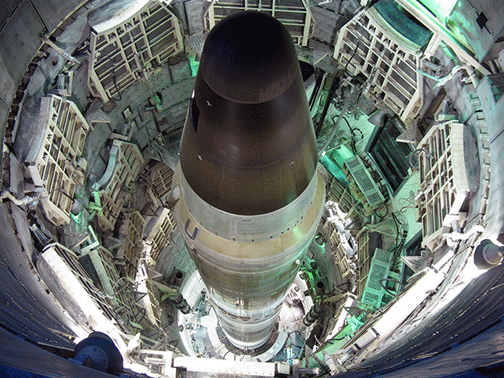
Amid all the talk about a new Cold War, here’s one hard, cold fact: Nearly 25 years after the collapse of the Soviet Union, Washington and Moscow still have nearly 2,000 atomic bombs ready to fly at a moment’s notice to destroy each other.
And that so-called hair-trigger alert is now sparking new concerns that deepening distrust between the former foes significantly raises the risk of a miscalculation and nuclear disaster.
Story Continued Below
On Thursday the American general who recently commanded U.S. nuclear forces will lead a group of ex-Russian officers and other national security leaders in an appeal for the United States and Russia to take immediate steps to “de-alert” their respective arsenals.
Their proposal starkly warns that the current dismal state of relations — combined with other new factors such as the threat of cyberattacks — demands leaders on both sides be given more time to respond to potential provocations before ordering the unthinkable.
“Tension between Russia and the West over the Ukraine crisis has brought the parties one step closer to the precipice of nuclear brinksmanship, the point at which nuclear risk skyrockets,” according to the findings of the commission convened by the disarmament group Global Zero, which will be delivered at the United Nations. “This tension is uncharacteristic of their post-Cold War partnership, but it has flared to the point that it is producing dangerous misunderstandings and action-reaction cycles with strong escalatory updrafts.”
The group, led by retired four-star General James Cartwright, who oversaw the U.S. nuclear arsenal before leaving the military in 2011, says the United States and Russia are at serious risk of an accidental nuclear confrontation, spurred by flawed intelligence or a misreading of the other side’s intentions. The primary reason: Fully half of their large arsenals remain designed to respond within minutes, what is known as launch-on-warning. As the report points out, “the go-code comes as a message that is the length of a tweet.” And “Minuteman missiles are so named for a reason.”
By requiring more steps be taken to prepare the weapons for launch, Russia and the United States would have hours — if not several days — to develop better information before reacting, while still maintaining a strong deterrent force, Cartwright told POLITICO.
“These weapons that are on alert are particularly vulnerable to being hijacked or [the systems] indicate something that is not true in a situation where you only have a few minutes to make a decision,” said Cartwright, who was head of the U.S. Strategic Command before becoming vice chairman of the Joint Chiefs of Staff.
“In a tense military-political situation, like the one that exists currently as a result of the crisis in Ukraine, the probability of making erroneous decisions increases,” added retired Russian Major General Vladimir Dvorkin, former director of Research Institute No. 4 in the Russian Ministry of Defense. “That is why at the present time it would be necessary for the presidents of Russia and the U.S. to formally renounce the launch-on-warning form.”
…………….. http://www.politico.com/story/2015/04/russian-nukes-risk-disaster-117489.html#ixzz3d6YDSvLK
No comments yet.
1 This Month


Tell the Ukrainian Government to Drop Prosecution of Peace Activist Yurii Sheliazhenko

Petition to revoke the licensing of the Near Surface Nuclear Disposal Facility (NSDF) at Chalk River. https://www.ourcommons.ca/petitions/en/Petition/Details?Petition=e-7247


of the week – STOP SMALL MODULAR REACTORS IN CANADA
To see nuclear-related stories in greater depth and intensity – go to https://nuclearinformation.wordpress.com
-
Archives
- March 2026 (204)
- February 2026 (268)
- January 2026 (308)
- December 2025 (358)
- November 2025 (359)
- October 2025 (376)
- September 2025 (258)
- August 2025 (319)
- July 2025 (230)
- June 2025 (348)
- May 2025 (261)
- April 2025 (305)
-
Categories
- 1
- 1 NUCLEAR ISSUES
- business and costs
- climate change
- culture and arts
- ENERGY
- environment
- health
- history
- indigenous issues
- Legal
- marketing of nuclear
- media
- opposition to nuclear
- PERSONAL STORIES
- politics
- politics international
- Religion and ethics
- safety
- secrets,lies and civil liberties
- spinbuster
- technology
- Uranium
- wastes
- weapons and war
- Women
- 2 WORLD
- ACTION
- AFRICA
- Atrocities
- AUSTRALIA
- Christina's notes
- Christina's themes
- culture and arts
- Events
- Fuk 2022
- Fuk 2023
- Fukushima 2017
- Fukushima 2018
- fukushima 2019
- Fukushima 2020
- Fukushima 2021
- general
- global warming
- Humour (God we need it)
- Nuclear
- RARE EARTHS
- Reference
- resources – print
- Resources -audiovicual
- Weekly Newsletter
- World
- World Nuclear
- YouTube
-
RSS
Entries RSS
Comments RSS
 nuclear-news
Leave a comment