The irrationality of nuclear deterrence – General George Lee Butler
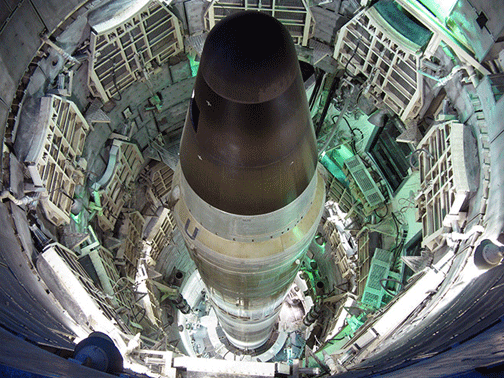
That we would pursue these weapons with such unfettered enthusiasm—competing amongst the [military] services for resources, going to roll out these shiny new things, cutting ribbons—spoke to me a great deal about the human condition. For some people, technology has absolutely mesmerizing qualities. If we can do it, we must.
That’s the kind of thinking that got us where we are today. To add to that, the military-industrial complex was being fed a virtually endless trough of money. There is no end to the number of people who will find any way to justify building something new, brighter and better. I’ve seen that happen time and time and time again
Ex-Chief of Nuclear Forces General Lee Butler Still Dismayed by Deterrence Theory and Missiles on Hair-Trigger Alert, TruthOut , 14 June 2015 00:00By Robert Kazel, Nuclear Age Peace Foundation | Interview After the Cold War ended in the early 1990s, the danger of nuclear weapons faded as a source of anxiety for some Americans. To them, worrying that the world’s stockpiles of missiles and bombs could eventually create catastrophe seemed as anachronistic as the duck-and-cover classroom drills of a previous generation. But for George Lee Butler, a four-star US Air Force general and the commander of US nuclear forces between 1991 and 1994, thinking about the possibility of just such a calamity didn’t end. The reality was always a phone call away.
The calls would come at least once a month, and there was never advance warning. Butler might be anywhere: his office at Offutt Air Force Base near Omaha, Neb., or traveling, or home sleeping. A hotline to other military officers and the White House sat on a bedside table, closer to his wife’s head because she was the lighter sleeper.
It always turned out to be an exercise—World War III obviously never broke out during Butler’s tenure. But, at least at the outset, he never knew for sure. The games were thought to be more useful if the participants—even a key player such as Butler—were kept in the dark about that…..
Actual presidents—in Butler’s day, George H.W. Bush and Bill Clinton—never took part in these “missile threat conferences.” Like a stand-in for a movie star who wished to avoid an unpleasant stunt, someone else always acted out the role of commander-in-chief at the other end of the line. Butler felt disgust that such a crucial task was left to a substitute.
Few knew it, but for Butler that sense of abhorrence gradually began to encompass nuclear weapons in general, as he became privy to more secrets about them………….
Former colleagues were surprised when Butler continued to make earnest, eloquent remarks to large audiences, condemning the same military systems he’d once managed. Now Butler was speaking freely about the “scourge” of nuclear weapons as being sinister and irreligious, and recommending they be dismantled everywhere they existed in the world through international agreements. These weapons were relics of a previous age when it was regrettably customary for rival nations to demonize one another, he argued. But they had no strategic value for any government in the post-Cold War world.
By 1999, he’d founded his own non-profit organization named the Second Chance Foundation and had begun to travel the world to promote his ideas. He spoke to journalists, military officers, defense officials, and scholars from the US, Canada, Western Europe, Russia, Pakistan, India and China. He received NAPF’s Distinguished Peace Leadership Award in 1999………..
Today, Butler is 75, and he has never stopped believing nuclear arms to be an enormous danger and outrageously immoral. They permit imperfect leaders to play God, he says, and make it all too easy for the planet to be ruined for all future generations in a span of hours. He’s incredulous that scores of US missiles are still kept on hair-trigger alert, poised to be launched in minutes. And he is more disillusioned than ever that defense strategists and politicians keep defending nuclear deterrence: a theory born in the 1950s that asserts nations can prevent nuclear war by keeping nuclear weapons ready for use in retaliation. Butler believed that once, fervently. But he now says deterrence probably never made much sense, and certainly is unbelievable in a world of unstable, unpredictable regional nuclear actors and terrorists who seek to actually use weapons of vast, destructive power.
Now Butler has penned his life story, a project he painstakingly worked on for many years after he and his wife, Dorene, left Omaha and moved to a gated community in Laguna Beach, Calif., in 2001. The self-published memoir, which he expects to be out this summer, recounts his boyhood in Georgia as part of an Army family and his 33-year military career starting with his graduation from the Air Force Academy in 1961. It explains in depth why he ultimately called for the total elimination of nuclear weapons, and discusses his disillusionment with government officials who, he says, have allowed shortsightedness, petty politics and bellicosity to obstruct the road to world nuclear disarmament.
Butler wants the autobiography, Uncommon Cause: A Life at Odds with Convention, to stand as his legacy. He’s hoping it will educate and inspire some of those who shape the world’s nuclear policies today.
In a wide-ranging interview at his house recently, Butler spoke with NAPF about the perils of nuclear weapons that arose during and just after the Cold War, and why the dangers continue. The following is an edited version of the conversation.
……………..If I could strike one word from the lexicon of the nuclear weapons enterprise, it would be “deterrence.” Because it’s easy. It’s lazy. It’s using rhetoric for a replacement of really rigorous thinking about what is exactly implied by your actions.
………….We deluded ourselves with regard to our capacity to manage crises. Deterrence was an open-ended invitation to just build more, and more complicated, systems. We always found a reason to go to the next level of arms, or the next hot technological biscuit to come popping out of the oven.
That just scared the bejesus out of the Soviets. They weren’t equipped to stay in that race, and ultimately Ronald Reagan saw that and he spent them into oblivion. The weapons became ever more numerous and more destructive. There’s no end to it, and the rationale was always that deterrence required it.
That we would pursue these weapons with such unfettered enthusiasm—competing amongst the [military] services for resources, going to roll out these shiny new things, cutting ribbons—spoke to me a great deal about the human condition. For some people, technology has absolutely mesmerizing qualities. If we can do it, we must. That’s the kind of thinking that got us where we are today. To add to that, the military-industrial complex was being fed a virtually endless trough of money. There is no end to the number of people who will find any way to justify building something new, brighter and better. I’ve seen that happen time and time and time again…
……….The cold, hard fact of the matter is that a nuclear weapon is, at its very core, anti-ethical. It is simply a device for causing wholesale destruction. Nuclear conflict is essentially an irrational activity, because essentially what you’re doing is signing your own death notice. http://www.truth-out.org/opinion/item/31366-ex-chief-of-nuclear-forces-general-lee-butler-still-dismayed-by-deterrence-theory-and-missiles-on-hair-trigger-alert
No comments yet.
1 This Month


Tell the Ukrainian Government to Drop Prosecution of Peace Activist Yurii Sheliazhenko

Petition to revoke the licensing of the Near Surface Nuclear Disposal Facility (NSDF) at Chalk River. https://www.ourcommons.ca/petitions/en/Petition/Details?Petition=e-7247


of the week – STOP SMALL MODULAR REACTORS IN CANADA
To see nuclear-related stories in greater depth and intensity – go to https://nuclearinformation.wordpress.com
-
Archives
- March 2026 (204)
- February 2026 (268)
- January 2026 (308)
- December 2025 (358)
- November 2025 (359)
- October 2025 (376)
- September 2025 (258)
- August 2025 (319)
- July 2025 (230)
- June 2025 (348)
- May 2025 (261)
- April 2025 (305)
-
Categories
- 1
- 1 NUCLEAR ISSUES
- business and costs
- climate change
- culture and arts
- ENERGY
- environment
- health
- history
- indigenous issues
- Legal
- marketing of nuclear
- media
- opposition to nuclear
- PERSONAL STORIES
- politics
- politics international
- Religion and ethics
- safety
- secrets,lies and civil liberties
- spinbuster
- technology
- Uranium
- wastes
- weapons and war
- Women
- 2 WORLD
- ACTION
- AFRICA
- Atrocities
- AUSTRALIA
- Christina's notes
- Christina's themes
- culture and arts
- Events
- Fuk 2022
- Fuk 2023
- Fukushima 2017
- Fukushima 2018
- fukushima 2019
- Fukushima 2020
- Fukushima 2021
- general
- global warming
- Humour (God we need it)
- Nuclear
- RARE EARTHS
- Reference
- resources – print
- Resources -audiovicual
- Weekly Newsletter
- World
- World Nuclear
- YouTube
-
RSS
Entries RSS
Comments RSS
 nuclear-news
Leave a comment