Merger of AREVA and EDF, to save nuclear giant AREVA- French tax-payers to fork out
 France announces plan to merge nuclear reactor businesses of state-owned atomic energy giants, Star Tribune By GREG KELLER Associated Press JUNE 3, 2015 PARIS — French nuclear giants Areva and EDF will merge their reactor businesses in a joint venture controlled by EDF — a wide-ranging reshuffle of the country’s state-owned atomic energy industry.
French President Francois Hollande’s office announced the deal’s broad outlines Wednesday, saying final details would be negotiated by the two companies within a month.
The French government, which controls over 80 percent of both companies, will inject new capital “of the necessary amount” in Areva as part of the deal……
 Areva lost nearly 5 billion euros ($5.6 billion) last year after taking a massive loss on new reactor projects in France and Finland……..
Last month Areva announced a 1-billion-euro cost-cutting plan, which included the removal of up to 6,000 jobs.
Only five years ago Areva was seen as a French success story, led by swashbuckling CEO Lauvergeon as it rode the wave of the so-called “nuclear renaissance.”
The company’s fortunes collapsed after a series of failures, including massive cost-overruns and technical failings with its new generation reactor; a disastrous investment in a Nigerien uranium mine; and the aftereffects of a global rejection of nuclear power after Japan’s Fukushima reactor meltdown http://www.startribune.com/france-to-merge-areva-edf-nuclear-reactor-businesses/306008871/
Anxiety in Malawi over Australian uranium miner Paladin’s pollution of Lake Malawi
“It’s shocking that Paladin has disposed of millions of tons of radioactive and chemically hazardous waste on a plateau with very negative geological and hydrogeological characteristics,”
On the shores of Malawi’s lake of stars, activists raise uranium fears, Guardian, Santorri Chamley, 3 June 15

When dead fish were washed ashore in northern Malawi, activists and residents looked to a nearby uranium mine for answers – the latest battle in a protracted conflict with Paladin, the mine’s Australian owners “……For many of the tens of thousands of people living in Karonga, a lakeside district in northern Malawi, life revolves around fishing. So when dead fish began to wash ashore, they were worried. Some blamed pollution from the nearby Kayelekera uranium mine, the country’s biggest foreign investment.
“People are fearful because there are a lot of fish dying in the lake, so people are suggesting that they are dying because of the discharge from the Kayelekera mine,” said Harry Hudson Mwanyembe, the chairman for health and environment on Karonga’s district council.
The Australian company that owns the mine, Paladin Energy Ltd, says it has complied with all its environmental obligations and routinely monitors aquatic life in the Sere River and elsewhere. It denies any responsibility for the dead fish but its operation in Kayelekera has been beset by controversy since it was openedby the late president Bingu wa Mutharika in 2009.
The disputes, legal battles and public concern over the mine go to the heart of what many call Africa’s resource curse. As one of the continent’s poorest countries – ranking 174 of 187 countries in the UN human development index – Malawi desperately needs foreign exchange, as well as employment and infrastructure. But its pursuit of extractive wealth has been stymied by a lack of adequate regulation and transparency as well as by corruption, activists say.
In Kayelekera, the pitfalls associated with launching a multi-million dollar enterprise, with government backing, in an area where people lack access to both information and power, are evident in the many rumours, claims and counter-claims surrounding the mine’s operations……
resident of Kayelekera, Philip Simbowe, said the government had sold the lives of Malawians for cash. Continue reading
Nuclear deal with Iran will significantly reduce Tehran’s enrichment capacity,
 Nuclear deal will reduce Iran enrichment capacity: US adviser Yahoo 7 News, 3 June 15 Doha (AFP) – A nuclear deal with Iran will significantly reduce Tehran’s enrichment capacity, US Vice-President Joe Biden’s national security adviser told a conference in Qatar on Monday.
Dr Colin H. Kahl, speaking at the US-Islamic World Forum in Doha, said the current deal being hammered out was the best on offer, despite many sceptical voices in the US and elsewhere, including Gulf Arab states.
“Under the deal we are negotiating… Iran’s enrichment capability will be substantially rolled back,” said Kahl.
“The deal we are negotiating makes us and the region safer.”
The ongoing talks to finalise a nuclear accord between Iran and world powers, including the United States, are deadlocked weeks ahead of a deadline.
Negotiations at the weekend in Geneva, Switzerland, failed to bridge differences between Washington and Tehran, especially over the crucial issue of inspections of military sites…….
Since the April 2 accord, technical experts have been meeting behind the scenes to overcome the remaining issues. But many of the decisions now need to be made at a political level. Following talks last weekend, US Secretary of State John Kerry broke a leg while cycling but advisers said the accident would not slow the globe-trotting diplomat.
Kahl said on Monday that “today” it would take Iran two-to-three months to produce enough fissile material for one bomb.But despite criticism he said a negotiated settlement was the best solution.
“In the absence of comprehensive agreement to deal with this challenge and constrain Iran’s programme, Iran would likely install and begin operating tens of thousands of fissile centrifuges in the near future,” he added.
The forum is a three-day long conference involving politicians, policy advisers and academics from across the Middle East and the United States. http://news.yahoo.com/nuclear-deal-roll-back-iran-military-us-adviser-154651601.html
Cyber attack an increasing threat to nuclear facilities – says IAEA
 UN watchdog group warns of cyberattacks on nuclear facilities, SC Magazine http://www.scmagazine.com/international-conference-on-computer-security-hosted-for-first-time/article/418241/ Ashley Carman, Editorial Assistant 3 Jun 15 Nuclear facilities around the world are facing daily cyberattacks on their systems, a United Nations nuclear watchdog group said during a Monday conference.
“Reports of actual or attempted cyberattacks are now virtually a daily occurrence,” said Yukiya Amano, director general of the International Atomic Energy Agency (IAEA). “Last year alone, there were cases of random malware-based attacks at nuclear power plants and of such facilities being specifically targeted.”
The conference at which Amano spoke, the International Conference on Computer Security in a Nuclear World, is in its inaugural year and goes until June 5, the UN reported.
“Staff responsible for nuclear security should know how to repel cyber-attacks and to limit the damage if systems are actually penetrated,” Amano said. “The IAEA is doing what it can to help governments, organizations, and individuals adapt to evolving technology-driven threats from skilled cyber adversaries.”
Secrecy, and no costing known, in South Africa’s plans for nuclear power
Key details of SA’s nuclear procurement plan kept under wraps, BD Live, BY CAROL PATON, 02 JUNE 2015 KEY DETAILS OF SA’S NUCLEAR PROCUREMENT PROGRAMME REMAINED SECRET IN A PRESENTATION BY TOP DEPARTMENT OF ENERGY OFFICIALS, AS WELL ENERGY MINISTER TINA JOEMAT-PETTERSSON TO PARLIAMENT’S PORTFOLIO COMMITTEE ON ENERGY.

However, officials said the procurement would be completed by the end of the financial year when “a strategic partner or partners” would be chosen.
While the officials gave a lengthy motivation on the need for nuclear power and SA’s preparedness for the new nuclear energy build, details about the cost, the financing and the procurement process were not provided. Inter-governmental agreements that SA has signed with various countries on nuclear co-operation, as well as a damning report by the Integrated Nuclear Infrastructure Review on SA’s readiness also remained under wraps.
Ms Joemat-Pettersson is backed by President Jacob Zuma in her quest to build 9.6GW of nuclear generation capacity. However, there are several detractors of the plan, including the former National Planning Commission, opposition political parties and a wide array of civil society and human rights lobby groups……
DA MP Gordon MacKay said that with regard to the financing the government had got the cart before the horse.”It is strange that we are wanting to buy something that we don’t know the cost of and we don’t know how we will pay for,” he said.
Mr MacKay also criticised the secrecy of the report compiled in the Integrated Nuclear Infrastructure Review process.While reports for other countries are available on the website of the International Atomic Energy Agency, the report compiled on SA remains “classified” despite being completed two years ago.
Mr MacKay said it was believed that the report showed SA to be unprepared for the nuclear procurement in 14 of 19 benchmark areas.http://www.bdlive.co.za/business/energy/2015/06/02/key-details-of-sas-nuclear-procurement-plan-kept-under-wraps
Unlikely that South Africa could fund its secretive nuclear power project
Too soon’ to assess SA on funding nuclear BD Live BY CHARLOTTE MATHEWS, 03 JUNE 2015, MOSCOW — Assumptions could not yet be made about SA’s capacity to finance its planned 9,600MW of new nuclear power because a number of other issues needed to be decided first, said Kirill Komarov, Rosatom State Corporation’s first deputy general director for development and international business.
He was speaking on the sidelines of the Atomexpo 2015 conference on nuclear technology in Moscow this week, which has attracted 1,600 delegates from 48 countries. Although Rosatom has the major role, there are speakers and exhibitors from nuclear vendor countries including France, Russia and China……..
The South African government seeks a large nuclear procurement despite doubts about its affordability. The target is to have the first reactor in commission by 2023……..
Given SA’s other spending priorities and weak economic growth, it seemed unlikely it could fund this programme in full………Rosatom had arranged financing for nuclear stations it built in Belarus, Hungary and India,……. • Rosatom sponsored Charlotte Mathews’s visit to Russia http://www.bdlive.co.za/business/energy/2015/06/03/too-soon-to-assess-sa-on-funding-nuclear
Whole brain radiation found not to be beneficial for brain cancer patients
 Cancer study could change radiation treatment for hundreds of thousands, Guardian, 1 June 15
Treating whole brain with radiation found to harm cognitive skills without improving survival, study finds – meaning many could be spared such care A major study could change care for many of the hundreds of thousands of people each year who have cancer that spreads to the brain from other sites, study leaders said on Sunday.
The study, one of three discussed at an American Society of Clinical Oncology conference in Chicago, found that contrary to conventional wisdom, radiation therapy to the whole brain did not improve survival, and harmed memory, speech and thinking skills.
“This is the classic question: Which is worse, the disease or the treatment?” said one study leader, Dr Jan Buckner of the Mayo Clinic in Rochester, Minnesota. Radiation helped control the cancer, Dr Buckner said, “but at the cost of cognitive decline”.
For patients, the study is not necessarily the bad news it may seem. It shows that in this case, quality of life is better with less treatment, and many people can be spared the expense and side effects of futile care………
The first study affects the most patients by far. An estimated 400,000 patients in the US alone each year have cancer that spreads to the brain, usually from the lungs, breast or other sites.
That is different from tumors that start in the brain, like the one that on Saturday claimed the life of Joseph “Beau” Biden, the son of vice-president Joe Biden.
Cancer that spreads to the brain is usually treated with radiosurgery – highly focused radiation with a tool such as the Gamma Knife, followed by less intense radiation to the whole brain. The latter treatment can cause hair loss, dry mouth, fatigue and thinking problems……
Dr Paul Brown of the University of Texas MD Anderson Cancer in Houston led a study of 213 patients with one to three tumors in the brain to see whether the risks of whole brain radiation were worth its help in controlling cancer.
Half of the patients had the usual radiosurgery and the rest had that followed by whole brain radiation. Three months later, 92% of patients who got both treatments had cognitive decline versus 64% of those given just radiosurgery.
“The negative effects far outweigh any benefits” of the combination treatment, Brown said……..http://www.theguardian.com/society/2015/may/31/cancer-patients-spared-brain-radiation-study
Abandon Great Lakes Nuclear Dump Plan – urge Great Lakes Waterkeepers and Waterkeeper Alliance
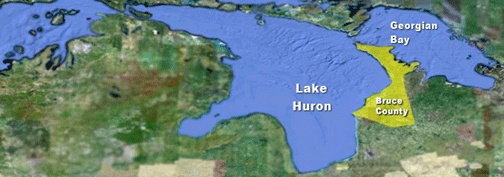 Great Lakes Waterkeepers and Waterkeeper Alliance Urge Canadian Authorities to Ditch the Great Lakes Nuclear Dump http://waterkeeper.org/2015/05/27/great-lakes-waterkeepers-and-waterkeeper-alliance-urge-canadian-authorities-to-ditch-the-great-lakes-nuclear-dump/ May 27 2015 by Maia Raposo Groups Renew Plea to U.S. Secretary of State to Oppose Threat to Drinking Water Supply for 40 Million People
NEW YORK, NY – May 27, 2015 – Environmentalists in the Great Lakes Basin are opposed to a new report from a Canadian Joint Review Panel that has called for the support of the Canadian Minister of the Environment to approve a deep geological repository for nuclear waste in Kincardine, Ontario due to its proximity to drinking water supplies for 40 million people in the United States and Canada. The proposed plan from Ontario Power Generation (OPG) is to store underground radioactive nuclear waste less than one mile from the shores of Lake Huron. Canadian officials are getting closer to approving this hazardous project and could even fast track the authorization of a final license within the next few months.
Under the Binational Great Lakes Water Quality Agreement (amended in 2012), both Canada and the US acknowledge the importance of anticipating, preventing, and responding to threats to the waters of the Great Lakes. Both countries share the responsibility and obligation to protect these shared waters from pollution.
“Great Lakes Waterkeepers and Waterkeeper Alliance oppose this project, which could threaten the drinking water supply of 40 million Americans and Canadians,” said Bob Burns, Detroit Riverkeeper. “We ask the U.S. State Department to stand with the citizens, local and state governments, and other stakeholders in the Great Lakes Basin whose voices have not yet been heard but who are at risk if the deep geological repository fails.”
Last September, the groups wrote to Secretary of State John Kerry and Canadian officials urging them to vote against this nuclear storage facility.
“With the Great Lakes containing 95% of the North America’s supply of fresh surface water, this is one of the worst possible locations for a permanent nuclear waste burial facility,” stated Doug Martz, St. Clair Channelkeeper. “Ontario Power Generation, the project proponent, did not investigate any other sites for this repository, but rather, selected the site based on the willingness of one local community. Furthermore, approval of this facility would set a devastating precedent for allowing other nuclear waste repositories to be located in the Great Lakes Basin.”
Marc Yaggi, executive director of Waterkeeper Alliance added: “The Great Lakes are suffering from failing infrastructure, contamination leaching from historical industrial and nuclear waste sites, ongoing agricultural pollution and invasive species. Intentionally siting a new toxic nuclear waste site in such close proximity to the largest fresh water system in the world would severely imperil the water security of two nations. The time to act is now, and we call again on Secretary Kerry to take action.”
The eight Waterkeeper organizations in the Great Lakes support proposed resolutions in the U.S. House of Representatives and Senate to urge government action to ensure that the Canadian Government does not permanently store nuclear waste underground in the Great Lakes Basin.
Contacts:
Tina Posterli, Waterkeeper Alliance, tposterli@waterkeeper.org, 516.526.9371
Doug Martz, St. Clair Channelkeeper, channelkeeper@wowway.com, 586.764.2443
Bob Burns, Detroit Riverkeeper, rlb315@comcast.net, 734.676.4626
###
Waterkeeper Alliance is a global movement uniting more than 250 Waterkeeper organizations around the world and focusing citizen advocacy on issues that affect our waterways, from pollution to climate change. Waterkeepers patrol and protect more than 2 million square miles of rivers, streams and coastlines in the Americas, Europe, Australia, Asia and Africa. For more information please visit:www.waterkeeper.org
The 8 Waterkeeper organizations in the Great Lakes are: Buffalo Niagara Riverkeeper, Detroit Riverkeeper, Grand Traverse Baykeeper, Lake Erie Waterkeeper, Milwaukee Riverkeeper, St. Clair Channelkeeper, Upper St. Lawrence Riverkeeper and Yellow Dog Riverkeepe
1 This Month



Tell the Ukrainian Government to Drop Prosecution of Peace Activist Yurii Sheliazhenko

Petition to revoke the licensing of the Near Surface Nuclear Disposal Facility (NSDF) at Chalk River. https://www.ourcommons.ca/petitions/en/Petition/Details?Petition=e-7247


of the week – STOP SMALL MODULAR REACTORS IN CANADA
To see nuclear-related stories in greater depth and intensity – go to https://nuclearinformation.wordpress.com
-
Archives
- March 2026 (212)
- February 2026 (268)
- January 2026 (308)
- December 2025 (358)
- November 2025 (359)
- October 2025 (376)
- September 2025 (258)
- August 2025 (319)
- July 2025 (230)
- June 2025 (348)
- May 2025 (261)
- April 2025 (305)
-
Categories
- 1
- 1 NUCLEAR ISSUES
- business and costs
- climate change
- culture and arts
- ENERGY
- environment
- health
- history
- indigenous issues
- Legal
- marketing of nuclear
- media
- opposition to nuclear
- PERSONAL STORIES
- politics
- politics international
- Religion and ethics
- safety
- secrets,lies and civil liberties
- spinbuster
- technology
- Uranium
- wastes
- weapons and war
- Women
- 2 WORLD
- ACTION
- AFRICA
- Atrocities
- AUSTRALIA
- Christina's notes
- Christina's themes
- culture and arts
- Events
- Fuk 2022
- Fuk 2023
- Fukushima 2017
- Fukushima 2018
- fukushima 2019
- Fukushima 2020
- Fukushima 2021
- general
- global warming
- Humour (God we need it)
- Nuclear
- RARE EARTHS
- Reference
- resources – print
- Resources -audiovicual
- Weekly Newsletter
- World
- World Nuclear
- YouTube
-
RSS
Entries RSS
Comments RSS
 nuclear-news
