Fukushima Daiichi ‘s Port has Record Levels of Radiation

 Record levels of radioactivity in plant’s port http://www3.nhk.or.jp/nhkworld/english/news/nuclear.html May 30, 2015 The operator of the damaged Fukushima Daiichi nuclear plant says it has found record-high levels of radioactive water in the facility’s port. It says the high levels are due to a leak of wastewater. Tokyo Electric Power Company officials said on Friday that contaminated water leaked from a crack in a hose connecting a wastewater tank to a building at the plant.
They later detected about 22,000 becquerels of beta ray-emitting substances per liter of water in a nearby drainage ditch. The ditch is in the upper part of a drainage channel. The utility also found the density of radioactive materials in the channel was around 6,600 becquerels per liter. That’s more than 200 times higher than the figure recorded on Wednesday.
TEPCO officials took samples of seawater from 4 locations in the port, where the leaked water reached via the drainage channel. They detected between 190 and 320 becquerels of radioactive substances per liter. The figure is the highest ever recorded in the port.
Utility officials say the leak stopped after they halted the flow of water, and that it has not affected waters in the Pacific Ocean outside the port. TEPCO workers are trying to collect water from the drainage channel to prevent it from reaching the ocean.
Just 30 miles from New York City – a nuclear disaster-in-waiting
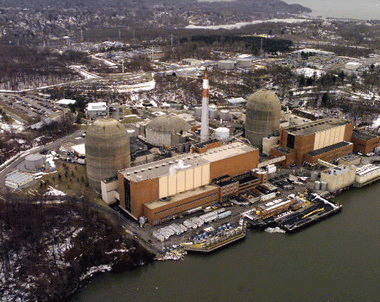 HOW A POTENTIAL FUKUSHIMA SITS 30 MILES FROM NYC , Pontiac Tribune, by Claire Bernish 11 May 15 “…………..there is something of grave concern scheduled to begin shortly, and its close proximity to the aging nuclear plant — which at one time found itself on the list of the nation’s worst — has largely escaped coverage by the corporate media. Oh, did I mention IPEC is located in a seismic zone?
When contemplating risk, there is an assumption that the factors under consideration will lead to an informed decision in answering the question: Is it worth it?
The Algonquin Incremental Market Project (AIM) is a glaring example of an entire industry hellbent on ignoring that essential question altogether. The Federal Energy Regulatory Commission (FERC), with approval by the Nuclear Regulatory Commission (NRC), gave the green light on plans for Spectra Corporation to construct a 42″, high – pressure natural gas pipeline which will run through the IPEC facility, less than a quarter mile — at one critical point just 105 feet — from the No 2 and No 3 reactors. But that’s only the beginning of the folly characterizing the AIM pipeline expansion, a project intended to pump fracked shale gas from Pennsylvania into New England.
Spectra, a giant in the natural gas infrastructure industry, has been seeking the addition to its 1,129 mile long Algonquin Pipeline since 2011. Though the project gained approval, how it managed to do, is a feat that defies logic entirely. Working with the NRC from its outset, engineer Paul Blanch is a nuclear energy proponent with decades of experience in nuclear safety and federal regulation, and holds security clearance for his job — by all accounts an industry ‘insider’. His take on the AIM project should carry weight:
“I’ve had over 45 years of nuclear experience and [experience in] safety issues,” Blanch told Truthout. “I have never seen [a situation] that essentially puts 20 million residents at risk, plus the entire economics of the United States by making a large area surrounding Indian Point uninhabitable for generations. I’m not an alarmist and haven’t been known as an alarmist, but the possibility of a gas line interacting with a plant could easily cause a Fukushima type of release.”
Gas is a volatile, explosive substance, and the pipelines tasked with transporting it are subject to corrosion and neglect, making maintenance and inspection the highest priority. However, a report [pdf] by the National Transportation Safety Board (NTSB) in January found operators had“inadequate evaluation of threats […] which may lead to underestimating the true magnitude of risks to a pipeline”, compounded by “inspectors [who] lack training to effectively verify the validity of an operator’s risk assessment”. With that in mind, an increase in the number of ‘incidents’ (read: accidents) in high – consequence areas (HCA), which are locations where injury and property damage are likely to occur, really comes as no surprise. And yet, Indian Point could qualify as the area of the highest consequences possible . . . New York City, with some 20 million people, sits just 37 miles to its south.
Why does this pipeline have approval? Continue reading
70 years of cancer-causing nuclear pollution in St Louis
 This week, internationally recognized physician Dr. Helen Caldicott reviewed documents and reports concerning the West Lake landfill. She stated in no uncertain terms that the health records and data clearly show that contaminants have been causing cancers in the affected region at elevated levels.
As the recipient of 21 honorary doctoral degrees for her work on the health consequences of exposure to nuclear material including the disasters at Three Mile Island, Chernobyl, and Fukushima, Caldicott is one of the world’s most-respected experts on the topic. With regard to the West Lake site, she concluded that ongoing health dangers demand that, “the [West Lake] site needs to be dealt with immediately. It needs to be cleaned-up this year.”
Radioactive site continues to plague St. Louis residents and region http://www.examiner.com/article/radioactive-site-continues-to-plague-st-louis-residents-and-region, 29 May 15 In North Saint Louis County, Missouri, in the City of Bridgeton, there is a ticking time bomb in the form of several contiguous landfills which contain radioactive waste and all the “daughter products” associated with weapons-grade uranium processing. Most notably, the site in question, the West Lake landfill, has the largest concentration in the nation of one of these highly dangerous daughter products.
 In a 2013 report entitled, The West Lake Landfill: A Radioactive Legacy of the Nuclear Arms Race, Robert Alvarez states, “Of significance is the fact that the largest estimated amount of Thorium-230, a long-lived, highly radiotoxic element, is present at West Lake — more than any other U.S. nuclear weapons storage or disposal site.” Continue reading
Urgent talks between USA and Iran before June 30 deadline
 Iran, US talks gain urgency as nuclear accord deadline nears SMH, June 1, 2015 Karen DeYoung, Geneva: Significant differences remain between the United States and Iran over a nuclear deal, but the two sides are clear on what needs to be resolved and the urgency of doing it before a June 30 deadline, a senior Obama administration official said after six hours of weekend talks here between US Secretary of State John Kerry and Iranian Foreign Minister Mohammad Javad Zarif.
The discussions, the official said, were “intense at times” as both sought clarification of the two biggest issues between them. Iran wants to know exactly which sanctions against it will be lifted and when.
The US and its global partners in the negotiations want specific mention in a final deal of international verification and monitoring provisions that include all Iranian sites, including military facilities. Other issues that remain unresolved include the extent to which Iran will provide details of its nuclear research history.
“All issues were reviewed” but “differences still remain”, Iranian negotiator Abbas Araghchi told reporters as his delegation depa http://www.smh.com.au/world/iran-us-talks-gain-urgency-as-nuclear-accord-deadline-nears-20150531-ghdd13.htmlrted for Tehran…….
Austria ready to take legal action against subsidising of nuclear reactors
 Austria ready to sue over subsidized nuclear plants: minister http://www.reuters.com/article/2015/05/27/us-austria-nuclear-idUSKBN0OC0KD20150527 Austria will take legal action to block any subsidized nuclear power plants in an effort to discourage use of the technology in Europe and scare off investors, the country’s environment minister, Andrae Rupprechter, said in a newspaper interview.
Rupprechter’s comments to business daily Wirtschaftsblatt reflect non-nuclear Austria’s tough stance, as  evidenced by its intent to take the European Commission to court over approval of Britain’s plans for the Hinkley Point nuclear plant.
Neighboring Czech Republic also plans to extend its nuclear capacity.
“Should other countries present similar subsidy plans, we will fight these in court,” the minister said in the interview published on Wednesday, saying such state backing hindered the rollout of renewable energy technology.
“Giving preference to nuclear power is unacceptable. Nuclear energy is neither safe nor economical. A lawsuit may also make potential investors hesitant.” (Reporting by Michael Shields; Editing by David Goodman)
A nation-wide network formed in Japan, to sue government and TEPCO, over the Fukushima nuclear disaster
Plaintiffs suing over Fukushima nuclear disaster form nationwide network,Asahi Shimbun, May 26, 2015 By MASAKAZU HONDA/ Staff Writer NIHONMATSU, Fukushima Prefecture–Ten groups of plaintiffs in lawsuits and other legal actions over the Fukushima nuclear disaster have joined forces to demand compensation and accountability from the government and Tokyo Electric Power Co.
The groups held a liaison conference, called Hidanren (coalition of nuclear accident victims), to mark its establishment in Nihonmatsu, Fukushima Prefecture, on May 24. The network comprises 20,000 people.
Ruiko Muto, who heads a group pursuing criminal responsibility of TEPCO and government officials, expressed frustration over the developments since the nation’s worst nuclear accident unfolded in March 2011 at TEPCO’s Fukushima No. 1 nuclear power plant.
She called on the groups to work together to press their demands.
“So far, no one has been charged with criminal responsibility,” Muto said. “Few (of the affected) are receiving compensation that they agree with, and few have a clear vision of how to rebuild their lives.”
She also said evacuees are under growing pressure to return to their homes soon amid a government campaign to label their hometowns as safe. The goals set by the conference include: having authorities and TEPCO offer an apology and full compensation to the victims; restore the victims’ livelihoods and lifestyles; provide medical service coverage; and introduce measures to reduce radiation exposure among residents………http://ajw.asahi.com/article/0311disaster/fukushima/AJ201505260003
Interview with Murakami Tatsuya: Fukushima and the Crisis of Democracy
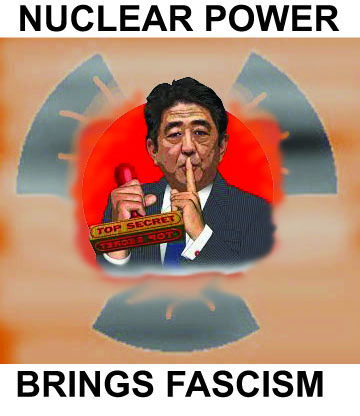 Fukushima and the Crisis of Democracy: Interview with Murakami Tatsuya The Asia-Pacific Journal, Vol. 13, Issue. 20, No. 1, May 25, 2015 Katsuya Hirano
Murakami Tatsuya is the former mayor of Tōkaimura or Tōkai village located approximately 75 miles north of Tokyo and 111 miles south of the Fukushima Daiichi plant.
Tōkaimura is considered the birthplace of nuclear power in Japan since the Japanese government built the first reactor for commercial use there in 1965 in collaboration with British nuclear scientists. As Mr. Murakami reveals below, the Japanese government at the time informed the residents of Tōkaimura only of the building of a nuclear research institute, not a power plant. As time passed, Tōkaimura became heavily dependent on the nuclear industry for its revenue and people’s livelihood. On September 30, 1999, the village had a nuclear criticality accident at the JCO nuclear reprocessing plant. It killed two people, left one person in critical condition, and exposed 667 people to radiation. They were the first victims of a nuclear accident in Japan. Mr. Murakami dealt with the emergency situation as mayor and subsequently became a vocal opponent of Japan’s nuclear energy policy. Since the Fukushima Daiichi Plant accident of 2011, he has been a leading figure in the anti-nuclear movement involving 24 village and town mayors, which calls for the abolition of all 54 reactors in Japan. The interview took place at his Tōkai residence in the summer and winter of 2014……..http://www.japanfocus.org/-Katsuya-HIRANO/4320/article.html
Voluntary evacuees from Fukushima may lose free housing in 2017
Fukushima may end free housing for voluntary nuclear evacuees in 2017, Japan Times, 27 May 15 JIJI FUKUSHIMA – The Fukushima Prefectural Government may stop providing free accommodations at the end of March 2017 for people who voluntarily left areas in the prefecture not subject to nuclear evacuation advisories, sources said.
Officials hope to encourage people who evacuated on their own to return home, but the proposed end to the assistance will certainty draw objections from them……..
Many voluntary evacuees are people with children as well as former residents of such areas as the town of Hirono, the village of Kawauchi and the city of Minamisoma, all geographically close to the government-designated evacuation zones.
They sought refuge outside their hometowns mainly due to concerns over exposure to radiation from the reactor meltdowns at Tokyo Electric Power Co.’s Fukushima No. 1 plant.
Under the Disaster Relief Act, the prefectural government provides prefabricated temporary housing for nuclear evacuees for free and fully finances their rent for private apartments.
The aid program was originally supposed to run two years, but it was extended by a year twice, with the current version set to expire at the end of next March. For voluntary evacuees, the prefecture hopes to terminate the assistance after another one-year extension, the sources said.
It is looking at continuing the free accommodations for people who fled the designated evacuation areas, the sources said. http://www.japantimes.co.jp/news/2015/05/18/national/fukushima-may-end-free-accommodations-voluntary-nuclear-evacuees-2017/#.VWt9hdKqpHy
The irrestistible appeal of home controlled electricity – with solar energy storage
What is certain is that the electricity equation will look very different in a few short years, and it looks like, for the first time in many years, that ordinary consumers will hold a bit more of the power
How home energy storage is going to change the way we think about power, Adelaide Now, CAMERON ENGLAND SUNDAY MAIL (SA) MAY 31, 2015 WHEN Elon Musk launched the Tesla Power Wall earlier this month, it was done in true Silicon Valley style.
The charismatic chief executive enters stage right, sans tie, and makes a pronouncement that his new product will change the world — cue rapturous applause from the audience and because this is the United States, whooping.
The thing about Musk’s pronouncement is that it’s most likely true.
It might not necessarily be his company — critics are divided as to whether Tesla will be the market leader it’s portraying itself as — but home and business energy storage is soon to change the way energy utilities, homes and governments think about power……..
Batteries allow homes and especially businesses to employ “peak shaving” — if power prices spike, flick over to using your own solar power and save money, or if the grid power is cheap, suck it out and sell it back later at a higher price.
Or simply save up the solar power your rooftop panels produce during the day for use in the evening, when your demand might be higher……..

Tesla Power builds on the Tesla Motors technology — relatively standard lithium ion batteries with smart software to help them interact with the grid. The initial interest has been huge. The company recently reported early orders of 50,000 to 60,000 batteries, or as Musk put it, “It’s like crazy off-the-hook”.
Effectively the company is sold out until the middle of next year and its huge new factory will not be big enough to keep up with demand.
At $US3000 for the battery and $US7000 installed with solar panels (US prices) the system makes it economic for houses to become much less dependent on grid power.
UBS estimates that in Australia, the system would pay itself back in six years.
But Tesla is not the only game in town — although it almost certainly has the best PR machine. Continue reading
Fukushima food coming to a grocery near you?
 How Fukushima Produce Is Making Its Way Into International Stores, Before It’s News,Wednesday, May 27, 2015 It is being reported that tainted food from Fukushima, Ibaraki, Gumma, and Chiba is making its way into local supermarkets in Taiwan due to the irresponsibility of mislabeling. What’s more, these food products were banned in Taiwan since March of 2011.
The first question is: Why are food products from the concerned Japanese prefectures surrounding Fukushima mislabelled?
The second question is: Why is Japan attempting to foist its unsafe and inferior radioactive foods on Taiwan?
Instead of humbly acquiescing to Taiwan’s wishes, Japan takes an aggressive approach even threatening WTO arbitration.
Taiwan’s Food and Drug Administration said the latest enforcement was in line with radiation safety management practices that other countries have put in place on Japanese food imports following the 2011 Fukushima nuclear disaster.
It said it “is necessary to protect the safety of food consumption” for Taiwanese.
But Japan is protesting the move, with the government warning that it may escalate the matter to the World Trade Organization, potentially deepening the conflict between Taipei and Tokyo……..
they are now still dealing with the Fukushima meltdown(s) — a set of intractable nuclear challenges which may have no practical solutions. That means that those prefectures surrounding Fukushima may always have an environment suffering from a proliferation of radionuclides. What exactly are radionuclides?
A radionuclide or radioactive nuclide is a nuclide that is radioactive. Also referred to as a radioisotopeor radioactive isotope, it is an isotope with an unstable nucleus, characterized by excess energy available to be imparted either to a newly created radiation particle within the nucleus or via internal conversion. During this process, the radionuclide is said to undergo radioactive decay, resulting in the emission of gamma ray(s) and/or subatomic particles such as alpha or beta particles.[1] These emissions constitute ionizing radiation. (Source: Wikipedia — Radionuclide)
Radionuclides, and especially the ionizing radiation which they emit, are certainly not something that anyone would want in their back yard, much less in their food. Nevertheless, Japan feels it can maintain the same policies that got them into this calamitous predicament. Hopefully, Taiwan will not relent to demands so unreasonable they strain credulity. After all, Japan needs to learn some critical lessons for their own benefit as well as for their trading partners.http://beforeitsnews.com/health/2015/05/how-fukushima-produce-is-making-its-way-into-international-stores-2575244.html
Extreme heat will finish “Business As Usual” in USA, and probably Australia ,too
 Anthony M Horton: Extreme heat – ‘Business as usual’ life to end in less than 30 years in the U.S.
A new study projects that the United States will have a four to six-fold increase in extreme heat exposure by 2070 — and even earlier in the South. Unfortunately, no similar study has been conducted in Australia…
As a scientist, I am concerned that research into a range of climate related issues are seemingly not on the agenda in Australia and stellar pillars such as the world renowned Commonwealth Scientific and Industrial Research Organisation (CSIRO) and the Bureau of Meteorology (BoM) are suffering increasingly deep staff cuts at a time when they are needed the most.
It also appears that the long held “without fear or favour” bastion of these pillars has also seemingly ended. If this is really the case, it is a truly sad day for Australia-especially given the many world leading breakthroughs achieved by the former and the proud record of the latter. …
I fear for the future of Australia if this trend becomes entrenched as, by the time the Government realises they have made a tactical error, there won’t be enough trained people left to pick up the slack, as they will have retired, retrained or will be employed elsewhere in the world. https://independentaustralia.net/environment/environment-display/business-as-usual-life-in-the-us-will-end-in-less-than-30-years,7750
Latest renewable energy news
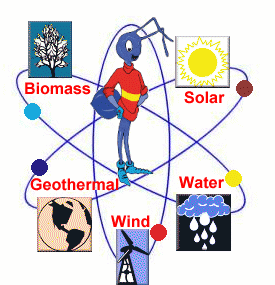 Renewable energy: The green light is finally on
- Anirudh Bhattacharyya, Hindustan Times May 29, 2015 http://www.hindustantimes.com/anirudhbhattacharyya/renewable-energy-the-green-light-is-finally-on/article1-1352832.aspx
Cheap solar lights up poor Indonesian communities
Kopernik is an Indonesian-based non-profit organisation introducing cheap and clean solar lighting to poor communities.
Perth wave energy project producing power and fresh water
Carnegie Wave Energy based in Perth is a world leader in wave energy technology. In 2014 the company began deployment of three wave energy converters at the Garden Island naval base off the coast near Perth. Large buoys rise and fall with passing waves. Each is tied by rope to the sea floor. As waves pass, the buoys rise, the ropes tighten and extremely high pressure is created in a water-based fluid. This is piped to shore where the pressure powers water desalination and the production of electricity. This technology, known as CETO, has application for small coastal towns and remote islands where oil or diesel is often used in generators. The Perth project is the first demonstration of a complete grid-connected CETO system anywhere in the world. http://www.abc.net.au/radionational/programs/scienceshow/perth-wave-energy-project-producing-power-and-fresh-water/6507450
Bjorn Lomborg’s ‘seven Nobel laureates’ not all what they seem — or even alive
Graham Readfearn, 31 May 15 The ‘seven Nobel laureates’ Bjorn Lomborg claims are waiting to collaborate with any other university willing to give his ‘Consensus Centre’ a home are not all what they seem — or even breathing. …
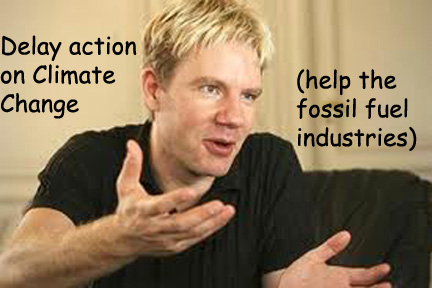
AS OFTEN turns out to be the case with matters of detail involving Bjorn Lomborg, not all is as it seems…….
https://independentaustralia.net/environment/environment-display/bjorn-lomborgs-seven-nobel-laureates-not-all-what-they-seem–or-even-alive-,7763
1 This Month


10 March A LIVE WEBINAR THE REAL EFFECTS OF NUCLEAR POWER
What the Industry Isn’t Telling Us
1:00 PM Mountain, 2 pm Central, 3 pm Eastern. Live on the Keepers of the Water Facebook page


18 March Webinar @ 1 PM EST: An Assessment of SMR Projects: The Case of Canada
register for the zoom:
https://us02web.zoom.us/webinar/register/WN_o8BIIOUvQ2ONJR1nta65DQ#/registration


of the week – STOP SMALL MODULAR REACTORS IN CANADA
To see nuclear-related stories in greater depth and intensity – go to https://nuclearinformation.wordpress.com
-
Archives
- March 2026 (76)
- February 2026 (268)
- January 2026 (308)
- December 2025 (358)
- November 2025 (359)
- October 2025 (376)
- September 2025 (258)
- August 2025 (319)
- July 2025 (230)
- June 2025 (348)
- May 2025 (261)
- April 2025 (305)
-
Categories
- 1
- 1 NUCLEAR ISSUES
- business and costs
- climate change
- culture and arts
- ENERGY
- environment
- health
- history
- indigenous issues
- Legal
- marketing of nuclear
- media
- opposition to nuclear
- PERSONAL STORIES
- politics
- politics international
- Religion and ethics
- safety
- secrets,lies and civil liberties
- spinbuster
- technology
- Uranium
- wastes
- weapons and war
- Women
- 2 WORLD
- ACTION
- AFRICA
- Atrocities
- AUSTRALIA
- Christina's notes
- Christina's themes
- culture and arts
- Events
- Fuk 2022
- Fuk 2023
- Fukushima 2017
- Fukushima 2018
- fukushima 2019
- Fukushima 2020
- Fukushima 2021
- general
- global warming
- Humour (God we need it)
- Nuclear
- RARE EARTHS
- Reference
- resources – print
- Resources -audiovicual
- Weekly Newsletter
- World
- World Nuclear
- YouTube
-
RSS
Entries RSS
Comments RSS
 nuclear-news