Japan SAYS it will start removing fuel debris from stricken reactors in 2021
Japan still aims to start removing nuclear fuel debris at the three damaged reactors at Tokyo Electric Power Co.’s Fukushima No. 1 power plant in 2021, it was learned Thursday.
The schedule remained intact in a draft update to the government’s roadmap to the decommissioning of reactors 1, 2 and 3, all of which experienced fuel meltdowns during the nuclear disaster from March 2011. The draft was submitted to a meeting of a government task force on the matter.
But it looks inevitable that the government will review the schedule. The exaction location of the molten nuclear fuel in the reactors is still unknown and radiation levels in and around the reactors are very high.
In autumn last year, the government and Tepco discussed a delay of about five years in the start of work to remove the fuel debris from reactor 1.
Meanwhile, the government is reviewing the schedule for removing spent fuel at storage pools at the three reactors.
Removal work has been slated to begin for reactor 3 by the end of this September. But the work will likely be delayed because radiation levels remain high and operations to remove rubble from the damaged building have not progressed as planned……http://fukushimaemergencywhatcanwedo.blogspot.com.au/
Nuclear reactors to operate for 100 years? That’s what AREVA & Toshiba want
 AREVA,Toshiba eye 100-year life cycle for nuclear plants John Downey
now, federal regulators allow up to 60 years of licensed energy production. But Gary Mignogna, CEO of Charlotte-based Areva Inc.(EPA:AREVA), says it’s time to consider a 100-year life cycle…..He noted that former Duke Energy CEO Jim Rogers had raised questions about whether plants could operate much beyond the 20-year extension the Nuclear Regulatory Commission offers after a plant’s 40-year initial license…….
Reverse engineering Ali Azad, chief executive of Toshiba (TYO:TOSBF) America Energy Systems, also based in Charlotte, says his organization is looking now at 80 years, at least, for existing plants. He says as you prepare to recondition existing plants for extended life, getting replacement parts becomes an issue. In some cases, the original equipment companies are no longer in business, for instance, he said.
So Toshiba is working on reverse engineering to fabricate replacement parts for older plants…..http://www.bizjournals.com/charlotte/blog/energy/2015/05/industry-eyes-100-year-life-cycle-for-nuclear.html
News on renewable energy
May 22, 2015: Focus on Renewable Energy, Green Buildings to Spur Demand for Building Integrated PV BIPV Takes on the Dual Role of Both Building Envelope Material and Power Generator SAN JOSE, Calif. — The annual installed capacity of building integrated photovoltaics (BIPV) is projected to exceed 11 GW by 2020, driven by the increasing focus on renewable energy and the green building movement in the construction sector, according to a new report by Global Industry Analysts Inc.
BIPV refers to photovoltaic products such as solar panels and modules that are integrated into traditional building materials. http://www.achrnews.com/articles/129658-may-22-2015-focus-on-renewable-energy-green-buildings-to-spur-demand-for-building-integrated-pv
Talk by the world’s biggest oil exporter of giving up fossil fuels and embracing solar and wind energy adds momentum towards a global climate change deal
http://www.theguardian.com/environment/damian-carrington-blog/2015/may/22/saudi-arabias-solar-for-oil-plan-is-a-ray-of-hope
Israel’s ‘KGB nuclear state’

 Dimona: Israel’s ‘Little Hiroshima’, Middle East Eye Richard Silverstein Tuesday 19 May 2015
.…..The secrecy of the nuclear programme, one interviewee calls it a “KGB state,” goes hand in hand with the Israel’s overall opacity around all manner of security issues. It’s not surprising that Israel has put its fate in the hands of a few nuclear bureaucrats like those who run Dimona, because it runs its overall military apparatus in the same way. No civilian oversight to speak of. The generals get what they want. All in the name of protecting the state. It’s a devil’s bargain.
Ben Gurion could have chosen a different path. He could’ve followed the path Shimon Peres advocated to deter the 1973 war: he urged a public nuclear test to warn the Arab states what they confronted if they attacked. In the longer term, such transparency might’ve gone a long way to ameliorate some of the worst offenses of the nuclear security state. But Ben Gurion believed the quieter Israel was about it, the less opposition he might face from the world, especially the US.
He made a choice to create a nuclear arsenal in order to offer the state a mechanism to guarantee survival in the face of imminent defeat. But now Israel has ensured its existence. There is no existential threat (no matter what Bibi says regarding Iran). Nuclear weapons don’t guarantee security. In fact, many serious analysts argue just the opposite.
Israel may eventually realise nuclear weapons are an albatross around its neck. They were never needed in the course of all Israel’s previous wars and likely will never be needed (especially if it would agree to a regional nuclear-free zone – a prospect that is an anathema to it, so far). Yet despite the utter lack of utility of Israel’s WMDs, its nuclear personnel have paid a huge and terrible price.
http://www.middleeasteye.net/columns/dimona-israel-s-little-hiroshima-1962915520
Three Mile Island and Chernobyl – nuclear industry learned nothing from these disasters
World Uranium Symposium 2015 – TMI and Chernobyl Workshop Fairewinds Energy Education, 21 May 15 In April of 2015, Fairewinds’ Chief Engineer, Arnie Gundersen and the Fairewinds crew headed to Quebec City for the World Uranium Symposium. Attended by more than 300 delegates from 20 countries that produce uranium for nuclear power and weapons, the symposium brought together experts who are calling on governments throughout the world to end all uranium mining. In this presentation, Arnie shares how the nuclear industry refused to learn from their own mistakes and repeated the same failures at Fukushima Daiichi that caused widespread devastation at Three Mile Island and Chernobyl.
Transcript:
FAIREWINDS ENERGY EDUCATION – World Uranium Symposium 2015 – TMI and Chernobyl Workshop “…… I studied Three Mile Island (TMI) extensively. I was one of the experts at the trial that never happened. So I studied TMI extensively, and to a lesser degree, but still significantly, I’ve studied Chernobyl from an operations standpoint. And I’ve come to the conclusion that if we as a civilization had learned the lessons of Fukushima – had learned the lessons of TMI and Chernobyl, Fukushima never would have happened. The first lesson that was totally ignored was that as engineers, we need to expect the unexpected. Every one of these events happened outside of what experts thought was the worst possible scenario. So the bottom line is that nuclear is a technology that does that routinely. You study all the reasons a power plant can fail and you think you’ve got them all, and there’s always one you haven’t analyzed, which is expect the unexpected. This is from the DIET Commission on Fukushima but I submit to you that if we replaced Fukushima with Chernobyl or if we replaced the word TMI and Fukushima, this statement would apply to both. The accident at Fukushima Daiichi cannot be regarded as a natural disaster. It was a profoundly man-made disaster that could have been and should have been foreseen and prevented. That’s not Fukushima specific. That’s also Chernobyl and TMI.
The DIET Commission – the DIET is the equivalent of a parliament in Japan. And they commissioned a study to look at the accident. So I come up with four areas – lessons we should have learned from TMI and Chernobyl. And had we learned those, we might have been able to avoid Fukushima. The first is that safety systems that engineers design will fail. The second is that emergency planning will fail. The third is that people will die. There’s no doubt in my mind that people died at Three Mile Island – I’ll talk about that. And then separately, obviously, we have deaths at Chernobyl, regardless of what the IAEA and the nuclear establishment will tell you. And the last is that the risk is grossly underestimated.
This is a picture of the remnants of the nuclear core at Three Mile Island. It was taken two years after the accident. I know the man who took these pictures, and to give you an idea of the mindset of these guys, they put a camera into the top of the nuclear reactor and they went down to where the core was and they didn’t see anything. So they pulled the camera out and they said something must be wrong with the camera. So they put it in a second time down to where the core was and they said something must be wrong with the camera and they pulled it back out again and recalibrated. The third time they sent it down, they finally said, oh, my God, we had a meltdown. So despite all the evidence, the incredible radiation levels in the power plant, two years later, it took this picture to convince the nuclear establishment that a meltdown had really happened.
It doesn’t take an engineer to see that there’s one unique item on this graph – that little bump in the middle there – that’s the hydrogen explosion that occurred inside Three Mile Island at about 1 o’clock in the afternoon. So we had an explosion at Chernobyl; we had one at TMI; and of course, we had a bunch at Fukushima. So expecting containments to retain their integrity based on the TMI experience is wrong, based on the Chernobyl experience is wrong and certainly based on the Fukushima experience.
I argued with the NRC – Nuclear Regulatory Commission – twice in 2010, because in their assumptions, they say that nuclear containments do not leak. So when they’re looking at siting a nuclear power plant and all of the calculations that go behind it, they say nuclear power plants do not leak. It’s on the record, on the advisory committee of reactor safeguard’s record – they don’t leak. But this picture shows just the opposite.
. I’m going to walk over here for a minute. Before the pressure spike and after the pressure spike, there’s a couple of pound difference. After the explosion, the containment never had a positive pressure again. It was never pressurized. What does that mean? It was leaking. And yet the nuclear industry will tell you that the containment retained its integrity at TMI despite the fact that that graph exists and is well known. The tail on the right side of that pressure spike is exponential, which also shows that the pressure was leaking out of the containment. Well-known fact but totally ignored when a power plant is licensed anywhere in the world, that containments do leak. …….
There’s a key lesson here is that a year after Chernobyl we had a picture of the core. Two years after TMI, we had a picture of the core. No one has a picture of the core at Fukushima. It’s so radioactive that nobody can get near it. This is what happens when you don’t learn from history. This is Fukushima 2, 3 and 4 – the little boxes. And this is a couple thousandths of a second in between. That flash is a hydrogen explosion that destroyed unit 3. That comment about if you don’t learn from history, you’re doomed to repeat it – and Fukushima has shown that we didn’t learn the lesson from Chernobyl and we didn’t learn the lesson from TMI.
This is a thermal image of Fukushima unit 3. The only geeky slide I’ve got today is this one. It’s provided by Tokyo Electric. What temperature does steam boil at? 100. That spot’s 128 degrees. That’s not steam leaking out of Fukushima. That’s hot radioactive gases. And despite the fact that I’ve been talking about this slide for four years, the Nuclear Regulatory Commission continues to say that a containment will not leak.
Second point – so systems will fail, whether it’s cooling systems or containment systems, systems will fail. Second point is emergency planning. The Japanese are the greatest emergency planners in the world. I mean they really expect that earthquakes will come. They’re known for this. And yet they failed miserably at evacuating their own people after Fukushima. But we shouldn’t be surprised. At Chernobyl, the Soviets didn’t evacuate people soon enough, either. And at TMI, we had the exact same problem; that we knew that radiation was ready to leak out and people were not evacuated for days afterward. The problem there is the reaction of the bureaucracy is not to protect the people; it’s to protect the bureaucracy. And when you buy into the concept that nuclear is safe, it’s very hard to then admit that you’ve been wrong and get on television and tell people to run like hell……..
The third point was that people will die. This is Dr. Steve Wing. If you go up on the Nuclear Regulatory Commission site, you’ll find that 10 million curies of radiation were released from Fukushima and nobody died. That’s the official party line of the Nuclear Regulatory Commission. Doctor Wing did an epidemiological study of the Susquehanna River Basin. You see the white is the Susquehanna River. The red on either side of it is incidents where cancer rates – lung cancer rates – were twice as high as average, and the green are the surrounding hills. So what Wing was able to prove definitively is that cancer rates in the river valley were much higher than can be attributed to anything except the accident.
Well, what happened at TMI? TMI happened on a calm day. There was an inversion. And all that radiation sat in the river valley. And so it ran up and down the river valley, but it didn’t disperse laterally and Wing’s data is damn convincing. Yet Wing has been laughed at now for 20 years. This study was published in 1990. People did die and there’s the proof right there. Well, the same thing happened at Chernobyl. Alexi Oblikov (?13:51) and Nurestrenko – the Nurestrenkos (?13:55) have published a book by the New York Academy of Sciences that shows that as many as a million people likely died and the nuclear industry got the editor of that fired. So after it was published, the editor was fired for publishing it. That’s the kind of pressures that we’re up against.
And the last person is Uri Vandishevski (?14:22). He’s the guy who sort of created the concept of Chernobyl heart. Cesium is an analog like potassium and it gets absorbed by your muscles. And in fetuses and in your people, when their hearts are still growing, that cesium winds up in their heart and causes defects. Well, Vandishevski had been studying this in lab animals and definitively showed that cesium causes heart defects in lab animals. And then he noticed that the same thing was happening to children from the Chernobyl disaster. And the bureaucracy’s response was to throw the guy in jail. So when you start throwing scientists in jail – I give you a lot of credit for actually doing this research – so when you start throwing researchers in jail, it has a chilling effect on other researchers. He was sentenced to eight years, but thanks to pressure from the EU – not from America and not from the nuclear industry but the EU – he was released after three. When he got out, all his samples had been destroyed and all his analysis was destroyed, and he published from memory. And of course, the nuclear industry’s position is well, it doesn’t count because he doesn’t have any data. So you throw people in jail and you destroy their data and then you ignore the fact that they had data in the first place.
The last point is the risk is greatly underestimated for nuclear power. We have this saying in the nuclear industry called PRA – probabilistic risk assessment – but I call it pray. And what the nuclear industry does is they assume they know every single way that a nuclear power plant can break and they assign probabilities in like a tree kind of a shape. The problem is this: if you have a deck of cards, what’s the chance of drawing an ace? You have four aces in 54 cards, so it’s one in 13. We know that. So you can do a probabilistic risk assessment if you know how many cards are in the deck. And that’s the problem with nuclear power. What we’ve found is that it breaks in ways that scientists haven’t counted on. So therefore, the probabilistic risk analyses are totally wrong. What I said in the speech in the last session, the people that do these PRA’s say there’s a one in a million probability, but yet we know we’ve had five meltdowns in 35 years – about once every 7 years. So history says once in 7, the nuclear industry says one in a million. Which one you going to believe? I frankly believe history. And then the last point is that if you properly weigh the risks and you properly weigh the benefits for nuclear power, it’s a distorted balance. The risks clearly, clearly exceed the benefits. Thank you very much. http://www.fairewinds.org/nuclear-energy-education//world-uranium-symposium-2015-tmi-and-chernobyl-workshop
EDF makes an offer to AREVA
 Nuclear: EDF made an offer to over 2 billion euros in the … – Les Echos 23 May 15 As he announced, the president of EDF Jean Bernard Levy has sent this Friday to Areva executives Philippe Varin and Philippe Knoche, its proposal for the resumption of the activity of reactors Nuclear Group (Areva NP, formerly Framatome). Reportedly, this offer values the activities concerned just over € 2 billion, net of liabilities of the company. Specifically, the valuation is calculated on the basis of a multiple of 7.5 times EBITDA (EBITDA) activities occasions, recalculated according to the area concerned and restructurings that have been completed. “ This is an indicative offer, which must be followed by a period of due diligence before being adjusted to become a firm offer, possibly with conditions precedent ,” said a source close to the folder. “ At this point, the offer of EDF covers about a third of the financing needs of Areva, estimated at around 7 billion euros ,” continues the source.
During his public this week, Jean-Bernard Levy was very explicit. If the proposal EDF responds to a request of the State, its majority shareholder…..wseconomymarket.blogspot.com.au
Congress Review of Iran Nuclear Deal Bill Into Law signed into law
Obama Signs Congress Review of Iran Nuclear Deal Bill Into Law NBC News Halimah Abdullah May 23rd 2015 President Barack Obama signed into law on Friday legislation giving lawmakers a chance to review any nuclear deal the White House seeks to hammer out with Iran.
The U.S. and five other world powers have crafted a delicate framework with Iran to keep it from developing nuclear weapons. The nuclear deal with Iran is a key part of the president’s foreign policy legacy, a fact he underscored during an interview this week with The Atlantic.
The law gives Congress at least a month to review the details of an agreement. During the review, the president would be prevented from lifting congressionally imposed sanctions on Iran……http://www.nbcnews.com/storyline/iran-nuclear-talks/obama-signs-congress-review-iran-nuclear-deal-bill-law-n363476
Investors warned ; uranium market still in trouble
The uranium sector DUNDEE CAPITAL MARKETS The Globe and Mail , May. 21 2015 “…..We have concerns regarding negative impact to investor and utility/trader sentiment, which could manifest itself in the already thin spot uranium market. The two other news items might influence investor sentiment but essentially cancel each other out. Uranium stocks retreated yesterday, followed by the price.”
Japan’s Government and TEPCO sued by Ex-Futaba mayor, over Fukushima nuclear disaster
Ex-Futaba mayor sues state, Tepco over Fukushima nuclear disaster Fukushima Emergency what can we do? 22 May 15 Katsutaka Idogawa, the former mayor of Futaba in Fukushima Prefecture, filed a lawsuit against the central government and Tokyo Electric Power Co. on Wednesday for exposing him to excessive radiation since the March 2011 nuclear disaster.
Democracy in danger: Trans Pacific Partnership must be stopped
 Do we really want to tell governments all around the world, including the U.S., that if they pass
legislation protecting the well-being of their citizens they could pay substantial fines to multi-national corporations because of the loss of future profits? What an incredible undermining of democracy! But that’s exactly what will happen if the TPP goes into effect.
The TPP MUst Be Defeated http://www.huffingtonpost.com/rep-bernie-sanders/the-tpp-must-be defeated_b_7352166.html?utm_hp_ref=politics Sen. Bernie Sanders 22 May 15
Independent U.S. Senator from Vermont Congress is now debating fast track legislation that will pave the way for the disastrous Trans-Pacific Partnership (TPP) unfettered free trade agreement. At a time when our middle class is disappearing and the gap between the very rich and everyone else is growing wider, this anti-worker legislation must be defeated. Here are four reasons why.
First, the TPP follows in the footsteps of failed trade agreements like NAFTA, CAFTA, Permanent Normal Trade Relations (PNTR) with China, and the South Korea Free Trade agreement. Over and over again, supporters of these agreements told us that they would create jobs. Over and over again, they have been proven dead wrong. Continue reading
Beginning of the end for troubled Diablo Canyon nuclear plant
 Federal ruling calls future of Diablo Canyon reactors into question http://www.foe.org/news/archives/2015-05-federal-ruling-calls-future-of-diablo-into-question May. 21, 2015 by: Kate Colwell Friends of the Earth: Decision is beginning of the end for troubled nuclear plant
WASHINGTON, D.C. – In a major victory that could mark the beginning of the end for the Diablo Canyon nuclear reactors, U.S. Nuclear Regulatory Commissioners have ruled that an Atomic Safety Licensing Board will decide whether Pacific Gas & Electric Co. was allowed to illegally alter the plant’s license. This alteration is an attempt to hide the risk from powerful earthquake faults discovered since it was designed and built. The Commission’s referral of the issue to the licensing board parallels a move that presaged the shutdown of Southern California Edison’s San Onofre nuclear plant two years ago.
“This is a major victory that could be the turning point for a nuclear-free future for California,” said Damon Moglen of Friends of the Earth, which had petitioned the NRC, saying that the secret amendment of the license was an illegal maneuver designed to avoid holding a public hearing on the issue as required by federal law. “PG&E now is following the same path that forced Southern California Edison to pull the plug on San Onofre,” Moglen said.
In a 3 -1 ruling released today, commissioners ruled that Friends of the Earth’s petition will now be considered by an expert panel of the licensing board. Friends of the Earth alleged that PG&E is operating the 1960-era nuclear reactors at Diablo Canyon in violation of their license and called for the reactors to be closed immediately pending public hearings to prove it is safe.
The Commission did not rule on closing the reactors pending public hearings, but ruled that the safety issues should now be considered by the Commission’s executive director for operations.
Today’s decision is all but identical to that by the Commission in November 2012 in response to a similar petition from Friends of the Earth regarding the damaged nuclear reactors at San Onofre. In that case, the licensing board ruled in May 2013 that public hearings should be held as part of a formal license amendment proceeding to assess the safety of San Onofre. When Edison announced the closure of San Onofre a few weeks later, they referred to the ASLB decision.
“This decision is indeed the beginning of the end for Diablo Canyon,” said Dave Freeman, former head of the federal Tennessee Valley Authority, the Los Angeles Department of Water and Power and the Sacramento Municipal Utility District. “PG&E is not going to get away with running Diablo Canyon when the plant can not withstand the ground motion from the earthquake faults we now know surround these reactors,” said Freeman, a special advisor to Friends of the Earth.
The ruling comes days after the NRC sent PG&E a letter requiring the utility to conduct further seismic risk studies to show whether Diablo Canyon — California’s last nuclear plant, on the Pacific coast near San Luis Obispo — is operating within the bounds of its license. Diablo Canyon is one of only two nuclear plants the NRC classified as high priority for the seismic risk study.
Expert contacts:
Damon Moglen, (202) 352-4223, dmoglen@foe.org
David Freeman, (310) 902-2147, greencowboysdf@gmail.com
Communications contacts:
Bill Walker, (510) 759-9911, bw.deadline@gmail.com (West Coast)
Kate Colwell, (202) 222-0744, kcolwell@foe.org (East Coast)
Tipping point for some Antarctic glaciers reached in 2009
Some Antarctic glaciers reached a tipping point in 2009 SARA PHILLIPS ABC Environmen t22 MAY 2015
Antarctic glaciers on the Bellinghausen Sea coast suddenly started melting in 2009.Credit: Alba Martin Espanol (Science)
Antarctic glaciers emptying into the Bellinghausen Sea all suddenly started melting around 2009. Scientists warn the sea level rise could be dramatic.
THE FIRST SIGNS Antarctic glaciers have reached some kind of melting ‘tipping point’ have been noticed by scientists from Europe.
The group of eight scientists, led by Dr Bert Wouters from the University of Bristol used sophisticated satellite measurements of the Antarctic glaciers that empty into the Bellinghausen Sea, on the Southern Antarctic Peninsula which reaches up almost to South America.
Glaciers are in effect, frozen rivers of snowpack, moving incrementally towards the ocean. These glaciers have existed in their current form for at least 5,000 years.
The scientists found that the height of the glaciers had dropped — some by as much as four metres. By analysing years of data, they could rule out the snow becoming more compact or a reduction in snowfall as the cause. This left only one possibility: that the glaciers were sliding faster towards the sea.
“The most likely explanation is that the glaciers have accelerated because the temperature of the ocean water has increased in the area, which we know from measurements. These warm waters will melt the floating ice shelves and the glaciers where they enter the sea from below and cause them to lose more ice,” said Dr Wouters, Marie Curie Research Fellow at the University of Bristol.
As the sea ice holding back the glaciers melts away, the glaciers slide faster into the sea. Last week researchers warned that elsewhere in Antarctica, the Larsen C ice shelf could collapse this century and what remains of the Larsen B ice shelf would be all gone by 2020, the majority of it having collapsed in 2002.
A tipping point
Curiously, the glaciers studied were relatively stable until 2009. After then, Dr Wouters said the glaciers appeared to have reached a “tipping point” with the glaciers studied simultaneously starting to slip into the sea…….http://www.abc.net.au/environment/articles/2015/05/22/4239285.htm
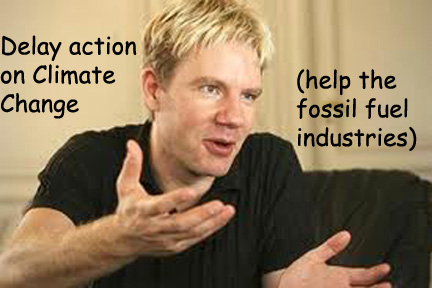
Rich fossil fuel fans funded Bjorn Lomborg’s Crentrev for Inaction on Climate Change
The Millions Behind Bjorn Lomborg’s Copenhagen Consensus Center US Think TankDeSmogBlog By Graham Readfearn • Tuesday, June 24, 2014 “………..The only income for the CCC in its first year in the US came in the form of a $120,000 grant from the New York-based Randolph Foundation. The foundation, seeded by money from the Richardson family’s sale of the Vick Chemical Company in 1985, gave CCCanother $50,000 in 2012.
The main trustee at Randolph is Heather Higgins, the president and CEO of Independent Women’s Voice and the chairman of its sister organisation Independent Women’s Forum. Higgins is the daughter of R. Randolph Richardson, a member of the family that sold Vick Chemical Company to Procter & Gamble for $1.2 billion.
Staff writers of both organisations regularly express scepticism about the science of human-caused climate change and cite Lomborg’s views approvingly.
A recent article from IWF senior fellow Vicki Alger claimed “a majority of scientists believe that global warming is largely nature-made” — ignoring several studies that show the vast majority of research from scientists studying climate change believe exactly the opposite.
IWF funders include the Claude R. Lambe Foundation, controlled by Charles Koch, and Donors Trust, a fund for conservative philanthropists that has pushed millions into organisations promoting climate science denial and fighting laws to cut greenhouse gas emissions.
Higgins is also board member at the Philanthropy Roundtable, another route for conservative philanthropy which shares two members of personnel with Donors Trust or its partner organisation Donors Capital Fund. Also on the board of trustees at Randolph is Polly Freiss, the daughter-in-law of conservative Christian businessman Foster Freiss.
Foster Freiss put more than $2 million into Republican Senator Rick Santorum’s 2012 run for his party’s nomination for the presidency. Freiss also bankrolled conservative news outlet The Daily Caller, which regularly publishes articles supporting the views of climate science denialists.
On his personal web page, Freiss promotes climate science denial sources including Climate Depot and The Heartland Institute. Friess’s website has also promoted Lomborg’s views.Foster Freiss and his daughter Polly attended the Koch brother’s secretive 2010 strategy meeting in Aspen, along with Heather Higgins and a host of other conservative activists.
The tax records of the Kansas-based Ewing Marion Kauffman Foundation indicate it has given the CCC two $150,000 grants — one in 2011 and another in 2012……..
DeSmog’s analysis of the tax records of not-for-profit groups and foundations donating to CCC accounts for only $520,000 of the total $4.3 million income of the CCC since it was launched in the US. The center’s new website makes no mention of its funding.
When so little is known about the funding for CCC, it is hard for anyone to know if Lomborg’s hope to find “unassailable” donors has come true……http://www.desmogblog.com/2014/06/25/millions-behind-bjorn-lomborg-copenhagen-consensus-center
Lack of clarity on finances of Bjorn Lomborg’s Climate Action Delaying Centre
It is unclear that Lomborg himself is a legitimate charity anywhere, but most of the money seems under his control. One might also wonder where income taxes are paid.
Perhaps with his new $4 million Australia Consensus Center (covered here, here, here) Bjorn Lomborg may pick a better site than a US shipping storefront, since he’ll receive much more taxpayer money, directly, courtesy of the Australian government. That does seem simpler
Bjorn Lomborg’s Copenhagen Consensus Center – Real Charity Or “Foreign Conduit”? DeSmogBlog By John Mashey • Sunday, April 26, 2015 Bjørn Lomborg is founder and president of the Copenhagen Consensus CenterUSA (CCC)), a tax-exempt 501(c)(3) “public charity” whose US physical presence is shown in the image: 262 Middlesex St, Lowell MA. Lomborg and the Copenhagen Consensus Center are known to DeSmog readers for efforts to downplay the importance of addressing climate change, a subset of climate science denialism that has infected the public debate across the English-speaking world.
Despite the name, it has not been based in Copenhagen since 2011. Deputy Director Roland Mathiasson remains there, but Lomborg moved to Prague in 2012. Workers seem mostly in Hungary, with a few in the US. The Board is Lomborg, Mathiasson, Scott Calahan (Ft Lauderdale) and Loretta Michaels (Washington, DC). Although some money is used for fundraising and PR in the US, much goes abroad to Mathiasson and Lomborg, who is said to travel 200 days a year.
The “real location” of CCC is unclear, and the Internal Revenue Service often cares about this with charities.
Copenhagen Consensus Center is a textbook example of what the IRS calls a “foreign conduit” and it frowns strongly on such things. It may also frown on governance and money flows like this, perhaps “inurement”:
From attached Form 990 summary, more than 60% went directly to Lomborg, travel and $853K promotion of his movie. According to Wikipedia it grossed $63K and the movie poster shows a picture of Lomborg, a light bulb and heading:
“A LIGHT BULB WON’T SOLVE GLOBAL WARMING
THIS GUY’S BRIGHT IDEAS MIGHT“
Even in a simple US charity, poor governance and obvious conflicts of interest are troublesome, but the foreign element invokes stringent extra rules. Legitimate US charities can send money to foreign charities, but from personal experience, even clearly reasonable cases like foreign universities require careful handling. It is unclear that Lomborg himself is a legitimate charity anywhere, but most of the money seems under his control. One might also wonder where income taxes are paid.
A foreign group’s creation of a US “shell” charity to gather US funds and funnel them abroad is the most obvious of “foreign conduits” in IRS parlance, #1 on its list of no-no’s. IRS revocation of 501(c)(3) status not only eliminates tax breaks for ordinary donors, but eliminates entirely crucial major gifts from private foundations like the Randolph Foundation, Ewing Marion Kauffman Foundation and the Paul E. Singer Foundation.
CCC seems to break many rules. Foreign citizen Lomborg is simultaneously CCC founder, president, and highest-paid employee. Most people are a little more subtle when trying to create conduits, as in this example, where the IRS determined someone was not eligible for 501(c)(3) status, despite various stratagems to obscure the relationships.
Perhaps with his new $4 million Australia Consensus Center (covered here, here, here) Bjorn Lomborg may pick a better site than a US shipping storefront, since he’ll receive much more taxpayer money, directly, courtesy of the Australian government. That does seem simpler…….http://www.desmogblog.com/2015/04/26/copenhagen-consensus-center-real-charity-foreign-conduit
1 This Month


Tell the Ukrainian Government to Drop Prosecution of Peace Activist Yurii Sheliazhenko

Petition to revoke the licensing of the Near Surface Nuclear Disposal Facility (NSDF) at Chalk River. https://www.ourcommons.ca/petitions/en/Petition/Details?Petition=e-7247


of the week – STOP SMALL MODULAR REACTORS IN CANADA
To see nuclear-related stories in greater depth and intensity – go to https://nuclearinformation.wordpress.com
-
Archives
- March 2026 (176)
- February 2026 (268)
- January 2026 (308)
- December 2025 (358)
- November 2025 (359)
- October 2025 (376)
- September 2025 (258)
- August 2025 (319)
- July 2025 (230)
- June 2025 (348)
- May 2025 (261)
- April 2025 (305)
-
Categories
- 1
- 1 NUCLEAR ISSUES
- business and costs
- climate change
- culture and arts
- ENERGY
- environment
- health
- history
- indigenous issues
- Legal
- marketing of nuclear
- media
- opposition to nuclear
- PERSONAL STORIES
- politics
- politics international
- Religion and ethics
- safety
- secrets,lies and civil liberties
- spinbuster
- technology
- Uranium
- wastes
- weapons and war
- Women
- 2 WORLD
- ACTION
- AFRICA
- Atrocities
- AUSTRALIA
- Christina's notes
- Christina's themes
- culture and arts
- Events
- Fuk 2022
- Fuk 2023
- Fukushima 2017
- Fukushima 2018
- fukushima 2019
- Fukushima 2020
- Fukushima 2021
- general
- global warming
- Humour (God we need it)
- Nuclear
- RARE EARTHS
- Reference
- resources – print
- Resources -audiovicual
- Weekly Newsletter
- World
- World Nuclear
- YouTube
-
RSS
Entries RSS
Comments RSS
 nuclear-news