Safety limits relaxed at Sellafield nuclear facility
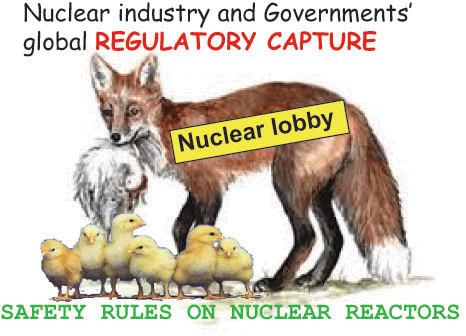 Trusting Sellafield to comply with the new operating rule to control waste stocks was like asking a fox to guard chickens,
Sellafield nuclear waste storage safety limit relaxed following accident, Guardian, Rob Edwards, 14 May 15 Amount of radioactive waste that can be kept in tanks allowed to breach legal limits to help cope with backlog caused by an accident in November 2013. Safety limits on the storage of some of the world’s most dangerous nuclear wastes at Sellafield in Cumbria have been relaxed after an accident knocked out a treatment plant.
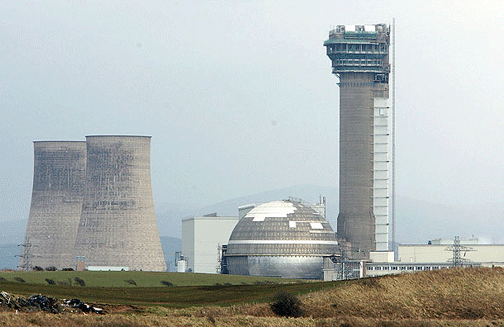
The government’s safety watchdog, the Office for Nuclear Regulation (ONR), has permitted the private company that runs Sellafield to breach legal restrictions on the amount of hot, high-level radioactive waste that can be kept in tanks. The limits are likely to be exceeded by up to 350 tonnes between April 2014 and July 2016.
Critics accused ONR of breaking their promises and putting Sellafield’s profits before safety. But ONR insisted there was “minimal hazard increase”, while Sellafield said it put safety first.
The waste storage limits, imposed in 2001, were meant to reduce stocks to below 5,500 tonnes of uranium equivalent by July 2015. The aim was to minimise the risk of a disaster spreading a plume of potentially lethal radioactive contamination over the UK and Ireland – officially regarded as Sellafield’s “worst credible accident”.
The liquid waste comes from Britain’s nuclear power stations and generates significant amounts of heat. It has to be constantly cooled and stirred to prevent it from overheating.
Sellafield asked for permission to breach the storage limits to help cope with a backlog caused by an accident in November 2013. A plant meant to solidify the waste to make it safer lost power, suffered “gross contamination” and had to be closed for 11 months.
The alternative to exceeding the storage limits was to temporarily close a nuclear fuel reprocessing plant at Sellafield that separates out the waste. But this would mean operating the plant for two or three years beyond 2018, when it is due to shut for good, placing extra strain on ageing downstream facilities, ONR said.
In a redacted report, ONR accepted that breaching the waste storage limits for 16 months would lead to a “modest increase in hazard”. But it concluded that temporarily shutting the reprocessing plant would be more risky, and so has replaced the limits with a weaker “operating rule” administered by Sellafield.
Gordon Thompson, executive director of the US Institute for Resource and Security Studies and an expert on Sellafield, pointed out that the site’s liquid high-level wastes were “one of the world’s major concentrations of radiological hazard”. He accused ONR of breaking a promise made in 2001 to halt reprocessing if necessary to ensure that waste stocks were reduced.
Reprocessing fuel from Britain’s newer reactors was “unnecessary, uneconomic, and hazardous,” he argued. “It compounds the waste problem, threatens international security, and never should have begun.”
Martin Forward, from the local anti-nuclear group, Cumbrians Opposed to a Radioactive Environment (CORE), attacked ONR for “its apparent willingness to put Sellafield’s business interests before those of health and safety”. Public confidence in the regulator’s competence would “sink to an all-time low”, he claimed.
Trusting Sellafield to comply with the new operating rule to control waste stocks was like asking a fox to guard chickens, he said. “ONR’s tight regulation of a highly hazardous nuclear industry seems to have gone out of the window.”…….
Sellafield, run by a company involving three multinationals, Amec, Areva and URS, strongly denied that it put business before safety. ………http://www.theguardian.com/environment/2015/may/14/sellafield-nuclear-waste-storage-safety-limit-relaxed
No comments yet.
1 This Month

of the week – Shut Down Drone Warfare!


Tell the Ukrainian Government to Drop Prosecution of Peace Activist Yurii Sheliazhenko

Petition to revoke the licensing of the Near Surface Nuclear Disposal Facility (NSDF) at Chalk River. https://www.ourcommons.ca/petitions/en/Petition/Details?Petition=e-7247
To see nuclear-related stories in greater depth and intensity – go to https://nuclearinformation.wordpress.com
-
Archives
- April 2026 (7)
- March 2026 (251)
- February 2026 (268)
- January 2026 (308)
- December 2025 (358)
- November 2025 (359)
- October 2025 (376)
- September 2025 (257)
- August 2025 (319)
- July 2025 (230)
- June 2025 (348)
- May 2025 (261)
-
Categories
- 1
- 1 NUCLEAR ISSUES
- business and costs
- climate change
- culture and arts
- ENERGY
- environment
- health
- history
- indigenous issues
- Legal
- marketing of nuclear
- media
- opposition to nuclear
- PERSONAL STORIES
- politics
- politics international
- Religion and ethics
- safety
- secrets,lies and civil liberties
- spinbuster
- technology
- Uranium
- wastes
- weapons and war
- Women
- 2 WORLD
- ACTION
- AFRICA
- Atrocities
- AUSTRALIA
- Christina's notes
- Christina's themes
- culture and arts
- Events
- Fuk 2022
- Fuk 2023
- Fukushima 2017
- Fukushima 2018
- fukushima 2019
- Fukushima 2020
- Fukushima 2021
- general
- global warming
- Humour (God we need it)
- Nuclear
- RARE EARTHS
- Reference
- resources – print
- Resources -audiovicual
- Weekly Newsletter
- World
- World Nuclear
- YouTube
-
RSS
Entries RSS
Comments RSS
 nuclear-news
Leave a comment