Amid the arms race, growing public revulsion for nuclear weapons
“Nuclear weapons are incompatible with the values upheld by our respective faith traditions — the right of people to live in security and dignity; the commands of conscience and justice; the duty to protect the vulnerable and to exercise the stewardship that will safeguard the planet for future generations. Nuclear weapons manifest a total disregard for all these values and commitments. There is no countervailing imperative — whether of national security, stability in international power relations, or the difficulty of overcoming political inertia — that justifies their continued existence, much less their use.”
 Nuclear nations meet at UN amid growing support for disarmament, National Catholic Reporter Thomas C. Fox | May. 7, 2015 This is the first of a two-part series.
As world leaders at the United Nations attempt to negotiate a pathway to further nuclear disarmament, it is reasonable to ask: With nuclear powers holding to their arsenals as a means to deterrence and with nuclear technology spreading, is global disarmament still possible?
By most reports, the mood at the monthlong U.N. Nuclear Non-Proliferation Treaty talks being held in New York is somber. Few expect breakthroughs, and without a breakthrough, serious disarmament is in doubt.
Some background: Seventy-five years ago this August, the United States dropped atomic bombs on the Japanese cities of Hiroshima and Nagasaki. Death toll estimates vary, from 100,000 to more than double that number. Those bombings remain the only use of nuclear weapons in warfare.
Twenty-five years later, in 1970, amid a costly nuclear arms race between the superpowers and with the nuclear genie spreading, world leaders called into effect the Nuclear Non-Proliferation Treaty (NPT). Continue reading
The new “modern” nuclear arms race between USA and Russia
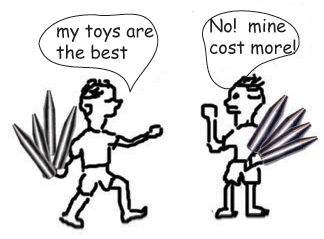 Russia and the US are racing to modernize their nuclear forces http://www.businessinsider.com.au/russia-and-the-us-are-racing-modernize-their-nuclear-forces-2015-5 JEREMY BENDER The Kremlin has embarked on a process to update all of its nuclear warheads and launch systems.
The modernization effort will affect all of Russia’s strategic and nonstrategic nuclear weapons — a total of 4,500 warheads, the Bulletin of Atomic Scientists reports. The modernization process includes the replacement of Soviet-era intercontinental ballistic missiles (ICBMs) with new rocket launch systems.
Also included in the modernization push is the development and launch of an upgraded Borei-class ballistic missile submarine. Within the coming decade, Moscow plans to replace two older ballistic missile submarine classes with the newly updated Borei. The new variant will feature improved electronics, among other modifications.
Russia is not alone in wanting to upgrade its nuclear forces. The US also wants to modernize its nuclear weapons and launch platforms with the express aim of making its arsenal more efficient without having to acquire new warheads.
“[W]hile we haven’t deployed major new strategic systems in some time, we’ve been modernising the ones we’ve got more or less continuously — new rocket motors and guidance systems for the Minuteman missiles, lots of rebuilt parts for the B-52s, etc., etc.,” Matthew Bunn, a nuclear proliferation expert at Harvard, told Politifact.
In total, the US modernization plans are estimated to cost a total of $US348 billion over the coming decade,accordingto estimates from the Congressional Budget Office.
However, the total bill could rise to as much as $US1 trillion over the following three decades thanks to upkeep costs, a report from the James Martin Center for Nonproliferation Studiesestimates.
This process of modernization is triggering what John Mecklin, the editor of The Bulletin of Atomic Scientists, calls a “different kind of arms race.”
“It’s one in which technological advance is the race,” Mecklin told the BBC. “Nuclear countries are trying to make sure that the other nuclear countries don’t get some sort of technological edge.”
This modernization drive has no resulted in matching efforts within the US and Russia. Just as Russia is modernising its arsenal of ICBMs and ballistic missile submarines, the US is also replacing its nuclear triad with new missiles, submarines, and a next-generation bomber.
Germany becoming a super power, with the success of its renewable energy
Germany, the Green Superpower Thomas L. Friedman, NYT MAY 6, 2015 BERLIN — A week at the American Academy in Berlin leaves me with two contradictory feelings: one is that Germany today deserves a Nobel Peace Prize, and the other is that Germany tomorrow will have to overcome its deeply ingrained post-World War II pacifism and become a more serious, activist global power. And I say both as a compliment.
On the first point, what the Germans have done in converting almost 30 percent of their electric grid to solar and wind  energy from near zero in about 15 years has been a great contribution to the stability of our planet and its climate. The centerpiece of the German Energiewende, or energy transformation, was an extremely generous “feed-in tariff” that made it a no-brainer for Germans to install solar power (or wind) at home and receive a predictable high price for the energy generated off their own rooftops.
There is no denying that the early days of the feed-in tariff were expensive. The subsidies cost billions of euros, paid for through a surcharge on everyone’s electric bill. But the goal was not simply to buy more renewable energy: It was to create demand that would drive down the cost of solar and wind to make them mainstream, affordable options. And, in that, the energiewende has been an undiluted success. With price drops of more than 80 percent for solar, and 55 percent for wind, zero-carbon energy is now competitive with fossil fuels here.
In my view the greatest success of the German energy transition was giving a boost to the Chinese solar panel industry,” said Ralf Fücks, the president of the Heinrich-Böll-Stiftung, the German Green Party’s political foundation. “We created the mass market, and that led to the increased productivity and dramatic decrease in cost.” And all this in a country whose northern tip is the same latitude as the southern tip of Alaska!

This is a world-saving achievement. And, happily, as the price fell, the subsidies for new installations also dropped. The Germans who installed solar ended up making money, which is why the program remains popular, except in coal-producing regions. Today, more than 1.4 million German households and cooperatives are generating their own solar/wind electricity. “There are now a thousand energy cooperatives operated by private people,” said the energy economist Claudia Kemfert. Continue reading
Scientists investigate effects of Fukushima radiation on Pacific Ocean animals
 US university testing animals in Pacific for Fukushima radiation — Photos show bodies riddled with tumors, eyes bleeding, covered in lesions — Some are missing testicles, eyeballs — Skin disintegrating, peeling off, turning yellow — Mammals affected by diseases never seen in species (WARNING: Graphic Pics)http://enenews.com/university-testing-animals-pacific-fukushima-radiation-gruesome-photos-show-bodies-riddled-massive-tumors-cysts-bleeding-eyes-covered-lesions-missing-testicles-eyeballs-skin-disintegrating-pe?utm_source=feedburner&utm_medium=email&utm_campaign=Feed%3A+ENENews+%28Energy+News%29
Colorado St. Univ., Apr 13, 2015 (emphasis added): CSU partners with Fukushima University to study radiation effects… Many CSU faculty and researchers are contributing to radiation research in Japan… including Thomas Johnson… professor of health physics, who is testing trace radiation samples in seal populations in thenorthern Pacific Ocean, where radiation from the Fukushima disaster was released.
Alaska Marine Science Symposium presentation, Raphaela Stimmelmayr (Dept. of Wildlife Management, North Slope Borough) & Gay Sheffield (Univ.of Alaska – Fairbanks Marine Advisory Program), 2014:
Incidental Gross Necropsy Findings in Subsistence-Harvested Ice Seals and Walruses
• Reproductive system: adnexal cysts [uterus], uterine and penile melanosis [darkening of skin], cliteromegaly [enlarged clitoris], cryptorchism [testicle(s) absent from scrotum], retained placenta;
• Endocrine system: thyroid cysts, adrenal nodules;
• Musculoskeletal system: synovial cyst [fluid-filled sacs in spine due to degeneration];
• Integumentary system: panniculitis [inflammation of fatty tissue], epidermal molt, skin sloughing;
• Respiratory system: lung tumor, parasitic granulomas [inflammation that forms when immune system is unable to eliminate a substance];
• Digestive system: microdontia [teeth smaller than normal], chronic interstitial pancreatitis [inflammation of pancreas], hepatic cyst [liver], cholestatic jaundice [yellowing of skin caused by thickening of bile or problems in liver], geophagia [eating dirt], and primary diffuse peritoneal tumor [membrane lining abdomen];
• A variety of the observed disease conditions are reported for the first time in ice seals and/or walruses.
• The majority of observed conditions in our material is classified as benign and are mostly inconsequential to the health of the harvested animals.
Areva’s nuclear fuel reprocessing plant in La Hague in crisis- shunned by clients
 Crisis for Areva’s La Hague plant as clients shun nuclear, News Daily May 6, 2015 EMMANUEL JARRY FOR REUTERS BEAUMONT-HAGUE, France – Areva’s nuclear fuel reprocessing plant in La Hague needs to cut costs as its international customers disappear following the Fukushima disaster, and its sole remaining big customer, fellow state-owned French utility EDF, pressures it to cut prices.
Located at the westernmost tip of Normandy, La Hague reprocesses spent nuclear fuel for reuse in nuclear reactors and is a key part in Areva’s production chain, which spans uranium mining to fuel recycling.
Its valuation and outlook are crucial for the troubled French nuclear group, which is racing to find an equity parter after four years of losses have virtually wiped out its capital……….
One of the world’s biggest nuclear waste storage facilities, La Hague’s four pools hold the equivalent of about 50 reactor cores under four meters of water.
Protected by 1.5 meter thick anti-radiation concrete walls, employees in space suits cut up spent nuclear fuel rods, extract uranium and about one percent of plutonium, and melt the remaining waste into glass for eventual deep storage.
Areva says reprocessing reduces natural uranium needs by 25 percent but opponents say that separating plutonium from spent nuclear fuel increases the risk of nuclear proliferation.
The United States does not reprocess its nuclear fuel, but Britain has a large reprocessing plant in Sellafield. A planned recycling plant in Rokkasho, Japan – modeled on La Hague – has been plagued by problems and is years behind schedule.
Since the 2011 nuclear disaster in Fukushima, Areva’s reprocessing unit has lost nearly all of its international customers.
The company’s “back-end” sales – which include reprocessing, logistics and decommissioning – have fallen to 1.53 billion euros in 2014, 18 percent of Areva’s turnover, from 2 billion euros, 30 percent of nuclear revenue, in 2004.
EDF SQUEEZE
In the past decades, more than 32,000 tonnes of spent nuclear fuel has been reprocessed at La Hague, of which nearly 70 percent for EDF, 17 percent for German utilities, nine percent for Japanese utilities and the rest for Swiss, Belgian, Dutch and Italian clients.
This year, La Hague expects to treat 1,205 tonnes of spent fuel, of which just 25 tonnes will come from abroad. That leaves Areva with EDF virtually as its sole customer, and although both firms are state-owned – Areva 87 percent, EDF 85 percent – EDF has played hardball in contract negotiations.
La Hague extracts plutonium from used nuclear fuel, which it then sends to Areva’s Melox plant in southeast France, which produces MOX fuel – a mixture of plutonium and spent uranium – for 22 (soon 24) of EDF’s 58 reactors.
The arrival of new management at both companies since the start of the year has ended years of hostility between France’s two nuclear champions, but a 6.5 billion euro contract to treat and recycle 1,100 tonnes per year of EDF’s spent fuel for the 2013-2020 period has still not been signed…………http://newsdaily.com/2015/05/crisis-for-arevas-la-hague-plant-as-clients-shun-nuclear/
Moves to solve Ukrainian crisis undermined by USA’s Senate Armed Services Committee

 How the Senate Armed Services Committee is Undermining Minsk II, Helen Caldicott M.D. by Ricky Onsman on May 6, 2015 By James Carden, The Nation, April 30, 2015
On April 28 three European foreign ministers—Serbia’s Ivica Dačić, Germany’s Frank-Walter Steinmeier and Switzerland’s Didier Burkhalter—met in their capacities as members of the OSCE’s Ministerial Troika to discuss the latest developments in eastern Ukraine. According to the OSCE, the foreign ministers “reiterated that [the Ukraine] crisis can be resolved only through peaceful means and that the political process in that regard should be advanced without delay” and “called on all sides to fully and unconditionally respect the cease-fire.”
Meanwhile, on April 26, Financial Times reported that Kiev is coming under increased pressure from Western European capitals to do its part to implement the Minsk cease-fire agreement. According to FT, German diplomats expressed frustration that Kiev is “dragging its feet” in implementing the agreement. For his part, French President Françl;ois Holland has warned Ukrainian President Petro Poroshenko that “the only line of conduct is the full implementation of the Minsk accord.”
Yet it seems these calls for a peaceful solution to the crisis are not only falling on deaf ears, but are also purposefully being undermined, in Washington.
To wit: the same day the aforementioned troika met in Belgrade, the 28th, the Senate Armed Services Committee held a hearing on “United States Security Policy in Europe,” though perhaps, given the tenor of the hearing, it should have been held under the rubric “The Russians are Coming!”
Armed Services Committee Chairman, Senator John McCain (R-AZ), got right to the point, running down a list of Russia’s sins—real and imagined. He derided the Obama administration’s “so-called reset” policy and warned of Mr. Putin’s “neo-imperial objectives.” McCain accused Russia of violating the Minsk II cease-fire agreement and hectored NATO allies to follow the example of Poland and Estonia and increase its defense expenditures. Unbelievably, McCain closed his remarks by telling the gallery, which included a visiting delegation of Ukrainian parliamentarians, that “none of us wants to return to the Cold War.”
Depressingly, there seemed to be little daylight between McCain and the committee’s ranking member, Senator Jack Reed (D-RI). Both he and McCain have called on President Obama to “provide defense lethal assistance” to Ukraine. Only Senators Angus King (I-ME) and Joe Manchin (D-WV) expressed any skepticism towards the idea of sending lethal aid to Ukraine. The situation that pertains in the Washington of 2015, is in stark contrast to the previous Cold War. Today, it would seem, Democrats and Republicans are engaged in a contest of who can ‘out-hawk’ the other on Russia………..
it is hard, given the tenor of the policy discussion on Capitol Hill over the past week, to escape the conclusion that President Obama is under intense pressure—not only from both political parties, but also, disturbingly, from the NATO supreme allied commander—to wade ever deeper into the Ukrainian morass.
Originally published at http://www.thenation.com/article/205921/how-senate-armed-services-committee-undermining-minsk-ii http://www.helencaldicott.com/how-the-senate-armed-services-committee-is-undermining-minsk-ii/
AREVA’s woes heralding a slippery global slope for the nuclear industry?
 French Nuclear Dynamo Stalls, NYT, By DAVID JOLLY and STANLEY REEDMAY 7, 2015 PARIS — For decades, France has been a been a living laboratory for atomic energy, getting nearly three-quarters of its electricity from nuclear power — a higher proportion by far than in any other country.
But in the last few years, the French dynamo has started to stall. New plants that were meant to showcase the industry’s most advanced technology are years behind schedule and billions of euros over budget. Worse, recently discovered problems at one site have raised new doubts about when, or even if, they will be completed……..
Alarmed by the French industry’s problems, the Socialist government of President François Hollande is expected soon to announce an industry overhaul. As the majority owner of the country’s two main nuclear companies — the reactor maker Areva and the big utility operator Électricité de France — the government will aim not only to put the companies on a firmer financial footing but to reorganize them in hopes of restoring the French industry’s role-model luster.
On Thursday, Areva took the first of those steps by announcing big cost-cutting plans. The move is likely to trim as many as 6,000 jobs from the company’s global work force of 45,000 — as many of 4,000 of those coming in France……….
With the French companies struggling, some nuclear experts see a slippery geopolitical slope. Continue reading
Australia’s cowardly and duplicitous stance on nuclear Non-Proliferation Treaty
Australia’s disarmament double-speak at the nuclear Non-Proliferation Treaty Review Conference 2015
| Online opinion By Gem Romuld – 7 May 2015 Despite being close in name, the gap between Australia and Austria on the issue of nuclear disarmament is stark. Austria is at the forefront of a global push to stigmatize, ban and eliminate nuclear weapons, whereas Australia is leading efforts to undermine this push.
During the first week of the nuclear Non-Proliferation Treaty Review Conference, currently underway in New York, the Australian Ambassador to the United Nations, Ms Gillian Bird, delivered a statement expressing concern that 45 years since the NPT entered into force, “some 16,000 nuclear warheads still exist”. But she dismissed the “call for a treaty banning nuclear weapons”, and stated Australia’s support for “practical, realistic measures to achieve actual nuclear disarmament”. Elaboration on these unambitious measures was saved for the 26-nation Statement on the Humanitarian Consequences of Nuclear Weapons, not to be confused with the much stronger Austrian-led 160-nation Joint Statement on the Humanitarian Consequences of Nuclear Weapons. Both ‘humanitarian statements’ acknowledged the renewed focus on the humanitarian impacts of nuclear weapons, catalysed by the three conferences that have been held on the subject since February 2013 by the Norwegian, Mexican and Austrian Governments. The Austrian-led statement said that the “humanitarian focus is now well established on the global agenda” and affirmed that “the only way to guarantee that nuclear weapons will never be used again is through their total elimination”. The Australian-led statement claims there are “no short cuts”, implying that the slow, and thus far ineffective, steps to disarmament are the only way to reach a world without nuclear weapons. Acknowledgement of the survivors of nuclear testing, including in Australia, was disappointingly absent, despite the moving testimonygiven before 158 nations by Kokatha-Mula woman Sue Coleman-Haseldine at the Vienna Conference on the Humanitarian Impact of Nuclear Weapons last December. |
US Senate passes Bill to give Congress a stake in nuclear deal with Iran
S enate Passes Bill to Review Iran Nuclear Deal Maya Rhodan @m_rhodan TIME, 7 May 15 Bill to give Congress oversight of the nuclear plan passes Senate
Republicans and some Democrats in Congress have been pushing for oversight of the pending deal given that current proposals include relief from some of the sanctions placed on Iran by Congress. The bill that passed Thursday requires that Congress be able to review and possibly reject any deal the U.S. and world powers make with Iran regarding nuclear weapons. If Congress approves of the deal — or fails to disapprove within a certain timeframe — the President’s deal can move forward……
While the debate continues, however, some lawmakers have signaled their support for the President’s negotiations with Iran. In a letter first reported on by the Washington Post, 150 Democrats urged Obama to “stay on course” and commended the work of world powers so far in the process.
“The stakes are too great and the alternatives are too dire,” the letter reads. “If the United States were to abandon negotiations or cause their collapse, not only would we fail to peacefully prevent the nuclear-armed Iran, we would make that outcome more likely.”
The Washington Post reports that the letter could mean the President has enough Congressional support to override a veto should lawmakers vote to reject the deal once it is released in June. http://time.com/3850806/congress-iran-nuclear-deal/
Saudi Arabia mulling plans for nuclear weapons
RIYADH—The nuclear deal that the U.S. and other world powers hope to reach with Iran would put a 10-year curb on the Islamic republic’s nuclear program. For some of Iran’s regional rivals, that is also becoming a deadline for developing nuclear arms of their own.
In Saudi Arabia, there are widespread public calls to match Iran’s nuclear quest. The two other Middle East heavyweights, Turkey and Egypt, could also feel compelled to follow suit, senior Western and Arab officials warn.
Such an arms race would further destabilize what is already the world’s most volatile region, where the risks of a nuclear war would be compounded by the threat of radioactive material falling into the hands of terrorist groups……..http://www.wsj.com/articles/saudi-arabia-considers-nuclear-weapons-to-offset-iran-1430999409
The nuclear danger powder keg that no one mentions – Pakistan

 The Nuclear Crisis Nobody Mentions Huffington Post George Kenney 05/07/2015 Those congressmen beating the war drums against Iran have reached new heights of hypocrisy considering their total disregard for the more dangerous, more immediate problems created by Pakistan’s nuclear arsenal. It is noteworthy and also downright strange that no one else–from any political persuasion–is paying attention.
The trouble is, Pakistan may become a failing state. We can’t know this for certain. The fact, however, that the possibility can be raised gives pause. A failing state with over a hundred nuclear weapons, building more as fast as it can, miniaturizing new weapons, and having perpetually hostile relations with its neighbor, India, also a nuclear power, presents risks far beyond regional security.
How, for example, should the world respond to a state that proliferates nuclear weapons but denies doing so and that might not even be able to control its proliferation? As a count of its nuclear arsenal edges toward several hundred, and as it increasingly deploys tactical nuclear weapons near its border, Pakistan’s government faces extraordinary challenges of command and control.
Hypothetically, suppose that during a future crisis with India a failing Pakistani government delegates control over tactical nuclear weapons to dozens of forward commanders. Suppose further one or two weapons are ‘lost.’ Conceivably, nobody we consider to be in authority would know what had happened, or would admit knowing. If later on a terrorist group obtained such a weapon they would attempt to detonate it. A smallish nuclear artillery shell, for example, could be sailed up the Thames to London on a yacht.
The point is, if Pakistan starts to ‘lose’ nuclear weapons the world has no ready response…………….
To hazard a more intuitive guess, bluster over Iran comes cheap whereas disarming Pakistan is the real deal. And if negotiations didn’t work does America go to war over the potential threat? A war that devastates Pakistan could be the result. Yet without diplomacy the very same war, the one the establishment doesn’t expect, could be the one we can’t avoid. Maybe it isn’t so surprising after all that we don’t talk about the stuff of nightmares.
It’s never too late for diplomacy but it’s imprudent to cut it so close. http://www.huffingtonpost.com/george-kenney/the-nuclear-crisis-nobody_b_7229122.html
Up to 592 Trillion Bq of Plutonium equivalent involved in disaster at US nuclear dump
 Gov’t Analysis: Up to 592 Trillion Bq of Plutonium equivalent involved in disaster at US nuclear dump – Over 5,000 times amount in waste drum blamed for WIPP release — Official: “We thought for sure” there were multiple ruptured drums — “It actually was measured” in city many miles away (VIDEO) http://enenews.com/govt-analysis-592-trillion-becquerels-involved-release-nuclear-dump-5000-times-waste-drum-being-blamed-wipp-disaster-official-thought-sure-multiple-ruptures-actually-measured-city-many-miles-aw?utm_source=feedburner&utm_medium=email&utm_campaign=Feed%3A+ENENews+%28Energy+News%29
DOE Town Hall in Los Alamos on WIPP Leak Findings (mp3), Apr 23, 2015 (emphasis added):
- Question (at 1:43:15 in): So you’ve come up with an amount that you think was in the drum, and you’ve been able to forensically track that. The underground is pretty contaminated at this point, the walls are contaminated, the filters are contaminated — andit actually was measured in Carlsbad 30 miles away. So that’s a significant quantity of plutonium or other isotopes. How is that quantity matching with what is in the drum?
- Ted Wyka, US Dept. of Energy Chief Nuclear Safety Advisor and chairman of DOE’s Accident Investigation Board: You’re right, any release is obviously too much. We do have hundreds of surveys… We think we have a pretty good source term calculation to the extent that we need to identify it as one drum…
- Question: I don’t feel like that answers my question, which is of course is your job, right?… There’s so much plutonium, americium, or whatever those secret ingredients were, and now it’s spread all over in a layer and it’s leaked into the air — what is that quanity?…
- Wyka (at 1:49:15 in): Does that mean there’s no other sympathetic secondary releases from other drums? I can’t tell you that.
U.S. DOE Accident Investigation Board (AIB) Report Phase 2, Radiological Release at WIPP(pdf), Apr 2015: The inventory in drum 68660 [was] 2.84 PE-Ci [plutonium equivalent curies]… Source terms initially released in Panel 7 Room 7 [is estimated at] 2 to 10 PE-Ci.
Savannah River National Laboratory WIPP Source Term Attribution Analysis (pdf), Aug 2014:
> ESTIMATES OF TOTAL INVENTORY OF ACTIVITY INVOLVED
- Source Term (ST) = MAR [Material at Risk] x DR [Damage Ratio] x ARF [Airborne Release Fraction] x RF [Respirable Fraction]
- Assume a 2 Ci release from Room 7 based on assessment from previous slide
- Bounding Case 1… MAR = ST / (DR x ARF x RF) = 2 Ci / 0.5 x 0.0005 x 0.5 = 16,000 Ci[592,000,000,000,000 becquerels]
- Bounding Case 2… MAR = ST / (DR x ARF x RF) = 2 Ci / 0.5 x 0.01 x 1.0 = 400 Ci
Note the AIB reports the total inventory of activity in drum 68660 was 2.84 Ci. SRNL’s estimate of total inventory of activity involved was 400-16,000 Ci (141-5,634 times drum 68660 inventory).
This may explain Wyka’s statement at the Carlsbad town hall, “We went in thinking there’s another drum…We thought for sure we’d see something. Most of the analysis team thought so.”
Lake Huron is NOT the answer to Canada’s nuclear waste problem- Dr. Benishek
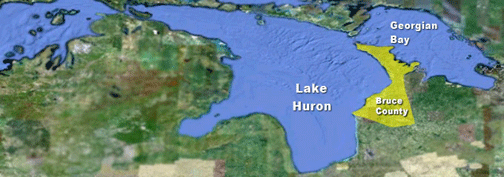 Dr. Benishek: Canada’s plan to store nuclear waste near Great Lakes unacceptable http://www.upnorthlive.com/news/story.aspx?id=1201537#.VUvfhY6qpHw 05.07.2015WASHINGTON D.C. –– More than seven million cubic feet of nuclear waste could be stored in less than a half of mile from Lake Huron.
A joint Review Panel in the Canadian government gave favorable recommendation Thursday on a proposal to place a permanent, underground, nuclear waste storage facility.
“The recommendation by the Canadian Joint Review Panel to approve a plan to bury waste from nuclear power plants less than a mile from Lake Huron is unacceptable,” said Dr. Benishek. “While I support the need to find long term storage solutions for nuclear waste, burying waste this close to the Lake Huron is not the answer. The Great Lakes play a tremendous role in our economy and way of life here in Northern Michigan and we must remain stewards of this natural resource. I am please there is bipartisan support in the House that is opposed to Canada’s plan, and I will continue to work with my colleagues to ensure that there is not permanent storage of nuclear waste in the Great Lakes Basin.”
6,000 employees of failing nuclear giant AREVA are to lose their jobs
French nuclear group Areva to cut up to 6,000 jobs worldwide, Yahoo 7 News May 8, 2015,
Paris (AFP) – French nuclear group Areva, which incurred massive losses last year, announced Thursday it would cut up to 6,000 jobs worldwide as it seeks to slash its costs by a billion euros by 2017. he number of job cuts will be between 5,000 and 6,000 worldwide, said the group’s human resources director Francois Nogue.Between 3,000 and 4,000 of the job losses will be in France.
Areva had earlier said it planned to reduce its labour costs by around 15 percent in France and 18 percent internationally.
The group’s labour costs currently come to between 3.5 billion and 4.0 billion euros — an unsustainable level given that revenues are only about twice that, said Nogue………….https://au.news.yahoo.com/a/27700325/french-nuclear-group-areva-to-cut-up-to-6-000-jobs-worldwide/
South Asia likely to have a non nuclear future
In spite of the enormous political clout of South Asia’s nuclear authorities and the hold they have in moulding public attitudes, in the long run the demise of nuclear fission power production globally is likely.
With abundant sun and wind, South Asia has only begun its travel towards renewables. Cheaper by the day, small decentralised solar and wind units offer the best option for urban and village households.
Why South Asia needs a non-nuclear future , Sci Dev Net, 7 May 15
- Nuclear energy’s share of global energy production dwindled to 10 per cent in 2013
- Pakistan plans to install two 1,100 megawatt reactors in Karachi, a city of 20 million
- Expansion of solar and wind energy can hasten the decline of nuclear energy
- Risky nuclear energy can be replaced by safer and cheaper options in South Asia, writes Pervez Hoodbhoy.Considered risky by increasing numbers of people, nuclear energy is now no longer the eagerly sought panacea to the world’s energy problems. From its all-time high of 17 per cent in 1995, its share of world production dwindled to 10 per cent in 2013. The Fukushima nuclear disaster, even more than Chernobyl, has left Japan and most western countries deeply worried and suspicious. Japan’s 48 reactors remain shut, about 120,000 people are homeless, and the three reactors that experienced core meltdowns are still in deep crisis. They will need another 30—40 years to fully decommission.Some developing countries are also losing their former enthusiasm. Post-Fukushima, Indonesia’s civil society insisted that the country’s nuclear electricity programme be scaled back. Its demands were largely met. So, why has it been difficult for public opinion to compel any Pakistani or Indian government to similarly change course?
Opaque programmes The reason is clear. Both countries used opaque civilian nuclear programmes to make nuclear weapons, which then became objects of national veneration and symbols of power. Shrouded in secrecy, nuclear establishments became a force in their own right. They were not subject to any significant scrutiny of safety aspects. Nor did they feel the need to reveal their plans for disaster management or prove their adequacy. While environmental impact mitigation schemes became legally necessary, these were not to be taken seriously. No attempts were made to educate populations near a reactor about radiation hazards. Continue reading
1 This Month



Tell the Ukrainian Government to Drop Prosecution of Peace Activist Yurii Sheliazhenko

Petition to revoke the licensing of the Near Surface Nuclear Disposal Facility (NSDF) at Chalk River. https://www.ourcommons.ca/petitions/en/Petition/Details?Petition=e-7247


of the week – STOP SMALL MODULAR REACTORS IN CANADA
To see nuclear-related stories in greater depth and intensity – go to https://nuclearinformation.wordpress.com
-
Archives
- March 2026 (212)
- February 2026 (268)
- January 2026 (308)
- December 2025 (358)
- November 2025 (359)
- October 2025 (376)
- September 2025 (258)
- August 2025 (319)
- July 2025 (230)
- June 2025 (348)
- May 2025 (261)
- April 2025 (305)
-
Categories
- 1
- 1 NUCLEAR ISSUES
- business and costs
- climate change
- culture and arts
- ENERGY
- environment
- health
- history
- indigenous issues
- Legal
- marketing of nuclear
- media
- opposition to nuclear
- PERSONAL STORIES
- politics
- politics international
- Religion and ethics
- safety
- secrets,lies and civil liberties
- spinbuster
- technology
- Uranium
- wastes
- weapons and war
- Women
- 2 WORLD
- ACTION
- AFRICA
- Atrocities
- AUSTRALIA
- Christina's notes
- Christina's themes
- culture and arts
- Events
- Fuk 2022
- Fuk 2023
- Fukushima 2017
- Fukushima 2018
- fukushima 2019
- Fukushima 2020
- Fukushima 2021
- general
- global warming
- Humour (God we need it)
- Nuclear
- RARE EARTHS
- Reference
- resources – print
- Resources -audiovicual
- Weekly Newsletter
- World
- World Nuclear
- YouTube
-
RSS
Entries RSS
Comments RSS
 nuclear-news