Large amount of radioactive cesium in Fukushima water purification center
 Nearly 6,000 Bq/kg of Cs-134/137 detected from melted slag of water purification center in Fukushima Fukushima Diary, On 4/30/2015, Fukushima prefectural government announced 5,645 Bq/Kg of Cesium-134/137 was detected from melted slag of a water purification center.
The sampling date was 3/12/2015. Because it contains 1,383 Bq/Kg of Cs-134, it is certainly from Fukushima nuclear plant.
The second highest reading of this March was 3,786 Bq/Kg. This water purification center is located in Koriyama city.
Cs-134/137 have been measured from melted slag of this purification center everyday since the beginning of this year…….http://fukushima-diary.com/2015/05/nearly-6000-bqkg-of-cs-134137-detected-from-melted-slag-of-water-purification-center-in-fukushima/
370 Billion Bq of Plutonium equivalent may have escaped from WIPP
Gov’t: Radioactive release “orders of magnitude” worse than predicted at US nuclear dump — 370 Billion Bq of Plutonium equivalent may have escaped from WIPP drum during “thermal runaway” & multiple fires — For amount to be that high, a “significant number” of breached drums is expected (VIDEO) http://enenews.com/govt-actual-radioactive-release-nuke-dump-orders-magnitude-predicted-370-billion-bq-plutonium-equivalent-escaped-wipp-drum-significant-number-nuclear-waste-containers-expected-be-breached-amount?utm_source=feedburner&utm_medium=email&utm_campaign=Feed%3A+ENENews+%28Energy+News%29
Sante Fe New Mexican, Apr 23, 2015 (emphasis added): The head of a team of federal investigators [said] he’s not certain whether more than one drum of nuclear waste contributed to contamination of [WIPP]… The reaction pushed temperatures inside the container to nearly 1,600 degrees, ripping open the drum and scattering radioactive material thatbreached not only the fortified room that held the waste, but WIPP itself, which was designed to never leak… [Officials] would not rule out minor seepage from other drums.
U.S. DOE Accident Investigation Report Phase 2, Radiological Release at WIPP, Apr 2015:
6.4.1 Analysis Summary
- The radiological release… resulted from an exothermic reaction that led to a thermal runaway in drum 68660 [that] exhibited the following fire behaviors: Expanding flame front of material expelled from drum… Ignition of exposed combustibles… Propagation within the waste array by flame impingement… Melting and burning of exposed plastics.
- The combustibles external to the waste containers were ignited… direct fire effectswere limited to Rows 8 through 18… there were multiple small fires that caused direct flame impingement on several waste packages… the fire… caused the migration of contamination throughout Panel 7 [and] significant fire damage.
- A thermal runaway is characterized as a very rapid temperature rise within the container… [This] ultimately… led to failure of the lid… permitting a rapid release of combustible gases and combustible solids.
7.1 Accident Scenarios and Source Term Evaluation
- Source term at Station A should be 10 to 100 times lower than the source term in Panel 7 Room 7… Station A source term is estimated [at] 0.1 plutonium equivalent curies (PE-Ci).
- DOE-STD-5506-2007… recommends a bounding estimate of 1E^-4 ARF [0.0001 Airborne Release Fraction] for a drum over-pressurization without a fire… This release estimate, when applied to the… drum inventory of 2.84 PE-Ci, results in an initial source term released to the room of 2.8E^-4 PE-Ci [0.000284 PE-Ci]… less than 1 percent of the 0.1 PE-Ci source term at Station A.
- The chemical reaction resulting in over-pressurization of the drum described above is similar to the… evaluation of a drum deflagration from hydrogen buildup from radiolysis which assumes burning of material expelled from the drum and a contained burning of material remaining within the drum… [The modeled] release estimate from a drum deflagration is about 3 percent of the 0.1 PE-Ci source term at Station A… the actual amount of material released as measured at Station A was larger than the amount predicted… by almost two orders of magnitude… For either the drum over-pressurization or drum deflagration scenarios discussed above, a much greater airborne source term is possible if the nitrate salts behaved as a combustible dust ignited in air or if a greater fraction of material were ejected and burned.
- The 0.1 PE-Ci source term at Station A can be divided by the range of 0.01 to 0.05 LPFs [Leakpath Factor] to estimate the range of source terms initially released… This results in a range of 2 to 10 PE-Ci [74 to 370 billion Bq] airborne in the room… [I]nventory in drum 68660 [was] 2.84 PE-Ci.
- If drum 68660 released a source term as modeled… a significant number of waste containers would be expected to be breached to cause the 2 to 10 PE-Ci source term estimate… Based on the above estimates… release fractions and deposition in the underground, indicated the release from drum 68660 alone was much larger than what would be modeled… [T]he source term evaluation, using conventional release modeling assumptions, could not conclusively affirm that container 68660 was the sole contributor to the release.
Finland’s very misguided nuclear obsession
The Finnish politicians have apparently not learned anything from Hiroshima, Nagasaki, Chernobyl, and Fukushima.
OL4 appears, thankfully, to have been shelved for the time being. But OL3, one of the ten most expensive construction projects in the world and beset by delays and astronomical costs, could end up as the world’s biggest nuclear mausoleum.
The Fennovoima project, however is still going ahead. But an active citizens’ movement has come together to oppose it, and they may yet succeed.
Finland’s new government (not yet appointed at the time of writing) will have the decision in its hands, as they will have to decide about the construction permit application that Fennovoima is to submit in July this year.
Petition: ‘Stop the Nuclear power plant in Pyhäjoki built by Fennovoima!‘
 Russian roulette? Finland’s inexplicable nuclear obsession, Ecologist Ulla Klötzer
1st May 2015 Does Finland suffer from a nuclear death wish? So it seems, writes Ulla Klötzer. Its government responded to the world’s two greatest nuclear disasters by … ordering a new nuclear plant. And as the Olkiluoto nuclear project descended into face and litigation over a disputed €5 billion, they resolved to build two more. This time, supplied by Russia’s nuclear weapon-maker Rosatom.
Finland was the first western country to decide to build a new nuclear power plant after the Chernobyl accident, as well as after the Fukushima catastrophe – despite of almost all opinion polls showing that a majority of Finns are critical to nuclear power.
The first project, decided upon in 2002, was at the existing Olkiluoto nuclear site – the OL3 European Pressurized Reactor (EPR), a ‘third generation’ pressurized water design.
 This 1.6 GW reactor, which is currently being built by the French company Areva for the Finnish energy supplier TVO, will be the biggest reactor in the world.
The construction work started in 2005 and the reactor was to be connected to the grid in 2009. The fixed turnkey-price was €3.2 billion. According to Areva, EPR is “a reactor with an unparalleled level of security, extremely resistant to both internal and external risks.”
Today, the price has soared to about €9 billion and the reactor is estimated to be completed only in 2018. According to the Helsinki Timesin November 2013, the OL3 reactor may upon completion become the most expensive building in the world. Continue reading
Russia has been reducing its nuclear armaments, complying with NPT
Is Russia Headed Towards Nuclear Disarmament?Sunday, 03 May 2015 Truth Out By Lizabeth Paulat, Care2 | Report Is Russia stepping up its game regarding the disarmament of nuclear weapons? This was the news last week when Russia sent a letter to a Non Proliferation of Nuclear Weapons Conference, describing the steps Russia has taken to fulfill the aims of the Non-Proliferation Treaty (NPT)……..
it turns out, neither side is doing that much better than the other. A look at the Federation of American Scientists fact sheet shows us that while Russia has a few more nuclear weapons (Russia has 7,500 while the U.S. has 7,200), the U.S. has more weapons strategically deployed.
But the real shame is that the U.S. and Russia are busy pointing fingers at each other, because when these two sides work together on nuclear disarmament they can achieve some monumental goals.
The Megatons to Megawatts program, which started in 1993, helped to rid the world of the equivalent of 20,000 nuclear warheads. It was a 10-year agreement that took Russia’s highly enriched uranium and converted it into electricity in the United States. This helped Russia rid itself of excess weapons, while powering about 10 percent of the United State’s electricity needs. The program ended in 2013, and so far there have been no talks on reinstating a similar deal………
Regardless of how these two countries go head-to-head, there is evidence that Russia has been steadily reducing their number of nuclear weapons and complying with the NPT. An independent peer review of Russia by the IAEA in 2013 revealed, “the Russian Federation had made significant progress since an earlier review in 2009. It also identified good practices in the country’s nuclear regulatory system”.
Although many will wait on another independent review before taking Russia’s claims to heart, most can agree that anything that conforms with the NPT is a step in the right direction. http://www.truth-out.org/news/item/30562-is-russia-headed-towards-nuclear-disarmament
This week, report on burying nuclear waste near Lake Huron due this week
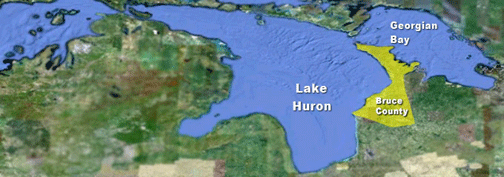 Report on burying nuclear waste near Lake Huron expected this week http://www.cbc.ca/news/canada/kitchener-waterloo/report-on-burying-nuclear-waste-near-lake-huron-expected-this-week-1.3059419 By Colin Perkel, The Canadian Press Posted: May 03, 2015 A Canadian environmental assessment of a proposal to bury nuclear waste deep underground near the shores of Lake Huron is expected this week amid fierce opposition to the idea from home and abroad.
Ontario Power Generation argues that storing the radioactive material in a huge underground bunker set in rock — the deep geological repository or DGR — is the safest way to deal with waste that is potentially dangerous for centuries.
For decades, the waste has been stored above ground at the Bruce nuclear power plant near Kincardine, Ont., and OPG says it could continue doing so safely but says a long-term solution is needed.
The proposed facility would be about 680 metres deep and close to the Bruce reactors and house hundreds of thousands of cubic metres of what is considered to be low- and intermediate-level waste from facilities across Ontario.
Stable bedrock and shale would essentially seal the facility, protecting both the surface and nearby lake for thousands of years, proponents say.Very favourable geologic features make the Bruce site in Kincardine one of the best possible locations,” OPG states.
Opponents say proposal is dangerous
Opponents, however, argue no system is foolproof and any problems – especially with a facility about one kilometre from a major water source for millions of people – could be catastrophic.
While the municipality, where many jobs and the economy are closely tied to the power generator, is officially a “willing host community” for the repository, grassroots groups have sprung up in the area to give voice to those concerns.
One of them, Stop the Great Lakes Nuclear Dump, has collected almost 75,000 signatures on an online petition and is already pledging to keep fighting the plan if the review panel green-lights it.
Group spokeswoman, Bev Fernandez, argues the intermediate-level waste — components from within the reactors — is almost as dangerous as spent nuclear fuel for which authorities are also seeking a permanent storage solution.
“This Kincardine waste dump is really the Trojan horse,” Fernandez says. “There is absolutely nothing stopping OPG from putting the high-level waste, the nuclear spent fuel, into this (repository); all it would take is a stroke of the pen.”
U.S. senator opposes underground storage of nuclear waste
Opposition has also been heard much farther afield. More than 150 communities, many in Michigan and Illinois, have passed resolutions opposing such underground storage.
Earlier this month, for example, Sen. Debbie Stabenow of Michigan introduced a resolution in the U.S. Senate calling on the Canadian government to ban any nuclear waste repository within the Great Lakes basin.
“A spill of nuclear waste into the Great Lakes could have lasting and severely adverse environmental, health, and economic impacts,” the resolution states.
The report from the three-person review panel will go first to the federal minister of the environment before being made public, likely Wednesday or Thursday.
Still, a positive environmental assessment will hardly be the last word on the project.
The minister will have four months to study the report and recommendations before deciding whether to give Ottawa’s stamp of approval.
Also required will be consultations with area First Nations as well as further approvals before construction can begin — which OPG hopes will happen in 2018 — with operations slated for 2025 if all goes well.
“There have been numerous studies that have proven this repository will not put the lake at risk,” Jerry Keto, an OPG vice-president has said. “We’ve been examining this rock for a decade.”
New Zealand leads the world in nuclear thinking
 NZ leader in ‘nuclear thinking’ http://www.nzherald.co.nz/northern-advocate/news/article.cfm?c_id=1503450&objectid=11444033 By Lindy Laird May 6, 2015 New Zealand still punches above its weight in the fight for nuclear weapon disarmament, says Whangarei MP Shane Reti who has just returned from an international conference on the subject.
Mr Reti, the executive secretary of the New Zealand Parliamentarians for Nuclear Non-Proliferation and Disarmament, said the Kiwi delegation had no qualms about telling giants like the US to hurry up and decrease its nuclear arsenal.
He was in New York at the five-yearly United Nations review of the Nuclear Non-Proliferation Treaty (NPT) last week with Labour MP Phil Goff, who is the Parliamentary anti-nuclear weapons group’s chairman, and NZ Disarmament Ambassador Dell Higie.
“New Zealand is well recognised as leading the world in nuclear thinking.
“We have substantive countries coming to us and saying ‘we’re under the nuclear umbrella, could you speak for us?’,” Mr Reti said.
“We do tell our story, that gives us some leverage,” he said of New Zealand’s anti-nuclear history which includes banning US nuclear weapons-carrying or powered naval ships. But 45 years after the “P5″ nuclear nations – US, United Kingdom, France, China and Russia – agreed to the NPT, dubbed the “grand bargain”, their massive weapons stocks still exist. That grand bargain was essentially if those countries were allowed to keep their nuclear capability in the meantime, they would begin to disarm,” Mr Reti said.
“It’s turning out to be no bargain and nothing grand. It isn’t happening fast enough. The issue for New Zealand at the conference was ‘you need to keep your word’.”
“The ‘Nuclear 5′ are recalcitrant, and the rest of the world is restless,” he said.
Those five nations are also the permanent members on the UN security council. New Zealand and other delegates want the disarmament issue raised in the general assembly forum instead of that security council.
The international focus is shifting to the humanitarian perspective “that moves beyond balancing weapons and talks about body counts”, Mr Reti said. “It also supports, and embedding in legislation de-alerting, or ‘take the finger off the trigger’ – where hours or days instead of minutes are taken to consider launching any retaliatory missiles. In 1983 an electrical storm appeared on Russian screens as a US nuclear missile attack and a counter attack was only avoided because a Russian expert on duty that day demanded visual confirmation,” Mr Reti said.
“Geese flying in large formations have appeared on military screens as a nuclear missile launch.”
Boeing blacklisted by largest Nordic fund company over nuclear weapons making
Nordea blacklists Boeing over nuclear arms Madison Marriage , Ft.com , 5 May 15 Boeing has been blacklisted by the largest Nordic fund company over concerns that the civil and defence aerospace group is producing nuclear weapons.
Nordea Asset Management, which oversees €174bn of assets, told FTfm it added Boeing to its exclusion list in May due to the group’s involvement in producing components for replacement nuclear-armed Trident ballistic missile submarines in 2014.
The exclusion creates further problems for Boeing, which has already been blacklisted by the world’s largest sovereign wealth fund and a number Europe’s largest pension funds.
Sasja Beslik, head of corporate governance at Nordea, said: “Boeing is in the process of developing a new nuclear programme, [which means] we cannot engage with them. These companies will not change their business models, because [nuclear] is too lucrative.”…….
Nordea already excludes a handful of companies involved in manufacturing or supplying nuclear weapons, including UK groups BAE Systems andBabcock International and Areva of France………
The Norwegian Government Pension Fund, the world’s largest sovereign wealth fund, has blacklisted 10 companies involved in the production of nuclear weapons, including Boeing, since 2005.
PGGM, the second-largest Dutch pension fund manager, with €189bn of assets, has similarly excluded more than a dozen companies, including Boeing, over their involvement in nuclear arms since 2008………http://www.ft.com/intl/cms/s/0/ab38fee8-eff9-11e4-ab73-00144feab7de.html#axzz3ZJPY7ucS
Workers Injured In Nuclear Weapons Lab Accident
Nine workers have been injured in an accident at the nuclear weapons research facility at Los Alamos National Laboratory.
One worker was in a critical condition after being burned while carrying out preventative maintenance at an electrical substation attached to the Neutron Science Center……http://news.sky.com/story/1477911/workers-injured-in-nuclear-weapons-lab-accident
Chinese nuclear companies keen to market reactors overseas
 Chinese Nuclear Firms Compete Abroad for Exports and for Market Share at Home, Energy Collective Two giant rival Chinese state-owned nuclear firms are pulling out the stops to achieve success with exports and increased market share of the restarted domestic reactor construction program. The so-called Hualong One, a 1000 MW PWR type reactor, is being hawked by both firms, but with significant enough design differences that potential customers worry about supply chain issues……..
Moving Inland from the Coast
Up to now China has been building its reactors at coastal sites. The reasons include the available seawater for cooling the units and the ability to deliver very large reactor components by barge. However, the China National Energy Administration is now looking at inland sites again. Following the Fukushima earthquake, the agency suspended consideration of new construction starts away from coastal regions.
The main issue was consideration of adequate cooling water supplies in an emergency. At issue is a 100% fail safe supply of water in regions which may have some areas which may have inadequate freshwater resources even without the demand of a new power plant………http://theenergycollective.com/dan-yurman/2223861/chinese-nuclear-firms-compete-abroad-exports-and-market-share-home
The Nuclear Non Proliferation Treaty has weaknesses, but it’s all that we’ve got
Fractious, divided but still essential, Economist Lack of progress on nuclear disarmament could lead to an ill-tempered non-proliferation treaty review May 2nd 2015 THE conference of the 191 signatories of the Nuclear Non-Proliferation Treaty (NPT) got under way at the UN headquarters in New York this week. The last such meeting, in 2010, produced agreement over a 64-point action plan. This time it is likely to be a much more divisive affair.
The aim of “RevCon”, as it is known, is to take stock of progress (or otherwise) over the previous five years in strengthening the three pillars on which the NPT’s “grand bargain” rests: the commitment to pursue disarmament by the five “official” nuclear weapons states—America, Russia, Britain, France and China, also known as the P5; action to stop the proliferation of nuclear weapons; and promotion of the peaceful use of nuclear energy.
At least one bit of good news for the four-week conference was the announcement on April 2nd of a framework agreement to overcome the decade-long crisis over Iran’s nuclear programme. If a comprehensive deal can be reached by the end of June and then successfully implemented, it will go a long way towards vindicating the NPT and the tools it provides to bring those who violate its safeguards back into compliance. Mark Fitzpatrick, a non-proliferation analyst at the London-based International Institute for Strategic Studies, believes that the agreement has strengthened two of the NPT’s pillars by upholding the right to a civil nuclear programme and confirming the role of intrusive inspections to ensure that all related activity is indeed peaceful.
Progress in most other areas since 2010 has been modest.The countries that do not have nuclear weapons are most concerned by the failure of the five that do to take further steps to reduce the size of their own nuclear arsenals. The previous RevCon was held in the afterglow of a New START deal between America and Russia to limit the number of deployed strategic nuclear weapons to 1,550 on each side, and the inspirational speech in Prague a year earlier by Barack Obama, America’s president, in which he held out the prospect of a world without nuclear weapons.
Since then, despite the establishment in 2009 of the so-called P5 process as a forum for discussing multilateral disarmament, not much has happened. ……….
Environment groups threaten threaten Palisades, NRC with lawsuit”
(NPR at Western Michigan University), an environmental coalition, including Beyond Nuclear, is intervening against regulatory rollbacks at Entergy Nuclear’s Palisades atomic reactor on the Lake Michigan shore in southwest Michigan.
Thiele interviewed Beyond Nuclear’s Kevin Kamps (a native of Kalamazoo — just 35 miles downwind of Palisades — who serves on the board of directors of Don’t Waste MI), as well as the coalition’s attorney, Terry Lodge. At the top of the story, Bette Pierman of Benton Harbor, chairwoman of Michigan Safe Energy Future (MSEF)–Shoreline Chapter, is heard presenting during a panel discussion. The interviews took place at a fund- and awareness-raising event held at the Old Dog Tavern on April 19th in downtown Kalamazoo. Music performed by the “Duffield-Caron Project, with Friends” can be heard in the background of the interviews.
The intervention focuses on the risk of pressurized thermal shock (PTS). Palisades has the worst neutron radiation embrittled reactor pressure vessel (RPV) of any nuclear power plant in the U.S. Like a hot glass under cold water (and a ton of pressure per square inch!), PTS could fracture Palisades’ RPV, causing a loss of coolant accident, core meltdown, and catastrophic radioactivity release.
Arnie Gundersen, Chief Engineer at Fairewinds Energy Education, and the expert witness for Beyond Nuclear and the coaltion at Palisades, has produced a humorous short video about this serious subject, entitled “Nuclear Crack Down?”
Leaked document shows how Internet trolls may be trained government agents
 Internet Trolls May be Trained Government Agents According to Leaked Document Health Impact News Editor, 3 Apr 15 Glenn Greenwald, a journalist, constitutional lawyer, commentator, and author of three New York Times best-selling books on politics and law, has been working with NBC News in publishing a series of articles on how covert government agents infiltrate the Internet to “manipulate, deceive, and destroy reputations.”
The information is based on documents leaked by National Security Agency (NSA) whistleblower Edward Snowden. Greenwald’s article, How Covert Agents Infiltrate the Internet to Manipulate, Deceive, and Destroy Reputations, is based on four classified documents produced by the British spy agency GCHQ, and presented to the NSA and three other English speaking agencies reportedly part of “The Five Eyes Alliance.”
In this shocking piece, Greenwald publishes a copy of a spy training manual used entitled: “The Art of Deception: Training for Online Covert Operations.” Greenwald writes that agencies like the NSA are “attempting to control, infiltrate, manipulate, and warp online discourse, and in doing so, are compromising the integrity of the internet itself.” Greenwald writes:
Among the core self-identified purposes of JTRIG are two tactics: (1) to inject all sorts of false material onto the internet in order to destroy the reputation of its targets; and (2) to use social sciences and other techniques to manipulate online discourse and activism to generate outcomes it considers desirable. To see how extremist these programs are, just consider the tactics they boast of using to achieve those ends: “false flag operations” (posting material to the internet and falsely attributing it to someone else), fake victim blog posts (pretending to be a victim of the individual whose reputation they want to destroy), and posting “negative information” on various forums.
While this kind of counter-intelligence activity may not sound surprising given the objectives of spy agencies going after terrorists, what disturbs Greenwald (and many others) is that the discussion regarding these techniques have been greatly expanded to include the general public: Critically, the “targets” for this deceit and reputation-destruction extend far beyond the customary roster of normal spycraft: hostile nations and their leaders, military agencies, and intelligence services. In fact, the discussion of many of these techniques occurs in the context of using them in lieu of “traditional law enforcement” against people suspected (but not charged or convicted) of ordinary crimes or, more broadly still, “hacktivism”, meaning those who use online protest activity for political ends. …….
it is not difficult to see how dangerous it is to have secret government agencies being able to target any individuals they want – who have never been charged with, let alone convicted of, any crimes – with these sorts of online, deception-based tactics of reputation destruction and disruption…………http://healthimpactnews.com/2014/internet-trolls-may-be-trained-government-agents-according-to-leaked-document/#sthash.eXKX8jjg.dpuf
Outdated policies regulate USA’s Nuclear Warheads
 An Ageing Cold War Policy May Make It Easier To Hack Nuclear Warheads KELSEY CAMPBELL-DOLLAGHAN Gizmodo 3 Apr 15 . The security of America’s nuclear arms is… less than perfect. And now, more critics are questioning the outdated policies that regulate them.
It’s been almost 25 years since the Cold War ended, but America (and Russia) still keep thousands of nuclear warheads on “high alert”, meaning they can be launched within minutes if a missile launched by an enemy is detected using radar or satellite systems. It’s a policy that might not have attracted much attention, if it wasn’t for General James E Cartwright and the anti-nuclear weapon organisation Global Zero.
Cartwright has been ramping up his calls for a change to the policy on both sides, with a New York Times op-ed in April and an interview with the AP this week. In the interview, he described how the hair-trigger system means nations can launch their missiles as soon as a threat is detected — which makes it far easier for a hacker to fake a threat and set off a retaliation:…….
The fact that we’re doing a terrible job securing our nuclear arsenal is not new. Researchers have beensaying that very explicitly for years. Not only is the infrastructure ageing, the education of the people who run it have been exposed as deficient. The same goes for Russia — which doesn’t even have the correct satellite infrastructure to detect launches anymore. As Cartwright points out, the vulnerability of these ageing systems is becoming a world-wide liability.
Unfortunately, tensions between Russia and the US are only growing, so it doesn’t seem likely that there’s a clear solution to the problem at hand. But when John Oliver shames you, you know it’s time to make some changes. [AP] http://www.gizmodo.com.au/2015/05/an-aging-cold-war-policy-may-make-it-easier-to-hack-nuclear-warheads/
Israel has 400 nuclear weapons – Iran claims
Iran’s claim that Israel has 400 nuclear weapons, WP By Glenn Kessler May 1 “It’s laughable that [Israeli Prime Minister Benjamin] Netanyahu has become everybody’s nonproliferation guru. He is sitting on 400 nuclear warheads, nuclear warheads that have been acquired in violation of the NPT [Nuclear Non-Proliferation Treaty].”–Iranian Foreign Minister Mohammad Javad Zarif, speaking in New York, April 29, 2015
In the debate over Iran’s nuclear ambitions, the unacknowledged nuclear stockpile of Israel often comes up.
In the 1950s and 1960s, Israel secretly acquired the technology and material to build nuclear weapons, frequently misleading the U.S. government about its intentions. (France was Israel’s partner in the building of the Dimona reactor in the Negev desert, while South Africa is believed by some to have assisted Israel in conducting at least one nuclear test in the 1970s.)
Zarif quickly noted that Israel (unlike Iran) is not a member of the NPT, but added: “Those who provided them with the technology were members of the NPT and violated the NPT to provide them with the technology, and we know who they were. And now they are the proponents of nonproliferation.” (Actually, France’s cooperation with Israel ended in 1966, before the NPT went into effect in 1970.)
Zarif’s estimate of Israel’s stockpile seemed rather large. Does Israel really have 400 nuclear weapons?
The Facts For a secret and unacknowledged program, the history of Israel’s quest for nuclear weapons is relatively well-documented. Our colleague Walter Pincus recently recounted how Israel misled the Kennedy and Johnson administrations about the facility in the Negev, describing it at one point as “a textile plant” and later as “a metallurgical research installation.”
Requested inspections by U.S. experts were cursory and often postponed — Israel refused to accept visits from the International Atomic Energy Agency – and later it was learned that the Israelis had built fake walls around the elevators that led to an underground reprocessing plant, according to a 2014 account in The Guardian newspaper.
By 1968, the CIA was convinced Israel had nuclear weapons – just as negotiations on the NPT were completed and the treaty designed to thwart the spread of nuclear weapons was opened for signature by members of the United Nations. U.S. officials concluded it was too late to turn back the clock and make Israel abandon its nuclear capability………….
Given that some 50 years have passed, how many nuclear weapons does Israel have?
Since Israel has never officially admitted having weapons, the answer relies on a bit of guesswork, principally how much plutonium might have been produced in Dimona. A key factor is the power level of the reactor, which (according to satellite imagery) does not appear to have increased much over time.
A leaked 1999 intelligence assessment by the Defense Intelligence Agency, published in Rowan Scarborough’s 2004 book “Rumsfeld’s War,” estimated that Israel had 60 to 80 weapons at the time, and would have 65 to 85 by 2020. (The report also said Iran would have 10 to 20 nukes by 2020.)……..
In 2014, the Bulletin of Atomic Scientists echoed that estimate. “We conclude that many of the public claims about the size of the Israeli nuclear arsenal are exaggerated,” a comprehensive report declared. “We estimate that Israel has a stockpile of approximately 80 nuclear warheads for delivery by two dozen missiles, a couple of squadrons of aircraft, and perhaps a small number of sea-launched cruise missiles.”
Other analysts believe that the number is closer to 100, and possibly a bit higher. In 2007, the Federation of American Scientists said the estimates range from 70 to 400 warheads………http://www.washingtonpost.com/blogs/fact-checker/wp/2015/05/01/irans-claim-that-israel-has-400-nuclear-weapons/
1 This Month

of the week – Shut Down Drone Warfare!


Tell the Ukrainian Government to Drop Prosecution of Peace Activist Yurii Sheliazhenko

Petition to revoke the licensing of the Near Surface Nuclear Disposal Facility (NSDF) at Chalk River. https://www.ourcommons.ca/petitions/en/Petition/Details?Petition=e-7247
To see nuclear-related stories in greater depth and intensity – go to https://nuclearinformation.wordpress.com
-
Archives
- April 2026 (91)
- March 2026 (251)
- February 2026 (268)
- January 2026 (308)
- December 2025 (358)
- November 2025 (359)
- October 2025 (376)
- September 2025 (257)
- August 2025 (319)
- July 2025 (230)
- June 2025 (348)
- May 2025 (261)
-
Categories
- 1
- 1 NUCLEAR ISSUES
- business and costs
- climate change
- culture and arts
- ENERGY
- environment
- health
- history
- indigenous issues
- Legal
- marketing of nuclear
- media
- opposition to nuclear
- PERSONAL STORIES
- politics
- politics international
- Religion and ethics
- safety
- secrets,lies and civil liberties
- spinbuster
- technology
- Uranium
- wastes
- weapons and war
- Women
- 2 WORLD
- ACTION
- AFRICA
- Atrocities
- AUSTRALIA
- Christina's notes
- Christina's themes
- culture and arts
- Events
- Fuk 2022
- Fuk 2023
- Fukushima 2017
- Fukushima 2018
- fukushima 2019
- Fukushima 2020
- Fukushima 2021
- general
- global warming
- Humour (God we need it)
- Nuclear
- RARE EARTHS
- Reference
- resources – print
- Resources -audiovicual
- Weekly Newsletter
- World
- World Nuclear
- YouTube
-
RSS
Entries RSS
Comments RSS
 nuclear-news