Take nuclear arsenal off high alert , urges former USA commander
Cartwright said cyberthreats to the systems that command and control U.S. nuclear weapons demand greater  attention. While the main worry once was a hacker acting alone, today it is a hostile nation-state, he said, that poses more of a threat even as the Pentagon has improved its cyberdefenses.
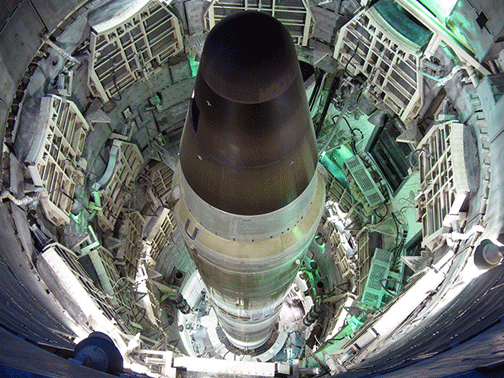 Former U.S commander: Take nuclear arsenal off high alert By Tribune wire reports contact the reporter 28 Apr 15 Taking U.S. and Russian missiles off high alert could keep a possible cyberattack from starting a nuclear war, a former commander of U.S. nuclear forces says, but neither country appears willing to increase the lead-time to prepare the weapons for launch.
Retired Gen. James Cartwright said in an interview that “de-alerting” nuclear arsenals could foil hackers by reducing the chance of firing a weapon in response to a false warning of attack.
Essentially adding a longer fuse can be done without eroding the weapons’ deterrent value, said Cartwright, who headed Strategic Command from 2004 to 2007 and was vice chairman of the Joint Chiefs of Staff before retiring in 2011.
The Obama administration has considered and rejected the idea before of taking nuclear missiles off high alert. There appears to be little near-term chance that Moscow would agree to pursue this or any other kind of nuclear arms control measure, given the deteriorating U.S.-Russian relations after Russia’s intervention in eastern Ukraine.
The U.S. and Russia also are at odds over a U.S. accusation that Moscow is violating a treaty banning medium-range nuclear missiles…….
An example of the high alert level of U.S. nuclear weapons is the land-based nuclear force. These are the 450 Minuteman 3 missiles that are kept ready, 24/7, to launch from underground silos within minutes after receiving a presidential order.
A study led by Cartwright proposes to adjust the missile command and control system so that it would take 24 hours to 72 hours to get the missiles ready for launch. Continue reading
Wide spread of radiation could result from smoke from fires in Chernobyl exclusion zone
Smoke from Chernobyl fire could spread radiation far and wide – experts Rt.com April 29, 2015 Smoke from burning forests in the  is capable of spreading contaminants across great distances, even after the fire has been stopped, ecology experts told RT.
The forest fire near the crippled Chernobyl nuclear power plant started on Tuesday and triggered an emergency alert, with police and National Guard mobilized to bring the flames under control……
Although the sarcophagus remains untouched by the fire, decades-old contaminants could still be released and travel far and wide, borne aloft by the smoke, nuclear safety expert John H. Large told RT:
“Brush fires and forest fires were the greatest concern in terms of the means by which you can disperse a secondary radiological impact from the original dissipation that occurred in 1986,” he said. John went to Chernobyl in 2006 to assess the situation there and spoke to dozens of scientists working on containing the contamination.
“In the exclusion zone and further away you have an area that has been abandoned for farming, abandoned for man management,” John says. “That means you’ve got lots of brush and young wood growing out of control, and that means there’s a big fuel load to have a fire.”
He says the high temperatures and volumes of smoke produced in a forest fire can take contaminants hundreds of kilometers away from the exclusion zone: “Radiation really doesn’t respect any international boundaries.”
Forest fires have happened in the area before, but have never been so serious, Timothy Mousseau, biology professor at the University of South Carolina, told RT:
“Previous forest fires had re-released about eight percent of the radiation from the original catastrophe. The fire that we’re seeing today seems to be on a much larger scale, and so we could see a re-dispersion of a very significant component of the original radiation.”
Another problem is that as the trees that have absorbed contaminants burn up and release smoke, this turns radioactive particles into a much more dangerous form than if they simply lie in the ground….http://rt.com/news/254193-chernobyl-fire-radiation-spread/
Despite the USA’s nuclear lobby – solar power is winning in Japan
 I predict, because solar is rising so rapidly in the land of the rising sun, that Japan will never restart any of its nukes – even though the U.S. media is demanding Japan restart one of its nukes. Let us pray that the solar home owners in Japan win this race against nuclear power. Our lives too depend on solar winning
 Four years after Fukushima, Japan is solar-powered Bay View by Theresa Coleman and Paul Kangas, 29 Apr 15 In the week before the March 11, 2011, earthquake at Fukushima, one person, Prime Minister Naoto Kan, did an extraordinary act that set Japan’s energy course in history for the next 100 years. He was able to convince the Japanese Parliament to pass a solar payment policy (SPP), that required big utilities in Japan to pay solar home owners $0.53 kwh for 20 years.
This is amazing. One, because the rate is very attractive to solar home owners and two, because he even made the effort.This one policy shift is now making Japan one of the leading solar powered nations on earth – far ahead of California or the U.S.
Number one in solar generation in 2014 was Germany. The same year they won the World Cup in soccer. They are on a roll.It is going to be interesting to see if China becomes No. 2 in 2015. It is a tight three-way race between Japan, Germany and China. Who will win?
The really big question is: “What inspired Prime Minister Naoto Kan to introduce this solar payment policy to the Japanese Parliament the day before Fukushima? Was it Chernobyl?
Apparently Kan had read the book “Solar Economy” by Hermann Scheer the year before. It got him to thinking about how solar policy could actually be drafted to shut down all the nuclear power plants in Japan over the next 50 years……….
This one policy shift is now making Japan one of the leading solar powered nations on earth – far ahead of California or the U.S. Number one in solar generation in 2014 was Germany.
Deal with Iran will not lead to nuclear weapons proliferation
Why an Iran deal won’t lead to nuclear proliferation, WP, By Dina Esfandiary and Ariane Tabatabai April 28 This post is part of the “Iran and the Nuclear Deal” symposium.
When the P5+1 and Iran announced their framework agreement earlier this month, some analysts reiterated that a final deal would result in aproliferation cascade in the Middle East. This widely held and long-standing assumption remains largely unchallenged. But a careful look at the actual technical capability, political and security context, and intentions of potential contenders confirms that much of this hype is baseless.
Those who invoke the proliferation cascade theory often confuse both the cause and the actual result. Would a nuclear agreement with Iran or nuclear-armed Iran cause a cascade? Does the regional spread of civilian nuclear programs count as a proliferation cascade, or is it restricted to the spread of the bomb?…….
First, the entire region, except for nuclear-armed Israel, is party to the NPT. This means that they’ve already legally given up the nuclear weapon option. Moreover, nuclear weapon states can’t legally provide them nuclear weapons either. Second, many countries have safeguards agreements and some, the additional protocol, in place. This means that their programs are under close International Atomic Energy Agency (IAEA) scrutiny. Continue reading
Britain’s status symbol – the Trident nuclear weapons system
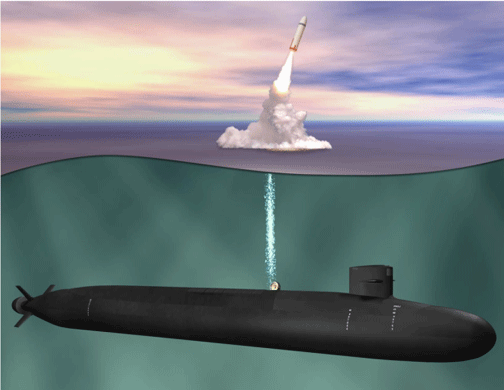 Trident nuclear weapons system is a ‘status symbol’ for the British establishment, says Nicola Sturgeon, The Independent 29 Apr 15 The Trident nuclear weapons system is a “status symbol” and will not help keep the UK safe, Scotland’s First Minister has said.
Nicola Sturgeon this morning accused the UK establishment of having an “obsession” with the weapons and suggested the project was sapping resources from more useful military investments.
“What I believe we need are strong conventional forces and I believe conventional forces have been compromised because of the obsession with Trident, which I think is a status symbol rather than a device to genuinely protect the country,” she told BBC Breakfast this morning.
“Britain is an island nation, a maritime nation, and yet Britain’s forces don’t have a single maritime patrol aircraft. When Russian submarines were thought to be patrolling in our territorial waters a few months ago, Britain had to call in other countries to check that out.
“We need strong conventional forces, not new nuclear weapons.”
Ms Sturgeon noted that of 200 countries in the world, 190 do not have nuclear weapons……..
The Green Party, SNP, and Plaid Cymru all oppose renewing the project, which is estimated to cost £100bn over its lifetime. http://www.independent.co.uk/news/uk/politics/trident-nuclear-weapons-system-is-a-status-symbol-for-the-british-establishment-says-nicola-sturgeon-10211674.html
Maine: democracy under threat – in the push for Small Modular Nuclear reactors
LePage Plan to Change Nuclear Power Rules Meets Resistance MPBN News, By Alanna Durkin, The Associated Press, 29 Apr 15
AUGUSTA, Maine – Republican Gov. Paul LePage’s proposal aimed at making it easier to bring small nuclear power plants to Maine is meeting fierce resistance because it would strip voters of their power to sign off on new plants.
Currently, Maine voters must approve the construction of any nuclear power plant. But LePage wants to remove that requirement for plants that generate 500 or fewer megawatts…….anti-nuclear activists said that removing voters’ right to decide whether Maine should build more potentially dangerous plants is wrong.
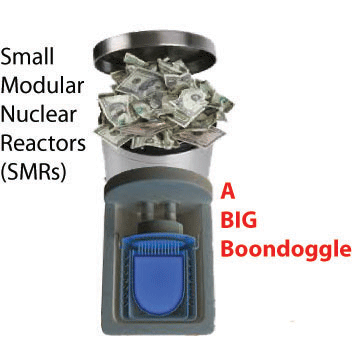
The state’s only nuclear power plant, Maine Yankee, closed in 1997.http://news.mpbn.net/post/lepage-plan-change-nuclear-power-rules-meets-resistance
Middle East chaos a financial bonanza for weapons industry
The Middle East accounts for approximately 32 percent of the United States’ weapons export market. From 2010 to 2014, the United States exported $43 billion in arms worldwide, according to the Stockholm International Peace Research Institute.
Russia has a thriving weapons export market as well. In 2012-2013, it sold $58.8 million in weapons to Iran and $1.2 billion in weapons to Syria
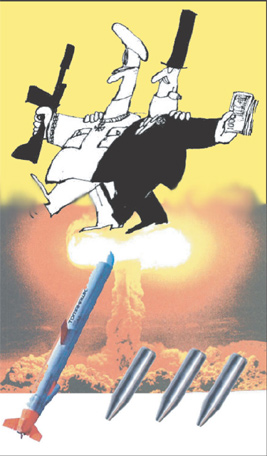 Weapons Manufacturers Are Making a Fortune Off Mid-East Chaos, Reader Supported News By Tim Mak, The Daily Beast 29 April 15
The Middle East is on a knife’s edge, thanks to a lunatic ISIS and a rising Iran. For American arms-makers, that means only one thing: opportunity.
 ar in Yemen. The continued threat of ISIS. Ongoing conflict in Iraq and Syria. Increasing Iranian influence. As America’s Middle Eastern allies watch their neighborhood burn, the U.S. defense industry is viewing increased instability as a money-making opportunity.
An unintended consequence of growing Iranian clout in the Middle East—punctuated most recently by a framework nuclear deal—has been the Obama administration’s decision to ease Gulf ally concerns by approving more sales of U.S.-made weaponry.
According to defense industry sources, inquiries for their product are way up. So while the region is a disaster for the Gulf states, the recent chaos is a timely godsend for the American defense industrial base—which due to congressional spending cuts is badly in need of customers. Continue reading
United Nations Secretary-General Ban Ki-moon warns on growing tensions, risks of nuclear war
Global tide of nuclear abolition has ebbed causing tensions among nations, Ban warns http://www.un.org/apps/news/story.asp?NewsID=50720#.VUBfRdKqpHw 28 April 2015 – Achieving a world free of nuclear weapons is “one of the most crucial debates of our time,” United Nations Secretary-General Ban Ki-moon said today, emphasizing that the international tide of nuclear abolition – so strong in 2010 – has ebbed and mounting tensions between nuclear-armed States have produced a return to Cold War mind sets.
“Nuclear weapons are again becoming embedded in national defence strategies. Support has deepened for misguided doctrines of deterrence,” Mr. Ban said in a message delivered by UN High Representative for Disarmament Affairs Angela Kane to the Symposium and High-Level Panel on the Non-Proliferation Treaty, Nuclear Disarmament, Non-Proliferation and Energy; Fresh Ideas for the Future.
“Modernization programmes envisage retention of these deadly weapons for decades to come. Nuclear weapon States have not demonstrated the leadership required to break the status quo, instead attaching hollow conditions to their disarmament obligations,” Mr. Ban added in the message.
The Symposium, a side event held in connection with the 2015 Review Conference of the Parties to the Treaty on the Non-Proliferation of Nuclear Weapons (NPT), which opened yesterday at UN Headquarters, was also expected to hear from UN Messenger of Peace, Michael Douglas.
“This Review Conference offers an opportunity to change the narrative; to remind all States parties that their collective good is best served by the full implementation of – and compliance with – all of the Treaty’s goals; and to put us back on course,” Mr. Ban said, calling on participants to provide ideas that will “propel us down the path to a world free of nuclear weapons.”
For over four decades, the Treaty has been a bulwark against the spread of the most dangerous and inhumane weapons ever devised, and it has been a central and essential mechanism for their elimination. Calling it “indispensable,” Mr. Ban said the Treaty has strengthened the security of all States parties, serving as a foundation for international security. Over the course of its history, the NPT has also helped cope with multiple challenges and competing positions.
While the ultimate goal of the NPT – to prevent the spread of nuclear weapons and to bring about their elimination – has not changed, the international security climate has evolved and continued to do so, with new problems constantly “testing our resolve,” Mr. Ban said.
To be effectively implemented, the Treaty requires constant tending to ensure that it remains strong and capable of safeguarding against the existential threat posed by nuclear weapons.
“We need new ideas to shore up the NPT, to confront new obstacles head on, and to overcome them,” he said. “Proliferation challenges persist. The Democratic People’s Republic of Korea continues with its dangerous and destabilizing activities, flouting international law and the will of the international community.”
At the same time, despite valiant efforts, the conference on a Middle East zone free of nuclear weapons and all other weapons of mass destruction has not yet taken place, Mr. Ban noted. The benefits of such a zone are manifold, including regional peace and stability.
“We have seen the sheer emergence of a movement seeking to address the humanitarian consequences of nuclear weapons. This has re-energized a frozen debate, reminding us that the indiscriminate and catastrophic costs of nuclear weapons are, at their core, human costs,” he added.
The 2015 Review Conference will run at UN Headquarters in New York through 22 May. The President-designate of the Conference is Ambassador Taous Feroukhi from Algeria.
The NPT is a landmark international treaty whose objective is to prevent the spread of nuclear weapons and weapons technology, to promote cooperation in the peaceful uses of nuclear energy and to further the goal of achieving nuclear disarmament and general and complete disarmament. It represents the only binding commitment in a multilateral treaty to the goal of disarmament by the nuclear-weapon States.
Generation IV Nuclear Reactors no better than the current ones
 Future Of Nuclear Industry Takes Yet Another Hit http://oilprice.com/Alternative-Energy/Nuclear-Power/Future-Of-Nuclear-Industry-Takes-Yet-Another-Hit.html By Charles Kennedy, 28 April 2015
Despite the rough patch that the nuclear industry has experienced in recent years, its future remains bright, the industry insists. That is because the next generation of nuclear reactors will provide significant safety and economic benefits over current reactors.
But what if the new designs are actually not all that much better than the current fleet?
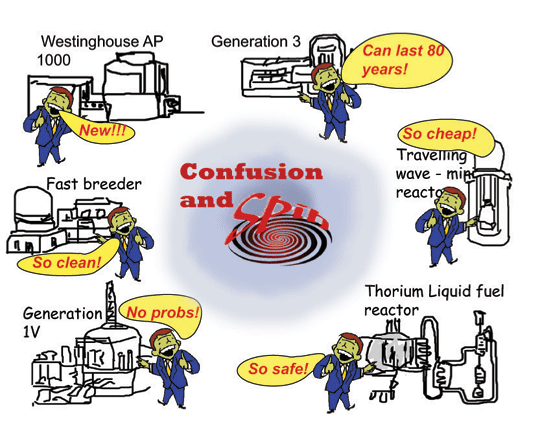
That is the provocative conclusion that France’s nuclear watchdog came to in a new report. Published on April 27, the IRSN said that the so-called “generation IV” reactors of the future may not be able to offer major upgrades in safety (most of the reactors running today are generation II – built in the 1960’s and 1970’s – and the newer designs that are currently under construction today are considered to be generation III).
The IRSN report reviewed six of the most promising generation IV reactor designs: sodium-cooled fast reactors (SFR); very high-temperature reactors (VHTR); gas-cooled fast reactors (GFR); lead-cooled fast reactors (LFR); molten salt reactors (MSR); and SuperCritical water reactors (SCWR).
Out of all of those, ISRN found that only the sodium-cooled fast reactor is close enough to maturity. SFRs have been trumpeted as an exciting concept – they can burn nuclear waste, reducing the need to build long-term spent fuel storage.
But after looking into the technology ISRN says it’s hard to say whether or not SFRs would be better. “While it seems possible for SFR technology to guarantee a safety level at least equivalent” to generation III reactors, “IRSN is unable to determine whether it could significantly exceed this level,” the report concluded. That is because liquid sodium can explode if exposed to water. IRSN also questioned the extent to which SFRs could actually burn through dangerous nuclear waste.
The report amounts to a big rebuke for generation IV reactors, the first significant criticism of a nuclear dream that has been hailed as the key to solving energy and climate change challenges.
However, ISRN also ultimately said that the devil will be in the details. The reactor designs could solve some of their drawbacks as the specifics are fleshed out. But unless generation IV designs can prove to be much safer than generation III designs, the nuclear renaissance may not be as bright as many had hoped.
At Nuclear Non-Proliferation Treaty (NPT) Austria calls for ban on nuclear weapons
Austria, backed by 159 nations, calls for ban on nuclear weapons UNITED NATIONS | BY LOUIS CHARBONNEAU (Reuters) – Austria on Tuesday called for banning nuclear weapons because of their catastrophic humanitarian effects, an initiative it said now has the backing of 159 countries.
Austrian Foreign Minister Sebastian Kurz was speaking at the five-year review conference of the 1970 nuclear Non-Proliferation Treaty (NPT).
“The only way to guarantee that nuclear weapons will never be used again is through their total elimination,” Kurz told the 191 parties to the treaty, the world’s benchmark arms control accord. “All states share the responsibility to prevent the use of nuclear weapons.”
Diplomats from the 159 countries supporting the ban, presented ahead of the 70th anniversary of the U.S. atom bombs dropped on Japan, said the initiative was modelled on successful campaigns to ban land mines and other weapons and could take years to move forward.
The initiative has virtually no support among NPT nuclear weapons states and veto-wielding Security Council members – the United States, Britain, France, Russia and China – or the countries of NATO, an alliance that provides a kind of “nuclear umbrella” security guarantee for its members.
But most of the 193 U.N. members back it.
The five permanent Security Council members signed the NPT as nuclear weapons states, although the pact calls on them to negotiate the reduction and eventual elimination of their arms caches. Non-nuclear states complain that there have been too few steps toward nuclear disarmament.
Iranian Foreign Minister Mohammad Javad Zarif on Monday demanded countries possessing nuclear weapons scrap any plans to modernize their arsenals.
Four other states presumed to have nuclear weapons – Israel, Pakistan, India and North Korea – are not listed as supporters of the initiative…….http://uk.reuters.com/article/2015/04/28/uk-nuclear-un-austria-idUKKBN0NJ2IE20150428

Forest fires threatening Chernobyl nuclear plant
Forest fires heading for Chernobyl nuclear plant – Ukraine Interior Ministry, Rt.com April 29, 2015 The Ukrainian National Guard has been put on high alert due to worsening forest fires around the crippled Chernobyl nuclear power plant, according to Ukraine Interior Minister Arsen Avakov.
“The forest fire situation around the Chernobyl power plant has worsened,” a statement on Avakov’s Facebook page says.
“The forest fire is heading in the direction of Chernobyl’s installations. Treetop flames and strong gusts of wind have created a real danger of the fire spreading to an area within 20 kilometers of the power plant. There are about 400 hectares [988 acres] of forests in the endangered area.”
Police and National Guard units are on high alert. Ukraine’s Prime Minister personally went to the affected area to oversee the firefighting. He says the situation is under control, “but this is the biggest fire since 1992.”
However, in comments to Russia’s Moscow Speaks radio, a representative of Greenpeace Russia said that the situation is much worse: “A very large, catastrophic forest fire is taking place in a 30-km zone around the Chernobyl power plant. We estimate the real area of the fire to be 10,000 hectares; this is based on satellite images. This hasn’t been officially acknowledged yet.”
The potential danger in this fire comes from the radioactive contaminants the burning plants have absorbed, ecologist Christopher Busby told RT. “Some of the materials that were contaminating that area would ahve been incorporated into the woods. In other words, they land on the ground in 1986 and they get absorbed into the trees and all the biosphere. And when it burns, they just become re-suspended. It’s like Chernobyl all over again. All of that material that fell on the ground will now be burned up into the air and will become available for people to breathe.”Christopher Busby is the scientific secretary of the European Committee on Radiation Risks………http://rt.com/news/253897-chernobyl-fires-rage-ukraine/
Sweden accelerates its closure of its uneconomic nuclear industry
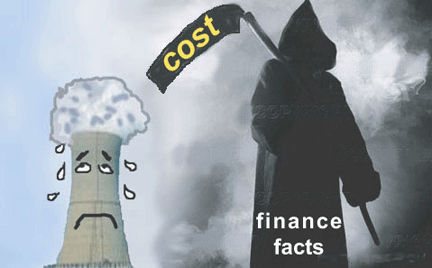 Sweden to speed up nuclear reactors closure The Local, 28 Apr 2015 Sweden’s state-owned energy group Vattenfall on Tuesday said it planned to shut down two nuclear reactors in 2018 and 2010, up to seven years earlier than expected. Vattenfall said reactors 1 and 2 at the Ringhals plant in south-west Sweden were too costly to keep in production until 2025 as previously planned.
“Ringhals 1 and 2 may be closed down between the years 2018 and 2020 instead of, as previously announced, around 2025,” Vattenfall said in a statement.
“The reason is declining profitability and increased costs,” it said……The Swedish group has been struggling to improve profits for several years, suffering from weak demand and plunging electricity prices………http://www.thelocal.se/20150428/sweden-speeds-up-nuclear-reactors-closure
Clean energy set to beat nuclear in Japan
Japan Sees Clean Energy Edging Out Nuclear Power in 2030, Bloomberg, Chisaki Watanabe and Emi Urabe 28 Apr 15 Clean energy sources will supply as much as 24 percent of Japan’s electricity in 15 years, while atomic power will account for as much as 22 percent, according to a draft report from the Ministry of Economy, Trade and Industry on what Japan’s electricity mix should look like by 2030……
If all 24 nuclear reactors currently under review for a restart by the country’s nuclear watchdog are allowed to switch back on, they would still not be able to generate more than 16 percent of Japan’s power, Greenpeace estimates. At least 10 more reactor units need to resume operations to reach the government’s target for nuclear, the group said.
Such a mass-scale restart is unlikely, according to Shaun Burnie, a nuclear specialist at Greenpeace Germany.
“The scale of the challenges facing the nuclear industry are such that generation from reactors is likely to collapse during the coming decade,” Burnie said in the statement. “Many reactors will never restart, and most reactors over the coming years will be too old to operate.”…..http://www.bloomberg.com/news/articles/2015-04-28/japan-expects-renewable-energy-to-edge-out-nuclear-power-by-2030
Switzerland’s government calls for a nuclear free world
Switzerland calls for nuclear-free world Swiss Info, 28 April 15 Swiss Foreign Minister Didier Burkhalter has called for an “ambitious and pragmatic” approach to eliminating nuclear weapons worldwide at the opening of a United Nations conference in New York.
The month-long meeting is taking stock of the 1970 nuclear Non-Proliferation Treaty, signed by 189 states.
In his speech, Burkhalter said current “global power shifts, geopolitical tensions, and regional instabilities… should not be an excuse for inaction” on disarmament.
The Swiss minister said the total elimination of nuclear weapons was not possible overnight but as an initial urgent step states should focus on the progressive reduction of nuclear-related risks.
“Nuclear-armed states should reduce the operational readiness of their weapons and lengthen decision times,” said Burkhalter.
He went on to stress that the Comprehensive Nuclear Test-Ban-Treaty had still not entered into force and negotiations on a treaty prohibiting the production of fissile material had yet to commence……..http://www.swissinfo.ch/eng/nuclear-arms_switzerland-calls-for-nuclear-free-world/41402170
Prime Minister Shinzo Abe muzzling critics in Japan’s media
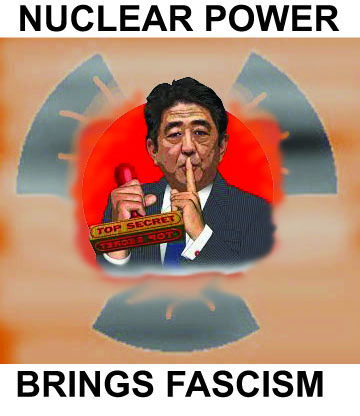 Effort by Japan to Stifle News Media Is Working, NYT By MARTIN FACKLER APRIL 26, 2015 TOKYO — It was an unexpected act of protest that shook Japan’s carefully managed media world: Shigeaki Koga, a regular television commentator and fierce critic of the political establishment, abruptly departed from the scripted conversation during a live TV news program to announce that this would be his last day on the show because, as he put it, network executives had succumbed to political pressure for his removal.
“I have suffered intense bashing by the prime minister’s office,” Mr. Koga told his visibly flabbergasted host late last month, saying he had been removed as commentator because of critical statements he had made about Prime Minister Shinzo Abe. Later in the program, Mr. Koga held up a sign that read “I am not Abe,” a play on the slogan of solidarity for journalists slain in January at a French satirical newspaper.
The outburst created a public firestorm, and not only because of the spectacle of Mr. Koga, a dour-faced former top government official, seemingly throwing away his career as a television commentator in front of millions of viewers. His angry show of defiance also focused national attention on the right-leaning government’s increased strong-arming of the news media to reduce critical coverage.
Mr. Abe’s efforts have had a chilling effect on coverage at a time when he is pushing ahead with a conservative agenda to dismantle the nation’s postwar pacifist consensus and put forth more positive portrayals of Japan’s World War II-era behavior. Experts warn that muzzling the press makes it easier for the government to make big changes that might not enjoy broad popular support, such as rewriting the pacifist Constitution, or even restarting the nation’s stalled nuclear industry.
“The Abe government is showing an obsession with the media that verges on paranoia,” said Keigo Takeda, a former editor in chief at Newsweek Japan who is now a respected freelance journalist. “I have never seen this level of efforts to micromanage specific newspapers and TV programs.”…..http://www.nytimes.com/2015/04/27/world/asia/in-japan-bid-to-stifle-media-is-working.html?smid=tw-share&_r=1
1 This Month



Tell the Ukrainian Government to Drop Prosecution of Peace Activist Yurii Sheliazhenko

Petition to revoke the licensing of the Near Surface Nuclear Disposal Facility (NSDF) at Chalk River. https://www.ourcommons.ca/petitions/en/Petition/Details?Petition=e-7247


of the week – STOP SMALL MODULAR REACTORS IN CANADA
To see nuclear-related stories in greater depth and intensity – go to https://nuclearinformation.wordpress.com
-
Archives
- March 2026 (222)
- February 2026 (268)
- January 2026 (308)
- December 2025 (358)
- November 2025 (359)
- October 2025 (376)
- September 2025 (258)
- August 2025 (319)
- July 2025 (230)
- June 2025 (348)
- May 2025 (261)
- April 2025 (305)
-
Categories
- 1
- 1 NUCLEAR ISSUES
- business and costs
- climate change
- culture and arts
- ENERGY
- environment
- health
- history
- indigenous issues
- Legal
- marketing of nuclear
- media
- opposition to nuclear
- PERSONAL STORIES
- politics
- politics international
- Religion and ethics
- safety
- secrets,lies and civil liberties
- spinbuster
- technology
- Uranium
- wastes
- weapons and war
- Women
- 2 WORLD
- ACTION
- AFRICA
- Atrocities
- AUSTRALIA
- Christina's notes
- Christina's themes
- culture and arts
- Events
- Fuk 2022
- Fuk 2023
- Fukushima 2017
- Fukushima 2018
- fukushima 2019
- Fukushima 2020
- Fukushima 2021
- general
- global warming
- Humour (God we need it)
- Nuclear
- RARE EARTHS
- Reference
- resources – print
- Resources -audiovicual
- Weekly Newsletter
- World
- World Nuclear
- YouTube
-
RSS
Entries RSS
Comments RSS
 nuclear-news