Maine’s Governor wants to remove voters’ rights on decisions on small nuclear reactors
 LePage’s plan to negate rule on nuclear power plants could be radioactive. Observers wonder why his attention to the issue begins with an attempt to disempower Maine voters. 26 Apr. BY BILL NEMITZ COLUMNIST bnemitz@pressherald.com | @BillNemitz Consider yourselves warned, fellow citizens. Gov. Paul LePage is fiddling around with Maine’s nuclear hot button.
“We anticipated this might provoke a conversation,” noted Patrick Woodcock, director of the Governor’s Energy Office, in an interview on Friday.
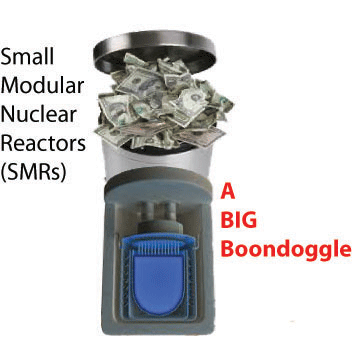 Under LePage’s new plan, scheduled for a hearing Wednesday at 1 p.m. before the Legislature’s Energy, Utilities and Technology Committee, voters would no longer have a say on the creation of nuclear power plants with generating capacities of 500 megawatts or less.
(Just so you know, the Fukushima Daiichi Nuclear Power Plant’s Unit 1 reactor – one of three destroyed by Japan’s apocalyptic tsunami in 2011 – had a generating capacity of 460 megawatts.)
Let’s back up a little.
Considering the complexity and controversy bound to greet any talk of dusting off nuclear generation in Maine, why start with a bill that effectively tells voters they’re being cut out of the process?
Or, as longtime anti-nuclear activist Ray Shadis of Edgecomb put it on Friday, “You don’t start a conversation by throwing a hand grenade in the room.”
Shadis, who currently represents the lone remaining intervenor in the proposed relicensing of New Hampshire’s Seabrook nuclear plant, sees this week’s hearing as “the kind of rudeness we’ve come to expect from Gov. LePage.”
He also thinks the governor is dreaming if he thinks small modular reactors – the brainchildren of a new generation of nuclear engineers working mostly out of the Massachusetts Institute of Technology – can attract the investment capital needed to put them on the energy radar here in Maine or anywhere else, for that matter.
“The most rabid anti-nuclear crowd are the investors in the market,” Shadis noted. “It takes a long time to realize any return at all. And the entirety of what you invest can turn from an asset to a liability overnight. Why bother risking your money? So they don’t.”
Thus, he said, LePage’s bill at best “is impractical, it’s silly. Out there in the energy world, where people are really trading on this stuff, it will make Maine the laughingstock. It will make us look like patsies.”
No comments yet.
1 This Month

of the week – Shut Down Drone Warfare!


Tell the Ukrainian Government to Drop Prosecution of Peace Activist Yurii Sheliazhenko

Petition to revoke the licensing of the Near Surface Nuclear Disposal Facility (NSDF) at Chalk River. https://www.ourcommons.ca/petitions/en/Petition/Details?Petition=e-7247
To see nuclear-related stories in greater depth and intensity – go to https://nuclearinformation.wordpress.com
-
Archives
- April 2026 (34)
- March 2026 (251)
- February 2026 (268)
- January 2026 (308)
- December 2025 (358)
- November 2025 (359)
- October 2025 (376)
- September 2025 (257)
- August 2025 (319)
- July 2025 (230)
- June 2025 (348)
- May 2025 (261)
-
Categories
- 1
- 1 NUCLEAR ISSUES
- business and costs
- climate change
- culture and arts
- ENERGY
- environment
- health
- history
- indigenous issues
- Legal
- marketing of nuclear
- media
- opposition to nuclear
- PERSONAL STORIES
- politics
- politics international
- Religion and ethics
- safety
- secrets,lies and civil liberties
- spinbuster
- technology
- Uranium
- wastes
- weapons and war
- Women
- 2 WORLD
- ACTION
- AFRICA
- Atrocities
- AUSTRALIA
- Christina's notes
- Christina's themes
- culture and arts
- Events
- Fuk 2022
- Fuk 2023
- Fukushima 2017
- Fukushima 2018
- fukushima 2019
- Fukushima 2020
- Fukushima 2021
- general
- global warming
- Humour (God we need it)
- Nuclear
- RARE EARTHS
- Reference
- resources – print
- Resources -audiovicual
- Weekly Newsletter
- World
- World Nuclear
- YouTube
-
RSS
Entries RSS
Comments RSS
 nuclear-news
Leave a comment