Renewable energy research kept secret by BHP
PRESS: BP Accused Of Hiding Renewable Energy Research – Guardian Fri, 24th Apr 2015 LONDON (Alliance News) – BP PLC has come under fire for not releasing multi-billion pound research into renewable energy to the public despite the company formerly promising to do so, The Guardian reported on Friday. The archive is based next to the Modern Records Office at Warwick University, and critics, including the chief executive of charity Share Action, Catherine Howarth, challenged BP executives at its annual general meeting to open up the archives to the public and to be more transparent about the issue of climate change, the Guardian reported……..http://www.lse.co.uk/AllNews.asp?code=vi7apovs&headline=PRESS_BP_Accused_Of_Hiding_Renewable_Energy_Research__Guardian
Uranium effluent discharged into Malawi river by Australian company Paladin
Malawi: Paladin Starts Discharging Uranium Wastes Into Public Rivers, AllAfrica, By Bishop Witmos Karonga April 23: Few months after Paladin Africa Limited differed with civil society organizations (CSOs) and some chiefs in Karonga over the disposition of uranium wastes into public water, the company has started discharging the effluent into Sere River.

Paladin Africa Limited, a member of the Paladin Energy group of companies, suspended its operations at Kayelekera Mine in the district in May, 2014, due to unstable uranium prices at an international market. The project is now on care and maintenance.
Malawi News Agency (Mana) has established Paladin invited Paramount Chief Kyungu and the District Commissioner (DC) for Karonga, Rosemary Moyo, to a meeting in Lilongwe early April this year (2015),to brief them about the company’s recent decision.
Paladin Africa Acting General Manager in Malawi, Greg Walker, confirmed in a telephone interview that the company, indeed, started releasing the uranium wastes into the public rivers………
Sere River flows into North Rukuru River, then into Lake Malawi.
When asked why the company decided to brief Paramount Chief Kyungu and the Karonga DC about their action in Lilongwe instead of explaining it to the general populace of Karonga, Walker said the company conducted enough meetings with relevant authorities in the district……..
Despite the decision by Paladin to start discharging its effluent into the public water, some people in the district feet it would have been safer if the company had constructed another dam where the wastes would be transferred into.
Chairperson for Karonga District Council, Patrick Kishombe, said in an interview the plan to release the waste water from the storage dam into Sere River is raising fears amongst communities who feel the water is not fully treated and could be a health hazard.
“This, I believe, will lead into many hazards, like killing of fish in Lake Malawi and may also cause skin cancer to some people,” said Kishombe.
Uranium contains gamma rays, particles that cause skin cancer to human kind, according to experts.
In developed nations, mining companies construct a stable tank that stores all the wastes, ready for transportation to recommended disposal sites. ……http://allafrica.com/stories/201504231621.html
US uranium mine- how Russia gained control
How Putin’s Russia Gained Control of a U.S. Uranium Mine, Bloomberg, 24 Apr 15 by William KennedyAndy Hoffman Since 2013, the nuclear energy arm of the Russian state has controlled 20 percent of America’s uranium production capacity.
Rosatom’s acquisition of Toronto-based miner Uranium One Inc. made the Russian agency, which also builds nuclear weapons, one the world’s top five producers of the radioactive metal and gave it ownership of a mine in Wyoming.
The deal, approved by a committee that included then Secretary of State Hillary Clinton, also followed donations from Uranium One’s Canadian chairman to the Clinton Global Foundation, the New York Times reported on Thursday.
Rosatom gained full control of Uranium One in early 2013.
Rosatom styles itself as Russia’s national nuclear corporation and today Uranium One is its international mining arm. As well as Willow Creek and the Kazakhstan assets, it owns mines in Australia and has exploration assets in Africa and the U.S…….http://www.bloomberg.com/news/articles/2015-04-23/how-putin-s-russia-gained-control-of-a-u-s-uranium-mine
Exploding the myth of nuclear energy as a low carbon source
When it comes to nuclear power, the industry wants you to think of electricity generation in isolation
Every aspect of the nuclear fuel cycle—mining, milling, shipping, processing, power generation, waste disposal and storage—releases greenhouse gases,

Why Do People Claim that Nuclear Power is a Low-Carbon Source of Energy?, Washington’s Blog
Even well-known, well-intentioned scientists sometimes push bad ideas. ……..
some scientists are under the mistaken impression that nuclear power is virtually carbon-free, and thus must be pushed to prevent runaway global warming. (If you don’t believe in global warming, then this essay is not aimed at you … although you might wish to forward it to those who do.)
But this is a myth. Amory Lovins is perhaps America’s top expert on energy, and a dedicated environmentalist for close to 50 years. His credentials as an energy expert and environmentalist are sterling…….
Lovins says nuclear is not the answer:
Nuclear plants are so slow and costly to build that they reduce and retard climate protection.
Here’s how. Each dollar spent on a new reactor buys about 2-10 times less carbon savings, 20-40 times slower, than spending that dollar on the cheaper, faster, safer solutions that make nuclear power unnecessary and uneconomic: efficient use of electricity, making heat and power together in factories or buildings (“cogeneration”), and renewable energy. The last two made 18% of the world’s 2009 electricity, nuclear 13%, reversing their 2000 shares–and made over 90% of the world’s additional electricity in 2008.
Those smarter choices are sweeping the global energy market. Half the world’s new generating capacity in 2008 and 2009 was renewable. In 2010, renewables except big hydro dams won $151 billion of private investment and added over 50 billion watts (70% the total capacity of all 23 Fukushima-style U.S. reactors) while nuclear got zero private investment and kept losing capacity. Supposedly unreliable windpower made 43-52% of four German states’ total 2010 electricity. Non-nuclear Denmark, 21% wind-powered, plans to get entirely off fossil fuels. Hawai’i plans 70% renewables by 2025.
In contrast, of the 66 nuclear units worldwide officially listed as “under construction” at the end of 2010, 12 had been so listed for over 20 years, 45 had no official startup date, half were late, all 66 were in centrally planned power systems–50 of those in just four (China, India, Russia, South Korea)–and zero were free-market purchases. Since 2007,nuclear growth has added less annual output than just the costliest renewable–solar power –and will probably never catch up. While inherently safe renewable competitors are walloping both nuclear and coal plants in the marketplace and keep getting dramatically cheaper, nuclear costs keep soaring, and with greater safety precautions would go even higher. Tokyo Electric Co., just recovering from $10-20 billion in 2007 earthquake costs at its other big nuclear complex, now faces an even more ruinous Fukushima bill.
Since 2005, new U.S. reactors (if any) have been 100+% subsidized–yet they couldn’t raise a cent of private capital, because they have no business case. They cost 2-3 times as much as new windpower, and by the time you could build a reactor, it couldn’t even beat solar power. Competitive renewables, cogeneration, and efficient use can displace all U.S. coal power more than 23 times over–leaving ample room to replace nuclear power’s half-as-big-as-coal contribution too–but we need to do it just once.
(Read Lovins’ technical papers on the issue here.)
Alternet points out:
Mark Cooper, senior fellow for economic analysis at the Vermont Law School … found that the states that invested heavily in nuclear power had worse track records on efficiency and developing renewables than those that did not have large nuclear programs. In other words, investing in nuclear technology crowded out developing clean energy.
BBC notes:
Building the [nuclear] power station produces a lot of CO2 ….
Greenpeace points out:
When it comes to nuclear power, the industry wants you to think of electricity generation in isolation ….. And yet the production of nuclear fuel is a hugely intensive process. Uranium must be mined, milled, converted, enriched, converted again and then manufactured into fuel. You’ll notice the [the nuclear industry] doesn’t mention the carbon footprint of all steps in the nuclear chain prior to electricity generation. Fossil fuels have to be used and that means CO2 emissions.
An International Forum on Globalization report – written by environmental luminaries Ernest Callenback, Gar Smith and Jerry Mander – have slammed nuclear power as catastrophic for the environment:Nuclear energy is not the “clean” energy its backers proclaim. For more than 50 years, nuclear energy has been quietly polluting our air, land, water and bodies—while alsocontributing to Global Warming through the CO2 emissions from its construction, mining, and manufacturing operations. Every aspect of the nuclear fuel cycle—mining, milling, shipping, processing, power generation, waste disposal and storage—releases greenhouse gases, radioactive particles and toxic materials that poison the air, water and land. Nuclear power plants routinely expel low-level radionuclides into the air in the course of daily operations. While exposure to high levels of radiation can kill within a matter of days or weeks, exposure to low levels on a prolonged basis can damage bones and tissue and result in genetic damage, crippling long-term injuries, disease and death.
See this excellent photographic depiction of the huge amounts of fossil fuel which goes into building and operating a nuclear power plant.
Nature reported in 2008:
“You’re better off pursuing renewables like wind and solar if you want to get more bang for your buck.”……. http://www.washingtonsblog.com/2013/04/nuclear-is-not-a-low-carbon-source-of-energy.html
Australia’s PM Tony Abbott sacked real climate scientists, now funds dodgy Bjorn Lomborg
 Lomborg’s influence over key ministers in the Abbott government is quite well-known. He is seen to be at the centre of much of federal cabinet’s climate groupthink………
The real travesty of funding Lomborg’s newest franchise is that it comes from the same government that defunded the Climate Commission. This was composed of Australia’s best climate scientists, economists and energy experts, with an operating cost of A$1.5 million per year. This, more than even the most horrendous of storms, really exposes the parlous state of the Abbott government’s desertion of future generations
As such, one has to have some sympathy for Lomborg, who is a strange kind of “climate change refugee”. In 2012, the Danish government pulled all funding from his centre. Since, he has only set up shop in countries that have strong climate change-denying lobbies – both in the private sector and within mainstream media. He has enjoyed this in the US.
Lomborg operates by attaching himself to these centres as an adjunct professor, which will be his title at UWA, rather than a staff member. This offers the freedom to command remuneration well above a professorial salary – such as the US$775,000 he was paid in 2012 by the CCC and the US$200,484 paid for his work in 2013………
a book, The Lomborg Deception, that focuses solely on the lack of rigour in Lomborg’s books The Skeptical Environmentalist (2001) and Cool It (2007).
The Lomborg Deception’s author, Howard Friels, documented how footnote after footnote does not support anything that Lomborg says. In Cool It, Lomborg opens with a claim directly ignoring research by the International Union for the Conservation of Nature showing that polar bear numbers in the Arctic are in terminal decline. He is bold enough to suggest they are actually increasing.
The problem is that Lomborg’s sources consist of a blog and a study that nowhere mentions polar bears – not even the ones that are dead. Not much rigorous thought and analysis there.
The mere fact that Lomborg’s franchise-style “consensus” centre is here is an indictment on the climate politics environment in Australia. The centre subverts the term “consensus”, which is otherwise famous for the 97% of climate scientists who have verified the fact of global warming.
But, what is perhaps a new low for Australia is how the federal funding for Lomborg’s centre was not even subject to a competitive process. Instead, it was through negotiations personally held between Lomborg and Education Minister Christopher Pyne.
Lomborg’s influence over key ministers in the Abbott government is quite well-known. He is seen to be at the centre of much of federal cabinet’s climate groupthink………
The real travesty of funding Lomborg’s newest franchise is that it comes from the same government that defunded the Climate Commission. This was composed of Australia’s best climate scientists, economists and energy experts, with an operating cost of A$1.5 million per year. This, more than even the most horrendous of storms, really exposes the parlous state of the Abbott government’s desertion of future generations.http://theconversation.com/the-bjorn-supremacy-is-australia-getting-the-climate-advice-it-deserves-40716
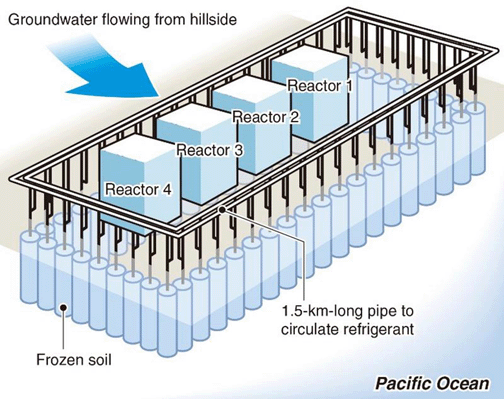
TEPCO begins freezing wall of ice around Fukushima Daiichi nuclear reactors
Fukushima Daiichi Frozen Wall Begins Freezing Operations http://www.fukuleaks.org/web/?p=14725 April 23rd, 2015 TEPCO’s contractors have begun the process of freezing the completed sections of the frozen wall. Blocks 1-8 are currently in the freezing process. Other sections are either still under construction or in the process of having the plumbing installed. The sections currently being frozen include the land side and north sides of the reactor building areas.
Growing global movement for 100% renewable energy
The most optimistic predictions for the UN COP21 climate negotiations in Paris at the end of this year center on an “80 by 50” scenario — a reduction in greenhouse-gas emissions by 80% from 2005 levels by 2050. In my opinion, that scenario is less a call-to-action than a call-to-arms. Previous global negotiations have shown that as long as there is any percentage of fossil-fuel energy left on the table, countries will fight for access to it, and productive discussions will come to an end. So we need to change the narrative. Instead of a call-to-arms, we need a doctrine of “mutually assured survival” — a doctrine in which all commit to the goal of 100% renewable energy.
Since 2013, renewable energies have been winning the race against fossil resources: the world is now adding more capacity for renewable power each year than for coal, natural gas, and oil combined. The question is no longer if the world will transition to sustainable energy, but how long it will take. And there’s no going back.
This transition is being driven largely by local governments.
A growing numbers of cities, communities and regions are proving that meeting 100% of our energy demand with renewable energy is viable. As urban areas are responsible for 70-75% of energy related CO2 emissions and 40-50% of global GHG emissions, this is an encouraging trend. My city — Vancouver, Canada — recently voted in favor of a target of 100% renewable energy.
100% RE Is Already a Reality Today
Other cities and states — from Hawaii and Georgetown, Texas, in the USA to Coffs Harbour in Australia — have already shown that making the transition to 100% renewable energy is a political, not technical, decision. The necessary technology and knowledge exists.
In Germany, in a network of 140 100% RE regions, 80 communities and municipalities have already reached their goal. One of them is the Rhein-Hunsrück District. As of early 2012, the District, which has around 100,000 inhabitants, officially began producing more than 100% of its electricity needs. In early 2014, it is estimated that Rhein-Hunsrück already produced more than 230% of its total electricity needs, exporting the surplus to the regional and national grid, or re-directing it to meet other energy demands.
The city of Greensburg (Kansas, USA) powers all local homes and businesses with100% renewable energy, 100% of the time. The story of Greensburg is one of tragedy to triumph: a tornado destroyed or damaged 95% of the town’s homes and businesses on May 4, 2007. The community — with a strong leader in Mayor Bob Dixon — turned disaster into opportunity and created a vision to rebuild Greensburg as a sustainable community.
Building efficiency and local wind, complemented by small solar installations and biogas, are the cornerstones of their master plan. The town has gathered a diverse group of experts to make their vision a reality.
Similarly, local governments across Japan are seeking to supply their regions with 100% renewable energy. The Great East Japan earthquake, the subsequent tsunami and the disaster at the Fukushima-daiichi nuclear power plant in March 2011, encouraged the people of Fukushima to reassess their energy system and to revitalize industry in the shattered region. This led to a vision of transition to renewable energy. Fukushima prefecture now has an official commitment to cover 100% of primary-energy demand in Fukushima with renewable resources by 2040.
Joining them are another 13 cities or regions that have registered a 100% renewable-energy target in the carbonn Climate Registry:……http://www.huffingtonpost.com/andrea-reimer/100-renewable-energy-the-new-normal_b_7126906.html
Hillary Clinton unfairly smeared in Fox News reporting on uranium deal
On the April 4 edition of Special Report, host Bret Baier previewed his upcoming hour-long special ondiscredited conservative author Peter Schweizer’s forthcoming book Clinton Cash, in which he accuses Bill and Hillary Clinton of influence peddling with foreign governments in exchange for donations to the Clinton Foundation and speaking fees. The segment focused on Schweizer’s allegations regarding Clinton’s purported role in approving the sale of the uranium mining company Uranium One to the Russian government.
New York Times reporter Jo Becker, whose own reporting on the Uranium One story has been criticized by the Clinton campaign for burying “original reporting that debunks the allegation that then-Secretary Clinton played any role in the review of the sale,” also appeared in the segment. Both the Times and Fox reportedly“made arrangements for exclusive access” to the book.
During the preview, Schweizer detailed the sale of Uranium One to the Russian state corporation Rosatom. ……….
Baier’s preview omitted important context to misleadingly suggest that Clinton personally approved the Russian purchase. According to Time, which received this chapter of Schweizer’s book in advance, the State Department’s role in approving the deal was part of an extensive bureaucratic process, and Schweizer’s chapter offers no indication of Hillary Clinton’s personal involvement in, or even knowledge of, the deliberations. In fact,Time quotes Jose Hernandez, who as former Assistant Secretary of State for Economic, Energy and Business Affairs was involved the deliberations on behalf of the State Department, denying that Clinton was involved in the matter at all.
Moreover, Time pointed out that the “deal’s approval was the result of an extensive interagency process that required the assent of at least nine different officials and agencies” through the Committee on Foreign Investment in the United States. According to the report, “State has just one vote on the nine-member committee, which also includes the departments of Defense, Treasury and Energy. Disagreements are traditionally handled at the staff level, and if they are not resolved, they are escalated to deputies at the relevant agencies. If the deputies can’t resolve the dispute, the issues can be elevated to the Cabinet Secretary level and, if needed, to the President for a decision. The official chairman of CFIUS is the Treasury Secretary, not the Secretary of State.”
Furthermore, the Uranium One deal also had to receive approval from “the Nuclear Regulatory Commission, an independent agency outside of the State Department’s purview, as well as Utah’s nuclear regulator. The deal also received approval from Canada’s foreign investment review agency.”
Clinton campaign press secretary Brian Fallon has denied any wrongdoing by Clinton and criticized Becker for burying crucial facts from her report “that debunks the allegation that then-Secretary Clinton played any role in the review of the sale.”
Relying largely on research from the conservative author of Clinton Cash, today’s New York Times alleges that donations to the Clinton Foundation coincided with the U.S. government’s 2010 approval of the sale of a company known as Uranium One to the Russian government. Without presenting any direct evidence in support of the claim, the Times story — like the book on which it is based — wrongly suggests that Hillary Clinton’s State Department pushed for the sale’s approval to reward donors who had a financial interest in the deal. Ironically, buried within the story is original reporting that debunks the allegation that then-Secretary Clinton played any role in the review of the sale.
Schweizer’s book has been roundly denounced and discredited as a smear campaign which presentserroneous evidence to support its claims. http://mediamatters.org/blog/2015/04/24/fox-news-baselessly-blames-hillary-clinton-for/203404
Uranium deal by Canada to India puts South Asian security at risk
Nuclear non-proliferation selectivism Nation.com http://nation.com.pk/columns/22-Apr-2015/nuclear-non-proliferation-selectivism Senator Sehar Kamran April 22, 2015 Canada recently signed a 280 million dollar deal for the supply of 3,000 metric tonnes of uranium over the next five years to India, a nuclear weapon state outside the NPT. This deal comes against the backdrop of experts’ warnings that the agreement will spur proliferation in the region, and if the Indian test of Agni III, mere hours after the signing of the deal, is any indication of things to come, the warnings are not without cause. The deal, if put in perspective of the recent efforts by the West to bring outlier states to abide by the rules of the Nuclear Nonproliferation Treaty (NPT), undermines the efforts for the universalisation of a rules-based nuclear non-proliferation regime.
It is staggering to think that the very same country that forsook all nuclear cooperation some 45 years earlier with India after the latter diverted nuclear fuel from Canadian reactors, supplied for ‘peaceful, civilian’ use, to conduct a nuclear weapons test would now actively sign a 5-year deal that can only further exacerbate the South Asian security dilemma. The deal brushes aside the entire controversy of the Indian episode of proliferation of nuclear fuel for conducting a nuclear test. At the very least, it is not a story any of the major powers are ready to lend an ear to anymore, busy as they are cashing in on the growing market economy of India. Paul Meyer, Canada’s former permanent representative to the Geneva Disarmament Conference expressed his fears in this regard saying that, “All of this flows from decisions where we essentially sold the shop some years back, sacrificing our nuclear non-proliferation principles and objectives for some other considerations, and I think it’s been a very poor deal for us in terms of the risks of nuclear proliferation.”
Following the US-India nuclear agreement and the NSG waiver, several other states have also engaged in nuclear commerce with India, and the Canadian deal is only the most recent example. Thus far, India has secured nuclear cooperation agreements with Russia, France, the US, Australia and Canada. Noticeable here is the fact that Australia despite being a NNWS of NPT that held out for so long against such a deal has in the end, given in for economic benefits over moral ground.
India’s membership of NSG opens the gates for advanced technology in the nuclear field for dual-use items, making India a potential supplier as well. India as a state outside NPT, non-signatory to CTBT and continuing to produce fissile material, does not fulfill the criteria for NSG membership. Moreover, the resultant technological advancements pose an equally great challenge for Pakistan in this field and destabilise deterrence stability in the region.
For Pakistan, the reward for a stringent export control on nuclear technologies and a transparent nuclear command and control structure has not been forthcoming from the international community. The lesson learnt is that it is geopolitics rather than a good non-proliferation record that governs eligibility for nuclear commerce.
Unlike its regional rival and other nuclear weapon states, Pakistan is the only state that has made its nuclear command and control structure explicit and constructively engages with the international community on these issues.
The regional security complex in which Pakistan is situated has left the state with few options. While American strategic compulsions might require building India as a counter weight to China, it will be at the cost of undermining regional non-proliferation and global nuclear non-proliferation norms, and the repercussions will be for Pakistan to bear. Many believe the nuclear competition in Southern Asia to be triangular; however, the nuclear cooperation offered by world powers to India will have direct implications for Pakistan specifically. Being conventionally weaker and constrained by economy, the state has to rely on maintaining a precarious strategic balance vis-à-vis India. India’s increasing fissile material stocks, both Pu and HeU, alongside its introduction of capabilities like BMD systems, canister launch system for missiles, MIRVed technology combined with the confidence to fight a conflict and control escalation, involve dangerous trends for the region. Indian missiles, cruise, hypersonic missiles and long-range ICBM production negate any claim of a minimum credible deterrence.
On the issue of the Nuclear Suppliers Group membership, criteria governing the inclusion of prospective outliers can help lessen the damage done to the non-proliferation regime by exemptions such as the 123 Agreement. It would also ensure that only those states qualify for nuclear commerce that uphold the nuclear non-proliferation norms and promote them. Such a move would also reiterate the nuclear community’s impartiality in mainstreaming nuclear non-proliferation treaty outliers.
Unless the regional concerns relating to development of technologies and impartiality in determining the future of non-proliferation outliers is established, non-proliferation concerns in South Asia will continue to pose a challenge. To convert this challenge into opportunity, the international community should promote indiscriminate policies to establish balanced and criteria-based engagements in the nuclear arena.
The writer is the President of Centre for Pakistan and Gulf Studies (CPGS) and Member Senate Standing Committees on Defence.
French Nuclear Fleecing of America: US DOE Hides Hot MOX Report


Jules Chéret: Moulin Rouge/ Paris Cancan 1890
89% French State Owned Areva’s Fleecing of America was only made possible with a little help from its friends: the US Congress (see campaign donations at bottom of page), and the US DOE-NNSA. The bungled, over cost, MOX “plutonium” plant was originally an Areva-Shaw project. Then Louisiana based Shaw was bought by Chicago Bridge and Iron (CB&I), which is based in the Netherlands, but seems American and Canadian run. Areva is also part of the WIPP consortium. It may be worth mentioning that Areva is 4.82% owned by the Kuwait Investment Authority (KIA). And, at one point Shaw was a co-owner with Toshiba of Westinghouse: http://en.wikipedia.org/wiki/The_Shaw_Group Areva is also fleecing the French taxpayer.
The concrete looks rather worn before it’s even built, but that’s not all…
Cropped Aerial photo of MOX plant taken on April 21,
©High Flyer, SRS Watch Air Force (www.srswatch.org)
View original post 1,337 more words
US: Radionuclides in Imported Foods – Levels of Concern
These are really levels of unconcern, not of concern, and show how much the US government hates the American people. They are the levels of radiation in food above which the government might do something.
This is a total of 1533 radioactive emissions-disintegrations per second per kg (2.2 pounds) of food! This even allows 163 Bq of strontium 90 per liter of milk or 617 Bq per gallon of milk. Strontium is a bone-seeker and calcium mimic. How is it acceptable that anyone, but especially children, drink radioactive milk? For a gallon of milk, total radiation allowed before the government will consider action is 1579 becquerels (Bq)! Cesium mimics potassium in the body and is important for nerve function, including the heart. Strontium mimics calcium, which is important for the function of muscles, including the heart, as well as for bones and teeth. Compare to the already high 100 Bq/kg…
View original post 1,118 more words
Friday roundup: nukes want more from DOE, Ex-Im, Exelon, and a happy note

 Westinghouse AP-1000 reactor under construction in Sanmen, China, courtesy of the U.S. Export-Import Bank.
On Tuesday, the Obama administration released the results of a major review of the nation’s electric grid, concluding that billions of dollars of investment is needed to modernize the grid, replace aging power lines and prepare for more renewables entering the electricity marketplace. The Department of Energy’s FY 2016 budget already includes a funding request from Congress to begin this task.
When billions of dollars are at stake, there can always be disagreement about the exact amount that should be spent, and how the upgrades are prioritized. But you wouldn’t think that anyone could deny that the grid needs upgrading, nor that it needs to be able to accommodate the rapidly growing deployment of renewables, both utility-scale and rooftop.
You wouldn’t think that unless, of course, you’re with the nuclear power industry and your response…
View original post 1,443 more words
1 This Month

18 March Webinar @ 1 PM EST: An Assessment of SMR Projects: The Case of Canada
register for the zoom:
https://us02web.zoom.us/webinar/register/WN_o8BIIOUvQ2ONJR1nta65DQ#/registration

of the week – STOP SMALL MODULAR REACTORS IN CANADA
To see nuclear-related stories in greater depth and intensity – go to https://nuclearinformation.wordpress.com
-
Archives
- February 2026 (256)
- January 2026 (308)
- December 2025 (358)
- November 2025 (359)
- October 2025 (376)
- September 2025 (258)
- August 2025 (319)
- July 2025 (230)
- June 2025 (348)
- May 2025 (261)
- April 2025 (305)
- March 2025 (319)
-
Categories
- 1
- 1 NUCLEAR ISSUES
- business and costs
- climate change
- culture and arts
- ENERGY
- environment
- health
- history
- indigenous issues
- Legal
- marketing of nuclear
- media
- opposition to nuclear
- PERSONAL STORIES
- politics
- politics international
- Religion and ethics
- safety
- secrets,lies and civil liberties
- spinbuster
- technology
- Uranium
- wastes
- weapons and war
- Women
- 2 WORLD
- ACTION
- AFRICA
- Atrocities
- AUSTRALIA
- Christina's notes
- Christina's themes
- culture and arts
- Events
- Fuk 2022
- Fuk 2023
- Fukushima 2017
- Fukushima 2018
- fukushima 2019
- Fukushima 2020
- Fukushima 2021
- general
- global warming
- Humour (God we need it)
- Nuclear
- RARE EARTHS
- Reference
- resources – print
- Resources -audiovicual
- Weekly Newsletter
- World
- World Nuclear
- YouTube
-
RSS
Entries RSS
Comments RSS
 nuclear-news