Russia’s thirst for Arctic mining causes effort to retrieve sunken nuc lear submarines
The most dangerous cast offs, say scientists, are the submarines, as the nuclear fuel in their reactors could ignite a 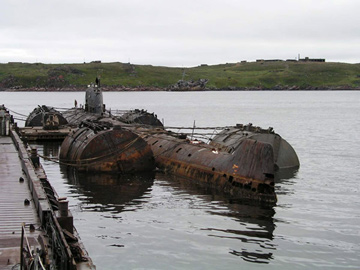 serious emergency.
the K-27 poses the most dangers for retrieval because its reactor might explode.
Raising sunken nuclear subs finally taking center stage , Bellona, April 22, 2015 by Anna Kireeva anna@bellona.ru, Charles Digges charles@bellona.no MURMANSK─ Two nuclear submarines lost or sunk by the Russian and Soviet Navies still lay at the bottom of the sea posing a possible source of contamination and laying tripwires to Moscow’s ambitious plans to develop the industrial and oil infrastructure of the Arctic.
The issue was one under discussion at a joint conference held by Bellona and Russian state nuclear corporation Rosatom last week in Murmansk. Authorities say lifting the K-27, scuttled by the Soviet navy after an accident, and the K-159, which the Russian navy lost while towing it to dismantlement, will require substantial research – and financing. The question of moving the submarines has long been on the table,but has gained little momentum in past year.
Now, though, they are standing in the way of Russia’s new national preoccupation with developing the Arctic for industry, oil and gas. The push early this week took antic proportions when Russian Deputy Prime Minister Dmitry Rogozin made a surprise visit Satuday to the Norwegian archipelago of Svalbard with no visa and despite sanctions against him not to enter the Europe for his role in in destabilizing the conflict in Eastern Ukraine……..
To realize the jingoistic mission, Russia has prioritized a giant Arctic pollution cleanup operation that would include dealing with decades of nuclear dumping in Arctic seas.
As revealed by Bellona in 2012, such litter includes nuclear submarines and ships, former military port infrastructure, sunken containers of spent nuclear fuel and nuclear waste…..
The waste includes 17,000 containers of radioactive waste; 19 ships containing radioactive waste; 14 nuclear reactors including five that still contain spent nuclear fuel; 735 other pieces of radioactively contaminated heavy machinery, two subs – the K-27, dumped in the shallows of the Kara Sea’s Novaya Zemlya Archipelago in 1981, and K-127, which sunk in 2003.
The joint forum, called “Results of cooperation on elevating nuclear and radioactive safety in Northwest Russia” took a more sober tone than Rogozin’s “ministerial visit,” as Russian media called it.
“If there is a lot of work going into the sphere of vessel dismantlement and rehabilitating land infrastructure, then the issue of sunken submarines and other radiation hazards has fallen from attention,” Mikhail Korbinsky, the Nuclear Safety Institute of the Russian Academy of Sciences (IBRAE) laboratory chief told the conference.
The radioactive dangers are clustered around Novaya Zemlya – a former nuclear test site – in the Kara Sea, and stand in the way of oil and gas prospecting points.
The most dangerous cast offs, say scientists, are the submarines, as the nuclear fuel in their reactors could ignite a serious emergency.
K-159 not prepped for sinking…… Of concern is that the submarine has no additional protective shielding preventing the escape of radionuclides into the environment. The sub also sustained an impact while sinking that could have further damaged its already shabby hull, and further increase the risk of rust corrosion and the release of radiation.
The scientists said this submarine is the more radioactive of the two that have sunk, and that it went down in an area of heavy marine traffic.
The scuttled K-27 The K-27, with its liquid metal cooled reactor, was prepped to sink. It’s reactors were flooded with a special preservation element – but a few years later it was discovered the preservative wasn’t holding.
“Water ingress into the reactor could cause an uncontrolled chain reaction,” said Korbinsky. “For the situation to reach heightened criticality, only five or six liters of water entering [the reactor] is sufficient.” He added that the subs highly enriched uranium fuel lying in shallow water of only 30 meters it the worst possible situation for a chain reaction……….Andrey Kramorenko, head of research and development for rescue and underwater technology at the Russian Navy’s Scientific Research Institute, told the conference the K-27 poses the most dangers for retrieval because its reactor might explode. He echoed Korbinsky, saying its shallow grave also presented risks………..http://bellona.org/news/nuclear-issues/radioactive-waste-and-spent-nuclear-fuel/2015-04-raising-sunken-nuclear-subs-finally-taking-center-stage
No comments yet.
1 This Month

of the week – Shut Down Drone Warfare!


Tell the Ukrainian Government to Drop Prosecution of Peace Activist Yurii Sheliazhenko

Petition to revoke the licensing of the Near Surface Nuclear Disposal Facility (NSDF) at Chalk River. https://www.ourcommons.ca/petitions/en/Petition/Details?Petition=e-7247
To see nuclear-related stories in greater depth and intensity – go to https://nuclearinformation.wordpress.com
-
Archives
- March 2026 (230)
- February 2026 (268)
- January 2026 (308)
- December 2025 (358)
- November 2025 (359)
- October 2025 (376)
- September 2025 (257)
- August 2025 (319)
- July 2025 (230)
- June 2025 (348)
- May 2025 (261)
- April 2025 (305)
-
Categories
- 1
- 1 NUCLEAR ISSUES
- business and costs
- climate change
- culture and arts
- ENERGY
- environment
- health
- history
- indigenous issues
- Legal
- marketing of nuclear
- media
- opposition to nuclear
- PERSONAL STORIES
- politics
- politics international
- Religion and ethics
- safety
- secrets,lies and civil liberties
- spinbuster
- technology
- Uranium
- wastes
- weapons and war
- Women
- 2 WORLD
- ACTION
- AFRICA
- Atrocities
- AUSTRALIA
- Christina's notes
- Christina's themes
- culture and arts
- Events
- Fuk 2022
- Fuk 2023
- Fukushima 2017
- Fukushima 2018
- fukushima 2019
- Fukushima 2020
- Fukushima 2021
- general
- global warming
- Humour (God we need it)
- Nuclear
- RARE EARTHS
- Reference
- resources – print
- Resources -audiovicual
- Weekly Newsletter
- World
- World Nuclear
- YouTube
-
RSS
Entries RSS
Comments RSS
 nuclear-news
Leave a comment