Meticulous research indicates much greater likelihood of another Chernobyl-scale nuclear accident
Wheatley and co’s work suggests that a Chernobyl-scale accident is worryingly likely to occur within the working lifetime of the reactors now being built. And when that happens, a once obscure place will enter the lexicon as a synonym for catastrophe, just like Chernobyl, Windscale and Fukushima.
These risks will have to be carefully weighed against the advantages. The question for engineers, policy makers and the general public alike is whether that risk is worth taking, given what’s at stake.
 The Chances of Another Chernobyl Before 2050?
  50%, Say Safety Specialists, MIT Technology Review April 17, 2015 “…..And there’s a 50:50 chance of a Three Mile Island-scale disaster in the next 10 years, according to the largest statistical analysis of nuclear accidents ever undertaken……..
Today, we get an answer thanks to the work of Spencer Wheatley and Didier Sornette at ETH Zurich in Switzerland and Benjamin Sovacool at Aarhus University in Denmark. These guys have compiled the most comprehensive list of nuclear accidents ever created and used it to calculate the likelihood of other accidents in future.
Their worrying conclusion is that the chances are 50:50 that a major nuclear disaster will occur somewhere in the world before 2050. “There is a 50 per cent chance that a Chernobyl event (or larger) occurs in the next 27 years,” they conclude.
The nuclear industry has long been criticised for its over-confident attitude to risk. But truly independent analyses are few and far between, partly because much of the data on accidents is compiled by the nuclear industry itself, which is reluctant to share it.
The International Atomic Energy Agency rates accidents using a system called the International Nuclear Event Scale, which is related to the amount of radiation released. However, the Agency does not publish a historical database of these accidents, probably because it has a dual role of both regulating the nuclear industry and promoting it. Continue reading
Flamanville nuclear safety problem – a knockout blow for UK’s EPR reactor project?
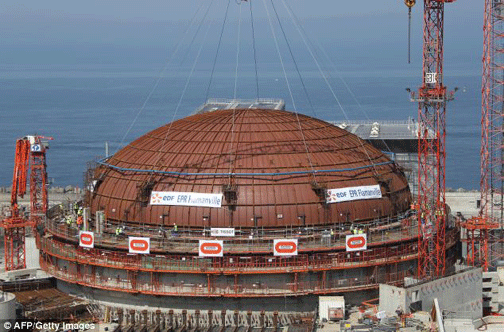 France’s nuclear calamity has UK worried, The Local, 21 Apr 2015 France’s world renowned prowess in the nuclear industry is being seriously undermined by its efforts to build a flagship nuclear reactor which is fast becoming a costly calamity. The future of the Flamanville 3 project appears to hang in the balance after yet another major setback that has London worried.
It was supposed to showcase the expertise of France’s nuclear energy industry to the world and is key to the UK’s own nuclear strategy. But after being beset by hold-ups and snags – the latest and potentially most serious one coming last week, the flagship project to build a new state of the art nuclear reactor, France is getting a reputation for all the wrong reasons and London has been left looking on nervously.
In 2005 the French government proudly gave the green light for construction to begin on the first third-generation nuclear reactor at Flamanville in Normandy on the north coast, a site environmentalists say is threatened by flooding.The third-generation “European Pressurized Reactor” (EPR), built by EDF and Areva, was supposed to be in operation by 2012 and is meant to be one of the safest reactors in the world, and the most energy efficient. It was commissioned as part of France’s nuclear renaissance programme that will see the country’s aging nuclear plants replaced over time.
However Flamanville 3, as it is known, is unlikely to start producing power anytime soon after being hampered by a litany of problems and incidents, including the death of a construction worker in 2011 (see below).
The latest setback came last week when it was revealed that “a very serious fault” had been detected in the steel of the “pressure vessel” – a key component of the reactor, meaning another delay of at least a year was likely. “It is a serious fault, even a very serious fault, because it involves a crucial part of the nuclear reactor,” said Pierre-Franck Chevet, head of France’s nuclear safety agency (ASN).
That “fault” means construction is unlikely to be completed before 2018 and more worryingly, the budget, initially set at €3.3 billion, is now estimated at more than €9 billion and counting.
In short Flamanville has become France’s own “nuclear catastrophe” as it was described in one of the many critical articles in the French press. Tests will need to be carried out on the steel vessel but if after these tests the vessel still does not meet necessary safety standards, it will need to be changed.
“That’s a very difficult operation in terms of costs and time,” said the ASN’s Chevet. The steel vessels weigh around 425 tonnes and stand around 11 metres high so building a new one would take considerable time and come at a huge cost.Changing the vessel would be a major headache given all the construction work that would need to be undone.
Some in the business of nuclear safety have even suggested that if the steel vessel needs replacing then the whole project could be scrapped. That will have authorities in the UK sweating as the same steel has been used to build two vessels destined for the planned EPR nuclear reactors at Hinkley Point in the UK.…….
“This is clearly the knock-out blow for the EPR reactor,” said Yannick Rousselet from Greenpeace. “What foreign client would want to purchase a reactor of this type, if even France itself is not able to complete the construction?
“The bill from the EPR reactor will be so high that it won’t end up showcasing what to do, but exactly the opposite,” said Rousselet. “This is a huge blow to the know-how of the French nuclear industry.”
Greenpeace has called for work at Flamanville to be called off.
“It must be stopped immediately so there is no more wasting of public funds on this industrial nightmare,” said Rousselet, who added that France should be concentrating resources on finding renewable energy solutions……..http://www.thelocal.fr/20150421/flamanville-frances-own-nuclear-nightmare
The demise of 2 robots inside the Fukushima nuclear disaster
These Robots Are Stranded Inside a Nuclear Disaster http://www.defenseone.com/technology/2015/04/these-robots-are-stranded-inside-nuclear-disaster/110683/ BY ADAM PASICKQUARTZ
This month, a Tokyo utility company sent two specially-designed robots on an ill-fated mission into the Fukushima nuclear disaster site to assess the damage.
Four years after an earthquake and tsunami destroyed Japan’s Fukushima nuclear plant, Tokyo Electric Power Co. is still at work trying to clean up the scene. This month TEPCOsent two specially-designed shape-shifting robots into the Fukushima No. 1 nuclear reactor to assess the damage.
Even if the robots hadn’t been damaged, a Pixar-style “WALL-E” ending was never in the cards: As IEEE Spectrum notes, the robots became so radioactive that they would have been permanently stored in a shielded box if they had returned from their missions.
The anonymous snakebots may be done for, but there is still a vast robot menagerie working on the Fukushima cleanup—including Quince, Packbot, Raccoon, and Rosemary
Austria’s opposition to nuclear power
Why Austria traditionally opposes nuclear power https://www.dailystar.com.lb/Opinion/Commentary/2015/Apr-22/295256-why-austria-traditionally-opposes-nuclear-power.ashx Andreas Molin The Daily Star Last October, the European Union approved a controversial subsidy deal to allow billions of pounds of state aid for Hinkley Point C, a new nuclear reactor planned for the United Kingdom. Austria’s intention to launch a legal challenge against this decision has provoked controversial comments in international media. So, why does Austria care about a nuclear power plant being built in the U.K., and what are the real issues at stake?
Austria has been deeply skeptical about nuclear power for decades. Recall that in a 1978 referendum, the Austrian electorate decided not to start the operation of the nuclear Zwentendorf power plant. After the catastrophic events in Chernobyl in 1986, the opposition to and concerns about nuclear power became deeply rooted in the Austrian population, at all levels of society. (Austria was among those countries in Central Europe that were most affected by the disaster.)
Information regarding the safety of nuclear power plants of Russian design, which became public after 1989, reinforced these apprehensions, leading to explicit government policy in 1990.
A joint publication by the Heads of the European Radiological protection Competent Authorities and the Western European Nuclear Regulators Association released in October 2014 clearly states “that the possibility of severe accidents … cannot be completely ruled out. Such accidents could be as severe as the Fukushima one, affect more than one European country and require rapid protective actions in several of them.”
The transboundary nature of the risks associated with nuclear power dictates that the legitimate interests of Austrian citizens are represented in relation to all nuclear projects and installations.
As a matter of principle, Austria does not consider nuclear power to be compatible with the concept of sustainable development. Therefore, it does not consider reliance on nuclear power to be a viable option to combat the greenhouse effect. Sustainable development, if fully applied to the energy sector, would require substantial increases in energy efficiency and energy saving as well as a switch to renewable sources of energy.
It has been argued that the Austrian government’s long-standing position on this subject, supported by numerous resolutions in parliament, is at the core of the intended legal challenge. But that is not the case. Austria fully respects every country’s sovereign right to decide on its national energy mix.
The Austrian objection stems from concern about the provision of British aid for the project, and the extent to which it would comply with common European state aid and competition rules. The current European Environmental and Energy State Aid Guidelines allow, under strictly defined circumstances, for state aid to renewable energy projects, but there are no such rules for nuclear power projects. Therefore, an assessment has to be made on the basis of general EU competition law.
As a general rule, the Treaty on the Functioning of the European Union prohibits state aid, while it leaves some room for certain policy objectives for which state aid can be considered compatible with the internal market.
European Commission guidelines and decision practice, as well as the European Court of Justice’s jurisdiction, have developed a set of principles that put these exemptions to the general rule into concrete terms. As the planned state aid for Hinkley Point C differs tremendously from all of these principles, it seems inevitable that the European Commission’s decision will be challenged.
The commission seems to be relying heavily on the idea of market failure, for instance, to justify its decision. This cannot be accepted: If the market fails to finance an unsustainable project, it is simply doing its job.
In essence, the arguments raised in order to justify this state aid could apply to any other large-scale power project as well. State aid for the Hinkley Point C nuclear power plant could therefore not only serve as a model for further nuclear new build projects, but also lead to a run on state aid throughout the entire EU energy sector.
Against this background, Austria felt it had no option but to challenge this state aid decision in the courts of the European Union. This action is not aimed at any particular EU member state, but rather seeks to defend a common competition regime, which this decision could render meaningless.
Andreas Molin is the director of the Austrian Federal Ministry of Agriculture, Forestry, Environment and Water Management. He is the Austrian representative in the Steering Committee for Nuclear Energy of the Nuclear Energy Agency of the Organization for Economic Cooperation and Development and has served as vice chairman of the European Nuclear Safety Regulators Group(ENSREG) since 2011. This commentary originally appeared at TheMark News (www.themarknews.com).
Exelon’s strategies indicate that the nuclear industry is a thing of the past
 Did Exelon Corporation Just Quietly Admit That Nuclear Power Is Dead?, Motley Fool, By Maxx Chatsko | April 21, 2015 | “………..The fast-falling costs of renewable energy and sudden global abundance of natural gas have turned the tables on nuclear power generators, which suffer from relatively high maintenance costs and, for newer plants, absurdly high upfront construction costs.
Therefore, it should also not come as a surprise that Exelon has been carefully hedging against its existing nuclear power plants by investing in lower-cost generation. For instance, the company recently handed General Electric Company (NYSE: GE ) over $500 million for four next-generation natural gas turbines, which will combine to generate over 2,000 MW of electricity for the Texas grid. Is this a quiet admission that traditional nuclear power is dead?……….
Although the details surrounding the natural gas fired turbines look favorable for investors, some simple number-crunching certainly favors the thesis that traditional nuclear power is dead, even if Exelon hasn’t explicitly mentioned the possibility (or considered it internally). While the company won’t be ditching its existing nuclear facilities anytime soon, investors surely shouldn’t expect it to build any new nuclear capacity, either………
Or think about it another way: Exelon’s investment will increase its 2013 natural gas capacity by 25% and represent more capacity than the company’s total wind and solar assets. Even if the company paid twice as much for future next-generation natural gas turbines, or $1 billion for 1,000 MW of capacity, it could replace its entire 19,000 MW nuclear fleet for just $19 billion. That’s 126% of the price tag Southern Co is shelling out for just 2,500 MW of new nuclear capacity!
If that doesn’t communicate the fact that new construction of traditional nuclear power is a thing of the past, then perhaps nothing will…….
The fact that Exelon is going all-in on cheaper and more profitable power generation is terrific news for investors, and the wider trend sweeping the power industry will be great news for General Electric investors, too. ………http://www.fool.com/investing/general/2015/04/21/did-exelon-corporation-just-quietly-admit-that-nuc.aspx
Japanese court to rule on injunction to block restart of 2 nuclear reactors
Japan nuclear ruling to show whether legal fight emboldened By Reuters | 21 Apr, 2015,KAGOSHIMA (JAPAN): A Japanese court will rule on Wednesday on an injunction to block the restart of two more nuclear reactors, a decision that could determine whether a legal drive by citizens to prevent the reopening of the sector on safety grounds will gather steam.
A court order preventing Kyushu Electric Power Co from operating Sendai would risk tying up the industry in legal battles for months or years.
Last week’s ruling “certainly sets a precedent and it will cause some of the other governors and other courts to think twice” about nuclear, said Michael Jones, Senior Analyst at consultancy Wood Mackenzie,
Local residents who submitted a suit against the restart of the restart of the Sendai reactors argue the utility and regulator has underestimated the risk of nearby volcanoes and operational plans lack credible evacuation measures. …….
Should the injunction request be rejected, as many expect, Japan’s biggest utilities still face the possibility of being forced to mothball their reactors amid mounting legal challenges, Jones said.
“It is not totally unreasonable to think that, to imagine, that the three largest utilities, Tepco, Chubu and Kans .. http://economictimes.indiatimes.com/articleshow/47004245.cms?utm_source=contentofinterest&utm_medium=text&utm_campaign=cppst
Fukushima radiation raises cancer risk for millions of people
Report says 32 million people in Japan are exposed to radiation from the Fukushima nuclear disaster (PRWEB UK) 11 March 2015 Geneva: Approximately 32 million people in Japan are affected by the radioactive fallout from the nuclear disaster in Fukushima, according to the 2015 Fukushima Report now available from Green Cross. This includes people who were exposed to radiation or other stress factors resulting from the accident, and who are consequently at potential risk from both long and short-term consequences.
The 2015 Fukushima Report is available for download in English at http://www.greencross.ch/en/news-info-en/case-studies/fukushima-report.html. Continue reading
Germany’s nuclear exit costly: other countries’ exit might be worse

Costs for Germany’s nuclear exit could rise to $75 billion http://www.reuters.com/article/2015/04/20/us-germany-utilities-nuclear-exit-idUSKBN0NB18S20150420 BERLIN Reuters) – The bill for shutting down Germany’s nuclear power plants and building a safe disposal site for nuclear waste could rise to 70 billion euros ($75 billion), the head of a government commission told daily Frankfurter Rundschau in an interview
E.ON, RWE, EnBW and Vattenfall [VATN.UL] are due to switch off their nuclear plants by a 2022 deadline set by Chancellor Angela Merkel’s government after the Fukushima disaster in Japan in 2011.
A decision by E.ON to restructure its business and spin off its conventional power plants raised additional fears that taxpayers may end up footing a portion of the bill for dismantling the nuclear plants and storing waste.
“There are significant financial risks coming up for the state,” said Michael Mueller, head of the government’s task force charged with finding a disposal site for nuclear waste.
The costs for the nuclear exit could rise to up to 70 billion euros over the next decades, meaning that the 36 billion euros ($38 billion) in provisions set aside by the four nuclear operators were not sufficient, he added.
Spokesmen from E.ON and EnBW said in separate statements that the companies’ provisions were sufficient and that they were certified on a regular basis by external auditors. conomy Minister Sigmar Gabriel has told lawmakers from his center-left Social Democrat (SPD) party that he wants to look into creating a public body to oversee the multibillion-euro risks associated with the nuclear switch-off.
The government is sounding out the option of subjecting the balance sheets of the four nuclear power plant operators to a stress test to ensure their provisions are adequate.
(Reporting by Michael Nienaber, Markus Wacket, Vera Eckert and Chris Steitz, editing by William Hardy)
Safety conscious regulator ousted by the nuclear industry – new documentary
 Top Nuclear Watchdog Forced Out by Industry, Reader Supported News By Lewis Beale, The Daily Beast19 April 15
A new documentary shows the lengths the industry will go to put the public at risk
 regory Jaczko was chairman of the U.S. Nuclear Regulatory Commission when Japan’s Fukushima power plant suffered a major meltdown in 2013. An advocate of tightening safety controls at America’s aging nuclear facilities after the Fukushima disaster, Jaczko soon discovered that despite his concerns, the influence of profit-hungry corporations over the NRC was affecting its ability to adequately police the industry—and putting the public in danger.
“When I served as chairman [of the NRC], there appeared to be commissioners who were more interested in industry conditions, that the NRC’s job was to protect the industry from the staff of the NRC,” Jaczko told The Daily Beast. “A lot of times, they said the staff was being too aggressive.”
Jaczko’s concerns, and his eventual ouster from the NRC, are part of a larger story told inIndian Point, a new documentary screening this week and next at the Tribeca Film Festival. Named after the electricity-generating nuclear reactor just 35 miles from New York City, the film is a cautionary tale about a technology once seen as an abundant and non-polluting energy source, but with downsides that could make oil spills and electrical brownouts seem as minor as a fender bender……..
Jaczko, whom the film alleges was ousted because of his views (his was the only dissenting vote on plans to build the first American nuclear plant in 30 years) is not alone in his concern about safety issues, and the industry’s reliance on old, outdated technology. Indian Point’s two reactors went online in 1975 and 1976, respectively, and, says Meeropol, “most of the plants in the U.S. are as old as Indian Point or older. Plants all over the country are having to replace major parts, they are just trying to fix things all the time. That’s a problem the entire industry has.”
Then there’s the issue of toxic waste. The fuel rods in these plants are highly radioactive, and can stay that way for 200,000 years. When they are spent, they need to be stored somewhere. The issue of what to do with this waste has never really been resolved, which means, says Musegaas, “Indian Point and other plants have become de facto toxic waste dumps for nuclear fuel.” According to the film, there is three times more toxic waste stored at Indian Point than there was in Fukushima.
Indian Point also delves into the environmental effect some of these plants have on our nation’s waterways. The fuel rods need to be constantly cooled, which means, in the case of a plant like Indian Point, 2.5 billion gallons of water are pulled from the Hudson every day, heated up when it passes through the plant, and dumped back in the river—a process that can kill millions of fish. “It’s mind-boggling how much life is going through the cooling system of this plant and getting toasted,” says Riverkeeper boat captain John Lipscomb in the film.
Given all these problems, it’s unsurprising that opposition to the Indian Point plant has been ongoing for decades…….
Jaczko: “The best thing to do is to figure out how to close it down. The best solution is to negotiate a narrow period of operation, so you can transfer the electricity generation and do it in a responsible way. If you can’t get your neighbors in the community to accept the plant, something’s not working.” http://readersupportednews.org/news-section2/312-16/29711-top-nuclear-watchdog-forced-out-by-industry
Tax battle, indigenous opposition – add to woes of uranium company Cameco
Multi-million dollar tax battle casts shadow over Canada-India uranium deal, Vancouver Observer The Canadian mining company selected to provide uranium to India is still fighting Canada Revenue Agency over millions in unpaid back taxes. Danny Kresnyak
Apr 19th, 2015 “……….. Cameco, the Saskatchewan-based company hired to supply India with 3,220 metric tonnes of uranium over five years, is wrapped up in legal a fight with Canada Revenue Agency over millions in owed taxes. In 2013, the Globe and Mail reported the company owes $800 million in back taxes………
in addition to the tax battle with Canada Revenue Agency, the company’s drilling operations in Saskatchewan are facing significant opposition from the Clearwater Dene First Nation…….
In a road north of La Loche, Saskatchewan, a group called “Holding the Line Northern Trappers Alliance” (HLNNTA) has been camping in the area to block companies from further exploratory drilling in their territory. The group first set up camp last November, and promises to remain until mining companies leave.
The HLNNTA argued they are unable to pursue the traditional, ecologically sound way of life of their ancestors, due to incursion by companies like Cameco looking for mineral deposits on their land.
HLNNTA spokesperson Candyce Paul told the Vancouver Observer she was opposed to the Cameco uranium deal with India. She said “scientific evidence is building towards proving that the uranium mining industry is killing the Indigenous people of northern Saskatchewan.”………
US FILM THE RETURN OF NAVAJO BOY RECEIVES YELLOW OSCAR
 Exposing Uranium Mining ‘Return of Navajo Boy’ Receives Yellow Oscar in Rio, Censored News 21 Apr 15 Navajo Boy Co-producer Bennie Klain, Dine’ (Navajo) US FILM THE RETURN OF NAVAJO BOY RECEIVES YELLOW OSCAR
RIO DE JANEIRO/QUEBEC CITY, Rio de Janeiro´s 5th International Uranium Film Festival started Wednesday, April 15, with a wonderful Gala and the presence of international guests from all five continents including French Canadian actress Karine Vanasse in Quebec City. Until April 25 this unique global film festival will screen more than 40 documentaries, short films, animations and fiction movies about nuclear power, uranium risks and atomic bombs. The Grand Council of the Crees (Eeyou Istchee) is the event’s principal host of this in the world most important film festival about nuclear energy and radioactive risks in Quebec.
USA 2000/2008, 57 min and 15 min, Epilogue / Documentary, Director:
Jeff Spitz, Produced by Jeff Spitz and Bennie Klain, www.navajoboy.com<(link is external)http://www.navajoboy.com>……
Call to Australian and Canadian govts not to sell uranium to India
International call not to sell uranium to India http://www.acfonline.org.au/news-media/media-release/international-call-not-sell-uranium-india April 15, 2015
 Canadian and Australian governments not to further advance controversial plans for uranium sales to India.
The call comes as Australian nuclear free campaigners join Indigenous landowners affected by uranium projects to present at the World Uranium Symposium in Québec.
The conference takes place against the backdrop of Indian Prime Minister Narendra Modi’s visit to Canada and Australian Foreign Minister Julie Bishop’s trip New Delhi to advance planned uranium sales.
“Canada and Australia should show responsibility restraint and prudence, as India has been criticised widely over the safety, security and transparency of its nuclear industry,” ACF’s Dave Sweeney said. “Australia and Canada should not rush into uranium sales agreements with India while serious concerns about safety and security remain unresolved.”
Australia’s controversial uranium deal with India has been widely criticised, including by former safeguards director John Carlson, who was for two decades head of Australia’s safeguards regime and was a keen nuclear promoter. Mr Carlson has raised concernsthat the new treaty’s administrative arrangements could substantially depart from Australia’s usual safeguards conditions, meaning Australia may be unable to keep track of what happens to uranium supplied to India.
Speaking from Québec ACF’s Dave Sweeney called on the Canadian and Australian governments not to further fuel instability in South Asia by selling uranium into the already volatile region.
“Uranium is not like other minerals. It is the fuel for nuclear weapons and creates carcinogenic waste that lasts for thousands of years,” he said. “Fuelling danger and instability in India is not in the interests of Canada or Australia.”
Use of inappropriately high radiation still occurring in US medical centers
CT Radiation Doses Still Too High in Most US Centers, STONE Shows Pam Harrison April 21, 2015 TORONTO — Some patients presenting to the emergency department with suspected kidney stones receive inappropriately high doses of radiation when undergoing CT. This is despite longstanding recommendations to use low-dose protocols in such patients…….http://www.medscape.com/viewarticle/843510
USA and Russian generals warn of danger of cyber criminals causing a nuclear disaster
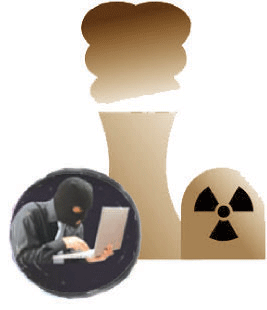 Сybercriminals may provoke nuclear disaster – US, Russian generals, Rt.com April 20, 2015 Modern technologies, coupled with Cold War-era nuclear doctrines and increasing tensions between the US and Russia make a nuclear war a real threat, say high-ranking retired officers from both countries.
The two generals say this system is susceptible to provocations and malfunctions. With the advent of precise computer technologies, the chance of such an error occurring has been decreasing. However, at a time when cyberattacks are becoming increasingly common, the danger of someone deliberately triggering a false warning has jumped.“This makes it all the more critical for Russia and the United States to talk, to relieve the pressures to “use or lose” nuclear forces during a crisis and minimize the risk of a mistaken launch,” their article reads.
The US and Russia have signed a joint nuclear arsenal reduction treaty called New START (Strategic Arms Reduction Treaty), in April 2010. It is aimed at drastically decreasing the number of nuclear weapons available to both nations.
Despite both Russia and the US complying with the treaty and reducing their arsenals to about 1,500 warheads each, they remain in possession of two of the world’s largest atomic payloads.
Cooperation on the treaty remains “a silver lining” amid growing Russia-US tensions, Assistant Secretary of State Frank Rose said on Thursday: “At such a hard time it is highly important to maintain transparency in the displacement and deployment of strategic nuclear weapons… The two sides have made a significant progress over the restrictions presumed by the treaty by February 2018”.http://rt.com/news/251361-nuclear-apocalypse-possible-warning/
Renewable energy now being produced globally, on an industrial scale
In developing countries, where renewables are best positioned to address the chronic lack of energy access, clean energy investment rose 36% to $131bn. It’s well on track to surpass investment in developed countries, which amounted to $139bn last year.
The world is finally producing renewable energy at an industrial scale’, Guardian Achim Steiner, 21 Apr 15 Clean energy has spread to every corner of the globe, with more than 100,000 megawatts of capacity installed last year Renewables are finally becoming a globally significant source of power, according to a United Nations Environment Programme report released in March by Frankfurt School UNEP Centre and Bloomberg New Energy Finance.
Driven by rapid expansion in developing countries, new installations of carbon-free renewable power plants in 2014 surpassed 100,000 megawatts of capacity for the first time, according to the Global Trends in Renewable Energy Investment report. It appears that renewable energy is now entering the market at a scale that is relevant in energy industry terms – and at a price that is competitive with fossil fuels.
The numbers are compelling. Renewables such as wind, solar and biomass generated an estimated 9.1% of the world’s electricity in 2014, up from 8.5% in 2013, according to the report. These sources made up the majority of new power capacity in Europe, and also brought electricity to new markets.
They also caught the eyes of investors: in 2014, energy investment in rose 17% over the previous year, surging to $270bn, according to the report.
Conventional wisdom meets unconventional growth
Some experts still predict that fossil fuels will supply the majority of our energy for decades to come, but the evidence strongly points in another direction. As the Global Trends report points out, the clean energy investment that funded almost half of all new power plants in 2014 came at what would, seemingly, be a very bad time for renewables. While oil prices were rapidly falling and China’s coal consumption was decreasing, both commodities were, if anything, more economically viable.
But at the same time, renewables appear to be increasing rather than decreasing in competitiveness. For example, a large-scale solar plant in Dubai has recently bid to provide electricity at less than $0.06 per kilowatt-hour. To put this in context, this is less than what the vast majority of consumers around the world pay to keep the lights on. It’s a third of the cost of electricity in Africa. Grid parity for solar is already available in many countries; in others, it’s just around the corner.
In developing countries, where renewables are best positioned to address the chronic lack of energy access, clean energy investment rose 36% to $131bn. It’s well on track to surpass investment in developed countries, which amounted to $139bn last year.
When it came to investment, China led with $83bn in clean energy funding, but many other countries followed closely behind. Some of the most promising states – like Brazil, India and South Africa – are expected to lead the way. Others, like Kenya, which boasts one of the largest solar rooftop system on the continent and shortly the largest wind farm, are more of a surprise……..http://www.theguardian.com/vital-signs/2015/apr/20/renewable-energy-global-trends-solar-power
1 This Month
19 February – VIRTUAL EVENT-Decision Time: AI and Our Nuclear Arsenal
12:45 p.m. Central / 1:45 p.m. Eastern
To see nuclear-related stories in greater depth and intensity – go to https://nuclearinformation.wordpress.com
-
Archives
- February 2026 (127)
- January 2026 (308)
- December 2025 (358)
- November 2025 (359)
- October 2025 (376)
- September 2025 (258)
- August 2025 (319)
- July 2025 (230)
- June 2025 (348)
- May 2025 (261)
- April 2025 (305)
- March 2025 (319)
-
Categories
- 1
- 1 NUCLEAR ISSUES
- business and costs
- climate change
- culture and arts
- ENERGY
- environment
- health
- history
- indigenous issues
- Legal
- marketing of nuclear
- media
- opposition to nuclear
- PERSONAL STORIES
- politics
- politics international
- Religion and ethics
- safety
- secrets,lies and civil liberties
- spinbuster
- technology
- Uranium
- wastes
- weapons and war
- Women
- 2 WORLD
- ACTION
- AFRICA
- Atrocities
- AUSTRALIA
- Christina's notes
- Christina's themes
- culture and arts
- Events
- Fuk 2022
- Fuk 2023
- Fukushima 2017
- Fukushima 2018
- fukushima 2019
- Fukushima 2020
- Fukushima 2021
- general
- global warming
- Humour (God we need it)
- Nuclear
- RARE EARTHS
- Reference
- resources – print
- Resources -audiovicual
- Weekly Newsletter
- World
- World Nuclear
- YouTube
-
RSS
Entries RSS
Comments RSS
 nuclear-news