Infantile Nuclear Peekaboo Game

Unlike traditional peekaboo, nuclear peekaboo is a most deadly game.
The nuclear industry, and those who are pro-nuclear, seem to not have evolved out of the infant stage where there is no understanding of object permanence, which is why peekaboo works: “Object permanence is the understanding that objects continue to exist even when they cannot be observed (seen, heard, touched, smelled or sensed in any way).” http://en.wikipedia.org/wiki/Peekaboo
The nuclear industry is constantly adding dangerous radionuclides into the environment. Even relatively short-lived radionuclides like tritium will be in the environment for well over a 100 years. Others will be in the environment for hundreds, thousands, and even millions of years. The nuclear industry legally flushes radionuclides into air and water. Whether it stays nearby or goes someplace else, it is ever building up in the environment. For instance, if 1 mSv is allowed into an individual’s environment each year…
View original post 920 more words
Issues Paper South Australia Royal Commission – confused and inadequate

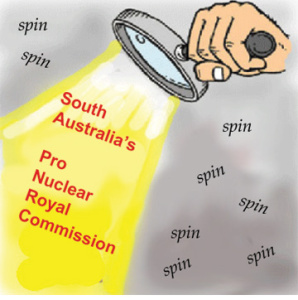 The paper appears to be totally confused by what is a cyclic process. For example, the phrase “once-through” cycle is an oxymoron and reprocessing spent fuel is just that, not recycling. These terms come from the nuclear industry’s spin doctors.
Nowhere in this Issues Paper is information given on Government funding of the nuclear industry either directly in the form of grants and through government supplied services such as exploration, testing, environmental, and occupational health and safety services or indirect in the form of administrative services associated with the nuclear industry. We have no way of telling, for example, whether government expenditure has been recouped through royalties.
NUCLEAR FUEL CYCLE (sic) ROYAL COMMISSION
ISSUES PAPER ONE
EXPLORATION, EXTRACTION AND MILLING (of Uranium and Thorium), critique by Dennis Matthews, 20 Apr 15
This, the first issues paper of the SA Government’s commission into expanding SA’s role in the nuclear industry, will…
View original post 1,741 more words
Why South Asia is not likely to go for nuclear power in the long run
Why South Asia needs a non-nuclear future Risky nuclear energy can be replaced by safer and cheaper options in South Asia, writes Pervez Hoodbhoy. SciDev.net 22 Apr 15
Considered risky by increasing numbers of people, nuclear energy is now no longer the eagerly sought panacea to the world’s energy problems. From its all-time high of 17 per cent in 1995, its share of world production dwindled to 10 per cent in 2013. The Fukushima nuclear disaster, even more than Chernobyl, has left Japan and most western countries deeply worried and suspicious. Japan’s 48 reactors remain shut, about 120,000 people are homeless, and the three reactors that experienced core meltdowns are still in deep crisis. They will need another 30—40 years to fully decommission.
Some developing countries are also losing their former enthusiasm. Post-Fukushima, Indonesia’s civil society insisted that the country’s nuclear electricity programme be scaled back. Its demands were largely met. So, why has it been difficult for public opinion to compel any Pakistani or Indian government to similarly change course?
Opaque programmes
The reason is clear. Both countries used opaque civilian nuclear programmes to make nuclear weapons, which then became objects of national veneration and symbols of power. Shrouded in secrecy, nuclear establishments became a force in their own right. They were not subject to any significant scrutiny of safety aspects. Nor did they feel the need to reveal their plans for disaster management or prove their adequacy. While environmental impact mitigation schemes became legally necessary, these were not to be taken seriously. No attempts were made to educate populations near a reactor about radiation hazards.
India’s environmentalists India’s story is similar. Environmentalists have had some success in mobilising anti-nuclear protesters, notably on issues of land acquisition. The Fukushima disaster energised anti-nuclear groups like the Konkan Bachao Samiti and the Gandhian group known as the National Alliance of People’s Movements. But, though Indian activists may have mustered a few thousand protesters on occasion — most notably at the Kudankulam and Jaitapur nuclear reactor sites — they have gained no significant victories. ………
Safer energy options In spite of the enormous political clout of South Asia’s nuclear authorities and the hold they have in moulding public attitudes, in the long run the demise of nuclear fission power production globally is likely. A quiet revolution in manufacturing technology is leading to a massive surge in energy from both windmills and photovoltaics, and innovative storage mechanisms are being invented. The “levelised cost” (the total cost of installing a renewable-energy system divided by its expected energy output over its lifetime) of rooftop systems is now close to that of retail electricity prices in some countries.
With abundant sun and wind, South Asia has only begun its travel towards renewables. Cheaper by the day, small decentralised solar and wind units offer the best option for urban and village households. This will greatly decrease the pressure on gas, oil, and hydro generation and release energy for industry. Instead of chasing outmoded and dangerous 20thcentury technology, it is time for India and Pakistan to follow the world into a cleaner, safer 21st century.
Pervez Hoodbhoy holds a doctorate in nuclear physics and teaches in Lahore and Islamabad.
This article has been produced by SciDev.Net’s South Asia desk. http://www.scidev.net/index.cfm?originalUrl=south-asia/environment/opinion/why-south-asia-needs-a-non-nuclear-future.html
Radioactive Rubble Invasion?

French Invasion, Norman Conquest, 1066, Bayeux Tapestry
As discussed a few days ago, the UK Dept. of Energy and Climate Change (DECC) wants to declare highly radioactive waste, effectively “non radioactive”, by magical fiat, in order to send to it to landfills throughout the UK. Once exempted, the waste can end up not only in landfills, but as construction filler or anyplace else for “Controls on disposal of this material, after removal from the premises where the wastes arose, are not necessary.” Almost all nuclear reactors in the UK are currently owned by French State owned EDF. The second French invasion is radioactive.
The amounts effectively declared “non-radioactive” (approx. 4000 Bq/kg) and to be sent to landfill are 6 x more radioactive than allowed for EU food (4 x greater than UK food rules; 40 x greater than Japanese rules) and allow 400 x more tritium (40,000 Bq/liter)…
View original post 1,354 more words
More media misinformation about Germany’s Energiewende

 Solar power in a small village in Germany’s Black Forest region.
Reuters today published a story (and it is indeed a “story”) with the alarming headline Costs for Germany’s nuclear exit could rise to $75 billion.
You can be sure the nuclear and coal advocates will start spreading that around as yet one more “failure” of Germany’s Energiewende, or energy transition. Look, they’ll say, at the huge costs ending nuclear power are inflicting on Germany and its citizens.
But, like the argument that use of coal has increased because of the Energiewende and shutdown of some of Germany’s nuclear reactors (as we stated here, with two citations, coal increased because of decisions made before the nuclear shutdown decision, and coal’s use is now dropping as more renewables continue to be added to the nation’s energy mix), the Reuter’s story shows a misunderstanding of the situation, aggravated by…
View original post 1,181 more words
Cumbrian Based Fukushima Companies Lie About Energy Produced by Moorside Plan


Every paper this week in Cumbria has a double page spread about the plan to build 3 diabolic reactors on ancient green fields and hedgerows .
The nuclear industry and their government cronies have done everything in their power to steamroller Cumbria down this vicious radioactive route. But still that is not enough for them. They are lying to Cumbrians about the amount of electricity these 3 untried untested “Chernobyl on steroids” reactors would produce.
The double page advertorials printed in every local newspaper proclaim that
“NuGen’s Moorside Project aims to provide approximately 7% of the UK’s current energy requirement.”
This is a blatant lie
If NuGen do not know the difference between electricity and energy then why should we believe their other blatant lies that this will be “safe” “low carbon” and the biggest lie of all is the pretence that nuclear is not killing us with increasing radiation linked diseases.
Cumbrians…
View original post 140 more words
Fukushima Lessons Still Not Learned in the US; NRC Drafted Press Materials Saying Diablo Safe to Operate, Weeks Before Receiving Seismic Safety Study
“I have learned that NRC drafted its press materials saying that its review of PG&E’s seismic study said that the plant remained “safe to operate” weeks before PG&E even submitted the study to NRC in the first place“, Senator Barbara Boxer, 15 April 2015.
“Statement of Ranking Member Barbara Boxer: “Oversight Hearing: The President’s FY 2016 Budget Request for the Nuclear Regulatory Commission” April 15, 2015 (Remarks as prepared for delivery)
Today, the Environment and Public Works Committee is holding a hearing on the budget request for the Nuclear Regulatory Commission (NRC), fee recovery, and management issues.
Among the management issues I wish to explore today are the slow pace at which the NRC is implementing measures intended to protect American nuclear plants in the wake of the earthquake, tsunami, and nuclear meltdowns in Japan in March 2011. I’d be interested in the Commission’s views about…
View original post 613 more words
Homicidal Japan Court Approves Restart of Nuclear Reactor by Dangerous Decade Volcano
“Although Sakurajima’s activity since 1955 has been characterized by frequent small eruptions, the volcano still poses a danger to the densely-populated surroundings. Roughly 7,000 years ago Sakurajima erupted with a volcanic explosivity index (VEI) of 6, equivalent to the 1991 eruption of Mount Pinatubo“. (Emphasis added) http://earthobservatory.nasa.gov/NaturalHazards/view.php?id=45388&eocn=image&eoci=morenh
Sakurajima is classified as a “Decade Volcano”, one of 17 volcanoes, worldwide, “identified by the International Association of Volcanology and Chemistry of the Earth’s Interior (IAVCEI) as being worthy of particular study in light of their history of large, destructive eruptions and proximity to populated areas“. http://en.wikipedia.org/wiki/Decade_Volcano Sakurajima, 3 October 2009, Photo by Krypton, CC-BY-SA-3.0 via Wikipedia
Please tell me that this is a nightmare from which we will all shortly awaken and that it is not real:
“UPDATE 1-Japan court approves restart of reactors in boost for Abe’s nuclear policy
Posted:Tue, 21 Apr 2015 21:57:59 -0400
*…
View original post 732 more words
The Age of Wind and Solar is very nearly upon us
 The Age of Wind and Solar Is Closer Than You Think, Scientific American. Renewable energy, spurred by a crisis in climate, may usurp fossil fuels by mid-century April 22, 2015 |By Michael T. Klare “……..
there are good reasons to believe that the transition to renewables will occur much faster than previously assumed, pushing that percentage higher and higher. Indeed, recent increases in wind and solar installations have been running at nearly twice the rate of the IEA’s projections for long-term capacity growth, suggesting that its projections of renewables’ share of global energy are much too low………
Under ordinary circumstances, Smil’s forecast would no doubt prove accurate. But these are not ordinary times: Continue reading
Nuclear lobby pushing for corporate welfare and exports, through the Export-Import Bank

“Taxpayers should not be in the business of subsidizing risky loans or giving money to big businesses and foreign countries,” said Levi Russell, spokesman for Americans for Prosperity, a Tea Party-aligned group that, along with dozens of other conservative groups, is urging Congress to let Ex-Im expire.
Ex-Im fight goes nuclear, The Hill, 22 Apr 15 The nuclear power sector is emerging as one of the most vocal proponents of the Export-Import Bank, as debate intensifies over whether to reauthorize the increasingly controversial institution.
The Nuclear Energy Institute (NEI) is leading the charge to demonstrate to lawmakers that closing the bank would threaten the billions of dollars in economic activity and tens of thousands of jobs that come from exporting U.S. nuclear power technology and products.
The nuclear industry is also proving to be a top player among the big business groups that are doing the bulk of the lobbying on Ex-Im, which provides financing for U.S. companies to sell products and services to foreign customers.
Exports are essential to the nuclear industry, because a new reactor has not come online in the United States in nearly two decades and only five are under construction…….
The global market represents an important bounty for the U.S. industry. Continue reading
Obama keen to sell USA nuclear technology to China
 Obama proposes 30-year agreement with China on nuclear power WASHINGTON
(Reuters) 22 Apr – President Barack Obama on Tuesday proposed a 30-year agreement to cooperate with China on nuclear power, a deal that would allow the transfer of material, reactors, components and technology between the two nations, if approved by the U.S. Congress.
(Reporting by Roberta Rampton and Jeff Mason!) http://www.reuters.com/article/2015/04/21/us-usa-china-nuclear-idUSKBN0NC29220150421
South Korea hopes new deal with USA will forward its nuclear technology export business
 S. Korea, US strike new civil nuclear deal, Phys Org 22 Apr 15
 South Korea and the United States agreed a new nuclear cooperation pact Wednesday that stopped short of granting Seoul the permission it had sought to start reprocessing spent nuclear fuel.
But Seoul welcomed the deal, saying it provided a framework for improving spent fuel management and boosting nuclear exports. The new pact, which replaces an existing 1974 accord, was struck after four-and-a-half years of intense, drawn-out negotiations.
The main sticking point had been South Korea’s desire to develop uranium enrichment and reprocessing capabilities in order to address concerns about energy security and the management of spent nuclear reactor fuel.
Seoul says its storage facilities for spent fuel will reach capacity in 2016.
Long-standing US policy opposes the spread of such capabilities because they can be used to produce weapons-grade nuclear material and therefore pose a significant proliferation risk.
A South Korean statement on the new deal was short on specific detail but suggested it opened the door to reprocessing sometime in the future, by allowing South Korea to conduct “research” into spent fuel management.
That includes research into “pyroprocessing”—a new technology considered largely proliferation resistant, since the product is thermally and radioactively far too hot to use for a weapon.
“We established a pathway to lift some restrictions on activities in Seoul-owned facilities and to allow certain activities in the future,” the statement from the foreign ministry said……..
The deal was signed by Park and the US ambassador to Seoul, Mark Lippert, and will now go through an internal review process in both countries prior to ratification.
South Korea is a key US military ally and analysts say Washington’s concerns on allowing reprocessing stem less from a distrust of Seoul’s ultimate intentions than from the impact it might have on negotiations with other countries.
There are also worries that wider concessions on reprocessing could further complicate efforts to roll back North Korea’s nuclear programme.
Currently, Japan is the only non-nuclear weapons state that has both the technical capability and international permission to operate a commercial spent-fuel reprocessing programme.
Seoul had argued that allowing Japan to reprocess while denying South Korea the same concessions, smacks of double-standards, but Japan was forced to accept highly intrusive safeguards and, US officials point out, it doesn’t have North Korea on its border.
South Korea is the fifth-largest consumer of nuclear energy in the world, and relies on 23 nuclear reactors to meet about 30 percent of its annual power needs.
It has sought to become a leading exporter of nuclear power plants since it won a $20 billion deal in 2009 to build nuclear reactors in the United Arab Emirates. http://phys.org/news/2015-04-south-korea-nuclear.html#jCp
Post Fukushima, cesium found in Vermont milk
Radiation Detected In Drinking Water In 13 More US Cities, Cesium-137 In Vermont Milk , Forbes, Jeff McMahon, 4/09/2011
• Unusual Reading At Chatanooga Nuclear Plant
• Milk Contamination At EPA Maximum
• Highest Levels Yet In Boise Rainwater
[UPDATED with FDA’s Derived Intervention Level, EPA’s MCL for Cesium-137]
Radiation from Japan has been detected in drinking water in 13 more American cities, and cesium-137 has been found in American milk—in Montpelier, Vermont—for the first time since the Japan nuclear disaster began, according to data released by the Environmental Protection Agency late Friday.
Milk samples from Phoenix and Los Angeles contained iodine-131 at levels roughly equal to the maximum contaminant level permitted by EPA in drinking water, the data shows. The Phoenix sample contained 3.2 picoCuries per liter of iodine-131. The Los Angeles sample contained 2.9. The EPA maximum contaminant level is 3.0, but this is a conservative standard designed to minimize exposure over a lifetime, so EPA does not consider these levels to pose a health threat. The FDA, not the EPA, regulates milk.
[UPDATE: The FDA’s Derived Intervention Level for iodine-131 in milk is much higher: 4700 picoCuries per liter. Read why.]
Radioactive isotopes accumulate in milk after they spread through the atmosphere, fall to earth in rain or dust, and settle on vegetation, where they are ingested by grazing cattle. Iodine-131 is known to accumulate in the thyroid gland, where it can cause cancer and other thyroid diseases. Cesium-137 accumulates in the body’s soft tissues, where it increases risk of cancer, according to EPA.
Airborne contamination continues to cross the western states, the new data shows, and Boise has seen the highest concentrations of radioactive isotopes in rain so far.
A rainwater sample collected in Boise on March 27 contained 390 picocures per liter of iodine-131, plus 41 of cesium-134 and 36 of cesium-137. EPA released this result for the first time yesterday. Typically several days pass between sample collection and data release because of the time required to collect, transport and analyze the samples.
In most of the data released Friday the levels of contaminants detected are far below the standards observed by EPA and other U.S. agencies.
But the EPA drinking-water data includes one outlier—an unusually, but not dangerously, high reading in a drinking water sample from Chatanooga, Tennessee………http://www.forbes.com/sites/jeffmcmahon/2011/04/09/radiation-detected-in-drinking-water-in-13-more-us-cities-cesium-137-in-vermont-milk/
USA Government subsidies to oil, gas and nuclear far exceed investments in renewables
Early Fossil Fuel & Nuclear Energy Subsidies Crush Early Renewable Energy Subsidies September 27th, 2011 by Stephen Lacey The political reaction to the Solyndra scandal has been laughably devoid of both short-term and long-term historical perspective. In an attempt to exploit a political opportunity, many House Republicans are railing against government investments in the renewable energy sector. However, those same politicians requested millions of dollars for cleantech projects in their own states just a year or two before.
This bad case of amnesia stretches far beyond the last two years. Apparently, many in Congress have forgotten about the last 100 years of government investments in oil, gas and nuclear — all of which have far outpaced investments in renewable energy like solar PV, solar thermal, geothermal and wind……..http://cleantechnica.com/2011/09/27/early-fossil-fuel-nuclear-energy-subsidies-crush-early-renewable-energy-subsidies/
1 This Month

of the week – Shut Down Drone Warfare!


Tell the Ukrainian Government to Drop Prosecution of Peace Activist Yurii Sheliazhenko

Petition to revoke the licensing of the Near Surface Nuclear Disposal Facility (NSDF) at Chalk River. https://www.ourcommons.ca/petitions/en/Petition/Details?Petition=e-7247
To see nuclear-related stories in greater depth and intensity – go to https://nuclearinformation.wordpress.com
-
Archives
- March 2026 (230)
- February 2026 (268)
- January 2026 (308)
- December 2025 (358)
- November 2025 (359)
- October 2025 (376)
- September 2025 (257)
- August 2025 (319)
- July 2025 (230)
- June 2025 (348)
- May 2025 (261)
- April 2025 (305)
-
Categories
- 1
- 1 NUCLEAR ISSUES
- business and costs
- climate change
- culture and arts
- ENERGY
- environment
- health
- history
- indigenous issues
- Legal
- marketing of nuclear
- media
- opposition to nuclear
- PERSONAL STORIES
- politics
- politics international
- Religion and ethics
- safety
- secrets,lies and civil liberties
- spinbuster
- technology
- Uranium
- wastes
- weapons and war
- Women
- 2 WORLD
- ACTION
- AFRICA
- Atrocities
- AUSTRALIA
- Christina's notes
- Christina's themes
- culture and arts
- Events
- Fuk 2022
- Fuk 2023
- Fukushima 2017
- Fukushima 2018
- fukushima 2019
- Fukushima 2020
- Fukushima 2021
- general
- global warming
- Humour (God we need it)
- Nuclear
- RARE EARTHS
- Reference
- resources – print
- Resources -audiovicual
- Weekly Newsletter
- World
- World Nuclear
- YouTube
-
RSS
Entries RSS
Comments RSS
 nuclear-news