Significant concessions made by Iran in nuclear deal
 As Iran pursues a peaceful nuclear programme, Iran’s enrichment capacity, enrichment level and stockpile will be limited for specified durations, and there will be no other enrichment facility than Natanz. Iran’s research and development on centrifuges will be carried out on a scope and schedule that has been mutually agreed.
 The grand bargain: What Iran conceded in the nuclear talks, Brookings, Richard Nephew | April 18, 2015 Since the P5+1 and Iran announced the agreed parameters for a comprehensive settlement of the Iran nuclear issue earlier this month, Washington punditry has obsessed over the fine points of both the joint statement read by EU Foreign Minister Mogherini and Iranian FM Zarif, and the fact sheet released by the Obama administration, to identify concessions made by the United States.
Much attention has centered on centrifuge numbers, the strategic implications of the Iranian nuclear program within the context of the deal and the decision to provide early sanctions relief to Iran in exchange for substantial nuclear steps by Iran.As with everything in Washington as late, the discussion quickly divided into two camps: those convinced that Obama gave up critical advantage over Iran too readily in order to get a nuclear deal that, even if better than what was anticipated, still is not satisfactory; and, those convinced that, given the alternatives, what Obama achieved was worth such concessions.
Fukushima nuclear catastrophe goes on – worst may not be over
CBS: Worst may not be over from Fukushima — “Effects of radiation have become much more severe” — “Enormous decline” seen in animal species — “Striking drop-off… really dramatic impacts” due to nuclear disaster (VIDEO)http://enenews.com/cbs-worst-be-fukushima-effects-radiation-become-severe-enormous-decline-animal-species-really-striking-drop-dramatic-impacts-video?utm_source=feedburner&utm_medium=email&utm_campaign=Feed%3A+ENENews+%28Energy+News%29
University of South Carolina, Apr 15, 2015 (emphasis added): Dwindling bird populations in Fukushima… as several recent papers from University of South Carolina biologist Tim Mousseau and colleagues show, the avian situation there is just getting worse… They recently published a paper in the Journal of Ornithology showing results from the first three years…Many populations were found to have diminished in number as a result of the accident, with several species suffering dramatic declines… What might be most disheartening to the researchers involved, and bird-lovers in general, is how the situation is progressing in Fukushima. Despite the decline in background radiation in the area over these past four years,the deleterious effects of the accident on birds are actually increasing.
Dr. Tim Mousseau, USC biologist: “The declines have been really dramatic… now we see thisreally striking drop-off in numbers of birds as well as numbers of species of birds. So both thebiodiversity and the abundance are showing dramatic impacts in these areas with higher radiation levels, even as the levels are declining.”
CBS News, Apr 16, 2015: Near site of Fukushima disaster, birds still in peril… birds are becoming a rarity around the damaged nuclear site… “There are dramatic reductions in the number of birds”… Mousseau told CBS News. “In terms of barn swallows in Fukushima, there had beenhundreds if not thousands in many of these towns where we were working. Now we are seeing a few dozen of them left. It’s just anenormous decline.”… Around Fukushima, Mousseau predicts the worst may not be over… “So now we see this really striking drop-offin numbers of birds as well as numbers of species of birds. So both the biodiversity and the abundance are showing dramatic impacts in these areas with higher radiation levels, even as the levels are declining.” Mousseau said the reason comes down to the long-term impact of the radiation. “It takes multiple generations for the effects of mutations to be expressed…”
Journal of Ornithology, A. Møller, I. Nishiumi and T. Mousseau, March 2015: Cumulative effects of radioactivity from Fukushima on the abundance and biodiversity of birds… overall abundance and diversity of species on average decreased with increasing levels of background radiation… the relationship became more strongly negative across years… Although there has been great public interest concerning the ecological, genetic and potential health consequences of the Fukushima radiological disaster, basic research to date has been surprisingly limited… Recent seminal studies of butterflies exposed to radioactive contaminants associated with the Fukushima disaster found strong evidence for increased mutation rates, developmental abnormalities and population effects as a direct consequence of exposure to radionuclides… Murase et al. (2015) made an equally compelling case for radiation having a negative impact on reproductive performance in the decline of Japanese goshawks.
Environmental Indicators (Journal), A. Møller and T. Mousseau, 2015: Many species occur both at Chernobyl and Fukushima, allowing a test of similarity in the effect of radiation on abundance….among the 14 species occurring at both sites [the] slope of the relationship between abundance and radiation for the 14 common species was… much stronger at Fukushima… [Since 2011] the effects of radiation on abundance became much more severe.
Watch the researchers bird counting in Fukushima at a “very hot and quiet site”
Energy investors advised to “cut their losses” and dump Hinkley nuclear reactor
 EDF should ‘cuts its losses’ as Hinkley plans come under threat, Western Morning News 18 Apr 15 Campaigners are calling on energy investors to “cut their losses” on plans for a new reactor at Hinkley Point after a “very serious” fault was discovered in a similar French scheme.
Members of the Stop Hinkley group say project backers EDF should “give up” on plans for two new nuclear reactors at the Somerset plant and pursue a more “sensible” sustainable energy strategy. The comments come as French officials revealed details of an anomaly that occurred during the construction of an identical EPR power plant in Normandy.
EDF Energy, which will own and operate the Hinkley plant, said further investigations would be carried out on the development as soon as possible.
But the revelation has given rise to concerns about the future of Britain’s power supply, as Hinkley was expected to generate roughly 16% of the country’s electricity by the mid-2020s.
The problem with the new reactor at Flamanville is understood to surround the quality of the steel used to construct a casing around the reactor, known as the pressure vessel. Pierre-Franck Chevet, head of France’s nuclear safety inspectorate, said it was potentially “very serious” as it involved “a crucial part” of the reactor.
He added that the same manufacturing techniques had been used for the identical casings intended for Hinkley Point, which “have already been manufactured”.
Plans to develop a new generation of British reactors at Hinkley go back to the last Labour government in January 2008. The EPR reactors chosen for the site use pressurised water and are built to resist the impact of a commercial airline crash……..
Alan Jeffery, spokesman for Stop Hinkley, suggested the company should abandon its plans for the Somerset plant and start pursuing alternative options for the Westcountry.
“EDF Energy should cut its losses and give up on Hinkley C now, so that the South West can get on with developing a sensible sustainable energy strategy,” he said.
“To tackle climate change effectively we need to get started on energy efficiency and renewable energy programmes now, not waiting around for the nuclear industry to sort out its problems first.
“We don’t need this massive project that is going to leave us with a legacy of highly dangerous nuclear waste and radioactive emissions into our environment.” http://www.westernmorningnews.co.uk/EDF-cuts-losses-Hinkley-plans-come-threat/story-26353282-detail/story.html#ixzz3XnLzU0Nw
Follow us: @WMNNews on Twitter | westernmorningnews on Facebook
Cold war nuclear strategy is obsolete – USA and Russia should scrap these risky policies
 How to Avert a Nuclear War, NYT, By JAMES E. CARTWRIGHT and VLADIMIR DVORKINAPRIL 19, 2015 We find ourselves in an increasingly risky strategic environment. The Ukrainian crisis has threatened the stability of relations between Russiaand the West, including the nuclear dimension — as became apparent last month when it was reported that Russian defense officials had advised President Vladimir V. Putin to consider placing Russia’s nuclear arsenal on alert during last year’s crisis in Crimea.
Diplomatic efforts have done little to ease the new nuclear tension. This makes it all the more critical for Russia and the United States to talk, to relieve the pressures to “use or lose” nuclear forces during a crisis and minimize the risk of a mistaken launch.
The fact is that we are still living with the nuclear-strike doctrine of the Cold War, which dictated three strategic options: first strike, launch on warning and post-attack retaliation. There is no reason to believe that Russia and the United States have discarded these options, as long as the architecture of “mutually assured destruction” remains intact.
For either side, the decision to launch on warning — in an attempt to fire one’s nuclear missiles before they are destroyed — would be made on the basis of information from early-warning satellites and ground radar. Given the 15- to 30-minute flight times of strategic missiles, a decision to launch after an alert of an apparent attack must be made in minutes.
This is therefore the riskiest scenario, since provocations or malfunctions can trigger a global catastrophe. Since computer-based information systems have been in place, the likelihood of such errors has been minimized. But the emergence of cyberwarfare threats has increased the potential for false alerts in early-warning systems. The possibility of an error cannot be ruled out………..
In theory, no sensible head of state would authorize a launch-on-warning strike after receiving information that just one missile, or a small number of missiles, were inbound, on the assumption that this was not an intentional, full-scale attack. But the launch-on-warning doctrine still rules in both Russia and the United States — in which case the risk, however small, of cataclysmic error remains.
This risk should motivate the presidents of Russia and the United States to decide in tandem to eliminate the launch-on-warning concept from their nuclear strategies. Continue reading
Schools near Pilgrim Nuclear Power Station updating potassium iodide protocols
 With Nuclear Station Close By, Schools Look To Update KI Protocol Cape News, MARY PETIET | 19 Apr 15 The Bourne School District has policies and procedures in place to administer potassium iodide pills to students and staff in the event of a nuclear disaster at the Pilgrim Nuclear Power Station in the neighboring town of Plymouth.
The school committee is taking steps to help streamline the permission protocol that allows parents to authorize the schools to administer the pills to their children. The district is also breaking apart the policy and procedures so that the procedures will be readily available to parents as part of the district’s online student handbook.
According to the state Department of Public Health, “Those within 10 miles of a nuclear power plant and may be exposed to radiation from a nuclear emergency should take a drug [KI] that would help protect them from thyroid cancer.”
The Bourne school Policy for the Preparation and Distribution of KI states, “Upon recommendation of the Massachusetts Department of Public Health and the Massachusetts Emergency Management Agency, The Bourne Public Schools agree to stockpile Potassium Iodide (KI) tablets for administration to students and employees in the event of a nuclear emergency during school hours. All efforts will be made to administer the Potassium Iodide in a timely manner, however prompt evacuation is of the utmost priority.”
The school committee is currently considering a change in the policy and the procedure around the possible administration of KI. Previously, these have been bound together, but Bourne High School nurse and lead nurse for the district Catherine Crosby-Norton said that Bourne schools are currently seeking to separate KI policy from procedure.
“The policy and the procedure don’t belong together. The policy in the case of a nuclear emergency is to treat students and staff with KI. The procedure outlines how this is done,” Ms. Crosby-Norton said………
Also under consideration by the school committee is the annual signing of permission slips by parents for possible administration of KI in the case of a nuclear mishap during school hours.
Ms. Siroonian said the district will continue to notify parents of KI procedures, but that the permission slip allowing students to receive KI will now need to be signed only once………
If the unimaginable should occur, trained school nurses would administer the dosage of “One (1) KI tablet for each registered student who has parent/guardian consent on file in the nurse’s office to receive KI,” the school policy states. After the dosage the recipient’s hand would be marked with a K in permanent black marker. The policy notes that the best location to administer the dosage is in the classroom, but adds that in case the recommendation is not received prior to an evacuation, the kits, including the tablets and permission sheets, must accompany the student body.
According to the Massachusetts Emergency Management Agency, “It is important to note that KI only protects the thyroid. Numerous other radionuclides may be released in an accident situation and KI would not protect individuals from these other types of radioactivity. The primary method of protection is evacuation and sheltering-in-place, and KI should be viewed as an adjunct to these primary measures.”………http://www.capenews.net/bourne/news/with-nuclear-station-close-by-schools-look-to-update-ki/article_fc9f29e2-e478-11e4-814a-e71ceb8dd4c2.html
Delays and yet more delays – safety issues for £24.5bn Hinkley Point nuclear power project
-

 Nuclear power: UK ‘must learn’ from French reactor concerns BBC 18 April 2015 Lessons should be learned from problems with a French reactor that is very similar to one planned in the UK, says Britain’s nuclear safety regulator.


- French regulators have been informed of “manufacturing anomalies” in components “particularly important for safety” at Flamanville 3 power plant, in Normandy.
- The reactor is similar to one planned for Hinkley Point, in Somerset.
- EDF Energy – involved in both projects – said a new series of tests was under way and it was working with regulators.
- An investigation revealed potential weaknesses in the steel used to make a safety casing around the reactor at Flamanville, near Cherbourg……..
By Joe Lynam, BBC business correspondent
- These safety issues in France could lead to even further delays in the construction and completion of the proposed £24.5bn Hinkley Point nuclear power plant.
- It has already been delayed by months as the government negotiated a contract for EDF to supply electricity at a guaranteed price for 35 years.
- The final decision on the project is expected in the coming months but is also delayed by Britain not having a fully functioning government – something which could be exacerbated if talks on forming a government drag on after the election……..
- The components in question have not yet been fitted at Hinkley, but it would cost money and could delay the project if they had to be entirely re-made.
Finland’s nuclear regulator demands safety check for Olkiluoto 3 nuclear reactor’s pressure vessel
Nuclear watchdog seeks re-check of Olkiluoto 3 reactor yle 18 Apr 15 The Finnish Radiation and Nuclear Safety Authority (STUK) is demanding that energy utility TVO carry out new tests of the durability of the pressure vessel planned for the Olkiluoto 3 nuclear reactor. This follows a recent discovery by French officials of inconsistencies in the mechanical toughness of a vessel made for a similar reactor, also being built by the French company Areva.

The third unit for the Flamanville, France reactor was built by Areva in France, while the one to be used in the Finnish reactor has been assembled in Japan. Both units are of the European Pressurised Reactor (EPR) type.
“There are inconsistencies in the material that the reactor vessel is made of,” Tapani Virolainen, Deputy Director of STUK’s Nuclear Reactor Regulation Department, confirmed to Yle…….Virolainen explains that anomalies were found in both the reactor vessel head and reactor vessel bottom head. He says STUK will ask TVO to re-check the reactor vessel’s manufacturing process…….http://yle.fi/uutiset/nuclear_watchdog_seeks_re-check_of_olkiluoto_3_reactor/7937448
Republican lawmaker talks ‘nightmare scenario’ of nuclear dirty bomb
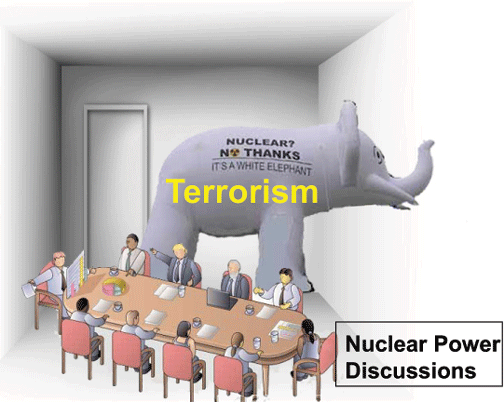 U.S. Rep. King talks ‘nightmare scenario’ of nuclear dirty bomb Boston Herald, April 19, 2015 By: Paul Bush While other Republicans were in Nashua for the party’s summit Friday morning, U.S. Rep. Peter King (R-N.Y.) was at Franklin Pierce University warning about the dangers the country faces from Islamic State fighters and from a possible nuclear “dirty bomb” attack.
King also cited his fears that future terrorists would make a crude bomb from nuclear materials that would create massive radioactive contamination.
“One nightmare scenario would be to have one or more dirty bombs put together 50 or 60 miles outside of a city and then brought into an urban area,” King said……
Tritium is a major radioactive pollutant from Canada’s CANDU nuclear power reactors.

 Tritium Traffic: Deadly Dividends for Nuclear Industry, Peace Magazine By David H MartinIn February, 1934, the British journal, New Scientist, published an article by Tom Wilkie, “Old Age Can Kill the Bomb.” It was an ingenious solution to the arms control nightmare of verification; controlling not only the number of weapons, but the strategic materials that fuel them — mainly plutonium, enriched uranium and tritium. Wilkie focused on tritium, because it turns into non-radioactive helium at a rate of 5.5 per cent per year. A halt of tritium production would rapidly cripple all nuclear arsenals. Thus, attention was rivetted on Ontario Hydro’s plan to produce about 57 kilograms of tritium by 2006. A one megaton thermonuclear warhead (equivalent to one million tons of TN”) may contain as little as one gram of tritium.
Tritium (H3) (a form of hydrogen that emits beta radiation), is a major radioactive pollutant from Canada’s CANDU nuclear power reactors. Unlike American reactor systems, the CANDU uses heavy water as a moderator and coolant. The moderator and the heavy water coolant slows down the neutron release from the uranium fuel in the reactor so that a chain reaction can take place. The active ingredient in heavy water is deuterium, another form of hydrogen. When the deuterium picks up a neutron, some of it is transformed into tritium. The concentration of tritium in the heavy water increases with the age of the reactor.
The CANDU reactor system produces 2400 times as much tritium as the American light water reactor. Continue reading
530 Minamisoma residents sue government over hot spot delisting
530 Minamisoma residents sue government over hot spot delisting KYODOSome 530 residents of a city near the Fukushima No. 1 nuclear plant filed a lawsuit Friday demanding that the central government revoke a decision to remove their districts from a list of radiation hot spots, ending their entitlement to handouts… (registered readers only) http://www.japantimes.co.jp/news/2015/04/17/national/crime-legal/530-minamisoma-residents-sue-government-hot-spot-delisting/#.VTQwstKqpHw
Cameco uranium company a “great corporate citizen”? Actually NO!
Don’t call Cameco a “great corporate citizen,” group says BY JASON WARICK, THE STAR PHOENIX APRIL 17, 2015 Governments should not describe Cameco as a “great corporate citizen” while suing the company over a $1.5 billion tax debt, a lobby group says.
“One questions whether governments should promote companies who so flagrantly violate Canadian tax law,” said Dennis Howlett, executive director of Canadians for Tax Fairness………
Howlett noted Cameco is in court for allegedly avoiding payment of $1.5 billion in federal and provincial taxes by funnelling business through a Swiss subsidiary. The IRS in the United States also alleges the mining company owes it more than $30 million. Cameco is disputing the allegations.
Howlett said he wonders what deterrent there is for companies to dodge their taxes if governments continue to praise them. He said it sends all the wrong signals, noting the issue is particularly serious because of the massive amounts involved.
“It is very much a concern,” he said.
Speaking to reporters at the Saskatchewan legislature on Thursday, Wall said he’s been “watching very carefully” as the tax case develops…….. http://www.thestarphoenix.com/news/call+Cameco+great+corporate+citizen+group+says/10982294/story.html
Nearly 200,000 Japan documents designated as special secrets in 2014
Some 190,000 documents designated as special secrets in 2014, Mainichi 17 Apr 15 The government had 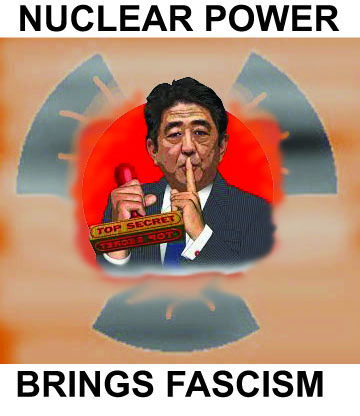 designated 189,193 administrative documents as confidential under the state secrecy law as of the end of last year, the Cabinet Secretariat announced on April 17.
This was the first time that the agency released the number of such governmental documents since the Act on the Protection of Specially Designated Secrets came into force in December of last year.
According to the Cabinet Secretariat, the documents are owned by 13 ministries and agencies. The actual number of documents designated as special secrets has not been disclosed, however, since the released figure includes duplicated documents that are shared among several ministries and agencies.
The Defense Ministry tops the list of classified document holders, with 60,173 individual documents, followed by the Cabinet Secretariat with 55,829, the Foreign Ministry with 35,783, the National Police Agency with 17,874, the Public Security Intelligence Agency with 9,297, and the Japan Coast Guard with 9,174.
In January, the Cabinet Secretariat announced that 10 ministries and agencies had classified 382 individual pieces of information as special state secrets as of the end of last year — all of which are found within the aforementioned 189,193 documents………http://mainichi.jp/english/english/newsselect/news/20150418p2a00m0na004000c.html
Nuclear Armageddon risk comes ever nearer- Noam Chomsky
Chomsky: World racing toward nuclear ‘precipice’ Leading American political analyst and philosopher Noam Chomsky says the world is racing toward a nuclear “precipice” and the United States poses the “greatest threat” in this regard. Press TV 19 Apr 15
Chomsky said in an interview with Euronews broadcast on Friday that “one [threat to humankind] is environmental catastrophe which is imminent and we don’t have a lot of time to deal with it and we are going the wrong way, and the other has been around for 70 years, the threat of nuclear war, which is in fact increasing. If you look at the record it is a miracle we have survived.”
He revealed that President Barack Obama has just “initiated a trillion dollar program of modernization of the US nuclear weapon system, which means expanding the nuclear weapon system.”
“That’s one the reasons why the famous doomsday clock, established by the Bulletin of Atomic Scientists has, just a couple of weeks ago, been pushed two minutes closer to midnight. Midnight is the end. It’s now three minutes from midnight. That’s the closest it’s been in thirty years. Since the early Regan years when there was a major war scare,” he added.
Chomsky said that “the US and Israel are the two major nuclear states in the world,” adding, “in international polls, run by US polling agencies, the United States is regarded as the greatest threat to world peace by an overwhelming margin”…….http://www.presstv.ir/Detail/2015/04/18/406819/World-racing-toward-nuclear-precipice
1 This Month

of the week – Shut Down Drone Warfare!


Tell the Ukrainian Government to Drop Prosecution of Peace Activist Yurii Sheliazhenko

Petition to revoke the licensing of the Near Surface Nuclear Disposal Facility (NSDF) at Chalk River. https://www.ourcommons.ca/petitions/en/Petition/Details?Petition=e-7247
To see nuclear-related stories in greater depth and intensity – go to https://nuclearinformation.wordpress.com
-
Archives
- March 2026 (230)
- February 2026 (268)
- January 2026 (308)
- December 2025 (358)
- November 2025 (359)
- October 2025 (376)
- September 2025 (257)
- August 2025 (319)
- July 2025 (230)
- June 2025 (348)
- May 2025 (261)
- April 2025 (305)
-
Categories
- 1
- 1 NUCLEAR ISSUES
- business and costs
- climate change
- culture and arts
- ENERGY
- environment
- health
- history
- indigenous issues
- Legal
- marketing of nuclear
- media
- opposition to nuclear
- PERSONAL STORIES
- politics
- politics international
- Religion and ethics
- safety
- secrets,lies and civil liberties
- spinbuster
- technology
- Uranium
- wastes
- weapons and war
- Women
- 2 WORLD
- ACTION
- AFRICA
- Atrocities
- AUSTRALIA
- Christina's notes
- Christina's themes
- culture and arts
- Events
- Fuk 2022
- Fuk 2023
- Fukushima 2017
- Fukushima 2018
- fukushima 2019
- Fukushima 2020
- Fukushima 2021
- general
- global warming
- Humour (God we need it)
- Nuclear
- RARE EARTHS
- Reference
- resources – print
- Resources -audiovicual
- Weekly Newsletter
- World
- World Nuclear
- YouTube
-
RSS
Entries RSS
Comments RSS
 nuclear-news