New report indicates that deep burial of plutonium better and cheaper than MOX reprocessing
 NuClear News, April 15 Alternatives to MOX A new report by Frank von Hippel and Gordon MacKerron reviews programs in France, Japan, the UK and the US to dispose of large stocks of separated plutonium in nuclear power reactor mixed-oxide (MOX) fuel. Most of these efforts have suffered long delays and large cost increases and all have failed to reduce plutonium stockpiles. This has led some of these countries to consider alternatives.
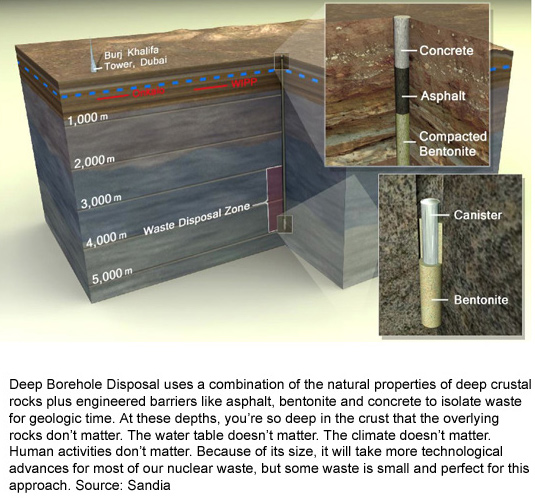
A less costly and more effective approach may be to treat plutonium as a waste to be processed into a stable form and deeply buried. These alternative approaches include disposal with radioactive waste or spent fuel or disposal down a 3-mile (5-kilometer) deep borehole. The report recommends that more than one direct-disposal approach be pursued. It also recommends that the countries that share the problem of plutonium disposal collaborate on exploring direct-disposal options.
Finally, it recommends that the quantities of plutonium disposed by the weapon states be verified by the IAEA. The huge cost overruns in the under-construction MOX plant at the DOE’s Savannah River Site in South Carolina led the Obama Administration to conclude in 2013 that plutonium disposal via MOX “may be unaffordable.”
This has revived policy interest in the U.S. in the possibilities of direct disposal of plutonium as a waste. Efforts to convert foreign separated plutonium into MOX fuel encountered technical problems in the UK, forcing the abandonment of the Sellafield MOX Plant. The UK has therefore looked, in at least a pro forma way, at direct-disposal alternatives.
In the late 1990s, the U.S. studied in considerable depth a “can-in-canister” option in which immobilized plutonium would be embedded in some of the high-level reprocessing waste from which it had been originally separated. This was a way to create a radiation barrier around the plutonium like that around the plutonium in spent fuel, which makes plutonium inaccessible except via chemical and mechanical operations controlled remotely from behind thick radiation shields.
The can-in-canister approach also shares the merit with MOX that it just adds marginally to the quantity of an already existing waste form for which a geological repository has to be found in any case. This option may still be of particular interest in the US, which will be disposing of reprocessing waste for several decades into the future.
In France and the UK, where high-level waste vitrification has been ongoing in parallel with reprocessing, it may be impossible to pursue the “can-in-canister” option unless it is planned well before reprocessing ends. There are other options, however. One that appears increasingly attractive is deep borehole disposal. It does not involve a radiation barrier, but retrieval would be much more difficult than from a closed geological repository.http://www.no2nuclearpower.org.uk/nuclearnews/NuClearNewsNo73.pdf
No comments yet.
1 This Month


Tell the Ukrainian Government to Drop Prosecution of Peace Activist Yurii Sheliazhenko

Petition to revoke the licensing of the Near Surface Nuclear Disposal Facility (NSDF) at Chalk River. https://www.ourcommons.ca/petitions/en/Petition/Details?Petition=e-7247


of the week – STOP SMALL MODULAR REACTORS IN CANADA
To see nuclear-related stories in greater depth and intensity – go to https://nuclearinformation.wordpress.com
-
Archives
- March 2026 (212)
- February 2026 (268)
- January 2026 (308)
- December 2025 (358)
- November 2025 (359)
- October 2025 (376)
- September 2025 (258)
- August 2025 (319)
- July 2025 (230)
- June 2025 (348)
- May 2025 (261)
- April 2025 (305)
-
Categories
- 1
- 1 NUCLEAR ISSUES
- business and costs
- climate change
- culture and arts
- ENERGY
- environment
- health
- history
- indigenous issues
- Legal
- marketing of nuclear
- media
- opposition to nuclear
- PERSONAL STORIES
- politics
- politics international
- Religion and ethics
- safety
- secrets,lies and civil liberties
- spinbuster
- technology
- Uranium
- wastes
- weapons and war
- Women
- 2 WORLD
- ACTION
- AFRICA
- Atrocities
- AUSTRALIA
- Christina's notes
- Christina's themes
- culture and arts
- Events
- Fuk 2022
- Fuk 2023
- Fukushima 2017
- Fukushima 2018
- fukushima 2019
- Fukushima 2020
- Fukushima 2021
- general
- global warming
- Humour (God we need it)
- Nuclear
- RARE EARTHS
- Reference
- resources – print
- Resources -audiovicual
- Weekly Newsletter
- World
- World Nuclear
- YouTube
-
RSS
Entries RSS
Comments RSS
 nuclear-news
Leave a comment