Strange and extreme tissue damage in dead dolphins near Fukushima
Japan Scientist: “I’ve never seen this before” — White lungs found in dolphins that died during mass stranding near Fukushima — Interruption of blood supply leading to death of tissue — Disease has been  linked to radiation exposurehttp://enenews.com/dead-dolphins-washed-fukushima-entirely-white-lungs-head-scientist-ive-never-before-interruption-blood-supply-leading-tissue-death-disease-linked-radiation-exposure-large-spike-after-chernoby?utm_source=feedburner&utm_medium=email&utm_campaign=Feed%3A+ENENews+%28Energy+News%29
Asahi Shimbun, Apr 11, 2015 (emphasis added):
- Google Translate: Ibaraki Prefecture… for a large amount of dolphin which was launched on the shore… the National Science Museum… investigated… researchers rushed from national museums and university laboratory, about 30 people were the anatomy of the 17 animals in the field. [According to Yuko Tajima] who led the investigation… “the lungs of most of the 17… was pure white ischemic state, visceral signs of overall clean and disease and infections were observed”… Lungs white state, that has never seen before.
- Systran: The National Science Museum… investigated circumstance and cause etc concerning the mass dolphin which is launched to the seashore of Ibaraki prefecture… the researchers ran from the museum and the university laboratory… approximately 30 people dissected 17… [Yuko Tajima] of the National Science Museum which directed investigation research worker [said] “the most lung 17 was state with true white, but as for the internal organs being clean”… The lung true white as for state, says… have not seen.
Fukushima Diary, Apr 12, 2015: According to National Science Museum, most of the inspected 17 dolphins had their lungs in ischaemia state… The chief of the researching team stated “Most of the lungs looked entirely white”… internal organs were generally clean without any symptoms of disease or infection, but most of the lungs were in ischaemia state. She said “I have never seen such a state”.
Wikipedia: Ischemia is a vascular disease involving an interruption in the arterial blood supply to a tissue, organ, or extremity that, if untreated, can lead to tissue death.
Many reports have been published on the links between ischemia and radiation exposure:
- “It has been shown that the ionizing radiation in small doses under certain conditions can be considered as one of starting mechanisms of… IHD [ischemic heart disease].” –Source
- “Radiation risks on non-cancer effects has been revealed in the [Chernobyl] liquidators… Recently, the statistically significant dose risk of ischemic heart disease… was published.” –Source
- “Incidence of and mortality from ischemic heart disease (IHD) have been studied in a cohort of 12210 workers [at] Mayak nuclear facility… there was statistically significant increasing trend in IHD incidence with total external gamma dose.” –Source
- “Numerous studies have been published concerning non cancer diseases in liquidators… Risk of ischemic heart disease… seems increased.” –Source
- “In 1990 the International Chernobyl Project has been carried out under the aegis of the IAEA… It is known that the international experts who had taken part in the International Chernobyl Project were aware of the report by the Minster of the Ministry of Health Care of Belarus delivered at an informal meeting arranged by the IAEA… The Belorussian Minister reported about… the worsening of the general health state of the affected population… “Among adults in 1988 there was a two- to fourfold increase, in comparison with preceding years, in the number of persons suffering from… ischemic heart diseases” –Source
- “In a study on a Russian cohort of 61,000 Chernobyl emergency workers… a statistically significant risk of ischemic heart disease was observed.” –Source
USA’s Nuclear Regulatory Commission puts the nuclear industry’s interests ahead of safety concerns
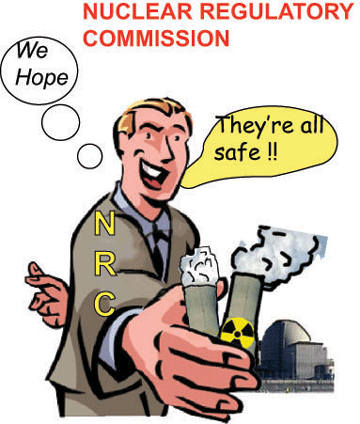 In the U.S. it comes down to the NRC, says Macdonald, because it sets the level of risk that is acceptable. “The utilities are only going to do what the NRC dictates. So it’s really NRC’s responsibility to assess whether this represents a danger to integrity of pressure vessels,” he says.
NRC Opposes European Moves to Tighten Nuclear Safety Post-Fukushima By Spectrum, Peter Fairley 14
Apr 2015 Nuclear power plants’ reactor pressure vessels (RPVs) (at right – yellow marks suggesting c—the massive steel  jars that hold a nuclear plant’s fissioning fuel—face incessant abuse from their radioactive contents. And they must be built with extra toughness to withstand pressure and temperature swings in the event of a loss-of-cooling accident like the one that occurred at Fukushima in 2011. As the triple meltdowns at Fukushima Daiichi showed, the next layer of defense against a nuclear release—the so-called containment vessels—can not be counted on to actually contain molten nuclear fuel that breaches the RPV.
Nuclear safety authorities have recently discovered weaknesses in several RPVs, and their contrasting responses suggest that the ultimate lessons from Fukushima are still sinking into international nuclear power culture—especially in the United States, where the Nuclear Regulatory Commission (NRC) is resisting calls to mandate tougher inspection of RPVs.
Broadly speaking, European regulators have ordered operators to do more to improve safety post-Fukushima than the NRC has. France, for example, is mandating four times as much investment than the U.S. in upgrades such as reinforced bunkers, back-up power, and emergency cooling systems,according to industry estimates cited by Bloomberg Business nuclear safety correspondent Jonathan Tirone.
In February, U.S. diplomats worked to defeat a European initiative to strengthen the Convention on Nuclear Safety, created after the 1986 Chernobyl meltdown. The Europeans wanted the currently voluntary treaty to set mandatory safety standards—a proposal that the United States apparently judged too threatening for U.S. nuclear operators struggling to compete amidst a glut of cheap power generated from natural gas. “The U.S. …worried that the proposal would have required shutting down their plants,” according to Mark Hibbs, senior associate in the Carnegie Endowment for International Peace. Continue reading
Radiation has wreaked havoc with Fukushima’s birds
No birdsong in Fukishima: ‘Dramatic’ decline of birds linked to radiation from 2011 disaster
- Researchers find that bird species are continuing to drop in Fukushima
- The barn swallow, for example, dropped from hundreds to dozens
- This is despite radiation levels in the region starting to fall
- And comparing it to Chernobyl could reveal what the future holds
By JONATHAN O’CALLAGHAN FOR MAILONLINE, 16 April 2015
 Bird numbers have dramatically declined in Fukushima, research has revealed Scientists analysed 57 species in the region and found that the majority of populations had diminished as a result of the nuclear accident. They found that one breed in particular had plummeted from several hundred before the 2011 disaster to just a few dozen today.
The research, published in the Journal of Ornithology, was carried out by scientists at the University of South Carolina including biologist Dr Tim Mousseau.
They showed that the situation has steadily worsened since the disaster on 11 March 2011………
And while background radiation has declined in the region in recent years, the negative effects of the accident on birds are actually increasing.
‘The relationship between radiation and numbers started off negative the first summer, but the strength of the relationship has actually increased each year,’ Dr Mousseau said.‘So now we see this really striking drop-off in numbers of birds as well as numbers of species of birds.
‘So both the biodiversity and the abundance are showing dramatic impacts in these areas with higher radiation levels, even as the levels are declining.’…….http://www.dailymail.co.uk/sciencetech/article-3041695/No-birdsong-Fukishima-Dramatic-decline-birds-linked-radiation-2011-disaster.html
New Film ‘Nuclear Power in the Age of Fukushima’ – studies New York’s Indian Point facility
 New Film on Indian Point Explores ‘Nuclear Power in the Age of Fukushima’ http://www.commondreams.org/news/2015/04/16/new-film-indian-point-explores-nuclear-power-age-fukushima Film alleges former nuke commission chair was ousted by pro-industry forces who thought he was being ‘too aggressive’ in his efforts to protect the public. by Deirdre Fulton, staff writer
The 94-minute film, titled Indian Point and directed by Ivy Meeropol, features unprecedented footage of the three-unit nuclear power plant station, which was designed in the 1950s and sits in Buchanan, New York, just 35 miles up the Hudson River from Times Square.
In an interview, Meeropol said the film is “about one aging and controversial nuclear power plant in the age of Fukushima. The story is told from both inside and outside the plant, through characters who care deeply about its future.”
It delves specifically into the story of Gregory Jaczko, who was chairman of the U.S. Nuclear Regulatory Commission (NRC) when Japan’s Fukushima power plant suffered a major meltdown in 2013. The film alleges that Jaczko—an advocate of tightening safety controls at America’s aging nuclear facilities after the Fukushima disaster (his was the only dissenting vote on plans to build the first American nuclear plant in 30 years)—was ousted from the NRC by pro-industry forces who thought he was being “too aggressive” in his efforts to protect the public.
When asked by IndieWire what she wants people to think about after seeing the movie, Meeropol responded: “That there are consequences to our insatiable demands for energy and there are no easy answers for how to capture that energy safely. But even more pressing, since we are currently using nuclear power across the country and the globe, nuclear power plants must be regulated, and we need to be certain that our regulatory bodies are not compromised by their relationships with industry.”
The Daily Beast describes Indian Point as “a cautionary tale about a technology once seen as an abundant and non-polluting energy source, but with downsides that could make oil spills and electrical brownouts seem as minor as a fender bender.”
Just this week, the Disaster Accountability Project, a nonprofit organization that monitors responses to nuclear emergencies, called on the NRC to establish a 50-mile disaster warning zone for Indian Point. Currently, the NRC requires communities located within 10 miles of nuclear power plants to develop emergency plans.
But the Wall Street Journal reports that the NRC, “in response to the Disaster Accountability Project’s recommendations, said that the current 10-mile zone for emergency planning is appropriate and that plans in those areas will provide adequate protection to the public in a nuclear accident.”
Meeropol and Jaczko will participate in a Q&A following the film’s premiere on Friday evening.
The very real danger of huge gas pipeline close to New York Nuclear Power Plant
 Doing the Unthinkable: Giant Gas Pipeline to Flank a New York Nuclear Power Plant Wednesday, 15 April 2015 00:00By Ellen Cantarow, Truthout | News Analysis A very large gas pipeline will soon skirt the Indian Point Energy Center (IPEC), an aging nuclear power plant that stands in the town of Cortlandt in Westchester County, New York, 30 miles north of Manhattan. The federal agencies that have permitted the project have bowed to two corporations – the pipeline’s owner, Spectra Energy, and Entergy, which bought the Indian Point complex in 2001 from its former owner.
A hazards assessment by a former employee of one of the plant’s prior owners, replete with errors, was the basis for the go-ahead. A dearth of mainstream press coverage leaves ignorant the population that stands to be most impacted by a nuclear catastrophe, which experts say could be triggered by a potential pipeline rupture. I urge Truthout’s audience to read an earlier article by Alison Rose Levy, which includes details I haven’t space to recap here.
Since 2011, Spectra Corporation, owner of the 1,129-mile Algonquin Pipeline, which runs from Texas to Beverly, Massachusetts, where it connects with another pipeline running into Canada, has sought to expand the pipeline in order to transport fracked gas north from Pennsylvania. Spectra, one of the largest natural gas infrastructure companies in North America, calls the planned enlargements “The Algonquin Incremental Market Project” (AIM).
AIM includes a two-mile section of 42-inch pipe carrying gas under very high pressures. It is this pipeline segment that will flank IPEC, which stands in a seismic zone. The nuclear complex has a derelict history. In 2001, The New York Timesreported that “the plant has encountered a string of accidents and mishaps since it went into operation on June 26, 1973.” The IPEC has also been on the federal list of the nation’s worst nuclear power plants………
David Lochbaum, a nuclear engineer who graduated from college a few months after the March 1979 Three Mile Island nuclear disaster, has done accident training at many nuclear plants, and has also worked as a technology instructor for the NRC. “Nuclear power plants,” he told Truthout, “are pretty robust. It takes many things to go wrong for a disaster to occur like Fukushima. But a natural gas pipeline poses a threat that could challenge all of them. The biggest threat would be if the pipeline release took out the power supply of the plant. That was the big problem with Fukushima. The tsunami water took out the power and left the plant with no power [but] a few batteries.”
Industry-Compliant Agencies
Blanch, who has worked with the NRC since its inception in 1974, said it is “an agency that has a symbiotic relationship with the industry … If the Nuclear Regulatory Commission imposes [stringent] safety regulations on the industry, it could impact the economic viability of the industry and also the Nuclear Regulatory Commission itself.” He said he became aware of the commission’s industry tilt when he worked as an engineering manager for Northeast Utilities, identified “a serious safety concern” and “saw where the NRC was not really concerned about safety, but more concerned about their survival.” He added, “They will provide an illusion of action; they will take very visible action against small problems, but when it comes to the big problems, they fail to take any action because of its economic impact on the industry.”……..
Efforts by India’s government to shut down Greenpeace
India government trying to shut us down: Greenpeace ABC 16 Apr 15 Greenpeace believes the Indian government has blocked donations from being deposited in its bank accounts, both locally and internationally.
 GREENPEACE INDIA accused the government Tuesday of preventing local donors from funding its
activities, saying the move was aimed at shutting down its operations in the country.
The latest allegation comes less than a week after the right-wing government suspended the environmental watchdog’s foreign funding licence and blocked several of its bank accounts, citing violations of rules governing international financial transactions.
Following the ban, Greenpeace said, many donors even in India were unable to deposit money into the group’s local accounts. It said it suspected the accounts had been blocked by the government.
The group described the fresh step as an all-out attack by the government to “suppress democracy and silence those with an alternative vision of development”. The government has also blocked our domestic accounts and is now preventing ordinary Indians from supporting our work for clean air, healthy forests, pesticide-free food and a liveable environment,” Samit Aich, executive director of Greenpeace India, said in a statement………http://www.abc.net.au/environment/articles/2015/04/15/4217058.htm
Computer hackers targeting nuclear power plants
 Hackers have ‘begun targeting nuclear power plants,’ cyber warfare expert warns Jerusalem Post, By YAAKOV LAPPIN 4/16/2015 Computer hackers have begun targeting electric and nuclear power plants around the world, as well as other critical infrastructure sites in increasingly audacious attacks, a senior Israeli cyber security expert warned on Thursday. Col. (res.) Dr. Gabi Siboni, director of the Cyber Security Program at the Institute for National Security Studies (INSS) inTel Aviv, said the recent “major infiltration of Sony Pictures and news that Home Depot and Target were victims of cyber attacks affecting millions of customers is the least of the world’s worries.”
“The disruption and possible infiltration of critical infrastructure is the most severe form of cyber attack. Such attacks on airplanes or air traffic control towers, for instance, means that hackers could cause accidents, or even paralyze entire flight systems. As of now, this area of capabilities is the exclusive domain of developed states. I strongly believe however, that the next 9/11 will happen without suicide bombers aboard the plane with box-cutters but will occur because of a cyber incident perpetrated by a terror organization.”………
International Atomic Energy Agency (IAEA) being used to derail nuclear deal with Iran ?
 Iran nuclear deal: ‘Accusations with very little proof’, DW 14 Apr 15 In an interview with Deutsche Welle, former IAEA nuclear inspector Robert Kelley suspects the nuclear watchdog could be misused as a tool to derail the nuclear deal with Iran. Diplomats and experts will start hammering out the legal and technical details of a nuclear agreement between Iran and six world powers next week in Vienna, the EU diplomatic service announced Thursday.
Foreign ministers from Iran and the group of Britain, China, France, Russia, the United States and Germany agreed on the outlines of the deal on April 2 in Lausanne. In addition, Iran and the group of six still have to draw up a list of Iranian nuclear sites, which experts from the International Atomic Energy Agency, IAEA, will get to visit as part of its probe into alleged nuclear weapons projects.
A senior IAEA delegation returned from a visit to Tehran on Thursday, without any answers on ten new suspected research and development projects identified by the agency in addition to the two that are already being discussed.
DW talked to Robert Kelley, former IAEA director for nuclear inspections in Iraq and now expert for nuclear energy and weapons issues with the Stockholm-based International Peace Research Institute.
DW: The IAEA plays a central role in the nuclear deal reached in Lausanne on April 2. Now, an IAEA delegation under chief inspector Tero Varjoranta, which sought answers to allegations over the possible military use of Irans nuclear program in the past, left Tehran without those answers. What exactly is the IAEA looking for?……….
In this age of satellites and super high sensitive detectors, how difficult would it be to effectively hide nuclear activities?
The very best detectors in the world are the IAEA inspectors. If you for some reason offend Iran so much, that they kick the IAEA out, then you are blind. You won´t know anything about what is going on. So one of the things that are good about this new agreement is: The inspectors have access to every aspect of uranium mining, conversion to the right chemicals, chemicals producing uranium hexafluoride in the enrichment plant and things after the enrichment plant. So the inspectors are getting a very good picture of everything Iran is openly doing.
And they are also going to be looking at procurement. The import regime is part of the agreement. That is a very powerful thing. The chances of having a completely clandestine, hidden, secret program becomes much more difficult when you have these things in place. Things like the handling of uranium and plutonium do leave a lot of signatures and detectors can pick them up. Not from space but on the ground. But you can´t detect things like explosives and explosive bridgewire detonators, because they have conventional military uses, they are used in mining, for all kinds of other activities. And you can´t call that a nuclear activity. http://www.dw.de/iran-nuclear-deal-accusations-with-very-little-proof/a-18388394
History of Israel’s secrecy in cover-up of its nuclear weapons program

 How Israel Hid Its Secret Nuclear Weapons Program, Politico, An exclusive look inside newly declassified documents shows how Israel blocked U.S. efforts to uncover its secret nuclear reactor. By AVNER COHEN and WILLIAM BURR April 15, 2015 For decades, the world has known that the massive Israeli facility near Dimona, in the Negev Desert, was the key to its secret nuclear project. Yet, for decades, the world—and Israel—knew that Israel had once misleadingly referred to it as a “textile factory.” Until now, though, we’ve never known how that myth began—and how quickly the United States saw through it. The answers, as it turns out, are part of a fascinating tale that played out in the closing weeks of the Eisenhower administration—a story that begins with the father of Secretary of State John Kerry and a familiar charge that the U.S. intelligence community failed to “connect the dots……..
The Israeli Decision and Lapses in U.S. Intelligence
The Americans were truly surprised by the audacity of the Israeli nuclear project. Soon after Prime Minister David Ben-Gurion came to power in 1955, he launched a secret initiative to determine whether, and how, Israel could build a nuclear infrastructure to support a national program aimed at producing nuclear explosives. A senior defense official named Shimon Peres took charge of the project. Within three years, he did the almost impossible—transforming the idea of a national nuclear program from a vague vision into a real technological achievement. Unlike the chairman of the Israeli Atomic Energy Commission, professor David Ernst Bergmann, who preached self-reliance, Peres believed that Israel must not and could not reinvent the wheel—it had to focus on finding a foreign supplier who could provide the most comprehensive nuclear package possible suited for a weapons-oriented program……..
Dimona is the story of a huge secret. Secrecy was essential to shield and insulate the highly vulnerable, newly born project from hostile outsiders. At the very core, of course, it was an Israeli secret—the largest, most awesome and longest-held secret that Israel has ever generated. But it was more than just an Israeli secret; Israel’s partners France and Norway also wanted secrecy. ………..
The dilemma the Eisenhower administration faced after the discovery of Dimona in December 1960-January 1961 would endure for the entire decade. From then on, three successive U.S. administrations—under presidents Kennedy, Lyndon Johnson and Richard Nixon—would have to deal with it as well. Kennedy chose the toughest path of struggle and confrontation in his effort to check the program; Johnson realized that the U.S. had limited leverage on the issue and planted the seeds of compromise and looked the other way; finally, in a bargain with Prime Minister Golda Meir, Nixon accepted the Israel’s de facto nuclear status as long as it stayed secret—a controversial and unacknowledged deal that remains in place effectively through the current day.
Avner Cohen is a professor of nonproliferation studies at the Middlebury Institute of International Studies at Monterey and the author of Israel and the Bomb.
William Burr is a senior analyst at the National Security Archive, George Washington University, where he directs the Archive’s Nuclear Documentation Project and edits its special Web page, The Nuclear Vault. http://www.politico.com/magazine/story/2015/04/israel-nuclear-weapons-117014.html#.VTAlHtyUcnl
Massive governmental and media effort to cover up the truth about Fukushima
 Study: Conspiracy of Fukushima Cover up Between Government and Media Proven, Your News Wire, 14 Apr 15 by Royce Christyn A groundbreaking study by American University sociology Prof. Celine Marie Pascale has proven there is a continuing and massive effort by varying world governments and major mainstream media outlets to cover up the horrifying truth of Fukushima.
According to the press release made public by the University and Pascale, the media and government (regarding the Fukushima cover up) “largely minimized health risks to the general population”.
Natural News reports: Just how bad was the radiation fallout from the near-complete destruction of three nuclear reactors at the Fukushima power station following a massive earthquake-generated tsunami in March 2011? The answer is, most people simply don’t know – because the media coverage of the damage and fallout, at the time of the accident and in the four years since, has been grossly inadequate, according to a new study –
As noted by American University sociology Prof. Celine Marie Pascale, there has especially been a dearth of U.S. media coverage, the disaster long disappearing from the headlines of domestic newspapers and cable news networks, despite the fact that the crippled plant dumps three hundred tons of radioactive water into the ocean daily, and the region surrounding the plant remains uninhabitable – probably forever.
Further, her new analysis found that U.S. news media coverage of Fukushima “largely minimized health risks to the general population,” says a press release from the university.
The release further states:
Pascale analyzed more than 2,000 news articles from four major U.S. outlets following the disaster’s occurrence March 11, 2011 through the second anniversary on March 11, 2013. Only 6 percent of the coverage – 129 articles – focused on health risks to the public in Japan or elsewhere. Human risks were framed, instead, in terms of workers in the disabled nuclear plant.
‘Articles discuss instead how dangerous cosmic radiation is’
“It’s shocking to see how few articles discussed risk to the general population, and when they did, they typically characterized risk as low,” said Pascale, who studies the social construction of risk and meanings of risk in the current century.
“We see articles in prestigious news outlets claiming that radioactivity from cosmic rays and rocks is more dangerous than the radiation emanating from the collapsing Fukushima Daiichi nuclear plant,” she added.
The sociology prof examined news articles, editorials and letters from two major U.S. papers – The New York Times and The Washington Post – and two additional, prominent online news sites – Politico and The Huffington Post. The four outlets are not only among the largest, most influential in the U.S., they are also the most-cited by television news and talk shows, as well as other newspapers and blogs. Also, they are talked up in social media often, says Pascale. So, in that sense, she says, seeing how risk is presented in national prominent media can provide data on how the issue is framed nationally, in public conversations.
The press release further discussed Pascale’s analytical method and variables: – See more at: http://yournewswire.com/study-conspiracy-of-fukushima-cover-up-between-government-and-media-proven/#sthash.08pZB0ka.dpuf
Success of wind energy in reducing USA’s greenhouse gas emissions
Wind energy blows US emissions onto right track for 2025 target http://www.newscientist.com/article/dn27361-wind-energy-blows-us-emissions-onto-right-track-for-2025-target.html#.VTBP5tyUcnl 16 April 2015 by Fred Pearce Is Uncle Sam going green at last? US carbon emissions from power stations this year are set to be the lowest for 20 years, as decrepit coal-fired power plants shut and clean wind farms and less-dirty natural gas plants replace them.
And back in 1994, the US economy was only 42 per cent of its current size, adding evidence to the idea that an economy can grow while its emissions go down.
This year’s emissions are expected to be 15.4 per cent below 2005 levels. The startling projection comes from analysts at Bloomberg New Energy Finance. It suggests that the US may now be on course to meet the promise that the Obama administration will take to UN climate negotiations in Paris later this year, to cut total CO2 emissions by 28 per cent below 2005 levels by 2025.
So what is going on? Most attention has focused on the replacement of coal in conventional power plants by natural gas, much of it from fracking. Burning gas emits only half as much CO2 as burning coal.
And there is much more to come from wind, says William Nelson, an analyst at Bloomberg New Energy Finance. He expects 9 gigawatts more wind generating capacity to be commissioned during 2015, much of it in Texas. It is a wind of change that he calls a giant, permanent step towards decarbonising out entire fleet of power plants.
How BP started, then stopped renewable energy projects
 BP dropped green energy projects worth billions to focus on fossil fuels, Guardian, Terry Macalister, 16 Apr 15 Oil firm invested billions of pounds in clean and low-carbon energy in the 80s and 90s but later abandoned meaningful efforts to move away from fossil fuels and locked away the research BP pumped billions of pounds into low-carbon technology and green energy over a number of decades but gradually retired the programme to focus almost exclusively on its fossil fuel business, the Guardian has established.
At one stage the company, whose annual general meeting is in London on Thursday, was spending in-house around $450m (£300m) a year on research alone – the equivalent of $830m today.
The energy efficiency programme employed 4,400 research scientists and R&D support staff at bases in Sunbury, Berkshire, and Cleveland, Ohio, among other locations, while $8bn was directly invested over five years in zero- or low-carbon energy.
But almost all of the technology was sold off and much of the research locked away in a private corporate archive.
Facing shareholders at its AGM, company executives will insist they are playing a responsible role in a world facing dangerous climate change, not least by supporting arguments for a global carbon price.
But the company, which once promised to go “beyond petroleum” will come under fire both inside the meeting and outside from some shareholders and campaigners who argue BP is playing fast and loose with the environment by not making meaningful moves away from fossil fuels.
In 2015, BP will spend $20bn on projects worldwide but only a fraction will go into activities other than fossil fuel extraction.
An investigation by the Guardian has established that the British oil company is doing far less now on developing low-carbon technologies than it was in the 1980s and early 1990s. Back then it was engaged in a massive internal research and development (R&D) programme into energy efficiency and alternative energy……..
A major group of shareholders have called on the company to address climate change more robustly through a resolution to be heard at the AGM…….
Suzanne Dhaliwal from the UK Tar Sands Network said support for the AGM resolution looked hollow when the company was still engaged in carbon-heavy extraction activities. “It looks like a stalling mechanism to get large shareholders on board but from a grass roots level commitments to tackling climate change and continuing with tar sands are incompatible.”
Many leading environmentalists such as Jonathan Porritt believe fossil fuel companies will never play a leading role in any move to a low-carbon economy…….http://www.theguardian.com/environment/2015/apr/16/bp-dropped-green-energy-projects-worth-billions-to-focus-on-fossil-fuels
China stalls nuclear development in response to safety concerns about French-supplied reactors
Parts of the Taishan 1 and 2 nuclear reactors under construction in the southern province of Guangdong were made by the same manufacturer that supplied the reactor vessel for EDF’s EPR in Normandy, the site of anomalies found by France’s nuclear watchdog ASN last week………
rapid capacity expansion plan has been subject to delays, with the country’s approval process suspended after the Fukushima disaster in Japan in 2011. No new projects were given the go-ahead until earlier this year.
The construction of the world’s first AP1000 reactor, designed by the U.S.-based Westinghouse, has also been delayed as a result of design problems, and is now set to be completed next year. (Reporting By Shanghai Newsroom and David Stanway; Editing by Vincent Baby) http://www.reuters.com/article/2015/04/16/china-nuclear-areva-idUSL4N0XD3AU20150416
France’s State owned nuclear company AREVA now a costly burden
 Areva Is Costing France Plenty The company thought it had a winning nuclear reactor technology http://www.bloomberg.com/news/articles/2015-04-16/france-s-areva-falters-in-reactor-business-leaks-cash Nuclear plants supply almost three-fourths of France’s electricity, and they boast a near-spotless safety record and some of the cheapest electric rates in Europe. In 2001 the government created a state-owned company, Areva, to export French reactors and nuclear know-how to the rest of the world. Those ambitions are now in tatters, offering an object lesson in the dangers of French dirigiste industrial policy.
Areva, along with competing reactor builders Westinghouse Electric and General Electric, was hit hard when orders dried up after the 2011 Fukushima accident in Japan. Cheap shale gas and development of renewable energy have compounded those woes. But “you can’t really blame Areva’s plight on Fukushima,” says Steve Kidd, a British nuclear consultant and former executive of the World Nuclear Association, a London-based trade group.
$5.1b
Areva’s loss in 2014, on sales of $8.9 billionFrench authorities reported on April 7 that flaws were found in some of the steel used in the reactor vessel of an EPR being built in Normandy. That reactor is five years behind schedule, and its price tag has ballooned from $3.5 billion to $9.3 billion. Areva also is facing an investigation of its 2007 acquisition of Uramin, a Canadian uranium mining company. In 2011, Areva wrote off almost all of the $2.5 billion purchase price after concluding that the ore deposits were of negligible value. The government’s chief auditor, who faulted management for inadequate oversight and possible “dissimulation,” asked prosecutors to look into the Uramin purchase.
The next step for Areva may be a tieup with EDF, its top customer—an idea that horrified the utility’s investors, who dumped the stock after Energy Minister Ségolène Royal suggested it in March. Other government officials have suggested that Areva might work with EDF on engineering and maintenance, stopping short of a full merger.
The company still makes money supplying fuel and reprocessing waste for nuclear plant owners. It’s already clear, though, that Areva won’t be selling many new reactors. North American and European utilities stopped ordering them after the Fukushima accident, and the EPR’s problems have cast a pall over the company’s prospects in China, which now accounts for more than half of the new reactors expected to come online by 2030. Thanks to past collaboration with Areva and other Western suppliers, the Chinese have developed the technology they need to build their own reactors, says Steve Thomas, a professor at the University of Greenwich in England who studies the industry. The reactors built by Areva and Westinghouse “are just too expensive for the Chinese,” he says.
The French government’s 80 percent ownership of Areva helped mask its problems, consultant Kidd says. “Everyone was laughing” at the company’s projections for reactor sales, he says. “Everyone in the know could tell the chickens were going to come home to roost. I don’t think that would have happened in a private business.”
—With Francois de Beaupuy and Tara Patel
The bottom line: Areva’s bid to be the globally dominant maker of reactors was undone by cost overruns and strategic blunders.
USA still complies with New START plan – has cut nuclear warheads
U.S. Cuts Nuclear Warhead Levels In compliance with New START, U.S. now has 1,597 treaty warheads; Russia, 1,582 Washington Free Beacon AP BY: Bill Gertz April 16,
Despite nuclear saber-rattling by Moscow, U.S. nuclear forces are close to reaching warhead, missile, and bomber numerical cuts required under the 2010 New START arms treaty, a senior Pentagon official told Congress on Wednesday.
U.S. nuclear warheads counted under the treaty with Russia were reduced from 1,642 to 1,597 between Sept. 1 and March 1, said Robert Scher, assistant secretary of defense for strategy, plans, and capabilities.
Russian nuclear warheads were cut from 1,632 to 1,582 during the same period, Scher told the House Armed Services strategic forces subcommittee in prepared testimony.
The treaty requires both nations to reduce their deployed strategic warhead arsenals to 1,550 by February 2018.
For land-based and sea-based missiles and bombers, U.S. forces were reduced from 912 to 898, and Russian missiles and bombers were cut from 911 to 890.
The treaty limit for those weapons is 800 strategic delivery vehicles by 2018.
Scher said the reductions continued despite “serious concerns” over souring U.S.-Russia relations………http://freebeacon.com/national-security/u-s-cuts-nuclear-warhead-levels/
1 This Month

Petition to revoke the licensing of the Near Surface Nuclear Disposal Facility (NSDF) at Chalk River. https://www.ourcommons.ca/petitions/en/Petition/Details?Petition=e-7247


of the week – STOP SMALL MODULAR REACTORS IN CANADA
To see nuclear-related stories in greater depth and intensity – go to https://nuclearinformation.wordpress.com
-
Archives
- March 2026 (153)
- February 2026 (268)
- January 2026 (308)
- December 2025 (358)
- November 2025 (359)
- October 2025 (376)
- September 2025 (258)
- August 2025 (319)
- July 2025 (230)
- June 2025 (348)
- May 2025 (261)
- April 2025 (305)
-
Categories
- 1
- 1 NUCLEAR ISSUES
- business and costs
- climate change
- culture and arts
- ENERGY
- environment
- health
- history
- indigenous issues
- Legal
- marketing of nuclear
- media
- opposition to nuclear
- PERSONAL STORIES
- politics
- politics international
- Religion and ethics
- safety
- secrets,lies and civil liberties
- spinbuster
- technology
- Uranium
- wastes
- weapons and war
- Women
- 2 WORLD
- ACTION
- AFRICA
- Atrocities
- AUSTRALIA
- Christina's notes
- Christina's themes
- culture and arts
- Events
- Fuk 2022
- Fuk 2023
- Fukushima 2017
- Fukushima 2018
- fukushima 2019
- Fukushima 2020
- Fukushima 2021
- general
- global warming
- Humour (God we need it)
- Nuclear
- RARE EARTHS
- Reference
- resources – print
- Resources -audiovicual
- Weekly Newsletter
- World
- World Nuclear
- YouTube
-
RSS
Entries RSS
Comments RSS
 nuclear-news