Why China should avoid the doubtful dream of commercial nuclear reprocessing
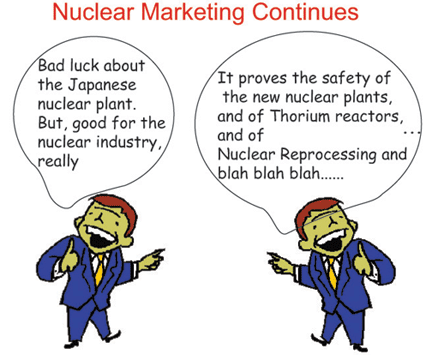
 Reprocessing in China: A long, risky journey, Bulletin of the Atomic Scientists, April 15 Hui Zhang“………Should China continue pursuing its plans for fast breeder reactors and commercialized reprocessing? Good reasons exist for avoiding this course of action. First, because most of China’s power reactors are newly built, Beijing will face little pressure over the next two decades to reduce its spent fuel burden. And spent fuel can be stored safely, at low cost, in dry casks—or disposed of safely in a deep geological repository.
Second, China faces no shortage of uranium resources for the foreseeable future. The nation’s identified resources more than tripled between 2003 and 2012, to 265,500 metric tons from 77,000 metric tons. China’s potential uranium reserves amount to more than 2 million tons. Beijing in recent times has also secured huge overseas uranium resources—about three times as large as its own identified uranium reserves. More such reserves could easily be added.
In any event, the cost of uranium accounts for only a small percentage of the cost of power that reactors generate. Simply put, the cost of uranium will not increase in the foreseeable future to levels that would justify the cost of reprocessing and breeder reactors. To the extent that China is concerned about potential disruptions in its uranium supply, it could easily and inexpensively establish a “strategic” uranium stockpile.
China should carefully examine the experiences of nations that have launched large reprocessing programs and built demonstration breeder reactors in the expectation that the commercialization of these reactors would follow. Commercialization did not follow in those countries—but huge expenses were incurred for cleaning up reprocessing sites and disposing of separated plutonium. For China, there is no urgent need to go down this risky road.
Plutonium recycling is much more expensive, and much less safe and secure, than operating light water reactors with a once-through fuel cycle. As for nuclear waste, dry cask storage is a safe, flexible, and low-cost option that can postpone for decades the need either to reprocess spent fuel or to dispose of it directly—allowing time for technology to develop. China has no convincing rationale for rushing to build commercial-scale reprocessing facilities or plutonium breeder reactors. http://thebulletin.org/reprocessing-poised-growth-or-deaths-door8185
No comments yet.
1 This Month

of the week – Shut Down Drone Warfare!


Tell the Ukrainian Government to Drop Prosecution of Peace Activist Yurii Sheliazhenko

Petition to revoke the licensing of the Near Surface Nuclear Disposal Facility (NSDF) at Chalk River. https://www.ourcommons.ca/petitions/en/Petition/Details?Petition=e-7247
To see nuclear-related stories in greater depth and intensity – go to https://nuclearinformation.wordpress.com
-
Archives
- April 2026 (103)
- March 2026 (251)
- February 2026 (268)
- January 2026 (308)
- December 2025 (358)
- November 2025 (359)
- October 2025 (376)
- September 2025 (257)
- August 2025 (319)
- July 2025 (230)
- June 2025 (348)
- May 2025 (261)
-
Categories
- 1
- 1 NUCLEAR ISSUES
- business and costs
- climate change
- culture and arts
- ENERGY
- environment
- health
- history
- indigenous issues
- Legal
- marketing of nuclear
- media
- opposition to nuclear
- PERSONAL STORIES
- politics
- politics international
- Religion and ethics
- safety
- secrets,lies and civil liberties
- spinbuster
- technology
- Uranium
- wastes
- weapons and war
- Women
- 2 WORLD
- ACTION
- AFRICA
- Atrocities
- AUSTRALIA
- Christina's notes
- Christina's themes
- culture and arts
- Events
- Fuk 2022
- Fuk 2023
- Fukushima 2017
- Fukushima 2018
- fukushima 2019
- Fukushima 2020
- Fukushima 2021
- general
- global warming
- Humour (God we need it)
- Nuclear
- RARE EARTHS
- Reference
- resources – print
- Resources -audiovicual
- Weekly Newsletter
- World
- World Nuclear
- YouTube
-
RSS
Entries RSS
Comments RSS
 nuclear-news
Leave a comment