Nuclear reprocessing has NOT gone according to plan, in China
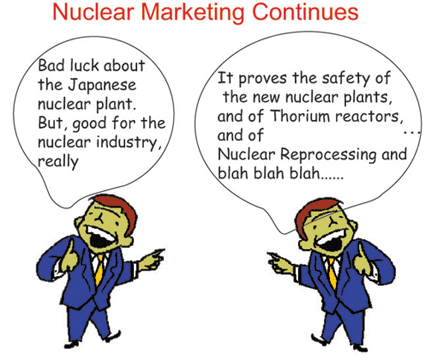 Reprocessing in China: A long, risky journey, Bulletin of the Atomic Scientists, Hui Zhang , April 15 Since 1983, a closed fuel cycle has been an official element of China’s nuclear energy policy. According to proponents, plutonium reprocessing and breeder reactors will allow full utilization of China’s uranium resources, drastically reduce the volume of radioactive waste that must be stored in an underground repository, and establish a way to dispense with the spent fuel accumulating in China’s reactor pools.
But Beijing’s attempts to develop commercially viable reprocessing facilities and breeder reactors have been afflicted with technological difficulties, serious delays, and cost overruns. At this point—especially taking into account China’s ample uranium resources and its easy access to additional resources abroad—it appears very doubtful that reprocessing and fast reactors are the proper way forward for China’s nuclear energy sector.
Not according to plan………..

 Parallel with development of the pilot reprocessing plant, China has been working to establish commercially viable plutonium breeder reactors. According to a plan in place until 2013, development of breeder reactors was to be a three-stage process. The first stage was to complete a project known as the China Experimental Fast Reactor. The second stage would involve building, by about 2020, a few demonstration fast reactors. Finally, commercialized fast reactors would be deployed around 2030. Progress always ran far behind schedule.
The China Experimental Fast Reactor is a sodium-cooled experimental fast reactor using technology developed for Russia’s BN-600 reactor. The project, with a planned capacity of 20 megawatts, was approved in 1995. Construction began in 2000. As with the pilot reprocessing plant, the experimental fast reactor encountered many difficulties during construction. Capital cost estimates had to adjusted twice, with each estimate double the previous one. The reactor went critical in July 2010 and, by July 2011, 40 percent of its full power was incorporated into the grid. The reactor, however, was online for only 26 hours during the remainder of 2011, and it produced the equivalent of just one full power-hour. Not until December 2014 did the reactor manage to operate at full capacity for 72 hours. So 19 years passed between project approval and operation at full capacity.
As for the second stage of the pre-2013 plan, CNNC in 2009 signed an agreement with Russia’s Rosatom to jointly construct two copies of Russia’s BN-800 fast neutron reactor in China. But Beijing has not officially approved the project. As with the French reprocessing plant, Chinese experts complain that Russia is demanding too high a price. It is not clear when or if the project will go forward. Instead, CNNC in 2013 began focusing on the development of the indigenous 600-megawatt China Fast Reactor (CFR-600). The start of construction is envisioned for 2017, with operations to commence in 2023—but the government has not approved the project yet.
Experts from CNNC have also, since 2013, urged the development of China’s first commercial fast reactor—a 1,000-megawatt reactor based on experience gained from the CFR-600. But CNNC expert Gu Zhongmao—an advocate of the closed fuel cycle—said at a recent workshop on nuclear energy in East Asia that “China needs at least another 20 to 30 years of effort before commercialization of fast reactor energy systems, and there are so many uncertainties ahead. It is beyond our ability to draw a clear picture 20 years ahead.”…………. http://thebulletin.org/reprocessing-poised-growth-or-deaths-door8185
No comments yet.
1 This Month

of the week – Shut Down Drone Warfare!


Tell the Ukrainian Government to Drop Prosecution of Peace Activist Yurii Sheliazhenko

Petition to revoke the licensing of the Near Surface Nuclear Disposal Facility (NSDF) at Chalk River. https://www.ourcommons.ca/petitions/en/Petition/Details?Petition=e-7247
To see nuclear-related stories in greater depth and intensity – go to https://nuclearinformation.wordpress.com
-
Archives
- April 2026 (103)
- March 2026 (251)
- February 2026 (268)
- January 2026 (308)
- December 2025 (358)
- November 2025 (359)
- October 2025 (376)
- September 2025 (257)
- August 2025 (319)
- July 2025 (230)
- June 2025 (348)
- May 2025 (261)
-
Categories
- 1
- 1 NUCLEAR ISSUES
- business and costs
- climate change
- culture and arts
- ENERGY
- environment
- health
- history
- indigenous issues
- Legal
- marketing of nuclear
- media
- opposition to nuclear
- PERSONAL STORIES
- politics
- politics international
- Religion and ethics
- safety
- secrets,lies and civil liberties
- spinbuster
- technology
- Uranium
- wastes
- weapons and war
- Women
- 2 WORLD
- ACTION
- AFRICA
- Atrocities
- AUSTRALIA
- Christina's notes
- Christina's themes
- culture and arts
- Events
- Fuk 2022
- Fuk 2023
- Fukushima 2017
- Fukushima 2018
- fukushima 2019
- Fukushima 2020
- Fukushima 2021
- general
- global warming
- Humour (God we need it)
- Nuclear
- RARE EARTHS
- Reference
- resources – print
- Resources -audiovicual
- Weekly Newsletter
- World
- World Nuclear
- YouTube
-
RSS
Entries RSS
Comments RSS
 nuclear-news
Leave a comment