Governments must stop subsidising the nuclear chain that leads to slavery and death
miningawareness 11 April 15 Thank you for pointing this out to us all. It’s important for anti-nuclear activists to not use “nuke-speak”, and easy to fall in the trap just by constant reading. A circle also sounds like the circle of life, whereas the nuclear industry is the chains of slavery and death. Really we must learn to leave everything in the ground, and recycle what is needed.
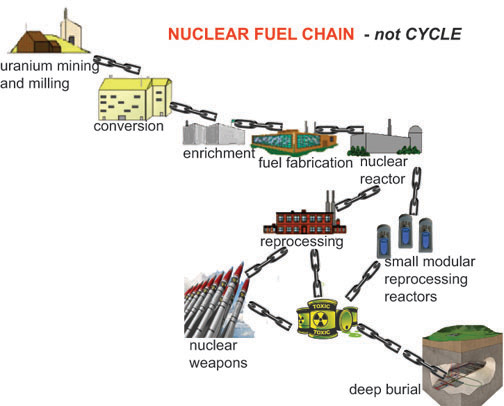
Indigenous Australians knew to leave things in the ground. They knew that sickness came from digging in the ground. There are conductive plastics already. Plastics are more and more vegetable based. If the governments would stop subsidizing the nuclear industry, the innovative potentials are out there. Universities can’t get money for algae research but the nuclear industry gets the monies.
These ideas from mining awareness sound deceptively simple. But if you go to his website, you will find very deep and complex matters explored, often in forensic detail miningawareness.wordpress.com
Rare Earths, Recycling and the Nuclear CHAIN – theme for April 15
FIRST – there is NO “Nuclear Fuel Cycle” – only a toxic Nuclear Fuel Chain 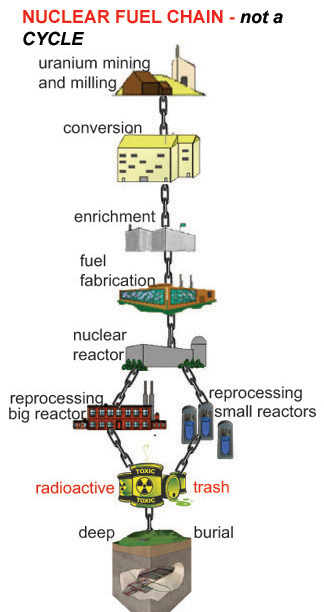
The nuclear lobby is telling one of its finest whoppers – that there really is a “nuclear fuel cycle” – that toxic radioactive wastes can be turned into lucrative nuclear fuel – for a never ending glorious “cycle”
Not true. It is truly a Nuclear Fuel Chain – that the lobby hopes to put around Australians’ necks. The new geewhiz (not yet existing) Liquid Fluoride Thorium Reactors (LFTRs) and Small Modular Nuclear Reactors (SMRs), including the Power Reactor Innovative Small Module (PRISM) – all produce highly toxic wastes that have to be buried. Reprocessing is NOT a “cycle”
SECOND – Rare Earths involve highly radioactive wastes – and require a big switch in DESIGN – so that they can be recycled.
Environmentalists must wake up to this. There must be a paradigm shift from the thinking, ) – from “dig it up – use it – throw it away” – to DESIGN.
The modern technologies that we value – from wind turbines to mobile phones must be redesigned, so that their rare earths can be easily retrieved and re-used.
Otherwise the planet will be further plagued by radioactive wastes from rare earths.

Agressive pro nuclear propaganda in Turkey (a taste of what’s to come, globally?)

 Nuclear energy: An unpopular product on sale http://www.todayszaman.com/columnist/joost-lagendijk/nuclear-energy-an-unpopular-product-on-sale_377657.html JOOST LAGENDIJK J.lagendijk@todayszaman.com szaman.co
I first noticed the advertisements on a tram I boarded in İstanbul last week. Later I saw huge billboards along major roads and a TV commercial trying to promote the same product: nuclear energy. For one moment I hesitated: Did I miss something and was Turkey already able to provide electricity from nuclear reactors? A quick check taught me it wasn’t at all far: Turkey’s first nuclear power plant, at Akkuyu, near Mersin, is still in the first phase of construction and will most probably only start producing electricity in 2023. So why then spend so much money on marketing a product that is not for sale in the foreseeable future?
For decades Turkey has tried to acquire its own nuclear power plants. For all kind of political and financial reasons, Ankara never managed to strike a deal with a foreign company to build one until in 2010 the Russian state-owned nuclear energy company Rosatom came up with an offer that Turkey could not refuse. The Russians will build, own and operate the $20-billion Akkuyu nuclear power plant while the Turkish state will guarantee the purchase of most of the electricity produced there against a fixed price. Three years later, in 2013, Turkey signed a second deal with a Japanese/French consortium that will build and operate another nuclear plant in Sinop but that will only start delivering after 2023. For the moment, all attention is focused on Akkuyu.
You can be sure last week’s publicity offensive is only the first phase of a long campaign to convince the Turkish population of the benefits of nuclear energy. The Turkish government knows very well that for now, most Turks are either opposed to nuclear energy or at the very least very skeptical about the presumptive advantages. Nuclear energy is an unpopular product that will need massive marketing to get it accepted by the time it becomes available.
In the months and years to come we will witness a very professional public relations campaign with only one aim: To try to take away the doubts about nuclear energy and highlight the positives. The arguments in favor will be a combination of the general ones always promoted by the nuclear industry and some specific Turkish ones. Belonging to the first category are the following catchwords: Improved safety, low costs, cleaner than coal, major contribution to fighting climate change. On top of that will come several presumed national bonuses: It will decrease Turkey’s energy dependency and current account deficit and will increase the country’s status and prestige.
All these justifications will be challenged by a motley collection of environmentalists, academics and local activists from Akkuyu and Sinop who don’t want their towns to be the places where this controversial experiment is located.
All these justifications will be challenged by a motley collection of environmentalists, academics and local activists from Akkuyu and Sinop who don’t want their towns to be the places where this controversial experiment is located.
The arguments against nuclear power are well-known as well: The unresolved waste issue, the lethal impact of possible accidents, the brighter future of renewable alternatives such as sun and wind power, and, in the case of Turkey, the danger of earthquakes and the growing dependency on Russia.
In a timely, recently published book on Turkey’s nuclear future, edited by George Perkovich and Sinan Ülgen, another potential risk is stressed and that is the need for an independent regulatory nuclear agency that will give Turks and the international community confidence that safety will be an overriding imperative. Whether or not such an agency can be effective and, if need be, go against the government, depends according to the authors on the evolution of the Turkish state. Will independent institutions still be allowed to operate freely in a country where power is increasingly concentrated in a de facto presidential system with few checks and balances left intact?
These and all the classical questions on nuclear energy will hopefully be part of the debate we should have in Turkey in the upcoming years. My advice: Be critical of the slick and polished pro-nuclear advertising campaigns that will be launched to prepare the ground. Take your time to listen to the arguments of the opponents who, I admit, convinced me some time ago that going nuclear is an old-fashioned, 20th-century solution at a time when better, safer and cheaper alternatives are available.
Only now, 29 years after the nuclear catastrophe, are Chernobyl reactors 1, 2 and 3 to be finally shut

 Final shutdown work authorized at Chernobyl nuclear power plant, Rt.com April 10, 2015 The Chernobyl nuclear power plant has officially launched the decommissioning and dismantling of its first three units. The move to fully shutdown the plant comes 29 years after it became site of the world’s worst nuclear disaster.

Though the Unit 4 reactor had been rendered inoperative in the 1986 meltdown, the first three continued to work for years after the devastating accident. Unit 2, 1 and 3 were put off the line in 1991, 1996 and 2000, respectively.Work will now be carried out to bring the three units into a “conserved” state in several stages, the first of which will take at least ten years, according to a statement on the plant’s website.……..A Chernobyl site operator said last year when the project was announced that its aim was to bring the three units “to a condition that ensures safe, controlled storage of radioactive substances and sources of ionizing radiation within them.”
A giant radiation shield is also currently being built around the site of the wrecked Unit 4 reactor as part of an effort to contain the radiation the site continues to leak. ……..http://rt.com/news/248737-shutdown-chernobyl-power-plant/
China’s new nuclear reactors lack required modern safety features

 Chinese nuclear reactors ‘did not receive latest safety tests before installation’ French manufacturer said recent test detected fault that could lead to cracks in reactor shell, South China Morning Post , 11 April, 2015 Stephen Chen chen.binglin@scmp.com Two new nuclear reactors in Taishan, Guangdong, did not undergo the same quality tests as a similar reactor in France that was found to have weak spots prone to cracks.
Special tests at the Flamanville EPR nuclear power plant were only carried out last year after France tightened its nuclear safety regulations, France’s Nuclear Safety Authority (ASN) told the South China Morning Post.
No such tests were conducted on the two third-generation EPR Taishan reactors before French nuclear manufacturer Areva shipped them to China. That meant the 50-billion yuan (HK$63 billion) Taishan plant, located about 80km west of Zhuhai and Macau, could be plagued by the same problem and not be detected.
 Weak spots in a reactor’s steel shell is a serious defect – once installed, the shell cannot be replaced throughout the reactor’s 60-year lifespan.
The tests in France found that excessive carbon in the steel that formed the reactor’s top and bottom could lead to unexpected cracks that could later spread.
The news comes as a shock to China’s burgeoning nuclear sector. With the completion date of the first project phrase expected by the end of this year, the Taishan EPR plant was a landmark project for China’s nuclear sector.
The plant’s two advanced 1.75GW pressurised water reactors were to be the world’s largest single-piece electric generators and their operation was said to be the safest, too.
Now it is not certain whether the Taishan reactors would comply with France’s stricter standards……….http://www.scmp.com/news/china/article/1763315/taishan-nuclear-reactors-did-not-receive-most-updated-safety-tests
Issues of anger and violence – in commander in charge of moving nuclear bombs
 He Handles American Nuclear Weapons, Has ‘Anger’ Issues A federal agent who ferries nuclear bombs around the U.S. allegedly threatened to kill a co-worker and got into physical fights with others—and bosses weren’t informed, an audit finds.The Daily Beast By R. Jeffrey Smith, 10 Apr 15 “…….the commander of a nuclear courier squad based in Oak Ridge, Tennessee—where the uranium portions of H-bombs are fabricated, stored, and periodically moved to other federal sites—allegedly threatened to kill one of his colleagues two years ago, and senior officials did not learn about it for five months, according to a recent inspection report by the Department of Energy’s top auditor.
Moreover, the commander in question repeatedly engaged in related misconduct without more senior officials being promptly informed, the report said. “Each of the seven incidents” described by the commander’s colleagues during the auditor’s investigation “involved physical or verbal altercations,” the report said. The misconduct began as long as a decade ago, but it wasn’t reported up the chain of command……….
The report noted that on two other occasions, in 2004 and 2008, the commander got into physical altercations with couriers, according to the accounts of those who worked with him, but senior officials said these also were not properly reported.
The alleged misconduct is embarrassing for a group of military and special forces veterans that arguably performs one of the nation’s most sensitive tasks—securely transporting nuclear bombs and weapons-usable nuclear materials among several dozen government factories, storage sites, and military installations nationwide, such as missile and bomber bases and submarine ports.
The stated mission of the little known courier group, the Office of Secure Transportation—an entity within the department’s National Nuclear Security Administration (NNSA)—is to “defend, recapture, recover” the bombs or explosives they transport. ……This story is from The Center for Public Integrity, a nonprofit, nonpartisan investigative news organization in Washington, D.C. To read more of their work on nationral security, go here or follow them on Twitter.….http://www.thedailybeast.com/articles/2015/04/10/he-handles-american-nuclear-weapons-has-anger-issues.html
Scientists detect Fukushima radiation in Canadian waters
Fukushima radiation in Canadian waters, DW 10 Apr 15 Scientists have detected radiation from Japan’s 2011 nuclear disaster off the Canadian coast. Experts disagree as to whether the amount detected constitutes a dangerous level or not. Trace amounts of the radioactive isotopes cesium-134 and cesium-137 have been found in samples that were collected close to Vancouver Island in British Columbia. According to the Integrated Fukushima Ocean Radionuclide Monitoring (InFORM) Network, it was the first time that traces of cesium-134 had been detected off North American coasts.
 As cesium-134 has a two-year half-life, any cesium-134 detected in the ocean today can only have been added recently – making Fukushima the only possible source.
Ken Buesseler, a marine chemist at Woods Hole Oceanographic Institution (WHOI), said in a statement: “Radioactivity can be dangerous, and we should be carefully monitoring the oceans after what is certainly the largest accidental release of radioactive contaminants to the oceans in history.”
He led an initiative that measured 60 sites along the U.S. and Canadian West Coast and Hawaii over the past 15 months for traces of radioactive isotopes from Fukushima. Using computer models, the scientist had already predicted that the traces would reach the coast,……..http://www.dw.de/fukushima-radiation-in-canadian-waters/a-18367257
Michigan lawmaker urges Congress to oppose Canada’s waste dump plan near Lake Huron
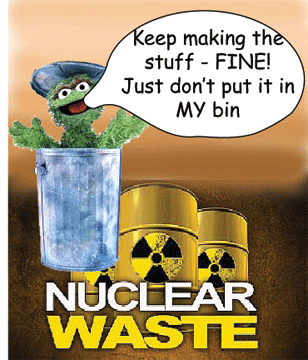 Michigan lawmaker: Congress should oppose Canada’s plan to bury nuclear waste near Lake Huron Star Tribune by: JOHN FLESHER , Associated Press April 10, 2015 – TRAVERSE CITY, Mich. — Michigan Rep. Dan Kildee said Friday he will push Congress to officially oppose Canada’s plans to allow nuclear waste to be stored underground less than a mile from Lake Huron, saying the country should find a site farther away from the Great Lakes, the world’s largest body of surface fresh water.
Kildee offered a similar resolution during the last congressional session, and numerous cities in the Great Lakes region have come out against the storage plan, but it failed to win House approval. Even if successful, it would have no force of law because Canadian officials will make the final decision.
Even so, the Democrat from Flint Township said the effort was worth making. He said the Ontario Power Generation plan to bury radioactive material, including discarded parts from the reactor core and ashes from incinerated floor sweepings and map heads, was “dangerous and an unnecessary risk we shouldn’t take.”
“The Great Lakes aren’t just a source of natural wonder,” said Kildee, whose district includes a section of the western Lake Huron coastline. “As the world’s largest body of fresh water, they’re vital to our way of life.”
Publicly owned Ontario Power Generation wants to bury 7.1 million cubic feet of low- and intermediate-level waste from its nuclear plants about 2,230 feet below the earth’s surface at the Bruce Power generating station near Kincardine, Ontario……..
Critics say there’s no way to guarantee the lake’s safety over the thousands of years that would be required for all the waste to lose its radioactivity.
Kildee’s office said the plan is opposed by 146 cities in the Great Lakes region, from Chicago to Toronto to Rochester, New York.
“My congressional resolution seeks to find an alternative location for this Canadian nuclear waste storage site so it does not endanger our state’s livelihood or economy — now or for future generations,” the congressman said.
A review panel of the Canadian Nuclear Safety Commission has conducted hearings on the project and is expected to issue a report by May 6. The Canadian environment minister would decide whether to approve or deny the project. If the minister endorses it, the review panel will decide whether to issue a construction license. http://www.startribune.com/politics/national/299322701.html
Robot fails, in effort to inspect inside of Fukushima reactor no 1
Fukushima Unit 1 Robot Dies In Containment During Inspection Simply Info April 10th, 2015
Kyodo News is reporting the robot died inside unit 1′s containment during the inspection. It stopped functioning part way through the inspection…….http://www.fukuleaks.org/web/?p=14672TEPCO has provided no other information about this yet.
Federal Judge OKs Uranium Mining Next to Grand Canyon National Park
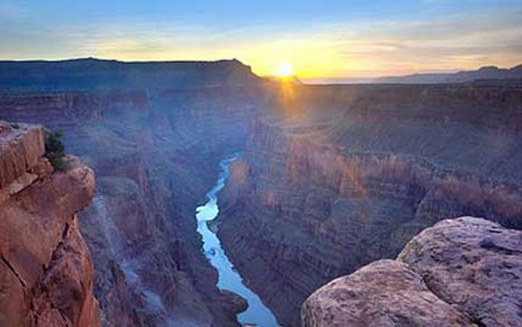 http://www.biologicaldiversity.org/news/press_releases/2015/uranium-mining-04-08-2015.html
Decision Allows Mining Without Tribal Consultation or Update Decades-old Environmental Review
PHOENIX, Ariz.— U.S. District Court Judge David Campbell denied a request to halt new uranium mining at the Canyon uranium mine, located only six miles from Grand Canyon National Park’s South Rim. The Havasupai tribe and a coalition of conservation groups had challenged the U.S. Forest Service’s decision to allow Energy Fuels Inc. to reopen the mine without initiating or completing formal tribal consultations and without updating an obsolete federal environmental review dating to 1986. At stake are tribal cultural values, wildlife and endangered species, and the risk of toxic uranium mining waste contaminating the aquifers and streams that sustain the Grand Canyon and Colorado River.
“We are very disappointed with the ruling by Judge Campbell in the Canyon Mine case,” said Havasupai Chairman Rex Tilousi. “We believe that the National Historic Preservation Act requires the Forest Service to consult with us and the other affiliated tribes before they let the mining company damage Red Butte, one of our most sacred traditional cultural properties. The Havasupai Tribal Council will meet this week to talk about appealing this ruling.” Continue reading
India’s government acts to cut off funding for Greenpeace: freezes its bank accounts
The Union Home Ministry on Thursday suspended the official registration for foreign funding of Greenpeace India for six months and froze seven bank accounts connected with the organisation, The Hindu, a local newspaper, reported.
Samit Aich, the executive director of Greenpeace, said the move was “an attack on democracy”.

“They don’t like the questions we are raising. We are environmental activists asking questions about the environment. There has been intimidation, illegal attacks for some time now,” he said……..
In January a Greenpeace campaigner was stopped by Indian officials from travelling to the UK to deliver a talk to MPs about the impact of mining on a poor communities and the environment in central India.
Government agencies had also found that “in the past couple of years, several UK nationals, including cyber experts and activists, had visited Greenpeace’s offices in India allegedly to help it organise protest activities”, the newspaper said.
In January the Indian government was told by judges to unblock funds received by Greenpeace which have been frozen by authorities since June.
The high court in Delhi, the capital, ruled that the previous freeze on funds that Greenpeace India had received from abroad was “arbitrarily illegal” and “unconstitutional”.
Over the past year, there have been a series of measures targeting Greenpeace and several other international NGOs working on similar environmental issues in India.
An intelligence report prepared for the incoming government of Narendra Modi, which took power after a landslide electoral win in May, accused several foreign-funded NGOs of stalling major infrastructure projects at the behest of unidentified foreign powers.
The report, which was leaked to the press, claimed that “people-centric” campaigns organised by NGOs blocked projects in seven sectors – nuclear power, uranium mining, thermal and hydroelectric power, farm biotechnology, extractive industries, and mega industrial projects – were aimed at keeping India in “a state of underdevelopment”.
In June, the government barred Greenpeace from receiving funds from Greenpeace International and Climate Works Foundation – some 30% of its funding. The remaining 70% is raised from local supporters in India. About £180,000 was frozen, before courts ordered its release.
Modi’s predecessor, Manmohan Singh, had complained that foreign-funded NGOs were blocking the expansion of nuclear power and the introduction of genetically modified products. http://www.theguardian.com/world/2015/apr/10/greenpeace-bank-accounts-frozen-by-indian-government
Steady fall in support for nuclear power among American public
A Slim Majority of Americans Say They Support Nuclear Energy Public approval has steadily dropped over the last five years, greentech media Julia Pyper April 10, 2015 Nuclear energy is losing popularity. A recent Gallup poll found that a slim majority of Americans — 51 percent — say they favor nuclear energy for electricity generation in the United States, while 43 percent say they oppose it. This year’s support levels are among the weakest Gallup has recorded in the last two decades. With a 46 percent approval rating, 2001 was the only year support sank lower.
Public approval of nuclear energy peaked in 2010 at 62 percent, shortly after President Barack Obama announced $8 billion in federal loan guarantees for the construction of two nuclear reactors in Georgia. The new, roughly 1,200 megawatt nuclear reactors at the Alvin W. Vogtle Electric Generating Plant, are the first to be built in the U.S. in three decades.
Over the last five years, support for nuclear energy has fallen by more than 10 percentage points………
The new Gallup poll similarly found a preference for renewable energy alternatives to nuclear power. The vast majority of respondents — 79 percent — called for a greater emphasis on solar power. Wind was close behind at 70 percent.
Thirty-five percent of Americans think the U.S. should put more emphasis on nuclear power, while 33 percent favor less emphasis and 28 percent say the emphasis should remain unchanged. Only coal had less support, with 43 percent of respondents saying coal should have less emphasis as a domestic energy resource……..http://www.greentechmedia.com/articles/read/a-slim-majority-of-americans-say-they-support-nuclear-energy
As hydraulic fracturing (fracking) increases- so do indoor levels of radon
 Small increases in radon track natural gas development with fracking in Pennsylvania, The Conversation, Joan A. Casey Robert Wood Johnson Health and Society Scholar at University of California, San Francisco Brian S. Schwartz Professor of Environmental Health Sciences at Johns Hopkins University 11 Apr 15
Historically, Pennsylvania has had one of the biggest indoor radon problems in the country. Why? Much of the bedrock in Pennsylvania contains high levels of uranium, which is radioactive and eventually decays to radium and radon gas. Radon gas can then enter buildings by diffusing through cracks in the foundation or by dissolving in water. It can get trapped in the basement and other areas of the home and can lead to health effects. Radon is the second-leading cause of lung cancer in the United States.
Due to high levels in Pennsylvania, indoor measurements are often taken when buildings are bought and sold with results reported to the state. This created a huge database, with over 1.5 million measurements from 1989 to 2013. The first unconventional natural gas development in Pennsylvania was in 2005, and by 2013 the industry had drilled 7,469 unconventional wells in the Marcellus shale.
Fracking is just one step in the process of unconventional natural gas development. The sheer scale of development in Pennsylvania made us, and others, wonder if the industry might be influencing those indoor radon measurements collected by the state. Once fully developed, some have estimated that there will be over 50,000 wells in the state……….
In our study we sought to take into account the cumulative effect of thousands of wells drilled statewide, and at a location more relevant to health – in buildings where people live, work and play. By contrast, the state study evaluated a few point sources of radiation pollution.
But what happens if a building is surrounded by hundreds of wells, which are each a potential point source? Is there a cumulative impact that the state missed? We believe our study is better suited for that possibility.
As public health professionals, our goal is to protect public health. We discovered that 42% of basement radon levels exceeded the level at which the EPA recommends people take action. Homes using well water had 21% higher radon levels than homes using municipal water.
With upward trends in radon levels, Pennsylvania’s long-standing radon problem certainly hasn’t gone away. We now leave it up to others – health professionals, economists, politicians and community members debating together – to weigh the evidence regarding the risks and benefits of unconventional natural gas development. For now we suggest homeowners continue to measure radon in their homes, the state continue to be vigilant about possible impacts of this industry on pathways and levels, and that future studies move beyond this first look to better understand the relationships that we may have uncovered. http://theconversation.com/small-increases-in-radon-track-natural-gas-development-with-fracking-in-pennsylvania-39991
According to mainstream media, Fukushima radiation is no problem at all
 Media Pushing the Idea That Fukushima Radiation Is Just Fine So Why Not Go Swim in It for Six Hours a Day Melissa Melton The Daily Sheeple 11 Apr 15
 – The mainstream media and their experts are finally openly admitting that radiation from the crippled nuclear reactor at the Fukushima Daiichi Nuclear Power Plant, the initial meltdown of which was equivalent to 168 of the atomic bombs dropped on Hiroshima during World War II, has reached North American shoes, but don’t worry.
Everything, according to the system, is just fine and dandy……..
Yeah. That’s a “very low risk.” The risk is so incredibly low in fact, that the EPA collectively shrugged and went, “Eh, no big deal, who cares” as they shut off radiation monitors back in 2011 not long after the 9.0 earthquake hit Fukushima.
Also hurry up and forget the fact that the government found it within their infinite wisdom to raise the limits for radiation exposure post-Fukushima as well. Can’t be bad for you if it’s “within [continuously raised] safety limits.”
Also don’t look too deeply into the fact that a disproportionately high number of Fukushima survivors are getting cancer…….
While you’re at it, ignore that just a little bit of Fukushima radiation has been detected in this fish and a little bit in that kelp and a little bit in those vegetables and a little bit found in milk from Washington to New Jersey and a little bit in some pollen and a little bit on the trade winds and a little bit in some fruit and a little bit and a little bit and a little bit more…
Meanwhile, the crippled reactor continues to dump 400 tons of irradiated groundwater a day, every day, into that ocean, but come on guys. The power company TEPCO, which is 75% owned by the Japanese government, says that the radiation somehow is magically quarantined right in front of the plant and magically does not spread throughout the ocean in an act that defies all scientific logic whatsoever http://www.thedailysheeple.com/media-pushing-the-idea-that-fukushima-radiation-is-just-fine-so-go-swim-in-it-for-six-hours-a-day_042015#sthash.CmE9KOYX.dpuf
–
Despite opposition and problems about liability, Prime Minister Narendra Modi aims to buy nuclear reactors
 Modi goes shopping for nuclear power in France and Canada Reuters | Apr 8, 2015, Times of India, NEW DELHI: Prime Minister Narendra Modi aims to advance the purchase of massive nuclear reactors and fuel from France and Canada to power a resurgent economy, overriding domestic opposition and concerns over liability laws as he embarks on a foreign tour.
In France, where Modi is making his first visit since taking office last year, he will seek to speed up price negotiations for the building of two reactors by state-run Areva SA of 1,650 megawatts each in the western state of Maharashtra………
1 This Month

of the week – Shut Down Drone Warfare!


Tell the Ukrainian Government to Drop Prosecution of Peace Activist Yurii Sheliazhenko

Petition to revoke the licensing of the Near Surface Nuclear Disposal Facility (NSDF) at Chalk River. https://www.ourcommons.ca/petitions/en/Petition/Details?Petition=e-7247
To see nuclear-related stories in greater depth and intensity – go to https://nuclearinformation.wordpress.com
-
Archives
- April 2026 (103)
- March 2026 (251)
- February 2026 (268)
- January 2026 (308)
- December 2025 (358)
- November 2025 (359)
- October 2025 (376)
- September 2025 (257)
- August 2025 (319)
- July 2025 (230)
- June 2025 (348)
- May 2025 (261)
-
Categories
- 1
- 1 NUCLEAR ISSUES
- business and costs
- climate change
- culture and arts
- ENERGY
- environment
- health
- history
- indigenous issues
- Legal
- marketing of nuclear
- media
- opposition to nuclear
- PERSONAL STORIES
- politics
- politics international
- Religion and ethics
- safety
- secrets,lies and civil liberties
- spinbuster
- technology
- Uranium
- wastes
- weapons and war
- Women
- 2 WORLD
- ACTION
- AFRICA
- Atrocities
- AUSTRALIA
- Christina's notes
- Christina's themes
- culture and arts
- Events
- Fuk 2022
- Fuk 2023
- Fukushima 2017
- Fukushima 2018
- fukushima 2019
- Fukushima 2020
- Fukushima 2021
- general
- global warming
- Humour (God we need it)
- Nuclear
- RARE EARTHS
- Reference
- resources – print
- Resources -audiovicual
- Weekly Newsletter
- World
- World Nuclear
- YouTube
-
RSS
Entries RSS
Comments RSS
 nuclear-news
