New legal case: sick USA sailors against Tokyo Electric Power

 U.S. Sailors Sick From Fukushima Radiation File New Suit Against Tokyo Electric Power, EcoWatch Harvey Wasserman | February 9, 2014 Citing a wide range of ailments from leukemia to blindness to birth defects, 79 American veterans of 2011’s earthquake/tsunami relief Operation Tomadachi (“Friendship”) have filed a new $1 billion class action lawsuit against Tokyo Electric Power.
The suit includes an infant born with a genetic condition to a sailor who served on the USS Ronald Reagan as radiation poured over it during the Fukushima melt-downs, and an American teenager living near the stricken site. It has also been left open for “up to 70,000 U.S. citizens [who were] potentially affected by the radiation and will be able to join the class action suit.”
The re-filing comes as Tepco admits that it has underestimated certain radiation readings by a factor of five. And as eight more thyroid cancers have surfaced among children in the downwind region. Two new earthquakes have also struck near the Fukushima site.
The amended action was filed in federal court in San Diego on Feb. 6, which would have been Reagan’s 103rd birthday. It says Tepco failed to disclose that the $4.3 billion nuclear-powered aircraft carrier was being heavily dosed from three melt-downs and four explosions at the Fukushima site. The Reagan was as close as a mile offshore as the stricken reactors poured deadly clouds of radiation into the air and ocean beginning the day after the earthquake and tsunami. It also sailed through nuclear plumes for more than five hours while about 100 miles offshore. The USS Reagan (CVN-76) is 1,092 feet long and was commissioned on July 12, 2003. The flight deck covers 4.5 acres, carries 5,500 sailors and more than 80 aircraft.
Reagan crew members reported that in the middle of a snowstorm, a cloud of warm air enveloped them with a “metallic taste.” The reports parallel those from airmen who dropped the Bomb on Hiroshima, and from central Pennsylvanians downwind from Three Mile Island. Crew members drank and bathed in desalinated sea water that was heavily irradiated from Fukushima’s fallout.
As a group, the sailors comprise an especially young, healthy cross-section of people. Some also served on the amphibious assault ship Essex, missile cruiser Cowpens and several others.
The plaintiffs’ ailments parallel those of downwinders irradiated at Hiroshima/Nagasaki (1945), during atmospheric Bomb tests (1946-1963), and from the radiation releases at Three Mile Island (1979) and Chernobyl (1986). Among them are reproductive problems and “illnesses such as Leukemia, ulcers, gall bladder removals, brain cancer, testicular cancer, dysfunctional uterine bleeding, thyroid illnesses, stomach ailments and a host of other complaints unusual in such young adults.”
One 22-year-old sailor declared to the court that “Upon my return from Operation Tomodachi, I began losing my eyesight. I lost all vision in my left eye and most vision in my right eye. I am unable to read street signs and am no longer able to drive. Prior to Operation Tomodachi, I had 2/20 eyesight, wore no glasses and had no corrective surgery.” Additionally, he said, “I know of no family members who have had leukemia.”
Plaintiff “Baby A.G.” was born to a Reagan crew member on Oct. 15, 2011—seven months after the crew members exposure—with multiple birth defects.
The suit asks for at least $1 billion to “advance and pay all costs and expenses for each of the Plaintiffs for medical examination, medical monitoring and treatment by physicians,” as well as for more general damages……..
Filed on Dec. 12, 2012, the initial suit involved just eight plaintiffs. It was amended to bring the total to 51.
That action was thrown out at the end of 2013 by federal Judge Janis S. Sammartino on jurisdictional grounds.
A January deadline for re-filing this second amended complaint was delayed as additional plaintiffs kept coming forward. Attorneys Paul Garner and Charles Bonner say still more are being processed.
The suit charges Tepco lied to the public—including Japan’s then Prime Minister Naoto Kan—about the accident’s radioactive impacts. Kan says Unit One melted within five hours of the earthquake, before U.S. fleet arrived. Such news is unwelcome to an industry with scores more reactors in earthquake zones worldwide.
The Plaintiffs say Tepco negligently leveled a natural seawall to cut water pumping expenses. The ensuing tsunami then poured over the site’s unprotected power supply, forcing desperate workers to scavenge car batteries from a nearby parking lot to fire up critical gauges. Tepco belatedly dispatched 11 power supply trucks that were immediately stuck in traffic.
Similar reports of fatal cost-cutting, mismanagement and the use and abuse of untrained personnel run throughout the 65-page complaint.
Attorney Bonner will explain much of it on the Solartopia Radio show at 5 p.m. EST on Tuesday, Feb. 11.
Some 4,000 supporters have signed petitions at nukefree.org, moveon.org, Avaaz and elsewhere.
Feb. 11—like the eleventh day of every month—will be a worldwide fast day for those supporting the victims of Fukushima’s deepening disaster.
The future of the U.S. Seventh Fleet, the nuclear power industry and a growing group young sailors tragically afflicted by Fukushima’s secret fallout will be hanging in the balance.
Visit EcoWatch’s FUKUSHIMA page for more related news on this topic. Harvey Wasserman edits www.nukefree.org, where petitions calling for the repeal of Japan’s State Secrets Act and a global takeover at Fukushima are linked. He is author of SOLARTOPIA! Our Green-Powered Earth. http://ecowatch.com/2014/02/09/u-s-sailors-fukushima-radiation/
Arrival of Fukushima’s radioactive isotopes on North American shores
 “BREAKING NEWS – Scientists detect Fukushima radiation on North American shores” — Coastal communities ‘concerned’ — Over 7 Bq/m3 of cesium from dock in Pacific Northwest — Professor: It indicates arrival of other radioactive substances — “Represents potential radiological health risk” (VIDEO) http://enenews.com/top-headline-fukushima-radiation-reached-north-american-shores-7-bqm3-cesium-detected-dock-pacific-northwest-professor-indicator-other-types-radioactive-substances-arrived-represents-potentia
Statesman Journal, Apr 6, 2015: BREAKING NEWS Scientists detect Fukushima radiation on North American shores — Seaborne radiation from Japan’s Fukushima nuclear disaster has reached North America… cesium-134 and cesium-137 in a sample of seawater taken in February from a dock on Vancouver Island… It’s the first time radioactivity from the March 2011 triple meltdown has been identified on West Coast shores [see: April 2011 — California seawater squeezed from kelp sample had 400,000 Bq/m3 of Iodine-131]… sample was taken Feb. 19… It contained 1.5 becquerels per cubic meter (Bq/m3) of cesium-134, the Fukushima fingerprint, and 5 Bq/m3 of cesium-137 [actually 1.4 and 5.8, respectively]… Fukushimaradiation concerns coastal communities… models have predicted that in general, the plume would hit the shore in the north first, then head south toward California… currents can be unpredictable… Woods Hole has received support from the National Science Foundation to analyze about 250 seawater samples that will be collected next month…
CTVNews, Apr 6, 2015: First low-level trace of Fukushima radioactivity detected off B.C. — But the levels are so low they are likely of little concern… Still, researchers say this is the first detectable of radioactivity from Fukushima found in a water sample taken from the U.S. and Canadian West Coast… Ken Buesseler, a marine chemist at WHOI who has been measuring radioactivity in Pacific seawater since 2011, says it’s been important to carefully monitor the oceans, given that the Fukushima disaster saw the largest accidental release of radioactive contaminants to the oceans in history.
Buesseler’s statement: “Even if the levels were twice as high, you could still swim in the ocean for six hours every day for a year and receive a dose more than a thousand times less than a single dental X-ray. While that’s not zero, that’s a very low risk.. We expect more of the sites will show detectable levels… Predicting the spread of radiation becomes more complex the closer it gets.”
CBC Radio, March 2015: Four years after the nuclear disaster in Fukushima, scientists like UVic’s Jay Cullen are still monitoring the Pacific waters near us for radiation. Listen to what he’s found and what he hasn’t… Cullen: “If we see cesium-134 in a water sample or a fish for example we know that that’s been affected by the Fukushima disaster… Not only is cesium a marker for other isotopes that were released… it also represents a potential radiological health risk because if its internalized… it can damage our cells and cause illness. So the risk of illness appearing in individuals relates to the activity, how much of that isotope ends up in their body. Given the nature of this disaster, with most of the isotopes going into the North Pacific Ocean, the most likely way that a human being would be exposed to this radioactivity at this point would be through the consumption of seafood.” >> Full interview here
Watch Woods Hole’s latest projection of Fukushima Cs-137 levels through 2021 here
Small Modular Reactors (SMRs) – the nuclear lobby’s desperate delusion
The cost per unit of output of SMRs is currently higher than the already expensive conventional, larger reactors. But the industry sees SMRs as a way to reduce costs and speed up construction by using large-scale standardized manufacturing that will churn out dozens, if not hundreds, of identical plants, each of which would ultimately produce cheaper kilowatt-hours than large one-off designs. But first someone needs to build a massive supply chain. Money for that would presumably come from customer orders – if there were any. The problem is it appears that no one actually wants to buy one.

 Small Reactor Delusion http://www.no2nuclearpower.org.uk/news/comment/small-reactor-delusion/ 9 Apr 15, The Financial Times seems to think that delays at Hinkley Point C will boost the argument for building small modular reactors (SMRs) in Britain.
In reality the nuclear industry is trying to find a silver lining to the cloud which is hanging over it, and using the problems of its own making to squeeze even more funds out of the hard pressed taxpayer. The FT reports that Rolls Royce wants more money for research for instance, and the recent House of Commons Energy and Climate Change Committee investigation concluded that deployment of SMRs is likely to be achieved through “sharing the costs between the public and private sector”.
There is already a provisionally agreed schedule to allow one SMR design to go through a Generic Design Assessment beginning in 2017. But this could take six years. By 2023 the cost of solar is expected to fall below that of gas, and the cost of offshore wind will have fallen below £100/MWh and will almost certainly be less than nuclear.
More information:
Small Modular Nuclear Reactors, the UK’s long-term nuclear strategy and Ireland’s future energy mix debate. NFLA March 2015http://www.nuclearpolicy.info/docs/nuclearmonitor/NFLA_New_Nuclear_Monitor_No37.pdf
New Reactor Types are all Nuclear Pie in the Sky, by Jim Green, Ecologist 2nd October 2014
http://www.theecologist.org/News/news_analysis/2577637/new_reactor_types_are_all_nuc
Japan mulls releasing radiation into air, instead of water – evaporation instead of Pacific ocean drainage
Japan considers evaporation, storage of tritium-laced Fukushima water TOKYO | BY AARON  SHELDRICK (Reuters) 8 Apr 15 – Japan is considering evaporating or storing underground tritium-laced water from the wrecked Fukushima nuclear plant as an alternative to releasing it into the ocean, Tokyo Electric Power Co’s chief decommissioning officer told Reuters on Wednesday.
The removal of hundreds of thousands of tonnes of water containing tritium, a relatively harmless radioactive isotope left behind in treated water is one of many issues facing Tokyo Electric as it tries to cleanup the wrecked plant.Tokyo Electric wants to release the tritium laced water to the ocean, a common practice at normally operating nuclear plants around the world, but is struggling to get approval from local fisherman, who are concerned about the impact on consumer confidence and have little faith in the company.
With the release to the ocean stalled, the government task force overseeing the cleanup is looking at letting the water evaporate or storing it underground, chief decommissioning officer Naohiro Masuda, told Reuters at the close of a seminar on decommissioning.
Masuda said he didn’t know when the discussions would be completed and a decision made.
Time and space is running out for Tepco, which has been forced to build hundreds of tanks to hold contaminated and treated water.
The evaporation method was used after the Three Mile Island disaster but the amounts were much smaller, Dale Klein, an outside adviser to Tepco told Reuters last week.
“They have huge volumes of water so they cannot evaporate it like they did at Three Mile Island,” Klein said. “If they did it would likely be evaporated, go out over the ocean, condense and fall back as rainwater. There’s no safety enhancement.”…….http://www.reuters.com/article/2015/04/08/us-japan-fukushima-water-idUSKBN0MZ0WC20150408
Local opposition to nuclear waste dumping seems to work, in Canada
 environmental groups, including Sierra Club Canada, have raised significant concerns about the transportation of liquid nuclear waste from Chalk River Laboratories near Ottawa to a U.S. government site in South Carolina.
 Coincidence or success? Nuclear waste facility drops towns after protest, rabble.ca
On March 3, the towns of Creighton, Saskatchewan and Schreiber, Ontario were dropped from considerationby the Nuclear Waste Management Organization (NWMO) to host a facility for highly radioactive used nuclear fuel.
Since 2010 the NWMO has been actively seeking a location to build what it calls a ‘long-term management site’ for the storage of used nuclear fuel. While there were originally 22 communities on the NWMO’s list of potential hosts, only nine  remain, all in Ontario, as candidates for a high-level waste site for used nuclear fuel.
While community activists celebrate being dropped from the lists, concerns about nuclear waste transportation remain. Local politicians are also quick to note a potential economic loss for their communities.
‘Geological complexities’ arise when there’s opposition Continue reading
Muzzling scientists: UK follows Canada’s lead
Following Canada’s Bad Example, Now UK Wants To Muzzle Scientists And Their Inconvenient Truths https://www.techdirt.com/articles/20150331/06512830496/following-canadas-
bad-example-now-uk-wants-to-muzzle-scientists-their-inconvenient-truths.shtml from the non-appliance-of-science dept Free Speech by Glyn MoodyWed, Apr 1st 2015
Under the new code, scientists and engineers employed at government expense must get ministerial approval before they can talk to the media about any of their research, whether it involves GM crops, flu vaccines, the impact of pesticides on bees, or the famously obscure Higgs boson.

The fear — quite naturally — is that ministers could take days before replying to requests, by which time news outlets will probably have lost interest. As a result of this change, science organizations have sent a letter to the UK government, expressing their “deep concern” about the code. A well-known British neurobiologist, Sir Colin Blakemore, told the Guardian:
“The real losers here are the public and the government. The public lose access to what they consider to be an important source of scientific evidence, and the government loses the trust of the public,” Blakemore said.
Not only that, by following Canada’s example, the British government also makes it more likely that other countries will do the same, which will weaken science’s ability to participate in policy discussions around the world — just when we need to hear its voice most.
Follow me @glynmoody on Twitter or identi.ca, and +glynmoody on Google+
Debate on whether or not Britain should have its Trident nuclear programme
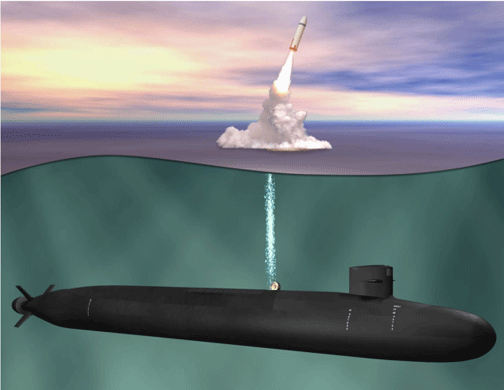 Trident debate: Should Britain have its own nuclear weapons arsenal? The Independent, ADAM WITHNALL 9 APR 15
  09 APRIL 2015 Michael Fallon has said the future of Britain’s nuclear deterrent will be at the heart of the general election debate, accusing Labour of being willing to scrap the Trident programme as part of a deal with the SNP…….Britain maintains four nuclear submarines, with at least one on full alert at any given time – and none of the major parties have pledged to change that.
But the Greens, the SNP in Scotland and Plaid Cymru in Wales have all called for the UK to set an example of nuclear disarmament and for the savings to be diverted to other public services……..http://www.independent.co.uk/news/uk/politics/generalelection/trident-debate-should-britain-have-its-own-nuclear-weapons-arsenal-10164477.html
USA’s Nuclear Regulatory Commission gambles with safety, using legalistic jargon
 US NRC Playing Brazen Legalese Games with Safety (Reactor Pressure Vessel Embrittlement) at Palisades Nuclear Power Station and Elsewhere, Mining Awareness, 9 Apr 15 In the April 18, 2013 US NRC “Summary of the March 19, 2013 Public Meeting Webinar Regarding Palisades Nuclear Plant” one finds brazen legalese statements by the US NRC in order to defend one of Entergy’s aging reactors, Palisades (Note that the NRC also had lawyer(s) working on the corporate side pushing the judge to ignore current concerns at Davis Besse Nuclear Power Station too. Davis Besse and Palisades endanger the largest surface fresh water system on earth.) The NRC inadvertently points out that, most likely, no US nuclear reactor has the more resistant materials required for safety starting in 1977.
Someone asked the NRC:
“Which are the other most embrittled plants in the U.S.? How many PWRs will reach their screening criteria in the next 10 years?”
The NRC responded:
“The NRC currently estimates that the following plants will exceed the PTS screening criteria of 10 CFR 50.61 during their 20-year period of operation beyond their original 40 year licenses. Updated fluence calculations, capacity factors changes, power uprate, new surveillance data, and improved material property information (i.e., the use of direct rather than correlative measurements of the vessel material’s resistance to fracture) can change these estimates…
1. Point Beach 2 (2017)
2. Palisades (2017)
3. Diablo Canyon 1 (2033)
4. Indian Point 3 (2025)
5. Beaver Valley 1 (2033)”
http://pbadupws.nrc.gov/docs/ML1310/ML13108A336.pdf
(It’s not clear if these years are the license expiration dates, or when they are estimated as in most danger of reactor pressure vessel fractures, minus uprates etc, which increase stress and put them at risk more quickly. PTS is Pressurized Thermal Shock. Point Beach is also on the Great Lakes (Lake Michigan, as is Palisades)
According to the NRC, Entergy-Palisades didn’t violate standards because there weren’t any! “Palisades did not violate the NRC’s PTS safety standards in 1981 since the NRC did not have any regulations pertaining to PTS until June 26, 1984.”
The NRC inadvertently explains that US Reactors are not up to even 1977 standards:
“For new plants, the reactor vessel beltline materials should have the content of residual elements such as copper, phosphorus, sulfur, and vanadium controlled to low levels. The levels should be such that the predicted adjusted reference temperature at the ¼ T position in the vessel wall at end of life is less than 200 °F. [These] recommendations … will be issued in evaluating construction permits docketed on or after June 1, 1977.”http://pbadupws.nrc.gov/docs/ML1310/ML13108A336.pdf
“There has been no ground-breaking on new nuclear plants in the United States since 1974. Up until 2013, there had also been no ground-breaking on new nuclear reactors at existing power plants since 1977.”http://en.wikipedia.org/wiki/Nuclear_power_in_the_United_States
Since permitting would normally come before ground-breaking this appears to mean that no nuclear reactors currently in operation are up to the 1977 standards for prevention of embrittlement. 1977 was 37-38 years ago. Jimmy Carter was President and the Cold War was far from over. Apple home computers weighed 11.5 pounds excluding the screen, which probably weighed almost as much. Apple Ipad air weighs less than one pound.
The NRC further states:
“In conclusion, there was no violation of NRC requirements concerning PTS at Palisades. Had Palisades ever violated PTS requirements the NRC would have shut down the plant.
Regulatory Guides do not contain requirements, only recommendations.”http://pbadupws.nrc.gov/docs/ML1310/ML13108A336.pdf
So, since the “Regulatory Guides only contain recommendations”, anything goes? What’s the NRC for then? Making the US tax-payer pay for lawyers and staff to protect the interests of the nuclear power industry? Safety doesn’t matter? Regulations are supposed to be laws. Aren’t they?
Where did concern about the US budget go anyway? A good place to start cuts is the US NRC, which has long been called an instance of regulatory capture. ……..https://miningawareness.wordpress.com/2015/04/09/us-nrc-playing-brazen-legalese-games-with-safety-reactor-pressure-vessel-embrittlement-at-palisades-nuclear-power-station-and-elsewhere/
Complex nuclear relationship between Pakistan, Saudi Arabia and Iran
Pakistan Has Complicated Nuclear Relationship With Saudi Arabia, Iran VOA, Ayesha Tanzeem April 07, 2015 ISLAMABAD—
Iran’s foreign minister visits Pakistan Wednesday to discuss the conflict in Yemen, which many see as a fight for influence between regional rivals Iran and Saudi Arabia.
Iran also has recently reached a framework nuclear agreement with six world powers to possibly curb the weapons potential of its nuclear program.
Saudi Arabia, in the past, has reportedly sought to form its own nuclear alliances to counter a perceived Iranian threat. A member of the Saudi royal family and the kingdom’s former intelligence chief, Prince Turki al-Faisal, warned a few months ago that the kingdom would seek the same nuclear capabilities that Tehran is allowed to maintain under any deal.
In this regard, Pakistan’s relationship with the kingdom is unusual.
On one hand, it has sold nuclear secrets to Iran in the past through a network run by former chief Pakistani nuclear scientist A.Q. Khan. The network also sold nuclear technology or know-how to Libya and North Korea.
On the other, it has faced allegations of promising Saudi Arabia a nuclear umbrella against Iran.
‘Unacknowledged nuclear partnership’…….http://www.voanews.com/content/pakistan-has-complicated-nuclear-relationship-with-saudi-arabia-iran/2710343.html
Nuclear submarine on fire – luckily it was unarmed

 Unarmed Russian nuclear submarine catches fire in shipyard, Stuff.co NZ, THOMAS GROVE , April 8 2015 Firefighters struggled to put out a blaze on a nuclear submarine as it underwent repairs at a shipyard in Russia’s northern province of Arkhangelsk on Tuesday (Wednesday NZT), Russian news agencies reported.
The agencies quoted sources as saying there were no weapons on board. Nobody was hurt, they said, although RIA news agency said the dry dock where the vessel was being repaired may have to be submerged under water to help extinguish the blaze.
The Emergencies Ministry declined comment on the reports of the fire at the Zvyozdochka shipyard, where the agencies said the 155-metre-long (just over 500 feet) 949 Antei submarine was being repaired.
“There is a fire on the submarine. We are fighting the fire now,” a shipyard source told Interfax news agency………http://www.stuff.co.nz/world/europe/67640388/unarmed-russian-nuclear-submarine-catches-fire-in-shipyard
1 This Month

of the week – Shut Down Drone Warfare!


Tell the Ukrainian Government to Drop Prosecution of Peace Activist Yurii Sheliazhenko

Petition to revoke the licensing of the Near Surface Nuclear Disposal Facility (NSDF) at Chalk River. https://www.ourcommons.ca/petitions/en/Petition/Details?Petition=e-7247
To see nuclear-related stories in greater depth and intensity – go to https://nuclearinformation.wordpress.com
-
Archives
- April 2026 (103)
- March 2026 (251)
- February 2026 (268)
- January 2026 (308)
- December 2025 (358)
- November 2025 (359)
- October 2025 (376)
- September 2025 (257)
- August 2025 (319)
- July 2025 (230)
- June 2025 (348)
- May 2025 (261)
-
Categories
- 1
- 1 NUCLEAR ISSUES
- business and costs
- climate change
- culture and arts
- ENERGY
- environment
- health
- history
- indigenous issues
- Legal
- marketing of nuclear
- media
- opposition to nuclear
- PERSONAL STORIES
- politics
- politics international
- Religion and ethics
- safety
- secrets,lies and civil liberties
- spinbuster
- technology
- Uranium
- wastes
- weapons and war
- Women
- 2 WORLD
- ACTION
- AFRICA
- Atrocities
- AUSTRALIA
- Christina's notes
- Christina's themes
- culture and arts
- Events
- Fuk 2022
- Fuk 2023
- Fukushima 2017
- Fukushima 2018
- fukushima 2019
- Fukushima 2020
- Fukushima 2021
- general
- global warming
- Humour (God we need it)
- Nuclear
- RARE EARTHS
- Reference
- resources – print
- Resources -audiovicual
- Weekly Newsletter
- World
- World Nuclear
- YouTube
-
RSS
Entries RSS
Comments RSS
 nuclear-news