Below Fukushima nuclear plant – pools of molten nuclear fuel
AP: Melted fuel may have “dropped even beyond” the bottom of Fukushima plant — ‘China Syndrome’ predicted by US gov’t analysis — IAEA Expert: Pools of corium beneath reactors are up to 2 stories high (VIDEO)http://enenews.com/ap-melted-fuel-could-dropped-beyond-bottom-fukushima-plant-iaea-expert-pools-corium-could-be-taller-2-story-house-video?utm_source=feedburner&utm_medium=email&utm_campaign=Feed%3A+ENENews+%28Energy+News%29
AP, Mar 27, 2015 (emphasis added): [It] was billed as a way to decipher where, exactly, the morass of nuclear fuel might sit at the bottom of reactors… But what went wrong, even in a simple demonstration for reporters… was a sobering reminder of the enormous challenges that lie ahead… a programming glitch could not be fixed in time for Friday’s demonstration… No one knows where the molten fuel debris lies, and in what shape or state. [TEPCO] has said itlikely sank to the bottom of the plant. But the fuel could have dropped even beyond. Tadashi Yotsuyanagi, an official in charge of the muon project at Toshiba… acknowledged the technology will not be able to get the complete image toward the bottom of the reactor… David Ireland, a professor who heads the Nuclear Physics Group at the University of Glasgow, said muons may be the only way to probe inside atomic reactors. “There are not really any other noninvasive options that will allow inspection,” he said in an email.
The Japan Times published the AP report above, however one sentence was altered. “Tepco has said it likely sank to the bottom of the plant. But the fuel could have dropped even beyond” vs. “But the fuel could possibly have escaped even beyond the containment facility to the outside environment.”
IAEA technical meeting Managing the Unexpected, Harri Tuomisto, Sr. Nuclear Safety Officer at Finland’s Fortum Power, 2012:
- Part 4: “If the cooling is not successful, it means the corium melts through the vessel… When this massive amount of corium enters into the containment zone, there are very, very many different energetic consequences… Interaction of molten core and concrete starts… concrete is eroding, and this eroding of concrete, for a long time it was known as China Syndrome.”
- Part 5: “The corium will be in 3 parts, there is a solid crust formation in the bottom of the pool, then there’s a pool of oxidic materials… The metals and oxides are not soluble with each other and the metals will be separated… which is bad news in the sense that theheat transfer to the vessel is much higher, and it’s much more difficult to guarantee the integrity of the [containment] vessel in that case.”
- Part 6: “Molten corium on the containment floor, it’s eroding the concrete and going partially downward. Actually it will never go to China, because it also erodes sideways… The final size of the pooling maximum case is 10 to 15 meters in diameter, and 6-7 meters [20-23 ft or 2 stories] deep — or even deeper.”
- Part 9: “There are quite many challenges… There are different energetic phenomenon… which can lead to different combustions… accelerating flames, or even detonations — which can cause a very high pressure in the containment and even break the containment… Then there’s this China Syndrome — attack of containment liner by corium — which can also bypass containment.” (See US gov’t analysis: Fukushima containment breached due to “failure of the drywell liner by melt-attack“)
- Slides 3-4: If corium melts through the vessel, there are various energetic consequences caused by ejected high-temperature molten corium… Molten corium on the containment basemat initiates core-concrete interaction that releases aerosols and non-condensible gases to containment atmosphere and erodes the concrete (‘China syndrome‘)
Japan’s PM pretended that Fukushima disaster was ‘under control’ – in order to get 2020 Olympic Games
 JP PM Abe “My saying Under-control was only to reassure the world to let Japan host 2020 Olympics” http://fukushima-diary.com/2015/03/jp-pm-abe-my-saying-under-control-was-only-to-reassure-the-world-to-let-japan-host-2020-olympics/ Following up these article..
Tepco inquired JP Gov about PM Abe’s statement to IOC “Contaminated water is entirely blocked” [URL 1]
[Column] How JP Prime Minister Abe lied to IOC about sea contamination [URL 2]
The Prime Minister of Japan, Abe stated he only wanted to “improve the atmosphere” by commenting “contaminated water situation is under control”.
In the summer of 2013, Abe stated to IOC that contaminated water problem is under control and it is entirely blocked within the 0.3 km2 area of Fukushima nuclear plant.
However in the House of Councilors of 3/3/2014, Abe was stating that there internationally was a political atmosphere that if Japan is not capable of settling contaminated water problems, it should not be allowed to host 2020 Olympics.
Abe added, it was his responsibility to remove such an atmosphere by saying the situation is under control, which does not mean more than he is in charge of reviewing the contaminated water situation.
http://kokkai.ndl.go.jp/SENTAKU/sangiin/186/0014/18603030014005.pdf
Thorium – a very large threat to the planet
 Don’t Jump on The Thorium Bandwagon – It’s Not Green, Not Viable, And Not The Answer To Our Energy Problems Prevent Disease.com, Nov 10, 2013 by KELLEY BERGMAN“….. thorium still represents a very large threat to the planet whose problems over current nuclear systems exist only in details. It is not eco-friendly by any stretch of the imagination, although it is being promoted as such to nations around the world. It’s not renewable, green or clean and definitely not the answer to the world’s energy crisis as scientists around the world are deceptively claiming.
Due to its extreme density, thorium is being highlighted for its potential to produce tremendous amounts of heat. Many companies have been experimenting with small bits of thorium, creating lasers that heat water, producing steam which can power a mini turbines. According to CEO Charles Stevens from Laser Power Systems (LPS) from Connecticut, USA,, just one gram of the substance yields more energy than 7,396 gallons (28,000 L) of gasoline and 8 grams would power the typical car for a century.
The idea of using thorium is not new. In 2009, Loren Kulesus designed the Cadillac World Thorium Fuel Concept Car.
Dozens of other companies are investing millions and jumping on the thorium bandwagon without any foresight or wisdom into the long-term devasting effects of another nuclear-based problem.
Thorium is now being heavily promoted by the nuclear industry and various lobbies. Its mining is based on exploitation of workers forced to work with bare hands and contamination, sacking and devastation of territories.
What Is Thorium?
Thorium is a radioactive chemical element. It produces a radioactive gas, radon-220, as one of its decay products. Secondary decay products of thorium include radium and actinium. In nature, virtually all thorium is found as thorium-232, which undergoes alpha decay with a half-life of about 14.05 billion years.
As far as nations go, Canada, China, Germany, India, the Netherlands, the United Kingdom and the United States have all experimented with using thorium as a substitute nuclear fuel in nuclear reactors.
Highly Carcinogenic Causing Defomities
Besides being radioactive, thorium is also a highly carcinogenic heavy metal used in military targeting systems and has been found in honey, milk, and other areas of the food chain where the military has been testing thorium such as Sardinia……
Sardinia is the victim of weapons manufacturers, polluting military activities and a political system that cares about power and money over the health of people and the environment. An epidemic of cancers and birth defects is now evident in this region through their soil, air, food and water contaminated with heavy metals, jet fuel and other poisons.
The nuclear physicist Evandro Lodi Rizzini of Brescia University and CERN (European Organization for Nuclear Research) found elevated levels of radioactive thorium 232 and cerium (proving that the thorium was man-made) in the tissues of 15 of 18 bodies in the Quirra area of Sardinia where they died of cancer between 1995 and 2000.
On March 24, 2012, prosecutor Domenico Fiordalisi in Lanusei, Sardinia, indicted twenty people on charges of “willful omission of precautions against injury and aggravated disasters or because they falsely certified the absence of pollution with the aim to “hide the environmental disaster.” The documents from Fiordalisi’s investigation have now been turned over to a tribunal for prosecution.
Fiordalisi opened his investigation when he learned the results of cancer research in the Quirra area. In the last 10 years, 65 percent of shepherds were diagnosed with leukemia, lymphomas and autoimmune diseases. He suspected that the materials used in the polygon contaminated soils, pastures, water and air poisoning people, plants and animals as a consequence.
On 8 May 2012, Fiordalisi reported to the Parliamentary Committee of Senators’ Inquiry on DU the results of these investigations led by him. He detailed how chromium, tungsten and thorium and of the extreme danger of the alpha particles generated by this substance.
He explained that thorium is much more harmful than depleted uranium, and that the area of the polygon of Quirra was completly impregnated. This substance has found its way into cheese, worms, mushrooms, sheperds and animals: pigs born with six legs and lambs with a single large eye. He stated that the 1187 milan missles that were launched between 1983 and 1999 which, in the opinion of the nuclear physicist Evandro Lodi Rizzini were responsible for an epidemic of cancers and lymphomas in the military due to the release of radioactive substances.
Dr. Rizzini said, “One micro-gram, that is, one millionth of a gram is sufficient to kill a person. It causes a rise in atomic disintegrations; with a production of 2000 alpha rays a day, nuclear radiation is most damaging.”
The organizations International Coalition to Ban Uranium Weapons and Mother Earth have good information about depleted uranium.
“With uranium-based nuclear power continuing its decades-long economic collapse, it’s awfully late to be thinking of developing a whole new fuel cycle whose problems differ only in detail from current versions.”
Amory Lovins, Rocky Mountain Institute, March 2009………….http://preventdisease.com/news/13/111013_Dont-Jump-on-The-Thorium-Bandwagon-Not-Green-Not-Viable-Not-The-Answer.shtml
Recycling of nuclear fuel is more expensive than dry cask storage of nuclear wastes
 The High and Hidden Costs of Nuclear Power POLICY August & September 2010, No. 162 Review By Henry Sokolski…….Discouraging the use of government financial incentives to promote commercial nuclear power. This recommendation was made by the Congressional Commission on the Prevention of Weapons of Mass Destruction Proliferation and Terrorism. It would clearly include discouraging new, additional federal loan guarantees for nuclear fuel or power plant construction of the type now being proposed by President Obama and the nuclear industry. ………
World’s largest moveable structure being built – the Chernobyl sarcophagus
 Chernobyl: Containing the world’s worst nuclear accident BBC News [excellent photographs] David Shukman Science editor 18 March 2015 Rising above the scene of the world’s worst nuclear accident is the spectacular sight of the largest moveable structure ever created on land.The complex of nuclear power plants at Chernobyl has dominated this corner of northwest Ukraine for decades but the new construction towers over it all.
The project is to build what is called a New Safe Confinement – in effect, a giant cover, a kind of dome, to fit over the building that houses the reactor that exploded on 26 April, 1986.
The radiation immediately above the reactor is still far too intense for the new enclosure to be built exactly where it is needed – anyone working there can only stay very briefly. So adjacent land has been cleared and then decontaminated – a massive task in itself – to allow the new structure to be assembled before being manoeuvred into position.
Sealed future Large enough to accommodate a couple of Boeing 747s or the Stade de France in Paris, and almost tall enough to hold St Paul’s Cathedral in London, the giant cover stands on a system of massive rails.
When complete, it will weigh an extraordinary 31,000 tonnes. Over several days, it will be rolled along its special track so as to just slide over the reactor building – a very tight fit – in order to seal it in.
There is still a 30km exclusion zone around the Chernobyl site
The task is “of a complexity and uniqueness we have never faced before”, according to Vince Novak, who runs the nuclear safety department of the European Bank for Reconstruction and Development. He has led the international drive to make Chernobyl less dangerous.
“Until this project is in place, we will not be safe,” he said during a media visit to the site.
“The ultimate objective is to protect the environment, contain the threat and deal with the radioactive material inside.”
Dangerous mix
This material is a nightmare mix of more than 100 tonnes of uranium, one tonne of plutonium, and other highly radioactive elements, formed into a previously-unseen lava-like mass.
Added to that are several thousand tonnes of sand and boron dropped on to the site by emergency workers at the time.
Vast quantities of radioactive liquids and dust are also present inside a reactor building that has itself long been in danger of collapse. In the months following the accident – when the reactor exploded and burned for 10 days – the authorities attempted to smother the building in an emergency “sarcophagus” of concrete and steel.
But this was only ever intended to be a temporary fix and has needed urgent repairs to try to keep it stable and intact………http://www.bbc.com/news/science-environment-31939778
25 times more carbon emissions from nuclear power than from wind energy
 Nuclear power results in 25 times more carbon emissions than wind. The man illuminating how dirty your energy really is
 Amy Kalafa MBA in Sustainability Candidate Bard College
Stephanie Milbergs Assistant director Bard MBA in Sustainability Rochelle J. March
Rochelle J. March Friday, March 13, 2015 Mark Z. Jacobson is director of Stanford University’s Atmosphere and Energy Program, as well as a professor of civil and environmental engineering. He is also a senior fellow of the Woods Institute for the Environment and of the Precourt Institute for Energy.
The main goal of Jacobson’s research is to better understand physical, chemical and dynamic processes in the atmosphere in order to solve atmospheric problems, such as global warming and urban air pollution, with improved scientific insight and more accurate predictive tools.
Jacobson also evaluates the atmospheric and health effects of proposed energy and transportation solutions to global warming and air pollution, maps renewable energy resources and studies optimal methods of integrating renewable electricity into the grid.
This Q&A is an edited excerpt from a Sustainable Business Fridays conversation Jan. 30 by the Bard MBA in Sustainability program, based in New York City. This twice-monthly dial-in conversation features sustainability leaders from across the globe…….
You just came out with a study, however, that states nuclear power results in 25 times more carbon emissions than wind. Can you explain these findings for us?
Jacobson: Sure, it’s rather straightforward. A life-cycle analysis of a wind turbine shows most of carbon outputs during its construction, practically zero when it’s in operation, and then, if you use today’s methods, during decommission a turbine outputs some carbon.
When you do the calculation, however, you find that wind power emissions are between 5 to 10 grams of carbon per kWh of electricity generated over the lifetime of the turbine. Using that as a baseline, you see over the lifetime of nuclear power, the carbon output is 70 grams per carbon per kWh.
This is from one, building of the nuclear power plant and then two, refining uranium, which is very energy-intensive. There is also timing involved: It takes on average in the U.S. 10 to 19 years for a nuclear power plant to get up and running, while a wind farm can be built on average in two to five years.
If we compare nuclear and wind from now, in two to five years you’ll have a wind farm up and start creating energy that’s clean, while with nuclear you have to wait 10 to 19 years to get that energy. If you add in these extra emissions, called opportunity cost emissions, you end up getting nine to 25 times more carbon in air pollution per kWh from nuclear than wind.
That is still better than coal or natural gas (60 to 120 times more), but other problems with nuclear power is of course 1.5 percent of plants have melted down, and the problems related to weapons proliferation with nuclear, radioactive waste, mining damage, etc. Not even mentioning the cost, which is very high and currently subsidized in the U.S. It’s not a viable option; it’s really the nuclear industry trying to push it to get more business.
The full recording of this conversation is also available. http://www.greenbiz.com/article/dirty-energy-source-stanford-prof-mark-jacobson-explains
Dubious public relations announcements from TEPCO
 TEPCO Unleashes Series Of Dodgy PR Announcements, Simply Info March 31st, 2015 TEPCO’s paid consultant from the US, Dale Klein is pushing TEPCO’s continuing quest to dump contaminated water into the ocean. The reason given today is that he claims it is harmless if you dilute it with other water. A ton of highly contaminated water is a ton of highly contaminated water, even if you add another ton of cleaner water to the release. This is an old industry PR tactic that is in dire need of retirement………http://www.fukuleaks.org/web/?p=14627
Ontario federal court nullified approval of 4 new and rebuilt nuclear reactors
The latest punch in the gut for nuclear proponents in the province comes from a May 14 Federal Court decision to nullify the approval of up to four new reactors at Darlington Station, about 60km east of Toronto.
Among other issues, the presiding Justice James Russell cited inadequate planning for both nuclear waste storage and a catastrophic accident as reasons to revoke the project’s license, which was originally secured following a multi-year environmental assessment (EA). Justice Russell found that the EA failed to adhere to the Canadian Environmental Assessment Act.
The Federal Court review of the EA was initiated by environmental groups Canadian Environmental Law Association (CELA), Greenpeace Canada, Lake Ontario Waterkeeper (LOW) and Northwatch with lawyers from Ecojustice and CELA representing the application in court.
In a press release following the decision, the environmental groups called the Federal Court’s ruling “common sense.”
Justin Duncan, Staff Lawyer for Ecojustice and co-counsel for groups, said “the court’s ruling means that federal authorities can no longer take shortcuts when assessing nuclear projects.”………http://rabble.ca/news/2014/05/anti-nuclear-advocates-federal-court-trouble-ontario-liberal-and-pc-energy-plans
India’s nuclear safety, and regulator independence not satisfactory – says IAEA
IAEA team completes review of Indian regulator, World Nuclear News 30 Mar 15 “…… the mission also provided recommendations and suggestions for improvement, many at the governmental level. The government should promulgate a national policy and strategy for safety and a strategy for radioactive waste management, it said. The team also recommended that the Indian government ensure that the AERB’s independence is embedded in law, ensuring its separation from other entities that could unduly influence the regulator’s decision making. The AERB itself should also review its policy and arrangements to ensure it maintains independence in its regulatory functions, the mission said.
The regulator should also consider increasing the frequency of on-site inspections and should develop and implement its own internal emergency arrangements, the reviewers found….The mission’s final report will be provided to the Indian government in about three months.http://www.world-nuclear-news.org/RS-IAEA-team-completes-review-of-Indian-regulator-2703158.html?utm_source=twitterfeed&utm_medium=twitter
Support for Iran nuclear talks, from Americans
In a Pew Research Center poll published Monday, 49 percent of Americans said they approve of talks over a nuclear deal with Iran while 40 percent expressed disapproval. Eleven percent were unsure………….
If a deal is reached, 62 percent of Americans believe Congress should have the final authority to approve agreements while 29 percent think Obama should have the final say.
In terms of party affiliation, Democrats are much more likely to support a nuclear deal with Iran. Sixty-two percent of Democrats and 36 percent of Republicans said they approve of the U.S. negotiating directly with Iran over a nuclear program.
This poll was taken March 25-29 among 1,500 adults and has a margin of error of plus or minus 2.9 percentage points.
Brave Japanese bureaucrat speaks out for reform of energy policy
Japan’s Lonely Brave Bureaucrat Speaks Out on TV Asahi Nuclear Free by 2045? 31 Mar 15 A former high level bureaucrat in the Japanese Ministry of Trade was one of the few public officials to bravely speak up for radical change in the wake of the earthquake-tsunami-meltdown catastrophe. The Economistwas one of the first in the English language media to report on Shigeaki Koga’s radical proposals for reform of national energy policy. In September 2011, The Economist reported his views:
UPDATES:
MARCH 30, 2015: The Japan Times reported on the controversial broadcast a few days afterwards: Ex-bureaucrat blasts Abe on news program.
MARCH 29, 2015: Asahi Shimbun reported on the controversial broadcast the day after I wrote the above: Abe critic claims on air he was axed from TV program at behest of management.
Sources:
Tomohiro Sasaki, “Ex-bureaucrat blasts Abe on news program,” The Japan Times, March 30, 2015. http://nf2045.blogspot.jp/2015/03/japans-lonely-brave-bureaucrat-speaks.html
200 years before Japan can hope to clean up Fukushima
Japan faces 200-year wait for Fukushima clean-up The chief of the Fukushima nuclear power station has admitted that the technology needed to decommission three melted-down reactors does not exist, and he has no idea how it will be developed.
the nuclear history of Port Hope – told in “Blind Faith”
 Blind Faith: The Nuclear History of Port Hope, Ontario January 15, 2015 by Dennis Riches @DennisRiches “……..hibakusha (the Japanese word for radiation victims) become invisible. When a new group of people become victims, such as in Fukushima in 2011, they feel that they have experienced a unique new kind of horror. For them, for their generation, it is new, but for those who know the historical record, it is a familiar replay of an old story. The people of Fukushima should know by now that they are bit players who have been handed down a tattered script from the past.
A case in point is “Blind Faith,” the superb 1981 book by journalist Penny Sanger, about the small irradiated Canadian town of Port Hope on the shores of Lake Ontario. (See the timeline at the end of this article) [2] In the 1970s it faced (and more often failed to face) the toxic legacy of processing first radium, then uranium for nuclear weapons and nuclear power plants.
In a saner world this book would not be out of print and forgotten. It would be a classic text known by everyone who has ever had to share his town with a dangerous corporate citizen. Then there would be no surprises when a nuclear reactor explodes or a cancer cluster appears somewhere new. It wouldn’t be a shock to see the victims themselves fall over each other in a rush to excuse their abuser, beg for a continuation of jobs and tax revenue, and threaten the minority who try to break the conspiracy of silence.
On the back cover of the 1981 paperback edition of “Blind Faith” there was an endorsement by the late great Canadian writer Farley Mowat, who passed away in the spring of 2014:
Penny Sanger has written a fascinating and fearsome account of the emotional turmoil that engulfs a small town when it discovers that its major industry is a threat to the health of its citizens. This is a classic account of how economic power enables industry to ride roughshod over those who must depend on it for their daily bread.
Although I wrote above that “Blind Faith” illustrates universal truths about what happens to communities contaminated with radiation, there are always unique aspects of the situation that come into play. In this case, we see the extreme complacency and obliviousness of Canadian society to the role that the country played in the development of nuclear weapons and nuclear power.
The uranium refinery in Port Hope was a key element in the Manhattan Project. ………
One stand-out account is that of a widow whose husband, a long-time Eldorado worker, had died of lung cancer at age 50. He had worked at Eldorado for over twenty years, during the era when workplace monitoring and standards were non-existent. Her husband was no longer there to say whether he too was “philosophical” about it and “couldn’t be bitter about it” like his wife and his daughter claimed. The widow said that in spite of her husband’s shortened life, they were grateful for the good jobs and university education that the children were able to get. Thanks to Eldorado, they had come up in the world.
Penny Sanger passed no judgment on this thinking, but I find it to be a rather disturbinging example of working man’s Stockholm Syndrome. The victim has internalized the values of the captor, and lost self-esteem and critical thinking skills in the process. The bereaved family shrugs that they “can’t be bitter about it.” They’ve internalized the value that children have to go to university to live worthwhile lives, and it’s alright if parents have to kill themselves to accomplish this goal.
It seemed to never occur to any of the Port Hope boosters that there were dozens of similar towns in rural Ontario that had found ways to survive without hosting toxic industries. I know a family of Polish immigrants who landed in Port Hope in the 1960s, and they managed to get by without working for Cameco. The children had the sense to leave town after high school when they saw their friends going straight to grim lives working with the yellowcake down at the plant. One of them managed somehow to get a couple of university degrees after he left town.
This lack of imagination among the terminally hopeful applies more widely. Not only do company towns fail to imagine less toxic ways to live, but large nations also fail to imagine new paradigms for energy and economic systems……..
“Blind Faith” is available on a website dedicated to the history of Port Hope. Since it is out of print and over thirty years old, I asked the author if she would allow its free distribution as a pdf file. She gave her permission, but of course the common sense rules apply. If you want to sell the book, ask the author for permission. If you redistribute it free, in whole or in part, do so with proper citation.Read it in a web browser:
http://www.porthopehistory.com/blindfaith/blindfaith.htm
Free download (permitted by author):
Penny Sanger, “Blind Faith” (pdf) (McGraw-Hill Ryerson, 1981), 135 pages. http://www.mintpressnews.com/MyMPN/blind-faith-nuclear-history-port-hope-ontario/
Examining the claims of the thorium nuclear lobby
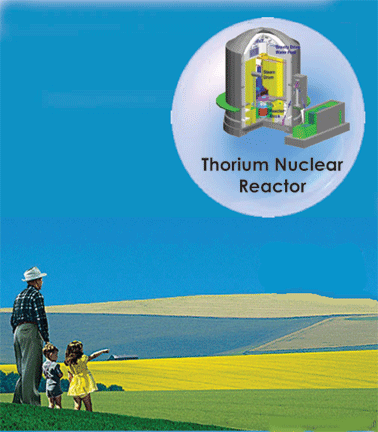 Don’t Jump on The Thorium Bandwagon – It’s Not Green, Not Viable, And Not The Answer To Our Energy Problems Prevent Disease.comNov 10, 2013 by KELLEY BERGMAN
“………Numerous claims of advantages for thorium as a nuclear fuel and for LFTR (Liquid Fluoride Thorium Reactor) design have been made over conventional solid fuel reactors.
Nuclear Weapons Proliferation
Claim: thorium reactors do not produce plutonium, and so create little or no proliferation hazard.
Response: a LFTR could be adapted to produce plutonium of a high purity well above normal weapons-grade, presenting a major proliferation hazard. Beyond that, the main proliferation hazards arise from:
- the need for fissile material (plutonium or uranium) to initiate the thorium fuel cycle, which could be diverted, and
- the production of fissile uranium 233U.Claim: the fissile uranium (233U) produced by thorium reactors is not “weaponisable” owing to the presence of highly radiotoxic 232U as a contaminant. Response: 233U was successfully used in a 1955 bomb test in the Nevada Desert under the USA’s Operation Teapot and so is clearly weaponisable notwithstanding any 232U present.
Safety
Claim: LFTRs are intrinsically safe, because the reactor operates at low pressure and is and incapable of melting down.
Response: the design of molten salt reactors does indeed mitigate against reactor meltdown and explosion. However, in an LFTR the main danger has been shifted from the reactor to the on-site continuous fuel reprocessing operation — a high temperature process involving highly hazardous, explosive and intensely radioactive materials. A further serious hazard lies in the potential failure of the materials used for reactor and fuel containment in a highly corrosive chemical environment, under intense neutron and other radiation.
State of Technology
Claim: the technology is already proven.
Response: important elements of the LFTR technology were proven during the 1970s Molten Salt Breeder Reactor (MSBR) at Oak Ridge National Laboratory. However, this was a small research reactor rated at just 7MW and there are huge technical and engineering challenges in scaling up this experimental design to make a ‘production’ reactor. Specific challenges include:
- developing materials that can both resist corrosion by liquid fluoride salts including diverse fission products, and withstand decades of intense neutron radiation;
- scaling up fuel reprocessing techniques to deal safely and reliably with large volumes of highly radioactive material at very high temperature;
- keeping radioactive releases from the reprocessing operation to an acceptably low level;
- achieving a full understanding of the thorium fuel cycle.
Nuclear Waste
Claim: LFTRs produce far less nuclear waste than conventional solid fuel reactors.
Response: LFTRs are theoretically capable of a high fuel burn-up rate, but while this may indeed reduce the volume of waste, the waste is more radioactive due to the higher volume of radioactive fission products. The continuous fuel reprocessing that is characteristic of LFTRs will also produce hazardous chemical and radioactive waste streams, and releases to the environment will be unavoidable.
Claim: Liquid fluoride thorium reactors generate no high-level waste material.
Response: This claim, although made in the report from the House of Lords, has no basis in fact. High-level waste is an unavoidable product of nuclear fission. Spent fuel from any LFTR will be intensely radioactive and constitute high level waste. The reactor itself, at the end of its lifetime, will constitute high level waste.
Claim: the waste from LFTRs contains very few long-lived isotopes, in particular transuranic actinides such as plutonium.
Response: the thorium fuel cycle does indeed produce very low volumes of plutonium and other long-lived actinides so long as only thorium and 233U are used as fuel. However, the waste contains many radioactive fission products and will remain dangerous for many hundreds of years. A particular hazard is the production of 232U, with its highly radio-toxic decay chain.
Claim: LFTRs can ‘burn up’ high level waste from conventional nuclear reactors, and stockpiles of plutonium.
Response: if LFTRs are used to ‘burn up’ waste from conventional reactors, their fuel now comprises 238U, 235U, 239Pu, 240Pu and other actinides. Operated in this way, what is now a mixed-fuel molten salt reactor will breed plutonium (from 238U) and other long lived actinides, perpetuating the plutonium cycle.
What Can You Do?
Spread the word about Sardinia. More information is available athttps://docs.google.com/open?id=0B-F67wRS5N7sR3hYMl9id0xkNWs where the original 7500-word research document is stored.
Contact your congressional representatives and demand the closure of the Sardinia NATO bases.
Do we really want another polluting energy source with high-level waste which is non-renewable and highly carcinogenic? Before jumping on the thorium bandwagon, please share this information, do your own research and think twice before spreading the hundreds of myths (not facts) about this very dangerous alternative to uranium.
Sources:
nuclearfreeplanet.org
nonukes.it
industrytap.com
envirosagainstwar.org
Kelley Bergman is a media consultant, critic and geopolitical investigator. She has worked as a journalist and writer, specializing in geostrategic issues around the globe.http://preventdisease.com/news/13/111013_Dont-Jump-on-The-Thorium-Bandwagon-Not-Green-Not-Viable-Not-The-Answer.shtml
Switzerland’s revised nuclear liability law makes things much more expensive for nuclear companies
Switzerland revises nuclear liability law World Nuclear News, 30 Mar 15 Switzerland’s government has adopted a total revision of the federal ordinance on civil nuclear liability. The ordinance governs the enforcement of the country’s new civil nuclear liability law, which was passed by parliament in 2008 but has yet to come into force.
The Federal Council adopted a revision of the ordinance on 25 March, the Swiss Federal Energy Office (SFOE) announced. Under the revision, the minimum coverage to be provided at the national level increased from CHF 1 billion ($1 billion) to €1.2 billion ($1.3 billion), which corresponds to provisions of international civil liability……
SFOE said the revision also simplifies the compensation procedure, improving the protection of Swiss victims in the event of a nuclear incident occurring abroad. It said that in such cases, the conditions for compensation and procedural provisions that would apply to Switzerland would be the same as for all other signatory states to the Paris Convention on Third Party Liability and the Brussels Supplementary Convention……
the revised ordinance “burdens the owners of nuclear facilities by the end of the term with unnecessary additional premium costs.”
The organization claims the revision means that operators of nuclear facilities will not only have to pay for insurance cover for their plants, but also separate coverage for each transportation of even low-level material. This, it says, “reduces the international competitiveness of the Swiss electricity industry once more.” http://www.world-nuclear-news.org/NP-Switzerland-revises-nuclear-liability-law-3003154.html?utm_source=twitterfeed&utm_medium=twitter
1 This Month



Tell the Ukrainian Government to Drop Prosecution of Peace Activist Yurii Sheliazhenko

Petition to revoke the licensing of the Near Surface Nuclear Disposal Facility (NSDF) at Chalk River. https://www.ourcommons.ca/petitions/en/Petition/Details?Petition=e-7247


of the week – STOP SMALL MODULAR REACTORS IN CANADA
To see nuclear-related stories in greater depth and intensity – go to https://nuclearinformation.wordpress.com
-
Archives
- March 2026 (222)
- February 2026 (268)
- January 2026 (308)
- December 2025 (358)
- November 2025 (359)
- October 2025 (376)
- September 2025 (258)
- August 2025 (319)
- July 2025 (230)
- June 2025 (348)
- May 2025 (261)
- April 2025 (305)
-
Categories
- 1
- 1 NUCLEAR ISSUES
- business and costs
- climate change
- culture and arts
- ENERGY
- environment
- health
- history
- indigenous issues
- Legal
- marketing of nuclear
- media
- opposition to nuclear
- PERSONAL STORIES
- politics
- politics international
- Religion and ethics
- safety
- secrets,lies and civil liberties
- spinbuster
- technology
- Uranium
- wastes
- weapons and war
- Women
- 2 WORLD
- ACTION
- AFRICA
- Atrocities
- AUSTRALIA
- Christina's notes
- Christina's themes
- culture and arts
- Events
- Fuk 2022
- Fuk 2023
- Fukushima 2017
- Fukushima 2018
- fukushima 2019
- Fukushima 2020
- Fukushima 2021
- general
- global warming
- Humour (God we need it)
- Nuclear
- RARE EARTHS
- Reference
- resources – print
- Resources -audiovicual
- Weekly Newsletter
- World
- World Nuclear
- YouTube
-
RSS
Entries RSS
Comments RSS
 nuclear-news