35-ton piece of machinery debris impedes gate at Fukushima No 1 nuclear reactor
Setback at Fukushima No. 1 plant threatens reactor 3 rod removal Tokyo Electric Power Co. has disclosed that a 35-ton piece of machinery debris might be resting on the inner gate of the spent fuel pool for reactor 3 of the Fukushima No. 1 power plant and that the gate is slightly out of position.
Tepco said Thursday that a fuel-handling machine dislodged during the March 2011 quake, tsunami and meltdown-triggered hydrogen explosions is touching one of two gates that stand between the pool and the reactor containment vessel……http://www.japantimes.co.jp/news/2015/03/27/national/debris-poses-risk-spent-fuel-pool-gate-fukushima-1s-reactor-3-tepco/#.VRiPYPyUcnk
It didn’t work: Toshiba’s state of the art technology to find Fukushima nuclear cores
Cutting-edge tech to scan Fukushima for nuclear fuel flops in front of reporters, Rt.com March 27, 2015 A presentation of state-of-the-art technology aimed to show the location of nuclear fuel molten debris at the crippled Fukushima plant in Japan ended in a flop, raising concerns about the $5 million project.
Fukushima operator Tokyo Electric Power Co (TEPCO) tasked Japanese tech giant Toshiba to come up with a solution after the nuclear plant was hit by an earthquake and tsunami in 2011.
After four years of research, Toshiba has developed a technology, which relies on muons in finding the nuclear fuel’s location.
Those tiny cosmic-ray subatomic particles are capable of going through almost anything except for the heavy elements like uranium and plutonium used for nuclear fuel.
The company plans to erect two tall walls right next to each reactor to shoot out muons through them to create an image of what’s inside – similar to medical X-rays.
Previously, the muons have been successfully used to scan volcanoes, ship’s cargoes and even the Egyptian pyramids.
But the technology’s presentation Friday turned into an epic fail as a programming glitch, which wasn’t fixed in time, prevented it from displaying any images of muons at all…….http://rt.com/news/244717-fukushima-muons-scan-toshiba/
New York endangered by High-Pressure Gas Pipeline Near a Nuclear Plant
Why on Earth Did the Feds Approve a High-Pressure Gas Pipeline Near a Nuke Plant? Nuclear safety expert: “We’re talking tens of millions of people who could be endangered.” By Alison Rose Levy / AlterNet March 27, 2015 A gas explosion leveled two buildings in New York’s East Village this past week, with two neighboring structures damaged, one still at risk for collapse, and 22 people injured, four of them severely. The fire raged from early afternoon into the next morning with more than 250 firefighters responding. Just over a year ago, a gas explosion leveled two buildings in Harlem, killing eight people. The National Transportation Safety Board has not yet released its conclusions as to what caused the Harlem fire.
While fires, explosions, plane crashes and others disasters are considered newsworthy, drawing people and the media to the scene, the quiet dramas of government policy, approval and planning that set the stage for—or can prevent—disastrous events are every bit as riveting……..
Since March 3, 2015, three high-risk conditions have begun converging north of the New York metro area: the aging Indian Point nuclear power plant; a high pressure, high-volume gas pipeline; and an authorization by the Federal Energy Regulatory Commission (FERC) to build a new segment of the pipeline in close proximity to the nuclear plant. In the few weeks since the authorization, apart from some felled trees in Yorktown Heights, there have been few visible signs that millions of New Yorkers may soon be living with the increased risk of a fiery, pipeline-triggered nuclear accident, 37 miles north of the City………http://www.alternet.org/environment/why-earth-did-feds-approve-high-pressure-gas-pipeline-near-nuke-plant
Torness nuclear power station has radiation leak
Radiation leak at Torness nuclear power station, Herald Scotland Rob Edwards Sunday 29 March 2015 An investigation is under way after a radiation leaked at the Torness nuclear power station in East Lothian, the Sunday Herald can reveal. According to the French state company that runs Torness, EDF Energy, radioactive tritium was discovered in water contained in part of the power station’s drainage system. The discovery was immediately reported to the Scottish Environment Protection Agency (Sepa) and the UK government’s Office for Nuclear Regulation (ONR)……
Dr Richard Dixon, director of Friends of the Earth Scotland, warned that Torness was “well into middle age and the cracks are literally beginning to show”.
He said: “This is the latest in a series of problems at Scotland’s two nuclear stations and shows that regulators need to be very vigilant if we are to avoid a serious release of radioactivity to the local environment while these plants continue to operate.”
The local liaison committee was told that reactors at Torness had to be unexpectedly shut down four times in 2014 because of a series of equipment faults. EDF Energy also operates a 39-year-old nuclear power station at Hunterston in North Ayrshire, where cracks and breakdowns were reported in October 2014.
Jason Rose, Scottish Green candidate for MP in East Lothian, thought that the number of leaks and shutdowns showed that Torness was well past its prime. “Those of us who have to live with a nuclear plant on our doorstep need assurances from EDF that more effort will be made to prevent these sorts of serious incidents,” he said.
“I remain extremely concerned that there will be no public scrutiny of plans to extend the operating life of the plant, and no effort by local or national government to prepare a smooth transition for workers and the economy. Local people should have a say in what happens next at Torness.”……http://www.heraldscotland.com/news/environment/investigation-under-way-into-radiation-leak-at-torness-nuclear-power-station.121878992
Ohio’s Senate Bill 310 props up Davis-Besse nuclear power plant, restricts renewables
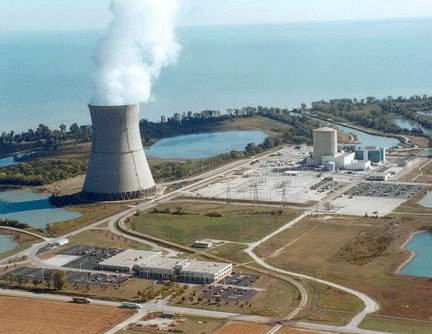 The case against the Davis-Besse nuclear power plant: Connie Kline By Other Voices http://www.cleveland.com/opinion/index.ssf/2015/03/the_case_against_the_davis-bes.html March 29, 2015 Aggressively lobbied by FirstEnergy Corp. and passed by the General Assembly in May 2014, Senate Bill 310, along with wind-turbine restrictions, decimated Ohio’s 2008 renewable-energy and energy-efficiency standards in order to force reliance on coal and nuclear power.
 Not coincidentally, in August 2014, FirstEnergy filed a rate case which, according to the Ohio Consumers’ Counsel and the Northeast Ohio Public Energy Council, could cost ratepayers up to $3 billion over 15 years to “bail out” FirstEnergy’s old, failing, noncompetitive Sammis coal plant and Davis-Besse nuclear reactor. The utility is threatening to close both plants if the Public Utilities Commission of Ohio denies its application.
According to a recent Pew Charitable Trusts’ report, in 2012, Ohio was number 13 in the country for new wind capacity and private investment in wind; this has virtually ceased due to SB 310.
August and September 2014 polls showed that Ohioans overwhelmingly favor efficiency and renewable energy over coal and nuclear.
According to NOPEC, construction of the Perry and Davis-Besse reactors caused “electric rates in northern Ohio to soar, becoming the highest in the state and among the highest in the nation and cost ratepayers “approximately $9 billion.”
Forty-year-old Davis-Besse has been plagued by near-catastrophes since its inception.
● Because it was built in a flood plain, a 1972 Lake Erie storm caused massive flooding of the entire construction site including the pre-operational reactor.
● In October 1977, a relief valve stuck.
● Uranium fuel must be submerged in water (coolant) at all times to prevent a meltdown. In June 1985, Davis Besse had a loss-of-feedwater accident. The Nuclear Regulatory Commission closed the plant for a year.
● A June 1998 tornado caused loss of external electric power.
● In March 2002, neglected, leaking boric acid in the coolant water had eaten through more than seven inches of the steel reactor lid, leaving only a 3/16″ liner to prevent radiation release. The plant closed for two years, costing ratepayers $600 million. Davis-Besse was fined $33.5 million, the largest in NRC history.
● The corroded lid was replaced before restart in 2004, but in 2010, cracks were found in this new lid, forcing its replacement in 2011.
● To replace aging, deteriorating, damaged parts, an unprecedented four large cuts have been made through the Davis-Besse concrete shield building which prevents release of radiation. Starting in 2011, cracks and voids were discovered in the building’s concrete.
● Davis-Besse’s steam generators were replaced in 2011 and 2014. A new tubing alloy was used.
Unprotected exposure to used reactor fuel can kill a person in minutes, yet no disposal solution exists for this waste which must be isolated from humans and the environment virtually forever. Funding for the permanent, deep-geological radioactive waste repository at Yucca Mountain, Nevada was canceled in 2011, making every reactor a de facto radioactive waste dump at the least environmentally suitable sites for potable water, in flood, erosion, and earthquake zones.
The industry claims that nuclear power does not contribute to climate change. In fact, the nuclear fuel cycle from mining and fabricating uranium to decommissioning reactors requires a significant amount of fossil fuel.
In January 2015, FirstEnergy commissioned a self-serving “study” by an industry group with a vested interest in the conclusion that Davis-Besse is economically beneficial. The study failed to consider energy efficiency or replacing Davis-Besse with renewable energy that typically provides more jobs per megawatt/hour than nuclear power. If Davis-Besse were truly a valuable asset, FirstEnergy wouldn’t be seeking up to $225 million a year in ratepayer subsidies to keep it operating.
According to the U.S. Department of Energy, nuclear power provides only 5 percent of Ohio’s generation. According to the World Nuclear Association, Davis-Besse’s lifetime capacity factor through 2012 was only 67.6 percent, one of the lowest in the country.
It’s time to stop throwing good money after bad and transition to safe, clean renewable energy. Davis-Besse should meet the fate of other U.S. reactors than have been permanently closed for safety and economic reasons.
Connie Kline, of Willoughby Hills, is former chairperson of the Ohio Sierra Club Nuclear Committee.
Washington wants to screw Nevada again on nuclear waste dumping?
If the government is serious about crafting a new national nuclear waste solution that involves asking states to accept and store dangerous military and commercial radioactive material, the least it can do is deliver a pitch to the state it tried to force the waste upon all those years ago.
Obviously, Washington has learned some lessons from the Yucca Mountain Project, the boondoggle to end all boondoggles, one of the most cynical exercises in political power the country has ever seen. About three decades ago, what was supposed to be an objective, scientific exercise in selecting a permanent storage site for the country’s high-level nuclear waste became a rigged game. Congress amended the Nuclear Waste Policy Act in 1987 to make Yucca Mountain, a ridge inside the Nevada Test Site about 100 miles northwest of Las Vegas, theonly site under study for the dump. Nevada had no political clout, so the rest of the country ganged up, scratched other potential locations from the list and said, “You’ll take our waste — and like it.” The legislation became known as the “Screw Nevada bill.”
No transparency in USA’s massive modernisation of nuclear weapons
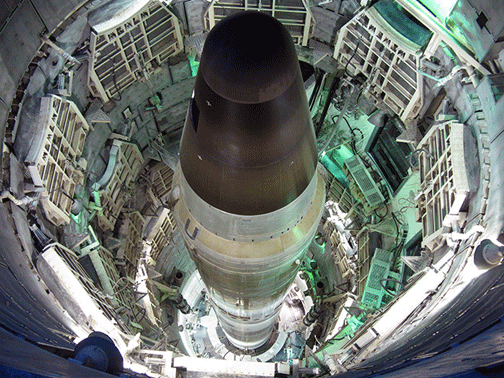 US wants nuclear transparency, but not for its own bombs, The National Tony Karon March 29, 2015 Amid all of last week’s headlines parsing Iran’s nuclear infrastructure as the deadline for a potential deal with world powers drew near, it was easy to miss the item in the Science section of The New York Times. It was about the US hydrogen bomb programme.
The H-bomb, the paper reminded readers, is a thermonuclear device. Its destructive power is 1,000 times that of the bomb that instantly killed 80,000 people in Hiroshima in 1945. And it has long been a feature in the arsenals of nuclear-armed states.
The news peg was a memoir by one of the founders of the US H-bomb programme, Kenneth W Ford. But even though he cited publicly available material, US Department of Energy censors blocked the book.
Transparency, of course, has never been deemed a virtue in any nuclear weapons programme anywhere in the world. That said, Iran’s leaders might see the irony in being held to stringent transparency requirements while states with well-established nuclear-weapons capability are absolved of the equivalent accountability.
But the basic hypocrisy of the major world powers’ application of the Nuclear non-Proliferation Treaty (NPT) is well-established. Five of the countries currently negotiating with Iran, which is an NPT signatory, are acknowledged to have nuclear weapons. The NPT requires signatories to submit their nuclear facilities to constant inspections to verify their commitment to refrain from building weapons. Meanwhile, the established nuclear weapons states are meant to negotiate their way to disarmament. But 45 years after they adopted the NPT, the established nuclear powers have not ended their addiction to nuclear weapons.
In that period, four non-signatories – India, Pakistan, Israel and South Africa – developed nuclear weapons, although post-apartheid South Africa signed the NPT and allowed the dismantling of its nukes. Meanwhile, a fifth country, North Korea, developed nuclear weapons after withdrawing from the NPT . So the negotiations with Iran are not aimed at keeping the Middle East free of nuclear weapons as much as to maintain America and Israel’s nuclear monopoly in the region.
But the censoring of Ford’s book reveals a deeper peril in America’s national conversation about nuclear weapons – or, more accurately, the absence of a national conversation about nuclear weapons………
In April 2009, president Obama made a historic speech in Prague committing to pursue a “a world without nuclear weapons”and to reduce the number of warheads in the US arsenal. But he also pledged, in light of continued nuclear capability by rival powers, to ensure that the US maintains an “effective arsenal”.
That commitment has now translated, according to the budget he submitted to Congress last month, into a massive modernisation scheme, which would cost $348 billion (Dh 1.28 trillion) over the next 10 years and as much as $1 trillion over a 30-year period.
Still, don’t expect to see much public debate over just what the US is building, and the circumstances in which it might conceivably decide – once again – to destroy a civilian population centre in a matter of minutes.
The world would be a much safer place if, as the NPT intended, efforts to stop new countries acquiring nuclear weapons were matched by the attempt to hold accountable those that already have them.
Tony Karon teaches in the graduate programme at the New School in New York http://www.thenational.ae/opinion/comment/us-wants-nuclear-transparency-but-not-for-its-own-bombs#page2
Dow Chemical’s purchase of wind energy shows the big shift to renewables
What Dow Chemical’s Huge Wind Deal Says About Our Energy Landscape, Clean Technica March 27th, 2015 By Mira Inbar Recently, The Dow Chemical Company signed an agreement to purchase 200 MW of wind output from a wind farm under development by a subsidiary of Bordas Wind Energy in South Texas. The wind power will power the company’s Freeport, Texas manufacturing site.
Everything about this announcement is huge: Freeport is the largest integrated chemical manufacturing complex in the Western Hemisphere. The wind farm will encompass nearly 35,000 acres of land, and annually supply an amount of electricity that could power more than 55,000 Texas homes.
Dow is the first chemical company in the US to power a manufacturing site with renewable energy at this scale. Their decision to do so is a clear sign that the energy landscape in the United States continues to evolve and that companies today have far more choice when it comes to accessing sustainable sources of power than they did just a few years ago.
So, what does Dow’s huge wind deal say about our energy landscape and the future of power generation? Three things:
1. Accelerating technological innovation and deployment at scale is driving down the cost of renewable energy.,……..
2. Wind energy is a perfect hedge against fossil fuel cost volatility……..
3. Deals like this represent an efficient use of electricity markets……..
Earlier this year, Texas completed a ten-year, $6.8 billion effort to build a huge network of new high-voltage power lines to connect all corners of the state to a robust electricity market that has become one of the most efficient and transparent in the world. These new transmission lines create better access to the market for all forms of electricity generation and allow for more efficient real-time operations and trading. This visionary investment has fostered competition and innovation, giving manufacturing companies more choice in their electricity supply so that they can better manage their costs.
Access to a reliable supply of cost-effective energy is a key ingredient to revitalizing manufacturing in America. Powering manufacturing with renewable energy is just one smart move to secure a future of sustainability, growth, and huge long-term competitive advantage.
Mira Inbar is an independent consultant who works with energy and clean technology companies. She can be reached @mirainbar or mira.inbar@gmail.com http://cleantechnica.com/2015/03/27/what-dow-chemical-huge-wind-deal-says-about-our-energy-landscape/
Pakistan Climate Change Minister calls for tapping massive clean energy potential
Mushahid Ullah Khan calls for tapping massive clean energy potential, Business Recorder, Sunday, 29 March 2015 SLAMABAD: Federal Minister for Climate Change Senator Mushahid Ullah Khan has said that renewable energy, which is clean and environment-friendly, is future of Pakistan.
“Pakistan is abundantly replete with the renewable energy sources, which can help the country cope with deepening energy crises and pave the way for achieving sustainable development goals,” the minister underlined.
 In a press statement issued here on Sunday in the context of the Earth Hour event observed across the world including Pakistan, he explained that renewable energy is generally defined as energy that comes from resources, which are naturally replenished on a human timescale such as sunlight, wind, rain, tides,waves and geothermal heat.
Highlighting the importance of marking the Earth Hour, the minister Mushahid Ullah Khan said that the global Earth Hour event, in fact, calls for the global climate action by investing in renewable energy technologies to free the world including Pakistan of reliance on fossil fuels for energy generation, which are unclean, unreliable and not environment-friendly………
“Above all, harnessing the sun’s power is deemed to be an attractive alternative. For, it is a renewable resource, which leads no pollution. In contrast to conventional fuels, its use requires no need for refining, transporting and conveying fuels and power over long distances,” the minister said.http://www.brecorder.com/pakistan/politics-a-policy/235421-mushahid-ullah-khan-calls-for-tapping-massive-clean-energy-potential.html
Sri Lanka Renewable Energy By 2030 ?
Renewable Energy By 2030, Sunday Leader, By Camelia Nathaniel The power and energy sector is set for a dramatic change by the year 2030. According to reliable sources, the country will be heading towards the renewable energy sources, where resources such as coal and petroleum will become things of the past…….
There is speculation that the power sector will be operational under eight categories mainly renewable energy sources such as wind, biomass and even hitherto undeveloped low head hydropower. At present Sri Lanka relies heavily on coal, oil, and hydro power for its energy. Fossil fuels are non-renewable, that is, they draw on finite resources that will eventually dwindle, becoming too expensive or too environmentally damaging to retrieve. In contrast, the many types of renewable energy resources – such as wind and solar energy – are constantly replenished and will never run out…….
The grid and off grid energy systems are planned to ensure the access to electricity to 98% of the households by 2016. Together with economic benefits, renewable resources provide the advantage of achieving ecological efficiencies as minimizing pollution and mitigating adverse climatic factors through the provision of clean environment friendly energy.
The Sunday Leader reliably learns that by the 31st of this month the power and energy sector will make huge strides in the direction of renewable energy to fulfill the energy requirements of the country. http://www.thesundayleader.lk/2015/03/29/renewable-energy-by-2030/
Changing political relations in Middle East as Iran-US nuclear deal approaches
Unholy Alliance” between Saudi Arabia and Israel. A US-Iran Nuclear Deal Would Trigger Regional Political Re-alignments By Salman Rafi Sheikh Global Research, March 29, 2015 Any probable nuclear deal between the United States of America and Iran is likely to result in giving a new trajectory to their bi-lateral relations; however, it is not the US-Iran relations alone that would enter a new phase of political history. As a matter of fact, this deal is most likely to send political jolts across the entire Middle Eastern political landscape, with Saudi Arabia and Israel standing as the most sensitive areas to bear its shocks; and as such, are most likely to clutch their hands into an alliance against Iran, and by default, against the US ambitions as well.
It is not, however, to suggest that Saudia and Israel would essentially adopt an anti-US strategic posture. What is becoming evident is that these three states will be re-negotiating the terms of their mutual relations to meet changing geo-political realities in a more ‘composite’ manner. This strategic negotiation is not, however, to be manned by the US itself, nor would it be playing the role of a crucial “balancer” between regional players. The US, in the contrary, would itself be a party to this process, and as such, would be more concerned about maintaining its own relations with Israel, Iran and Saudi Arabia than about merely assuring Israel and Saudia about the ‘harmless’ nature of the nuclear deal with Iran……..
The central issue between Saudia and USA on the one hand, and the US and Israel on the other hand, is not the deal itself; it is the place Iran would have in the future Middle East. …..http://www.globalresearch.ca/unholy-alliance-between-saudi-arabia-and-israel-a-us-iran-nuclear-deal-would-trigger-regional-political-re-alignments/5439349
Catholic Church throws its weight behind action on climate change
VATICAN CITY (CNS) – The Catholic Church supports the efforts of scientists to study the causes and effects of climate change and insists governments and businesses must get serious about specific commitments for protecting the environment.But Pope Francis, like his predecessors, does not pretend to have a technical solution to the problem. However, he does feel a responsibility to remind Christians of their religious obligation to safeguard creation, beginning with human beings who are created in the image and likeness of God.
Clearing his calendar for a week in late March, Pope Francis rolled up his sleeves to put the final touches on an encyclical letter about the environment; building on what he and his predecessors have said, the document — planned for publication early in the summer — is expected to present ecology as the ultimate pro-life, pro-poor, pro-family issue.
For Pope Francis, like Pope Benedict XVI, safeguarding creation is not simply about protecting plants and animals, or just about ensuring the air, water and land will support human life for generations to come. Those things are part of the task……….
1 This Month
To see nuclear-related stories in greater depth and intensity – go to https://nuclearinformation.wordpress.com/
12 February – Webinar The Big Push: New Nuclear Projects in Canada
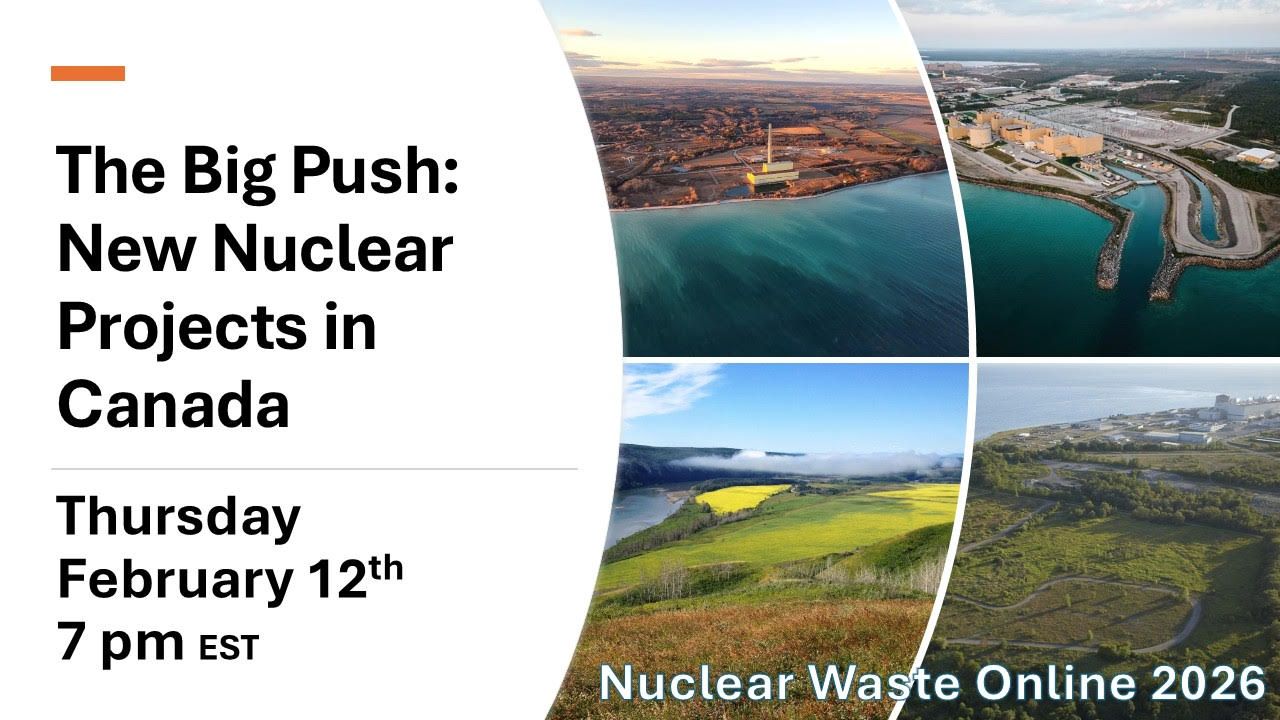
Thursday, February 12, 7 pm Eastern | 2nd of 4 sessions in the 2026 Nuclear Waste Online webinar series
Join a webinar on the push for new nuclear generation in Canada. Go to Northwatch.org to register or use the registration link https://us02web.zoom.us/webinar/register/WN_ZfWOf1GITqSRIZX8CB-A9w
-
Archives
- February 2026 (115)
- January 2026 (308)
- December 2025 (358)
- November 2025 (359)
- October 2025 (376)
- September 2025 (258)
- August 2025 (319)
- July 2025 (230)
- June 2025 (348)
- May 2025 (261)
- April 2025 (305)
- March 2025 (319)
-
Categories
- 1
- 1 NUCLEAR ISSUES
- business and costs
- climate change
- culture and arts
- ENERGY
- environment
- health
- history
- indigenous issues
- Legal
- marketing of nuclear
- media
- opposition to nuclear
- PERSONAL STORIES
- politics
- politics international
- Religion and ethics
- safety
- secrets,lies and civil liberties
- spinbuster
- technology
- Uranium
- wastes
- weapons and war
- Women
- 2 WORLD
- ACTION
- AFRICA
- Atrocities
- AUSTRALIA
- Christina's notes
- Christina's themes
- culture and arts
- Events
- Fuk 2022
- Fuk 2023
- Fukushima 2017
- Fukushima 2018
- fukushima 2019
- Fukushima 2020
- Fukushima 2021
- general
- global warming
- Humour (God we need it)
- Nuclear
- RARE EARTHS
- Reference
- resources – print
- Resources -audiovicual
- Weekly Newsletter
- World
- World Nuclear
- YouTube
-
RSS
Entries RSS
Comments RSS
 nuclear-news