No transparency in USA’s massive modernisation of nuclear weapons
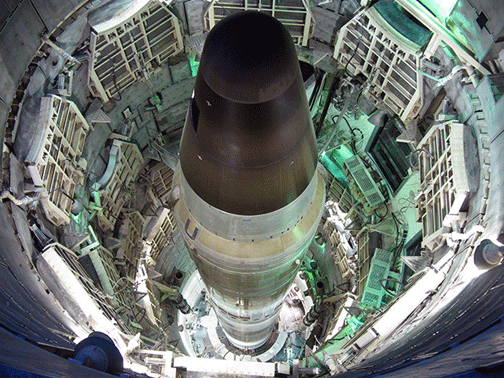 US wants nuclear transparency, but not for its own bombs, The National Tony Karon March 29, 2015 Amid all of last week’s headlines parsing Iran’s nuclear infrastructure as the deadline for a potential deal with world powers drew near, it was easy to miss the item in the Science section of The New York Times. It was about the US hydrogen bomb programme.
The H-bomb, the paper reminded readers, is a thermonuclear device. Its destructive power is 1,000 times that of the bomb that instantly killed 80,000 people in Hiroshima in 1945. And it has long been a feature in the arsenals of nuclear-armed states.
The news peg was a memoir by one of the founders of the US H-bomb programme, Kenneth W Ford. But even though he cited publicly available material, US Department of Energy censors blocked the book.
Transparency, of course, has never been deemed a virtue in any nuclear weapons programme anywhere in the world. That said, Iran’s leaders might see the irony in being held to stringent transparency requirements while states with well-established nuclear-weapons capability are absolved of the equivalent accountability.
But the basic hypocrisy of the major world powers’ application of the Nuclear non-Proliferation Treaty (NPT) is well-established. Five of the countries currently negotiating with Iran, which is an NPT signatory, are acknowledged to have nuclear weapons. The NPT requires signatories to submit their nuclear facilities to constant inspections to verify their commitment to refrain from building weapons. Meanwhile, the established nuclear weapons states are meant to negotiate their way to disarmament. But 45 years after they adopted the NPT, the established nuclear powers have not ended their addiction to nuclear weapons.
In that period, four non-signatories – India, Pakistan, Israel and South Africa – developed nuclear weapons, although post-apartheid South Africa signed the NPT and allowed the dismantling of its nukes. Meanwhile, a fifth country, North Korea, developed nuclear weapons after withdrawing from the NPT . So the negotiations with Iran are not aimed at keeping the Middle East free of nuclear weapons as much as to maintain America and Israel’s nuclear monopoly in the region.
But the censoring of Ford’s book reveals a deeper peril in America’s national conversation about nuclear weapons – or, more accurately, the absence of a national conversation about nuclear weapons………
In April 2009, president Obama made a historic speech in Prague committing to pursue a “a world without nuclear weapons”and to reduce the number of warheads in the US arsenal. But he also pledged, in light of continued nuclear capability by rival powers, to ensure that the US maintains an “effective arsenal”.
That commitment has now translated, according to the budget he submitted to Congress last month, into a massive modernisation scheme, which would cost $348 billion (Dh 1.28 trillion) over the next 10 years and as much as $1 trillion over a 30-year period.
Still, don’t expect to see much public debate over just what the US is building, and the circumstances in which it might conceivably decide – once again – to destroy a civilian population centre in a matter of minutes.
The world would be a much safer place if, as the NPT intended, efforts to stop new countries acquiring nuclear weapons were matched by the attempt to hold accountable those that already have them.
Tony Karon teaches in the graduate programme at the New School in New York http://www.thenational.ae/opinion/comment/us-wants-nuclear-transparency-but-not-for-its-own-bombs#page2
No comments yet.
1 This Month



Tell the Ukrainian Government to Drop Prosecution of Peace Activist Yurii Sheliazhenko

Petition to revoke the licensing of the Near Surface Nuclear Disposal Facility (NSDF) at Chalk River. https://www.ourcommons.ca/petitions/en/Petition/Details?Petition=e-7247


of the week – STOP SMALL MODULAR REACTORS IN CANADA
To see nuclear-related stories in greater depth and intensity – go to https://nuclearinformation.wordpress.com
-
Archives
- March 2026 (222)
- February 2026 (268)
- January 2026 (308)
- December 2025 (358)
- November 2025 (359)
- October 2025 (376)
- September 2025 (258)
- August 2025 (319)
- July 2025 (230)
- June 2025 (348)
- May 2025 (261)
- April 2025 (305)
-
Categories
- 1
- 1 NUCLEAR ISSUES
- business and costs
- climate change
- culture and arts
- ENERGY
- environment
- health
- history
- indigenous issues
- Legal
- marketing of nuclear
- media
- opposition to nuclear
- PERSONAL STORIES
- politics
- politics international
- Religion and ethics
- safety
- secrets,lies and civil liberties
- spinbuster
- technology
- Uranium
- wastes
- weapons and war
- Women
- 2 WORLD
- ACTION
- AFRICA
- Atrocities
- AUSTRALIA
- Christina's notes
- Christina's themes
- culture and arts
- Events
- Fuk 2022
- Fuk 2023
- Fukushima 2017
- Fukushima 2018
- fukushima 2019
- Fukushima 2020
- Fukushima 2021
- general
- global warming
- Humour (God we need it)
- Nuclear
- RARE EARTHS
- Reference
- resources – print
- Resources -audiovicual
- Weekly Newsletter
- World
- World Nuclear
- YouTube
-
RSS
Entries RSS
Comments RSS
 nuclear-news
Leave a comment