8 Significant facts about Fukushima Daiichi Nuclear Station
6. In Japan, the only radiation from Fukushima Daiichi Nuclear Reactors that is being measured is the radioactive cesium. However large amounts of strontium 90 and tritium are spreading all over Japan. Strontium and tritium’s radiation consists of beta rays, and are very difficult to measure. However both are extremely dangerous: strontium can cause leukemia, and tritium can cause chromosome disorder.
8. ……Tokyo Governor Naoki Inose said .“It is not under control now.”
Some Facts You Must Know About Fukushima Takashi Hirose | CounterPunch, 26 Mar 15 “………Here are eight things you need to know. Continue reading
Fukushima clean-up failures – RADIOACTIVE RAINWATER, BAD IDEAS, TECHNICAL ERRORS etc
Fukushima disaster followed by four-year litany of failures costing hundreds of millions http://www.news.com.au/world/asia/fukushima-disaster-followed-by-four-year-litany-of-failures-costing-hundreds-of-millions/story-fnh81fz8-1227280207492 VERY GOOD PHOTOS MARCH 26, 2015 THE tragedy of Fukushima is far from over, a whole four years after 18,000 people died when the Daiichi nuclear power plant was destroyed by a tsunami and earthquake.
Japanese government auditors have revealed that more than a third of the $2 billion of taxpayer money dedicated to the clean-up has been wasted.
Tourists are returning to the region as radiation fears fade, and there are plans to host events in the area for the 2020 Tokyo Olympics, yet the region is in chaos, seemingly cursed by a litany of failures and screw-ups.
- RADIOACTIVE RAINWATER Continue reading
Dubious USA Bills – Small Nuclear Reactors, “education on nuclear”, nuclear as “renewable”
 Nuclear power measures face questions CrossCut WEDNESDAY 25, MARCH 2015 by John Stang The big topic at the House Technology & Economic Development Committee hearing was whether Washington should find a place to build small modular reactors, which would be produced for utility customers. Sen. Sharon Brown, R-Kennewick, is sponsoring this proposal and the two other nuclear-related bills that the committee examined. The Senate passed the
  small modular reactor bill 27-21, mostly along party lines.Tri-Cities leaders envision a Boeing-style assembly plant to build small modular reactors. This is a long-range plan and is predicted to take several years to develop……
The concept is still on the drawing board. No one has built a commercial small modular reactor yet……
At the hearing, critics cited the lack of any track record on cost or safety for small modular reactors, plus concerns over the nation’s lack of a permanent place to store used nuclear fuel.
“Small nuclear reactors are still in the prototype stage. … The prototype has never been tested in power production yet,” said Thomas Buchanan of Physicians for Social Responsibility.
“I don’t think that the Department of Commerce should work on this until it has a design that passes the NRC,” said Chuck Johnson of the same organization.
Johnson argued that a single small-modular reactor would not generate enough electricity to efficiently recover its construction and operating costs…..
Deborah Wolpoff of Olympia pointed to the cancelation of the nation’s proposed nuclear fuel repository inside Yucca Mountain, with no replacement lined up. “I think it is irresponsible to promote this technology that produces this waste that we have no solution for,” Wolpoff said.
Committee member Rep. Gael Tarleton, D-Seattle, wondered why the Legislature should support a new nuclear industry while Hanford’s Cold War nuclear wastes are decades from being cleaned up….
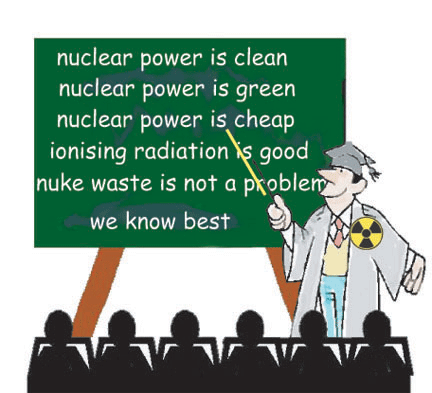 Another Brown bill, which the Senate passed 44-5, would create an education program aimed at providing nuclear science lessons to students in the eighth through 12th grades. Qualified American Nuclear Society members would be brought in for classroom sessions. Also, science teachers would receive instruction on nuclear science in order to teach the subject in the classrooms…….
Mary Hanson of Physicians Social Responsibility argued that the bill would give the nuclear industry influence over students, while other energy industries would not have the same access. She said American Nuclear Society members might be less versed in nuclear power’s health issues than its technical ones.
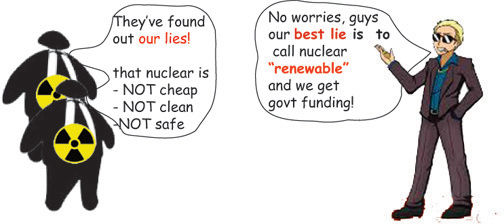
The third Brown bill, which the Senate passed 29-20, would add nuclear power to the list of alternative power sources that certain utilities can use to meet a state requirement to offer their customers voluntary participation in alternative energy purchases. The current list of green sources includes wind, solar, geothermal and biomass energy….
Physicians for Social Responsibility opposed it, contending nuclear energy is not a renewable power source….
http://crosscut.com/2015/03/nuclear-power-measures-face-questions/
Campaign to get the Canadian government to stop muzzling science journalism

 Ask Canadian Scientists Why You Can’t Ask Them About Science http://motherboard.vice.com/en_ca/read/ask-canadian-scientists-why-you-cant-ask-them-about-science by
STEPHEN BURANYI March 24, 2015
A coalition of journalists and academics is urging Canadians to write letters to government scientists, asking for data on pollution, global warming, and other federal research. They may not get much in response—but that’s precisely the point.
The week-long letter writing campaign, which began on Monday and is called Write2Know, is a protest of the government’s controversial practice of controlling access to both science and scientists—a policy that has never been officially codified, but has been enforced by government agencies for the past half-decade. Continue reading
USA to establish a new “independent” Nuclear Waste Administration
 Senators Propose New Nuclear WastAgency http://www.law360.com/publicpolicy/articles/635220/senators-propose-new-nuclear-waste-agency By Juan Carlos Rodriguez Law360, New York (March 24, 2015, — A bipartisan group of U.S. senators on Tuesday introduced legislation that would create a new agency to handle the disposal of spent nuclear fuel and establish a new working capital fund in the U.S. Treasury for nuclear waste projects.
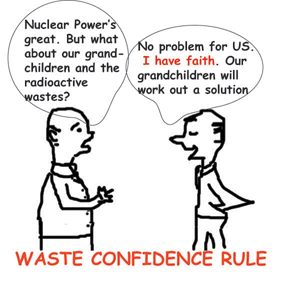 The act would establish the Nuclear Waste Administration, an independent agency to manage the country’s nuclear waste program in place of the U.S. Department of Energy. The agency would be headed by an administrator appointed by the president and subject to Senate confirmation, according to the senators.
The act would also require the NWA to establish siting processes for storage facilities and repositories and link those storage facilities and repositories. And the administrator would be authorized to begin siting a pilot storage facility for priority waste immediately, while not setting waste volume restrictions on storage.
“I appreciate my colleagues’ recognition that dealing with our nation’s defense waste — more than half of which exists at the Hanford Nuclear Reservation in Washington — is an important priority,” Cantwell, the Senate Energy Committee’s ranking member, said in a statement.
But the DOE said the U.S. is no longer generating defense high-level waste associated with weapons production, and the inventory and composition of defense high-level waste is finite, which means the department can use separate disposal pathways for some waste streams.
“In addition, some defense waste is less radioactive, cooler and easier to handle than commercial waste, which means a simpler design and potentially fewer licensing and transportation challenges for a defense repository. Separate disposal of defense high-level waste could allow greater flexibility in site selection — and that could help keep costs down,” the department said. http://www.law360.com/publicpolicy/articles/635220/senators-propose-new-nuclear-waste-agency
USA’s military and commercial nuclear wastes to be dealt with separately
Senators, Energy Department Float Nuclear Waste Proposals US News 25 Mar 15 A bipartisan group and Energy Secretary Ernest Moniz are exploring alternatives to a permanent storage facility in Nevada.
Four Senators from both sides of the aisle promoted legislation Tuesday calling for the construction of interim disposal sites for nuclear waste, a potential alternative to decades of deadlock over a permanent facility at Yucca Mountain in Nevada.
“Nuclear energy is a vital part of America’s energy portfolio, and for far too long, the American taxpayer has been on the hook for the federal government’s failure to implement an effective plan to handle the backend of the nuclear fuel cycle,” Sen. Lisa Murkowski, R-Alaska, and chairwoman of the Energy and Natural Resources Committee, said in a statement. “This legislation is an important step toward advancing the use of nuclear power in America.”
The bill does not mention Yucca Mountain, but it mirrors recommendations published in January 2012 by the Energy Department’s Blue Ribbon Commission on America’s Nuclear Future, a panel convened by President Barack Obama in 2010 to develop a new strategy for disposing of spent nuclear fuel. Continue reading
President Obama quietly “greenwashes” Small Modular Nuclear Reactors
SMR developers have already looked to the federal government as one of their most important potential customers.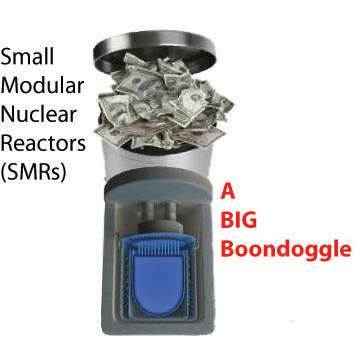
SMRs face major challenges before they can ever be deployed, including an apparent lack of private sector interest and the potential for unforeseen problems and cost overruns when building a factory to mass produce the technology
The failure to find investors caused two NuScale competitors, Generation mPower and Westinghouse Electric Co. LLC, to cut back on their SMR programs.
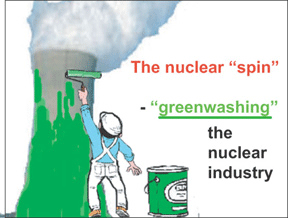 Obama executive order tags small modular reactors as clean energy https://www.snl.com/Interactivex/article.aspx?CdId=A-31794585-10540 By Matthew Bandyk 26 Mar 15 A new executive order issued by President Barack Obama to cut greenhouse gas emissions from federal government agencies could benefit what has become a pet project of the administration: small modular reactors. The in-development technology is the only form of nuclear energy to qualify as clean energy under the order.
The order, announced March 19, requires federal agencies to ensure that increasing amounts of the electric and thermal energy they consume come from low-carbon dioxide-emitting “alternative energy” sources. At least 10% of their energy must come from these sources starting in 2016, all the way up to 25% by 2025.
The definition of alternative energy in the order does not include “nuclear power” in general but specifically “small modular nuclear reactor technologies,” a term used to refer to a number of proposed designs for portable reactors typically under 300 MW, which are much smaller and potentially cheaper and easier to build than conventional nuclear reactors.
With the order, the Obama administration is pushing policies in support of small modular reactors, or SMRs, which are similar to proposals being contemplated at the state level. The Washington state senate, for example, recently passed a bill that would count SMRs among wind and solar as “qualified alternative energy resources” in the state’s voluntary alternative energy purchase program for utilities. Continue reading
USA plans for storage of the 5% of nuclear wastes that originate from defense programs
 U.S. to pursue storage for nuclear waste from defense programs, Japan Times, BLOOMBERG
An administration official who requested anonymity to discuss the plan said building the storage site probably will face fewer obstacles than establishing a repository for waste from nuclear power plants.
That’s in part because U.S. defense programs produce about 5 percent of all nuclear waste, the official said. Waste from generating electricity accounts for 85 percent of the total…http://www.japantimes.co.jp/news/2015/03/25/world/u-s-pursue-storage-nuclear-waste-defense-programs/#.VRR7wfyUcnk
A win for future generations in Saskatchewan, as nuclear waste dump rejected
The powerful Nuclear Waste Management Organization with all their money and all their experts could not beat back the duty we have to protect our future generations”
there has been strong Indigenous opposition in Ontario for years. Both the Nishnawbe Aski Nation (NAN), representing 49 First Nations in northern Ontario, and the Anishinabek Nation, representing 39 member First Nations across Ontario, have formally declared their opposition to nuclear waste in all of their traditional territories……
“This is what happens when people stick together and fight for what they believe in,” said Fred Pederson, a Pinehouse resident and member of the Committee for Future Generations Continue reading
Grave danger in Australia’s planned uranium sales deal with India
Australia and India face a graver test than cricket Against the backdrop of Australia and India squaring up in the World Cup cricket, the two nations now face a test with much graver consequences, write Dave Sweeney and Jim Green. SBS News, 26 Mar 15 When Prime Minister Tony Abbott signed a uranium deal with Indian Prime Minister Narendra Modi last September, he praised India’s “absolutely impeccable non-proliferation  record”. This praise came despite the reality that India is actively expanding its nuclear weapons arsenal and its missile delivery capabilities.
Mr Abbott declined to answer serious questions about India’s nuclear weapons program or the inadequate safety standards in and inadequate regulation of its civil nuclear program. Instead, he offered a cricketing cliché, declaring that Australia and India trust each other on issues like uranium safeguards because of “the fundamentally ethical principle that every cricketer is supposed to assimilate – play by the rules and accept the umpire’s decision”.
Gaining comfort from clichés while ignoring inconvenient truths might work for those in Canberra and mining company boardrooms but it fails any real world test.
The proposed India uranium agreement is currently being considered by federal parliament’s treaties committee, and it has yet to be ratified by parliament. Submissions to the treaties committee have raised many serious concerns − and not just from the usual suspects.
Those raising concerns and objections include John Carlson, former Director-General of the Australian Safeguards and Non-Proliferation Office; Ron Walker, former Chair of the International Atomic Energy Agency (IAEA) Board of Governors; Prof. Lawrence Scheinman, former Assistant Director of the US Arms Control and Disarmament Agency; Princeton University physicist Dr M.V. Ramana; and nuclear arms control expert Crispin Rovere.
The uranium agreement with India weakens Australia’s nuclear safeguards standards, increases the chances of Australian uranium finding its way into Indian weapons and would lead to further undermining of nuclear checks and balances. If the uranium agreement is approved there will be sustained pressure for Australia to apply equally inadequate standards to other uranium customer countries. As John Carlson notes in his submission: “If the Government does compromise Australia’s safeguards conditions, inevitably this will lead to other agreement partners asking for similar treatment.”
Mr Carlson’s critique carries particular weight given that for over two decades he was the head of Australia’s nuclear safeguards office……..http://www.sbs.com.au/news/article/2015/03/26/comment-australia-and-india-face-graver-test-cricket
UK’s official data show how renewable energy has overtaken nuclear
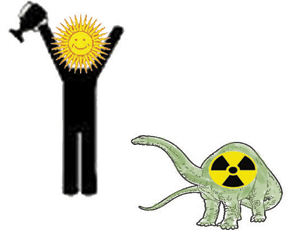
 UK: Solar grows 93% in 2014 as renewables overtake nuclear. http://www.pv-magazine.com/news/details/beitrag/uk–solar-grows-93-in-2014-as-renewables-overtake-nuclear_100018792/#axzz3VWyAXbwj Renewable energy generated 19.2% of the U.K.’s electricity in 2014, government figures show, surpassing nuclear generation for the first time ever
Official data from the U.K. government has confirmed that renewable energy contributed more to the grid than nuclear power for the first time ever in 2014.
The statistics show that renewables accounted for 19.2% of electricity generation last year, ahead of nuclear power, which generated 19% of the country’s electricity.
Total renewable electricity capacity at the end of the year stood at 24.2 GW, which was 4.5 GW – or 23% – more than a year previously.
Although solar PV’s share of renewable generation was a mere 6%, the industry’s participation in electricity generation grew a massive 93% last year, boosted by the 2.8 GW of solar PV capacity added over the course of 2014. Solar PV powered 3.9 terawatt hours (TWh) of electricity. No other renewable energy source grew as fast. Continue reading
Australia clearing out Aboriginal communities to make way for mining
Ghillar Michael Anderson, leader of the Euahlayi people and ambassador of the Aboriginal Tent Embassy in Canberra, wrote an open letter to the United Nations on March 3, in which he states that the proposed closures of remote communities are to open up the land for mining.
“For the Western Australian government to now dispossess and displace the peoples of these homelands is designed to facilitate an expeditious expansion of mining interests and other developments,” he wrote.
The announcement of the closures coincides with the introduction of the Aboriginal Heritage Amendment Bill by the Barnett government last November. The bill, which is about to be debated in state parliament, proposes changes to the Aboriginal Heritage Act 1972. These simplify the process of gaining permission to develop Aboriginal sites, as the chief executive of the DAA will have sole discretion over whether to deem heritage protection. This would continue a DAA trend over recent years of site assessment which is beneficial to industry.
Are Mining Interests Behind Western Australian Remote Aboriginal Community Closures?http://www.vice.com/en_au/read/are-mining-interests-behind-western-australian-remote-aboriginal-community-closures March 20, 2015 by Paul Gregoir Yesterday, 18,000 people turned out at rallies across Australia in protest of the Western Australian government’s proposal to close up to 150 remote Aboriginal communities.

The move will see municipal and essential services provided by the government cut. Premier Colin Barnett announced the closures in November last year, claiming many of these communities are economically unviable. Continue reading
Need for climate action – highlighted by Earth Hour Saturday 28 March
The 60-minute annual campaign organised by conservation group WWF encourages citizens, communities, businesses and organisations to switch the lights off for an hour from 8:30pm to highlight the plight of planet Earth. Now in its ninth year, Earth Hour’s goal is not to achieve measurable electricity savings, but to raise awareness of the need for sustainable energy use, and this year also to demand action to halt planet-harming climate change.  ‘Over 170 countries and territories have already confirmed their participation; more than 1200 landmarks and close to 40 UNESCO world heritage sites,’ Earth Hour head Sudhanshu Sarronwala told AFP. These range from the Christ the Redeemer statue in Rio de Janeiro, the Acropolis in Athens, Edinburgh Castle, Big Ben, Ecuador’s Quito historical centre and New York’s Times Square. Earth Hour 2015 takes place just months before UN member states are meant to sign an ambitious pact in Paris in December to limit galloping global warming, and just days before a loose end-March deadline for ‘those parties ready to do so’ to submit their carbon-curbing pledges. From a small, symbolic event held in Sydney in 2007, Earth Hour has grown to a global campaigning event with a festive twist. This year will include a glow-in-the-dark Zumba party in the Philippines, a co-ordinated candlelit dinner in Finland billed as the world’s largest, restaurant dinners by candlelight in London, and a power-generating dance floor to light up the Eiffel Tower after its hour-long sleep, said WWF. The organisers published a list of ideas for individual participants, which included barbecuing instead of stove cooking, a candle-lit street party or a picnic under the stars. An estimated nine million people in 162 countries took part in Earth Hour last year, according to the WWF, of whom 85 per cent ‘said that they felt inspired to do more to protect the planet, such as making small changes to live more sustainably and reduce their impact on the environment.’
Imperative to complete nuclear deal with Iran


The agreement under discussion by the P5+1 with Iran is fundamentally to provide assurances that Iran’s nuclear program has purely civilian, peaceful uses. This is not an arms control treaty because it will not address weapons. While there is evidence to suggest that Iran engaged in nuclear weaponization activities, there is no evidence that Iran now has nuclear weapons. As a non-nuclear-weapon state, party to the Treaty on the Nonproliferation of Nuclear Weapons (NPT), Iran is obligated not to manufacture, acquire, or otherwise obtain nuclear weapons. The agreement under discussion will impose requirements on Iran in addition to those it has as an NPT party. [Iran hopes the deal will be endorsed by a Security Council resolution and not involve the U.S. Congress since the five members of the United Nations Security Council are involved.]
 We Need To Get This Iranian Nuclear Deal Done, Forbes, James Conca, 26 Mar 15 By the sounds of the rhetoric going back and forth in the media, you’d think the Iranian Nuclear Deal we’re trying to put in place is a horrible loss for the United States, and that we’re being taken for a ride by the wily Ayatollahs.
Or that previous deals with Iran hadn’t ever worked.
Nothing could be farther from the truth. Last year, the five members of the United Nations Security Council, the United States, Great Britain, France, China and Russia, plus Germany, called the P5+1 Group, reached an interim deal with Iran to stop their nuclear weapons program while a larger deal could be brokered. Four key provisions were obtained in this deal and all four have occurred:……… Continue reading
Japan Anti-nuclear activists want formal public hearings on risks of restarting reactors in Fukui Prefecture
 Activists seek public hearings in Shiga on Takahama reactor restarts http://www.japantimes.co.jp/news/2015/03/26/national/activists-seek-public-hearings-in-shiga-on-takahama-reactor-restarts/#.VRS6i_yUcnk BY ERIC JOHNSTON STAFF WRITER MAR 26, 2015
Representatives of the Citizens’ Commission on Nuclear Energy, a group of scholars, engineers, lawyers, and activists, met with Gov. Taizo Mikazuki, who was elected on an anti-nuclear platform in July 2014, to discuss concerns over the restart of the No. 3 and 4 reactors at Kansai Electric Power Co.’s Takahama plant and what impact a disaster would have on the prefecture.
“It’s important to have a place where Shiga residents can discuss the technical, economic, and social problems related to the restart of the Takahama reactors and a disaster response system in case of an accident,” said Hitoshi Yoshioka, chairman of the citizens’ commission and a professor at Kyushu University.
Parts of the northern Shiga city of Takashima, which has a population of 52,400, lie within 30 km of the Takahama reactors. The prefecture has long been concerned about the central government’s disaster response plans and wants to be consulted by both Kepco and the central government about the restarts.
In addition, the group called on the governor to seek a wide variety of expert advice about the cost of restarts, and to consult economists who are skeptical of claims by the pro-nuclear camp about the economic and financial benefits of restarts.
Mikazuki, they said, expressed a desire to sponsor a public hearing, probably sometime after local elections in April. Both the governor and his predecessor have long worried about the impact of an accident on Lake Biwa, which provides water to about 14 million Kansai residents.
1 This Month



Tell the Ukrainian Government to Drop Prosecution of Peace Activist Yurii Sheliazhenko

Petition to revoke the licensing of the Near Surface Nuclear Disposal Facility (NSDF) at Chalk River. https://www.ourcommons.ca/petitions/en/Petition/Details?Petition=e-7247


of the week – STOP SMALL MODULAR REACTORS IN CANADA
To see nuclear-related stories in greater depth and intensity – go to https://nuclearinformation.wordpress.com
-
Archives
- March 2026 (222)
- February 2026 (268)
- January 2026 (308)
- December 2025 (358)
- November 2025 (359)
- October 2025 (376)
- September 2025 (258)
- August 2025 (319)
- July 2025 (230)
- June 2025 (348)
- May 2025 (261)
- April 2025 (305)
-
Categories
- 1
- 1 NUCLEAR ISSUES
- business and costs
- climate change
- culture and arts
- ENERGY
- environment
- health
- history
- indigenous issues
- Legal
- marketing of nuclear
- media
- opposition to nuclear
- PERSONAL STORIES
- politics
- politics international
- Religion and ethics
- safety
- secrets,lies and civil liberties
- spinbuster
- technology
- Uranium
- wastes
- weapons and war
- Women
- 2 WORLD
- ACTION
- AFRICA
- Atrocities
- AUSTRALIA
- Christina's notes
- Christina's themes
- culture and arts
- Events
- Fuk 2022
- Fuk 2023
- Fukushima 2017
- Fukushima 2018
- fukushima 2019
- Fukushima 2020
- Fukushima 2021
- general
- global warming
- Humour (God we need it)
- Nuclear
- RARE EARTHS
- Reference
- resources – print
- Resources -audiovicual
- Weekly Newsletter
- World
- World Nuclear
- YouTube
-
RSS
Entries RSS
Comments RSS
 nuclear-news