Nuclear terrorism danger would be magnified, if Japan reactivated nuclear reprocessing
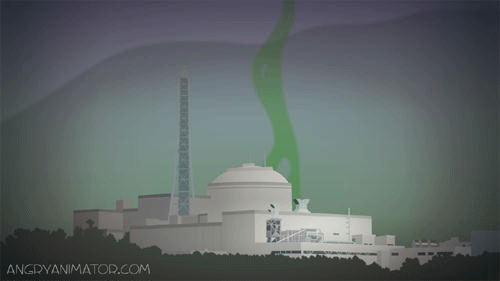 Nuclear terrorism risks in Northeast Asia: Japan’s reactor restart and spent fuel Nautilus Peace and Security NAPS Net Special Report by Peter Hayes 23 March 2015 “…..Japan’s Post-Fukushima Choice
Due to Fukushima, Japan now must choose to go in one of two directions that are largely exclusive: either towards a reactor restart choice that leads to a minimalist phase-out of separated plutonium over time; or towards a maximalist reliance on separated plutonium over time in a closed fuel cycle………
Should Japan opt to start enough reactors to justify reactivating the plutonium fuel cycle, then the implications for nuclear terrorism would be substantial. The train of logic for maximum spent fuel arising from a closed nuclear fuel cycle is radically different to that for the once-through fuel cycle. In this trajectory, the following would occur:
- Japan starts many more light water reactors, sooner rather than later, and extends reactor lifetimes beyond forty years, and constructs new reactors
- This choice enables far more MOx fuel fabrication and recycling of MOx fuel to these reactors than in the once-through fuel cycle usage; this choice would either slowly reduce or rapidly increase the stockpile of separated plutonium that would be supplemented (if the central state is willing to subsidize heavily the utilities for using MOx fuel) by reprocessing the spent fuel from the operation of the light water reactors
- Thereby generating a new stream of separated and un-separated plutonium in Japan to store and secure, and available for diversion or attack.
Although it does not follow automatically, this vision of the revived closed fuel cycle also implies that:
- The fast reactor is developed in order to burn actinides to reduce the waste disposal problem (whether it would do so is debatable)
- The fast reactor would be developed to breed plutonium based on the argument that doing so makes Japan more independent from external nuclear fuel supply.
All the steps in this second path which maximizes separated fuel involves more transport, more bulk processing and storage, and creates more opportunity for non-state actors to divert fissile material or to attack directly the spent fuel stocks in pools or other nuclear materials process sites in the envisioned “closed” fuel cycle. In short, this trajectory maximizes the nuclear terrorist threat, directly and indirectly, over the next thirty years, especially when the demonstration effect on other states to follow suit are taken into account. For exactly this reason, the United States has reaffirmed recently that it does not favor MOx use and breeder activity in Japan or elsewhere……..[19]http://nautilus.org/napsnet/napsnet-special-reports/nuclear-terrorism-risks-in-northeast-asia-japans-reactor-restart-and-spent-fuel/
No comments yet.
1 This Month


10 March A LIVE WEBINAR THE REAL EFFECTS OF NUCLEAR POWER
What the Industry Isn’t Telling Us
1:00 PM Mountain, 2 pm Central, 3 pm Eastern. Live on the Keepers of the Water Facebook page


18 March Webinar @ 1 PM EST: An Assessment of SMR Projects: The Case of Canada
register for the zoom:
https://us02web.zoom.us/webinar/register/WN_o8BIIOUvQ2ONJR1nta65DQ#/registration


of the week – STOP SMALL MODULAR REACTORS IN CANADA
To see nuclear-related stories in greater depth and intensity – go to https://nuclearinformation.wordpress.com
-
Archives
- March 2026 (76)
- February 2026 (268)
- January 2026 (308)
- December 2025 (358)
- November 2025 (359)
- October 2025 (376)
- September 2025 (258)
- August 2025 (319)
- July 2025 (230)
- June 2025 (348)
- May 2025 (261)
- April 2025 (305)
-
Categories
- 1
- 1 NUCLEAR ISSUES
- business and costs
- climate change
- culture and arts
- ENERGY
- environment
- health
- history
- indigenous issues
- Legal
- marketing of nuclear
- media
- opposition to nuclear
- PERSONAL STORIES
- politics
- politics international
- Religion and ethics
- safety
- secrets,lies and civil liberties
- spinbuster
- technology
- Uranium
- wastes
- weapons and war
- Women
- 2 WORLD
- ACTION
- AFRICA
- Atrocities
- AUSTRALIA
- Christina's notes
- Christina's themes
- culture and arts
- Events
- Fuk 2022
- Fuk 2023
- Fukushima 2017
- Fukushima 2018
- fukushima 2019
- Fukushima 2020
- Fukushima 2021
- general
- global warming
- Humour (God we need it)
- Nuclear
- RARE EARTHS
- Reference
- resources – print
- Resources -audiovicual
- Weekly Newsletter
- World
- World Nuclear
- YouTube
-
RSS
Entries RSS
Comments RSS
 nuclear-news
Leave a comment