UNPRECEDENTED – new book exposes climate denialism, and shows way to act on climate change
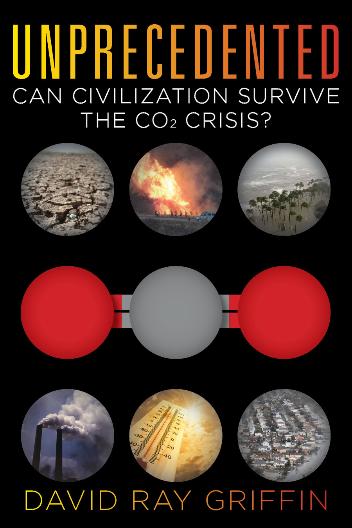 Everything you need to know about climate change and what can be done about it Clarity Press UNPRECEDENTED
Can Civilization Survive the CO2 Crisis?
By David Ray Griffin
ANNOTATED TABLE OF CONTENTS PART I: UNPRECEDENTED THREATS
Introduction: The basic issue is whether global warming, besides
leading to a hellish existence for our children and grandchildren,
will destroy civilization. Each chapter in Part I addresses 3
possible responses: Plan B (mobilization), Plan A (business as
usual), and Plan C (wait and see)……..
PART II: UNPRECEDENTED CHALLENGES AND FAILURES
11 Climate Change Denial: Worst in America, climate-change
denialism has resulted from a concentrated campaign by the
fossil-fuel industry to repudiate the scientific consensus and
promote public uncertainty. This chapter examines techniques
previously used by big business to impact public opinion in
relation to smoking, acid rain, CFCs, and the ozone layer,
showing how they are now being used by the fossil-fuel industry
to dispute the conclusion of virtually all climate scientists that
fossil fuels – coal, oil, and natural gas – are imperiling our planet.
The fossil-fuel industry, which knows its claims to be false, has
deceived many citizens into accepting its propaganda over the
evidence provided by climate scientists. This chapter debunks a
large number of the claims against climate science,
12 Media Failure: The fossil-fuel industry’s denialist strategy has
been forced upon, if not willingly embraced by, the major
American corporate media, leading to their failure to adequately
address either the science or the urgency of climate disruption.
Examined here are various media techniques geared to produce
public uncertainty on the issue: reduced coverage, inadequate
contextualization of extreme weather events, and false balance
(giving the opinions of propagandists paid by Big Oil as much
attention as the views of renowned climate scientists), and going
even beyond that to explicit denialism.
13 Political Failure: This chapter documents the historical record
of global failures to successfully address climate change and
explains reasons why. It demonstrates the extent to which
politicians have overruled the findings of science and analyzes
their motives. The record of US Presidents on climate change is
examined. Charting the Republican stampede toward absolute
climate change denial since 2011, it names specific malefactors
pursuing their selfish private interests to shed light on what
British journalist George Monbiot terms “the greatest political
failure the world has ever seen.”
14 Moral Challenge: There is a basic global ethic related to global
warming implicit in our understanding of human rights as well as
religious principles. The primary issue is intergenerational
justice – whether today’s generation will finally act fast and
decisively enough to save a tolerable planet for our descendants
or continue to act within the boundaries of its narrowly defined
self-interest. The notion of moral obligation in relation to climate
protection, along with the capacity of morality to make a
difference, is re-enforced by parallels to successful global
justice campaigns: the abolition of slavery and divestment from
South African apartheid.
revolved around theism, which comes in both traditional and non-
traditional forms. Traditional theism, which holds that the
supreme being is omnipotent, is held by most Evangelical
Christianity. This view often results in climate complacency,
holding that the world will not be destroyed by global warming
unless God wants this to happen – an attitude expressed by
several members of the U.S. Congress. Some Evangelical
Christians resist this tendency, instead fighting strongly to stop
global warming. But there are forms of theism that more fully
support climate concern.
16 Economic Challenge: Besides being impeded by limited
moralities and false religious ideas, society’s task of saving
civilization has also been impeded by false economic ideas.
Starting with the complacency of Yale’s William Nordhaus, this
chapter traces the mounting urgency of coming to grips with the
projected costs of climate disruption through the thinking of
Oxford’s Nicholas Stern and Harvard’s Martin Weitzman – who
warns that the costs could be infinite. Whereas Nordhaus argued
that going full out to reduce carbon emissions as quickly as
possible would damage the economy, a growing number of
economists have realized, with Stern and Weitzman, that going
full out is the only way to save the economy. This chapter ends
with the policies most needed: a carbon tax and the elimination
of fossil–fuel subsidies.
PART III: WHAT IS TO BE DONE17 Transitioning to Clean Energy: Fossil-fuel industry
propaganda has claimed that clean energy is too expensive and
could not, in any case, power civilization. But developments over
the past decade show that clean and renewable energy is now
not only achievable but also affordable. This chapter discusses
various types of clean energy, including solar, wind, geothermal,
and ocean energy, showing how these, combined with
hydropower, could provide far more than enough energy to
power civilization. Also discussed are automobiles, trains, and
airplane fuels that could make 100% clean transportation
possible. The great untold story is that the planet’s energy could
be 70% clean by 2035 and 100% clean by 2050.18 Abandoning Dirty Energy:…..
19 Mobilization:……http://www.claritypress.com/Griffin.html
No comments yet.
1 This Month


Tell the Ukrainian Government to Drop Prosecution of Peace Activist Yurii Sheliazhenko

Petition to revoke the licensing of the Near Surface Nuclear Disposal Facility (NSDF) at Chalk River. https://www.ourcommons.ca/petitions/en/Petition/Details?Petition=e-7247


of the week – STOP SMALL MODULAR REACTORS IN CANADA
To see nuclear-related stories in greater depth and intensity – go to https://nuclearinformation.wordpress.com
-
Archives
- March 2026 (183)
- February 2026 (268)
- January 2026 (308)
- December 2025 (358)
- November 2025 (359)
- October 2025 (376)
- September 2025 (258)
- August 2025 (319)
- July 2025 (230)
- June 2025 (348)
- May 2025 (261)
- April 2025 (305)
-
Categories
- 1
- 1 NUCLEAR ISSUES
- business and costs
- climate change
- culture and arts
- ENERGY
- environment
- health
- history
- indigenous issues
- Legal
- marketing of nuclear
- media
- opposition to nuclear
- PERSONAL STORIES
- politics
- politics international
- Religion and ethics
- safety
- secrets,lies and civil liberties
- spinbuster
- technology
- Uranium
- wastes
- weapons and war
- Women
- 2 WORLD
- ACTION
- AFRICA
- Atrocities
- AUSTRALIA
- Christina's notes
- Christina's themes
- culture and arts
- Events
- Fuk 2022
- Fuk 2023
- Fukushima 2017
- Fukushima 2018
- fukushima 2019
- Fukushima 2020
- Fukushima 2021
- general
- global warming
- Humour (God we need it)
- Nuclear
- RARE EARTHS
- Reference
- resources – print
- Resources -audiovicual
- Weekly Newsletter
- World
- World Nuclear
- YouTube
-
RSS
Entries RSS
Comments RSS
 nuclear-news
Leave a comment