Nuclear news for this week

Christina Macpherson’s websites & blogs
Iran nuclear talks reaching deadline. White House urges US Congress not to sabotage Iran nuclear negotiations
Asian and Pacific Green Parties unite in aim for nuclear free region
Anti nuclear protest: 45,000 people march in Taiwan. Anti nuclear rallies in over 200 German towns
Climate. IAE finds that renewable energy and efficiency are significantlyreducing greenhouse gas emissions
Japan. Govt aims to end nuclear power ban – but legal obstacles remain. Five old nuclear reactors to bite the dust. Japanese public to bear the costsof scrapping them. As Japan has no solution to nuclear wastes, closing reactors should start the end of nuclear industry. “Nuclear village” , like USA’s “military industrial complex” allows TEPCO to go unscathed. Anothermajor leak of radioactive water at Fukushima nuclear facility. Fukushima’s bags ofradioactive trash pile up
Europe. Legal case developing against EU’s approval of State subsidies for Hinkley nuclear plant. Renewable Energy Target to be raised in Norway and Sweden
USA. Revolving door for job between US Department of Energy and nuclear corporation. Nuclear lobby looking for tax-payer funded guinea pigsto test their new gimmicks. 100% renewable energy for Hawaii by 2040/
Canada. Nuclear reactors are not needed for medical isotopes
UK. In just one year, Sellafield nuclear clean-up bill jumps an extra £5bn
France. Nuclear company AREVA – too big to fail?
South Korea blames North Korea for nuclear power cyber attack
Japan has no solution to nuclear wastes. Closing reactors should start the end of nuclear industry

 Decommissioning reactors should be step toward ending reliance on nuclear power Asahi Shimbun, 19 Mar 15 Kansai Electric Power Co. and Japan Atomic Power Co. on March 17 decided to decommission three nuclear reactors that have been in operation for more than 40 years. And on March 18, two more nuclear reactors, operated by Chugoku Electric Power Co. and Kyushu Electric Power Co., joined the “to be decommissioned” list.
This is the first application of the regulation that, in principle, limits the operation of nuclear reactors to 40 years. That rule was adopted after the March 2011 accident at the Fukushima No. 1 nuclear power plant.
Nearly 20 of Japan’s 48 commercial nuclear reactors have been in service for 30 years or longer. Utilities get a one-time-only chance to extend operations beyond 40 years, but the reactor in question must pass special inspections and will require further investments. As the reactors continue to age, the utilities will have to make up their minds from year to year.
Since succeeding in nuclear power generation in 1963, Japan has promoted nuclear energy without any plans for decommissioned reactors. As a result, the nation is now stuck with all sorts of issues that must be resolved if the decommissioning of older reactors is to proceed. Only by overcoming these challenges and becoming a “nation capable of decommissioning nuclear reactors” will Japan be able to take its first firm step toward weaning itself off nuclear energy.
NUCLEAR WASTE PROBLEMS UNRESOLVED
Nuclear waste poses the most critical challenge to the planned decommissioning of nuclear reactors. Directives are effectively nonexistent as to where to store spent nuclear fuel and nuclear waste left behind by dismantled reactors.
The government has never addressed this issue, citing its “nuclear fuel cycle” policy that presupposes the full recycling of all spent nuclear fuel. But in practice, this policy is completely useless. Utilities are effectively forced to resort to on-site storage of spent fuel in cooling pools or dry casks.
According to a promise made by Kansai Electric to the Fukui prefectural government, spent nuclear fuel will be “stored or disposed of outside the prefecture.” The utility’s decision to dismantle two reactors at the Mihama power plant means having to deal with this promise.
The handling of radioactive waste is just as problematic. While the waste is supposed to be sorted by the level of radioactivity and stored underground accordingly, nothing has been decided about specific storage locations, not only for highly radioactive waste but also for low-level waste. Nor have any standards been set for the management of buried waste.
Obviously, reactors cannot be dismantled in the absence of rules for spent fuel and nuclear waste disposal. In fact, Japan Atomic Power, which became the first in the nation to decide to decommission a reactor at the Tokai power plant in Ibaraki Prefecture, had to postpone the dismantling work for three years, and then an additional five years, because disposal rules for low-radiation nuclear waste could not be established in time.
Having given up on waiting for communities to volunteer as permanent storage sites for highly radioactive waste, the government has decided to take the initiative and start selecting candidate sites. But given that no community has ever volunteered, the selection process is obviously not going to be easy. To ensure that no community will be forced to become a nuclear waste dump against its will, the government must guarantee procedural transparency and be fully ready for dialogue with every candidate……..http://ajw.asahi.com/article/views/editorial/AJ201503180044
Japan’s govt aims to end nuclear power ban – but legal obstacles remain
 That date could be pushed back, however, if courts grant injunctions to prevent restarts of all the country’s nuclear power stations, thereby extending Japan’s longest stretch without nuclear power since the 1960s.
The NRA’s consent on Wednesday was the second in a three-step process that all reactors have to go through before they will be allowed to restart. A final inspection in advance of a restart is also required……..As many as two-thirds of the country’s reactors may never return to operation because of high costs, local opposition or seismic risks, a Reuters analysis showed last year.: http://sputniknews.com/news/20150319/1019700843.html#ixzz3Uro9hHAx
Exposing the nuclear lobby’s agenda for Australia
What does the nuclear lobby want, for South Australia?, Online Opinion,
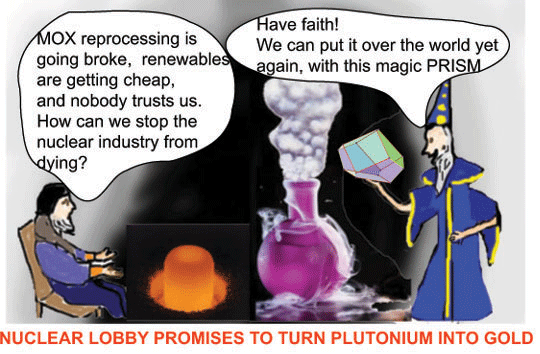
| By Noel Wauchope 19 March 2015 “….It is difficult to work out exactly what is planned in nuclear industry expansion for South Australia. The plans involve some or all of these industries: uranium enrichment, nuclear power, importation and storage of nuclear wastes, 4th Generation nuclear reactors, and expansion of uranium mining. However, we can be grateful to ABC Radio’s Ockham’s Razor programme, as it provided the nuclear lobby with a platform for setting out succinctly their intentions. Oscar Archer, a well -known voice for the nuclear industry, explains…… Australia should get a fleet of PRISM small nuclear reprocessing reactors – Archer’s plan is for “IFS+IFR: Intermediate Fuel Storage and Integral Fast Reactor, namely the commercially offered PRISM breeder reactor from General Electric Hitachi.”What he means here is the Power Reactor Innovative Small Module Archer then sets out the sequence of events that would lead to the establishment of this fleet. In Archer’s words “it goes like this. Australia establishes the world’s first multinational repository for used fuel – what’s often called nuclear waste” However, he notes that “This is established on the ironclad commitment [my emphasis] to develop a fleet of integral fast reactors to demonstrate the recycling of the used nuclear fuel”…… the sting in the tale of his plan is really exactly what he calls the first step – the overturning or weakening of Federal and State laws. The Federal Act protects against nuclear reprocessing and expanded nuclear industries. ARPANSA sets safety standards for exposure to ionising radiation. South Australian State Law would have to be overturned, too – under the Nuclear Waste Storage Facility (Prohibition) Act 2000 The central premise of Oscar Archer’s promotion of this nuclear chain of events is that Australia should go out on a limb – be the first country in the world to import nuclear wastes and to order a mass purchase of PRISM reactors….. The PRISM reactor exists only on paper and its development is decades away from completion. David Biello, in Scientific American comments “Ultimately, however, the core problem may be that such new reactors don’t eliminate the nuclear waste that has piled up so much as transmute it. Even with a fleet of such fast reactors, nations would nonetheless require an ultimate home for radioactive waste, one reason that a 2010 M.I.T. report on spent nuclear fuel dismissed such fast reactors.”
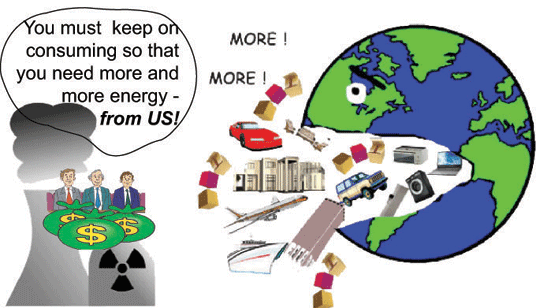
The PRISM can’t melt down in the way that conventional nuclear reactors can. However, its essential use of plutonium entails hazardous transport – vulnerability to terrorism and use as a “dirty” bomb. And – finally the PRISM reactor itself becomes radioactive waste requiring security and burial. There is another, underlying premise here that needs to be examined. This is the premise that it is OK for Australia and the world to continue to consume energy endlessly…….
The plan purports to reduce greenhouse emissions by means of thousands of little reactors, (and big ones) – but their development is so many decades away that it would be too late for climate change action. We are left with a plan that looks suspiciously as if the troubled nuclear industries of USA, Canada and UK have selected Australia as the guinea pig for a plan to reverse their industries’ present decline.
|

Flogging a dead horse – India’s government and the nuclear industry
More important than all this is the Indian policymakers’-and-shapers’ disconnect from reality and obsession with nuclear technology
Contrary to pet myths, nuclear power is rapidly shrinking worldwide.
India would commit a historic blunder by expanding nuclear power generation
Fukushima, the world’s worst-ever nuclear accident (http://gu.com/p/46fjj/sbl), has probably sounded the death-knell of the global nuclear industry. It brutally exposed the unaffordable nature of nuclear risks even in developed societies, and has made atomic power publicly unacceptable everywhere
Nuclear has nothing going for it—not when wind and solar energy annually grow worldwide at 25% and 40%-plus, when their generation costs fall to those of gas- or coal-based power, and their modularity and flexibility establish their unparalleled versatility.
Four years after Fukushima, India still flogs a nuclear dead 
 horse http://www.dnaindia.com/analysis/column-four-years-after-fukushima-india-still-
flogs-a-nuclear-dead-horse-2069971 Thursday, 19 March 2015 – It’s a telling comment on the state of the Indian media that most of it blacked out the fourth anniversary of the still-continuing Fukushima nuclear catastrophe, which fell on March 11. The same media reported breathlessly on the Indian government’s plans to triple domestic nuclear power-generation capacity by 2020-21, and on the “breakthrough” achieved on the nuclear liability issue during Barack Obama’s recent visit to India.
In reality, there was no breakthrough—only sleights-of-hand to substitute administrative memoranda for proper laws enacted after prolonged legislative debate. This trick, meant to please US nuclear suppliers at the expense of India’s public, falls foul of Parliament’s intent. But it still won’t work. Westinghouse and GE, now owned by Japanese capital, are unlikely to sell reactors to India so long as an element of liability exists.
As for the projected capacity tripling, it belongs to an established pattern of extravagant promises and poor performance: if the Department of Atomic Energy’s 1967 projection had materialised, India by 2000 would have had 43,500 MW in capacity; it had 2,700 MW! Tripling assumes that 19 reactors would be started and completed in six years, when average global construction time is 10 years. Eight reactors are to be imported, an unlikely prospect given that companies like “nuclear champion” Areva, for which the Jaitapur site is earmarked, are on bankruptcy’s verge. Continue reading
Legal firm sets out the case against EU Commission approving State aid for Hinkley nuclear project
STATE AID FOR HINKLEY POINT NUCLEAR POWER PLANT: BBH TO PREPARE A LAWSUIT AGAINST THE EU COMMISSION http://www.beckerbuettnerheld.de/en/article/state-aid-for-hinkley-point-nuclear-power-plant-bbh-to-prepare-a-lawsuit-against-the-eu-commission/12.03.2015
In October last year, the European Commission approved the state aid scheme in favour of the British nuclear power plant project Hinkley Point C. The German electricity supply company Greenpeace Energy has now decided to take legal action against this decision with the help of the renowned German energy law firm Becker Büttner Held (BBH). A number of municipal energy utilities, such as Stadtwerke Schwäbisch Hall, are considering and, respectively, preparing to join the lawsuit.
According to plans by the British government, Hinkley Point nuclear power plant – which is to be constructed in the southwest of England – is to receive state support for no less than 35 years. The scheme was backed by the European Commission, which in October last year gave the green light for a state aid package of approximately €23 billion. This means that, starting from 2023, the nuclear power plant operators will be paid a guaranteed purchase price above the usual market price for the electricity produced.
Based on the so-called Contract for Difference (CfD) the British government pays a fixed feed-in tariff: The electricity produced by Hinkley Point C nuclear power plant is to be remunerated by 12.8 cents per kWh – plus compensation for inflation. On top of that, a number of additional, significant state subsidies are granted, including a guarantee in the event of a shutdown for political reasons. The scheme is completed by a loan guarantee given by the British government, a generous appraisal of the future decommissioning costs and the fact that no tendering procedure was carried out.
With a total capacity of 3,260 MW, about 7% of the highly subsidised electricity generated in Great Britain will then enter the EU’s internal electricity market. As a consequence, the Hinkley Point model will affect the European electricity market. Furthermore, the Commission’s decision provides a kind of blueprint for the specific interests of Germany’s neighbouring countries such as Poland and the Czech Republic, as well as those of Slovakia and Slovenia – also because the British government is already planning the construction of further nuclear power plants within the scope of the CfD mechanism. The potential locations of these future power plant can be seen on the website of the British Department of Energy and Climate Change (DECC).
BBH’s clients doubt that the state aid granted to Hinkley Point is in conformity with EU competition law. Continue reading
March 29 Public Hanford nuclear meetings organised by community groups
 The community-led program will be held from 9:30 a.m. to noon March 29 at Vancouver’s Marshall Community Center, 1009 E. McLoughlin Blvd. It is free and open to the public.
The Hanford Nuclear Reservation in Eastern Washington was conceived as part of the Manhattan project in World War II and produced material for the bomb dropped on Nagasaki. The government subsequently used the remote desert site to produce material for the nation’s nuclear arsenal.
Today, the nation’s most contaminated nuclear site is subject to a decades-long cleanup under the auspices of the U.S. Department of Energy.
“The health of the Columbia River depends on successful cleanup of the Hanford nuclear site and its dangerous nuclear and chemical pollution. Residents throughout the Pacific Northwest have a huge stake in the cleanup effort at Hanford, and we are reaching out to help give them a greater voice in the process,” said Dan Serres, Conservation Director for Columbia Riverkeeper.
The event is organized by Columbia Riverkeeper, Hanford Challenge, Heart of America and Washington Physicians for Social Responsibility. It is billed as an opportunity to provide input on the Hanford cleanup and for downstream communities to learn more about the issues.
No good reasons to tie Saskatchewan’s future to nuclear power
 No to nuclear http://www.leaderpost.com/technology/nuclear/10895427/story.html THE LEADER-POST MARCH 17, 2015 Dale Dewar, Wynyard Re: “Prof says Sask. needs nuclear power” (March 7). Why hasn’t Saskatchewan gone nuclear?
1. Cost: No nuclear reactor has been built on budget (or even close to it) or on time. If it ever gets running, the energy produced has never been cost-efficient.
2. Water: No matter what the size of a nuclear power plant, it needs a lot of water. The water is returned to the rivers or lakes at a higher temperature.
3. Waste: No solution has been found. As for burying it in “solid rock”, once the rock has been disturbed to create the burial site, it is no longer solid. Two recently promising burial sites have leaked in less than two decades. One of the difficulties with problems underground is that when they occur, the tunnels are too dangerous for investigations.
4. Technology: The only time Canada has gone with unproven technology (which small modular reactors are) we were left with a government funded multi-million white elephant in the two Maple reactors near Ottawa. Need I remind people about the “new tech” reactor in Finland, still incomplete despite due date of 2012 and still uncertainty about it working?
There are no good reasons to tie our future to nuclear power. Promoting nuclear power as “green” is false – the only time it is green is the brief window during which it operates at full capacity (which is rare). And even then, its coolant water is warming the rivers. We have enough algae bloom already!
Dewar is a Saskatchewan physician, international human rights activist and author of From Hiroshima to Fukushima to You.
April 11 climate action march i n Quebec
 Act on Climate March http://act-on-climate.ca/media/ Quebec, March 19, 2015 – Prominent Canadian actors, musicians, and authors including Indigenous rights advocate and actress Tantoo Cardinal, Juno award winning artists Claire Boucher (Grimes) and Sarah Harmer, and best selling journalist and author Naomi Klein are urging people across Canada to come to Quebec City to march for the climate on April 11.
“I’m booking a train ticket to Quebec City for April 11th to Act on Climate! This is one of those vital times where we need to lead our leaders,” said Juno-nominated musician Sarah Harmer. “Join the thousands who will be there to push our provincial leaders to act now to develop a low carbon economy in Canada.”
People across Canada are invited to push for federal and provincial action to combat a growing climate crisis and transition the country to renewable energy.
“We need to leave the oil in the ground and move to wind and solar,” said actress and Order of Canada recipient Tantoo Cardinal. “It’s time our Prime Minister and our premiers went beyond fear, greed and control and use this opportunity to weave a new paradigm. Your grandchildren will thank you.”
The mobilization on April 11th is scheduled three days before provincial and territorial leaders are to meet in Quebec City for a special Council of Federation meeting to talk about the climate change. Organizers expect thousands of people from all over Canada to take part in the demonstration. “I am supporting this march because it’s time for governments to tell us that they recognize the new economic reality – the changing world attitudes to oil and its volatility, the world-wide increase in renewables, the fact that, despite lack of subsidies, there are more Canadian jobs now in renewables than in oil,” said Booker prize winning author Margaret Atwood.
“The only thing standing between this world and environmental catastrophe is us,” said Claire Boucher (Grimes). “On April 11th, we our elected leaders must turn away from the tarsands and act on climate.”
The list of artists also includes, Academy Award winning actress Emma Thompson, musician and artist Yasmine Van Wilt a.k.a. Van Wild, and actress and model Shannon Baker.
“There has never been a better time to transform not just how we generate power but who benefits from that power,” said author and journalist Naomi Klein. “With prices plummeting, the oil and gas industry is in crisis, and they are demanding a fresh wave of government handouts and subsidizes. That’s insane. Public money does need to be spent, but it needs to go towards building a clean and just economy — before climate change overtakes us.”
People are encouraged to sign-up to attend the march at http://act-on-climate.ca/
Cyclone Pam – forerunner to more climate disaster for Vanuatu and the world
the Guardian’s campaign for divestment from fossil fuels is so important. If you haven’t signed it already, do so for Vanuatu. http://www.theguardian.com/commentisfree/2015/mar/19/developed-nations-sow-wind-vanuatu-reaps-whirlwind
 Developed nations have sown the wind, Vanuatu has reaped the whirlwind, Guardian, 19 Mar 15 Andrew Simms As emissions alter weather patterns, island nations are the bellwethers that show what our future will be if we fail to tackle climate change……..joint work in 2011 by the National Oceanic and Atmospheric Administration in the US and the UK’s Met Office concluded that a Texas heatwave was 20 times more likely to be caused by climate change than by natural weather variation. A winter warm spell in Britain the same year was 62 times more likely than in the 1960s. The Met Office’s Hadley Centre now confidently states that it “can identify any changed risk of such events”.
In time, more analysis will be done on Cyclone Pam, but Lonsdale’s personal experience and gut reaction fits a pattern of expectations described in the most recent and most comprehensive collation of science on extreme events in theIPCC’s Fifth Assessment Report. It concluded that: “The frequency of the most intense storms will more likely than not increase in some basins. More extreme precipitation near the centres of tropical cyclones making landfall is projected in North and Central America, east Africa, west, east, south and southeast Asia as well as in Australia and many Pacific islands.”
So, while the present is pretty bad for Vanuatu, in a warming world the future looks set to worsen. For this island nation, that is bitterly ironic. . Vanuatu is an archipelago in the western Pacific, famous for having no regular military. When it topped the index in 2006 its ecological footprint per person was no higher than those in non-industrialised countries like Mali and Swaziland, life expectancy matched that in Turkey, and life satisfaction levels were considered as high as New Zealand’s. It is democratic, rich in natural wealth but, being remote, exports little, avoiding the scramble of competing in global markets. It is also hugely culturally diverse with more than 100 languages spoken across its islands.
Small island states tend to do very well in the index topped by Vanuatu. Over countless generations and in the face of geographical isolation, many Pacific islands developed more cooperative economies and highly resilient farming methods. In a warming world they are bellwethers, and carry lessons for us all. If climate change renders small island states unliveable, the international community will sooner or later have to learn to accept and support environmental refugees. Though this would be tragic, remote island populations can, at least, relocate. However, blue island-planet populations cannot.
We will seal our own fate if we fail to learn to share and live within our overall environmental thresholds. There is a long way to go. The World Bank recently tweeted that climate change exacerbates the risk of already costly disasters. It’s a shame then, that as recently as 2012-13 the World Bank Group increased lending to $2.7bn for fossil fuel projects, including toward new oil and gas exploration.
It’s one more reason why the Guardian’s campaign for divestment from fossil fuels is so important. If you haven’t signed it already, do so for Vanuatu. http://www.theguardian.com/commentisfree/2015/mar/19/developed-nations-sow-wind-vanuatu-reaps-whirlwind
UNPRECEDENTED – new book exposes climate denialism, and shows way to act on climate change
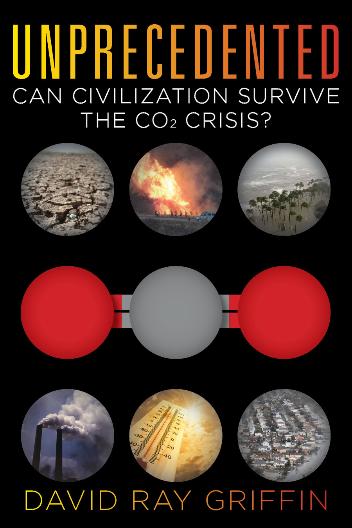 Everything you need to know about climate change and what can be done about it Clarity Press UNPRECEDENTED
Can Civilization Survive the CO2 Crisis?
By David Ray Griffin
ANNOTATED TABLE OF CONTENTS PART I: UNPRECEDENTED THREATS
Introduction: The basic issue is whether global warming, besides
leading to a hellish existence for our children and grandchildren,
will destroy civilization. Each chapter in Part I addresses 3
possible responses: Plan B (mobilization), Plan A (business as
usual), and Plan C (wait and see)……..
PART II: UNPRECEDENTED CHALLENGES AND FAILURES
11 Climate Change Denial: Worst in America, climate-change
denialism has resulted from a concentrated campaign by the
fossil-fuel industry to repudiate the scientific consensus and
promote public uncertainty. This chapter examines techniques
previously used by big business to impact public opinion in
relation to smoking, acid rain, CFCs, and the ozone layer,
showing how they are now being used by the fossil-fuel industry
to dispute the conclusion of virtually all climate scientists that
fossil fuels – coal, oil, and natural gas – are imperiling our planet.
The fossil-fuel industry, which knows its claims to be false, has
deceived many citizens into accepting its propaganda over the
evidence provided by climate scientists. This chapter debunks a
large number of the claims against climate science,
12 Media Failure: The fossil-fuel industry’s denialist strategy has
been forced upon, if not willingly embraced by, the major
American corporate media, leading to their failure to adequately
address either the science or the urgency of climate disruption.
Examined here are various media techniques geared to produce
public uncertainty on the issue: reduced coverage, inadequate
contextualization of extreme weather events, and false balance
(giving the opinions of propagandists paid by Big Oil as much
attention as the views of renowned climate scientists), and going
even beyond that to explicit denialism.
13 Political Failure: This chapter documents the historical record
of global failures to successfully address climate change and
explains reasons why. It demonstrates the extent to which
politicians have overruled the findings of science and analyzes
their motives. The record of US Presidents on climate change is
examined. Charting the Republican stampede toward absolute
climate change denial since 2011, it names specific malefactors
pursuing their selfish private interests to shed light on what
British journalist George Monbiot terms “the greatest political
failure the world has ever seen.” Continue reading
World peace in the balance as Iran nuclear talks reach deadline
 Deal or no deal? What happens next after Iran nuclear talks climax Guardian, Julian Borger and Chris Fenn, 19 Mar 15 This weekend marks the moment when negotiators attempt to finalise an accord that could launch a new era between Tehran and the west. It’s D-day for multinational talks on Iran’s atomic ambitions, as negotiators descend on Lausanne to try to finalise agreement on what nuclear technologyIran may pursue and what is beyond the pale.
The difference between success and failure could not be more stark. So what happens next if there’s a deal – and what would transpire if the talks failed?……. http://www.theguardian.com/world/2015/mar/19/what-happens-next-after-iran-nuclear-talks-climax
See photos of The Radioactive Man Who Returned To Fukushima To Feed The Animals
 Photos The Radioactive Man Who Returned To Fukushima To Feed The Animals That Everyone Else Left Behind Bored Panda 20 Mar 15 The untold human suffering and property damage left in the wake of the Fukushima disaster in Japan has been well-documented, but there’s another population that suffered greatly that few have discussed – the animals left behind in the radioactive exclusion zone. One man, however, hasn’t forgotten – 55-year-old Naoto Matsumura, a former construction worker who lives in the zone to care for its four-legged survivors.
He is known as the ‘guardian of Fukushima’s animals’ because of the work he does to feed the animals left behind by people in their rush to evacuate the government’s 12.5-mile exclusion zone. He is aware of the radiation he is subject to on a daily basis, but says that he “refuses to worry about it.” He does take steps, however, by only eating food imported into the zone.
See more about his work and what he has seen in the exclusion zone below!…….http://www.boredpanda.com/fukushima-radioactive-disaster-abandoned-animal-guardian-naoto-matsumura/
Japan’s Prime Minister Abe avoids Fukushima discussion, at U.N. conference on disaster risk
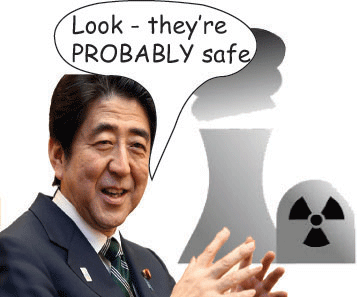 Abe mum on Fukushima at U.N. disaster risk confab, Japan Times KYODO, JIJI, STAFF REPORT MAR 15, 2015 SENDAI – Prime Minister Shinzo Abe had little to say on the tsunami-triggered core meltdowns in Fukushima as representatives from across the globe met at a U.N. conference on disaster risk reduction Sunday to underscore the urgent need to address climate change and reduce disaster impacts
On the second day of the U.N. World Conference on Disaster Risk Reduction in Sendai, French Minister of State for Development and Francophony Annick Girardin said climate change is responsible for over 80 percent of the damage caused by natural disasters.
The Sendai conference is “above all a call for lucidity, because it is no longer possible to ignore climate chaos” in the context of disaster risk mitigation, Girardin told the gathering, which began Saturday.
Meanwhile, in a speech Saturday at the conference, Prime Minister Shinzo Abe had few words on the triple core meltdown at the Fukushima No. 1 power plant. The disaster in Fukushima Prefecture erupted after a massive quake on March 11, 2011, spawned huge tsunami that took out the plant’s cooling systems.
Abe’s speech was strongly criticized by Tamotsu Baba, mayor of the town of Namie. “(Abe’s speech) was no good at all. He may not have wanted to give negative impressions (of Japan) because world leaders have gathered here,” Baba told reporters Saturday.
Namie is close to the plant, and about 21,000 of its residents were still living outside the town as of the end of February after losing their homes to radioactive fallout.
Speculation has been rife that Abe was attempting to avoid discussion about the Fukushima disaster because the No. 1 plant is plagued with radioactive water woes, including operator Tokyo Electric Power Co.’s failure to disclose the extent of the tainted water flowing into the Pacific……http://www.japantimes.co.jp/news/2015/03/15/national/abe-mum-on-fukushima-at-u-n-disaster-risk-confab/#.VQs8VtKUcnk
1 This Month
10 March A LIVE WEBINAR THE REAL EFFECTS OF NUCLEAR POWER
What the Industry Isn’t Telling Us
1:00 PM Mountain, 2 pm Central, 3 pm Eastern. Live on the Keepers of the Water Facebook page

18 March Webinar @ 1 PM EST: An Assessment of SMR Projects: The Case of Canada
register for the zoom:
https://us02web.zoom.us/webinar/register/WN_o8BIIOUvQ2ONJR1nta65DQ#/registration


of the week – STOP SMALL MODULAR REACTORS IN CANADA
To see nuclear-related stories in greater depth and intensity – go to https://nuclearinformation.wordpress.com
-
Archives
- February 2026 (256)
- January 2026 (308)
- December 2025 (358)
- November 2025 (359)
- October 2025 (376)
- September 2025 (258)
- August 2025 (319)
- July 2025 (230)
- June 2025 (348)
- May 2025 (261)
- April 2025 (305)
- March 2025 (319)
-
Categories
- 1
- 1 NUCLEAR ISSUES
- business and costs
- climate change
- culture and arts
- ENERGY
- environment
- health
- history
- indigenous issues
- Legal
- marketing of nuclear
- media
- opposition to nuclear
- PERSONAL STORIES
- politics
- politics international
- Religion and ethics
- safety
- secrets,lies and civil liberties
- spinbuster
- technology
- Uranium
- wastes
- weapons and war
- Women
- 2 WORLD
- ACTION
- AFRICA
- Atrocities
- AUSTRALIA
- Christina's notes
- Christina's themes
- culture and arts
- Events
- Fuk 2022
- Fuk 2023
- Fukushima 2017
- Fukushima 2018
- fukushima 2019
- Fukushima 2020
- Fukushima 2021
- general
- global warming
- Humour (God we need it)
- Nuclear
- RARE EARTHS
- Reference
- resources – print
- Resources -audiovicual
- Weekly Newsletter
- World
- World Nuclear
- YouTube
-
RSS
Entries RSS
Comments RSS
 nuclear-news