Cesium -137 – a particularly dangerous nuclear isotope
 Note the immense inventories of Cesium-137: 150 million Curies that are located in the nearby spent fuel pool at Indian Point Nuclear Power Plant which is about 40 miles from here by road and less than that as the radioactive cloud flies. Many of the 104 US commercial nuclear reactors and power plants have more than 100 million Curies of Cesium-137 in their spent fuel pools. This is many times more than in the spent pools at Fukushima
 The Implications of The Massive Contamination of Japan With Radioactive Cesium
  Steven Starr
Senior Scientist, Physicians for Social Responsibility
Director, University of Missouri, Clinical Laboratory Science Program
Helen Caldicott Foundation Fukushima Symposium
New York Academy of Medicine, 11 March 2013 “….. A large number of highly radioactive isotopes released by the destruction of the Fukushima Daiichi nuclear power plant grossly contaminated the Japanese mainland. Most of these radionuclides had short half lives which meant they would essentially disappear in a matter of days or months. For many of those who were exposed to them there will be major health consequences.
However, there were some radioactive elements that will not rapidly disappear. And it is these long-lived radionuclides that will remain to negatively affect the health of all complex life forms that are exposed to them.
 Chief among them is Cesium-137, which has taken on special significance because it is has proven to be the most abundant of the long-lived radionuclides that has remained in the environment following the nuclear disasters at Chernobyl and Fukushima. It has a 30 year radioactive half life which is why it persists in the environment. Scientists now believe that it will be 180 to 320 years before the Cesium-137 around the destroyed Chernobyl reactor actually disappears from the environment.
Cesium is water soluble and quickly makes its way into soils and waters. It is in the same atomic family as potassium and it mimics it, acting as a macronutrient. It quickly becomes ubiquitous in contaminated ecosystems.
It is distributed by the catastrophic accidents at nuclear power plants because large quantities of volatile radioactive cesium build up inside the fuel rods of nuclear reactors. Thus any accident at a nuclear reactor that causes the fuel rods to rupture, melt, or burn will cause the release of highly radioactive cesium gas.
Long-lived radionuclides such as Cesium-137 are something new to us as a species. They did not exist on Earth in any appreciable quantities during the entire evolution of complex life. Although they are invisible to our senses they are millions of times more poisonous than most of the common poisons we are familiar with. They cause cancer, leukemia, genetic mutations, birth defects, malformations, and abortions at concentrations almost below human recognition and comprehension. They are lethal at the atomic or molecular level. Continue reading
Anti nuclear rallies in over 200 German towns

 By Diet Simon, 17 Mar 15 About 12,000 anti-nuclear activists demonstrated in recent days in more than 200 German towns in commemoration of the Fukushima catastrophe four years ago and against the current nuclear situation in Germany.
There were pickets, and rallies in Neckarwestheim, Düsseldorf, Berlin und Dannenberg. The demos focused on the aging nuclear power station in Germany, waste issues and the evil methods energy companies are employing to dodge their responsibilities.
Obviously not as many people took to the streets as immediately following the Fukushima catastrophe, so the more than 200 events were all the more noteworthy. Countless local newspapers reported on them. It was a successful reminder of the nuclear dangers, pulling the issue back into public focus.
Tenacity is a special strength of the German anti-nuclear movement.
Staring Thursday this week (19 March) many selected German cinemas will show an antinuclear film, „Die Reise zum sichersten Ort der Erde“ (The journey to the safest place on earth) dealing with the unsolved problem of disposing nuclear waste.
Many activists have talked to their local cinemas to run it so as to reach the biggest possible public (schedule of showings). Most found that it needed just a phone call or a face-to-face conversation to persuade cinema operators to show it.
As part of special screenings experts discuss with audiences about the film and its pressing question, where to with our life-threatening waste.
The film will also screen at the Environmental Filmfestival in Washington DC, from 17 to 29 March.
Some media comment: “A film about insanity” (Grit Lemke, DOK Leipzig); “Unideological and with unshakeable belief in a public who can think for themselves” (Saiten Ostschweizer Kulturmagazin); “A magnificent documentary film” (Susan Boos, Die Wochenzeitung); “Most watchable” (Susanna Petrin, Aargauer Zeitung); “Excellent documentation” (Blick);
“Looking away is forbidden” (Hans Nüsseler, Swiss television).
Production: Mira Film GmbH | Weststrasse 182 | CH-8003 Zürich | Tel +41 (0) 43 960 3684 | info@mirafilm.ch| www.mirafilm.ch
World distribution: Autlook Weltvertrieb | Spittelberggasse 3/14 | A-1070 Wien I Tel +43 720 34 69 34 Iwelcome@autlookfilms.com | www.autlookfilms.com
The film’s website: http://www.diereisezumsicherstenortdererde.ch/de/
South Korea blames North Korea for nuclear power cyber attack

 South Korea claims North hacked nuclear data Hackers stole blueprints, employee data, and threatened “destruction” if demands not met, Ars Technica, by Sean Gallagher – Mar 18, 2015 The South Korean government issued a report today blaming North Korea for network intrusions that stole data from Korea Hydro and Nuclear Power (KHNP), the company that operates South Korea’s 23 nuclear reactors. While the government report stated that only “non-critical” networks were affected, the attackers had demanded the shutdown of three reactors just after the intrusion. They also threatened “destruction” in a message posted to Twitter………
In addition to identifying the malware used in the attack, the South Korean government’s investigation traced Internet traffic related to the attack back to addresses for a network in northeast China near the North Korean border. The government had earlier requested assistance from the Chinese government in identifying the source of the attack. http://arstechnica.com/security/2015/03/south-korea-claims-north-hacked-nuclear-data/
Japan’s old nuclear reactors to bite the dust
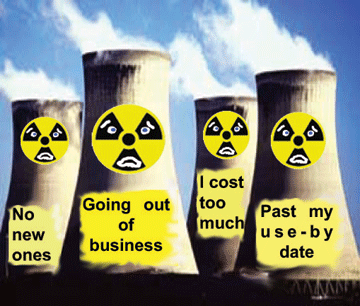
 Japan utilities set to scrap five aging nuclear reactors (Reuters) 17 Mar 15- Three aging nuclear reactors in Japan will be decommissioned due to the high cost of upgrading them in line with tougher safety standards set after the Fukushima disaster, their operators said on Tuesday.
Another two reactors were also likely to be scrapped, local media reports said, with announcements expected later in the week.
The moves are the first concrete sign that Japan’s nuclear industry is heeding a government request to shut down older reactors that are considered more vulnerable to natural disasters in the hope that it will ease public concerns about a restart of other reactors……..
It is the first time utilities have opted to close older reactors to comply with new safety standards set after the Fukushima disaster that limits a nuclear reactor’s lifespan to 40 years unless it can clear tough rules for a one-time extension. The deadline to apply for that extension is July 2015.
Japan’s trade ministry has been pushing nuclear operators for a quick decision on scrapping aging reactors that are too costly to upgrade, promising financial support for a smooth decommissioning.
Japan has revised accounting rules to allow utilities to spread the write-offs for reactor closures over 10 years and to pass on some of the cost to ratepayers. http://www.reuters.com/article/2015/03/17/us-japan-nuclear-decommission-idUSKBN0MD0WX20150317
Revolving door for job between US Department of Energy and nuclear corporation
 Critics view former DOE official’s $1.7 million job at uranium-enriching corporation with concern, Daily Kos, 16 Mar 15 by Meteor Blades It’s another story of the revolving-door between the corporate world and high-level government officials. But this one about the uranium enrichment company—Centrus Energy Corp.—is unique.
For nearly five years Dan Poneman was deputy secretary of the U.S. Department of Energy and as acting secretary before Ernest Moniz got the post. Effectively, he was the department’s chief operating officer. During that time, DOE directed hundreds of millions of dollars to the struggling Centrus, which was then called the United States Enrichment Corporation (USEC). The company emerged from a Chapter 11 bankruptcy just last September.
Later this month Poneman, who left DOE in October, will take over as president and CEO for an annual paycheck of $1.7 million. That has disturbed some people:
Tyson Slocum, director of the energy program for the consumer advocacy group Public Citizen, said Poneman’s move is one of the most glaring examples of the revolving door he has seen. The move also shows that the government’s decision to privatize the company in the 1990s—spinning the company off from DOE—has failed, he said.”This doesn’t really pass the smell test,” he said. “You’re putting a top former government official in charge of the company; it’s safe to say his appointment as CEO is all about maximizing their influence with key federal officials for all types of federal support.”
……..in 2009, the government said it wouldn’t provide a $2 billion loan guarantee to USEC because the proposed plant had technological issues and was not ready to go fully operational. That, plus the move away from nuclear power in some countries because of the Fukishima reactor meltdowns, caused the market for concentrated uranium to contract and USEC’s stock price plunged. The bankruptcy filing followed.
And then there was a Government Accountability Office report that concluded DOE had violated the law several times when it arranged four uranium transfers in 2012 and 2013 to bolster USEC. DOE argued the GAO had got the law wrong.
Last September, the company emerged from bankruptcy with its new name—Centrus—and a bland branding slogan: “Fueling the future of nuclear power.” Last week, Senator John Barrasso (R-WY) sent a letter to Secretary Moniz, reminding him of the transfers and asking for more transparency in such matters in the future: He also wrote:
DOE has long had an improper relationship with USEC. Mr. Poneman’s appointment as President and CEO only promises to make that record worse. His appointment to the Board of Directors of the Traxys Group, the sales agent for the current recipient of publicly-owned uranium, is also troubling. For these reasons, I ask that you conduct a rulemaking, with full notice and public comment, before authorizing all future sales or transfers of uranium. Only by adhering to the transparency and accountability requirements of the Administrative Procedure Act will DOE be able to restore confidence in its management of publicly-owned uranium.”
On the barbs being addressed at him and Centrus, Poneman says:
“It’s got to operate successfully on its own two feet as a viable commercial operation to get away from the perception that it’s running to the government all the time,” he said.
Given the volatility of the business he’s in, that could be a tall order.
ORIGINALLY POSTED TO METEOR BLADES ON MON MAR 16, 2015 HTTP://WWW.DAILYKOS.COM/STORY/2015/03/16/1371313/-CRITICS-VIEW-FORMER-DOE-OFFICIAL-S-TOP-POSITION-AT-URANIUM-ENRICHMENT-COMPANY-WITH-CONCERN?UTM_SOURCE=FEEDBURNER&UTM_MEDIUM=FEED&UTM_CAMPAIGN=FEED%3A+DAILYKOS%2FINDEX+%28DAILY+KOS%29&UTM_CONTENT=ICEROCKET+BLOG+SEARCH#
100% renewable energy for Hawaii by 2040
 Hawaii aims for 100% renewable energy by 2040, REneweconmy By Ari Phillips on 13 March 2015 Hawaii is on track to pass legislation this year requiring the state to go 100 percent renewable by 2040.
Earlier this month, committees in the Hawaii House and Senate both unanimously recommended bills that would raise the state’s Renewable Portfolio Standard (RPS) from the current target of 70 percent by 2030 to the ultimate goal of 100 percent by 2040. Hawaii has 100% renewabl eenergy had an RPS since 2001, and right now the state gets just over 21 percent of its power from renewable sources — a 12 percent increase in just six years.
“Even our utility is saying we can hit 65 percent by 2030, so 100 percent is definitely doable,” Sen. Mike Gabbard (D), sponsor of the Senate bill, SB 2181, and chair of Hawaii’s Energy and Environment Committee, told ThinkProgress. “This is huge for our state’s future. Each year, we spend $3 to $5 billion importing fossil fuels to power our economy. Our electricity bills are roughly three times the national average.”
The Aloha state is 2,500 miles from Los Angeles — about the same distance as New York City to L.A. — and its energy situation bears little resemblance to the mainland’s. Along with Alaska and Texas, it is one of only three states to have its own electricity grid — in fact, it has three of them for three different islands. In 2013, the state had the highest electricity prices in the nation due to its heavy reliance on imports. More than two-thirds of electricity generation on the island archipelago comes from imported oil; in the rest of the U.S., oil accounts for less than one percent of electricity generation.
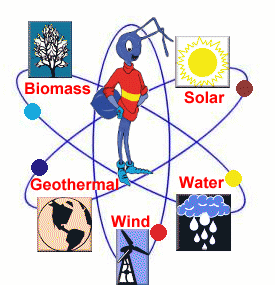
As recently six years ago, more than 90 percent of Hawaii’s yearly electricity generation came from coal and oil. With renewable technologies rapidly advancing, Hawaii’s abundant solar, wind, hydro, and geothermal sources are moving in quickly as replacements for costly fossil fuels.
“We are on the leading edge of the 21st century renewable energy transformation,” Chris Lee (D), Sponsor of the House version of the bill, HB 623, and chair of the House Energy and Environment Committee, told ThinkProgress. Lee said he’s been pushing for a 100 percent RPS bill for three years, but that this is the first year there’s been overwhelming support to move forward……….http://reneweconomy.com.au/2015/hawaii-aims-for-100-renewable-energy-by-2040
Greater cancer risk for girls – radioactive fallout from Fukushima
it is very important that we recognize the danger posed to children by the routine ingestion of contaminated food with Cesium-137 where ever they might live. It is also important to prevent further nuclear disasters which release these fiendishly toxic poisons into the global ecosystems. Given the immense amounts of long-lived radionuclides which exist at every nuclear power plant this is an urgent task.
The Implications of The Massive Contamination of Japan With Radioactive Cesium [excellent slides and graphs]
Steven Starr
Senior Scientist, Physicians for Social Responsibility
Director, University of Missouri, Clinical Laboratory Science Program
Helen Caldicott Foundation Fukushima Symposium New York Academy of Medicine, 11 March 2013 “……..So now that we have some idea of the extreme toxicity of Cesium-137, let’s look at the extent of the contamination of the Japanese mainland.
It is now known that the reactors 1, 2, and 3 at Fukushima Daiichi all melted down and melted through the steel reactor vessels within a few days following the earthquake and tsunami of March 11, 2011. This was not made public by either TEPCO or the Japanese government for two months.
The greatest amounts of highly radioactive gases were released shortly after the meltdowns and 80% of this gas released by the reactors is believed to have traveled away from Japan over the Pacific. However the remaining 20% was dispersed over the Japanese mainland.
On March 11th, the US National Nuclear Security Administration offered the use of its NA-42 Aerial Measuring System to the Japanese and US governments. The National Atmospheric Release Advisory Center of the Lawrence Livermore Lab stood up to provide atmospheric modeling projections. The next two slides were produced by Lawrence Livermore and presumably given to the Japanese government.
On March 14th, the easterly winds which had been blowing the highly-radioactive gases and aerosols coming from Fukushima out to sea, shifted and pushed the radioactive plume back over the Japanese mainland. You can see the progression. The red indicates the radioactive plume.
Note that the images indicate that the plume first went south over Tokyo and then reversed and went north as the wind changed. All the areas where the radioactive gases passed over were contaminated. However the heaviest contamination occurred where rainfall was occurring and the radiation rained out. This accounts for the patchy deposition of the radioactive fallout.
Eight months after the disaster, the Japanese Science Ministry released this map, which shows that 11,580 square miles, which is 30,000 square kilometers, which represents 13% of the Japanese mainland, had been contaminated with long-lived radioactive cesium. Note that the official map does not note any Cesium-137 contamination in the Tokyo metropolitan area, unlike an unofficial survey done at about the same time by Professor Yukio Hayakawa of Gunma University. Given the fact that the Japanese government and TEPCO denied for two months that any meltdowns had occurred at Fukushima, one must look at all official data with a healthy degree of skepticism.
4500 square miles (or earlier today we heard 7700 square miles)—which is an area larger than the size of Connecticut—was found to have radiation levels that exceeded Japan’s previously allowable exposure rate of 1 millisievert per year.
Rather than evacuate this area, Japan chose to raise its acceptable radiation-exposure rate by 20 times, from 1 millisievert to 20 millisieverts per year.
However, approximately 300 square miles adjacent to the destroyed Fukushima reactors were so contaminated that they were declared uninhabitable. 159,000 Japanese were evicted from this radioactive “exclusion zone.” They lost their homes, property, and businesses, and most have received only a small compensation to cover the costs of their living as evacuees.
Note here that the criteria used for evacuation is the millisievert. It is not a measured quantity of radiation per unit area that I have described such as the Curie or Becquerel. Rather the Sievert is a calculated quantity. It’s calculated to represent the biological effects of ionizing radiation. In other words, the millisievert is a derived number, based on the mathematical models which are used to convert the absorbed dose to “effective dose.”
So what is the increased health risk to Japanese based upon their exposure to 20 millisieverts per year? Let us examine figures constructed on the basis of data published by the National Academy of Sciences, courtesy of Ian Goddard.
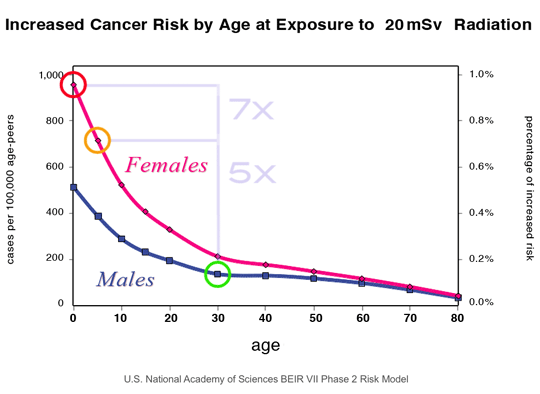
The vertical Y-axis is calibrated to the number of cancer cases per 100,000 age-peers, and the horizontal X-axis depicts the age of the population, beginning at zero years and moving towards old age. Now examine the allegedly safe dose of 20 millisieverts per year.
As a result of this exposure, there will be about 1000 additional cases of cancer in female infants and 500 cases of cancer in infant boys per 100,000 in their age groups. There will be an additional 100 cases of cancer in 30 year old males per 100,000 in this age peer group.
Notice that children, especially girls, are at the most risk from radiation-induced cancer. In fact a female infant has 7 times greater risk and a 5 year old girl has 5 times greater risk of getting a radiation-induced cancer than does a 30 year old man. Continue reading
The advance of solar energy about to disrupt fossil fuel industries
 Is renewable energy ready to disrupt fossil fuels? CNBC Leslie Shaffer | @LeslieShaffer1 18 Mar 15 Prices of fossil fuels may be plumbing multi-year lows, but that’s not likely to keep them from being displaced by the advance of renewable energy, especially solar, analysts said.
“Renewable energy technologies are far further advanced than many may believe: solar photovoltaic (PV) and on-shore wind have a track record of successful deployment, and costs have fallen dramatically in the past few years,” Alex Thursby, chief executive of the National Bank of Abu Dhabi (NBAD), said in a report published this month. “In many parts of the world, indeed, they are now competitive with hydrocarbon energy sources.”
Read MoreFive crazy things being powered by the sun
Over the past few years, more than 50 percent of new investment in electricity generation capacity has been from renewable sources, with around $260 billion a year invested in renewable-energy technology over the past five years, said the report, which was prepared for NBAD by the University of Cambridge and PwC.
The cost of solar PV is down more than 80 percent since 2008 and modern wind turbines produce around 15 times more electricity than in the 1990s, it said………
The development of cost efficient electricity-storage technology may be the missing link on wider adoption, Deutsche Bank said.
“Solar plus storage is the next killer app that could significantly accelerate global solar penetration,” it said, adding it expects “significant progress” on improving the cost within five years.
—By CNBC.Com’s Leslie Shaffer; Follow her on Twitter @LeslieShaffer1 http://www.cnbc.com/id/102510242
Very few parents aware of the danger to children from UV radiation
Although 85 % of Americans recognizing that UV rays can damage the eyes, only 65 % wear sunglasses as protection, and ensure even fewer report that their children wear sunglasses* forzest ranbaxy review .
To parents, carers and other help to understand better, the risks to take with UV irradiation to the eyes and UV exposure UV exposure, Healthy Women, the leading independent health information source for women, offers a free education to minimize resource, Fast Facts for your Health related: The Sun & your Eyes: What You Need to Know. It may take years before you can have a harmful effect of the sun on your eyes, but do some damage may occur on short notice, says Elizabeth Battaglino Cahill, Fast Facts Healthy Women. This latest in our series of Fast Facts for Your Health resources can help families understand the potential damage that UV can, can cause to their eyes and eyesight. It’s a quick read on the unexpected sources of UV radiation damage as well as simple, practical advice to reduce the risks of UV radiation. .
1 This Month
Chernobyl: The Lost Tapes – A good documentary on Chernobyl on SBS available On Demand for the next 3 weeks– https://www.sbs.com.au/ondemand/tv-program/chernobyl-the-lost-tapes/2352741955560

of the week–London Campaign for Nuclear Disarmament

Tell the Ukrainian Government to Drop Prosecution of Peace Activist Yurii Sheliazhenko
To see nuclear-related stories in greater depth and intensity – go to https://nuclearinformation.wordpress.com
-
Archives
- April 2026 (152)
- March 2026 (251)
- February 2026 (268)
- January 2026 (308)
- December 2025 (358)
- November 2025 (359)
- October 2025 (376)
- September 2025 (257)
- August 2025 (319)
- July 2025 (230)
- June 2025 (348)
- May 2025 (261)
-
Categories
- 1
- 1 NUCLEAR ISSUES
- business and costs
- climate change
- culture and arts
- ENERGY
- environment
- health
- history
- indigenous issues
- Legal
- marketing of nuclear
- media
- opposition to nuclear
- PERSONAL STORIES
- politics
- politics international
- Religion and ethics
- safety
- secrets,lies and civil liberties
- spinbuster
- technology
- Uranium
- wastes
- weapons and war
- Women
- 2 WORLD
- ACTION
- AFRICA
- Atrocities
- AUSTRALIA
- Christina's notes
- Christina's themes
- culture and arts
- Events
- Fuk 2022
- Fuk 2023
- Fukushima 2017
- Fukushima 2018
- fukushima 2019
- Fukushima 2020
- Fukushima 2021
- general
- global warming
- Humour (God we need it)
- Nuclear
- RARE EARTHS
- Reference
- resources – print
- Resources -audiovicual
- Weekly Newsletter
- World
- World Nuclear
- YouTube
-
RSS
Entries RSS
Comments RSS
 nuclear-news