Japan must face the problems and politics of demolishing dead nuclear reactors
 Questions remain over future plan for Japan’s aging nuclear plants Japan Times, 12 Mar 15 BY ERIC JOHNSTON As the debate about what to do with Japan’s aging nuclear reactors intensifies, questions remain about the ramifications of decommissioning plants, and how to tear down the facilities in a way that’s efficient, affordable, safe, and that has the support of the local community.
In the United Kingdom, these concerns formed the basis of a policy that has led to the decommission of numerous power stations, two of which began operating in the 1950s……
Seven of Japan’s 48 commercial reactors are at least 40 years old — in principle their maximum operating life. Another five are at least 35 years old and their fate will have to be decided within the next few years.
Kyushu Electric plans to decommission the 40-year-old Genkai No. 1 plant, while Kepco is expected to shut down the Mihama No. 1 and 2 reactors, both of which are over 40 years old. Chugoku Electric plans to decommission the 41-year-old Shimane No. 1 reactor, while the Tsuruga No. 1 reactor, which is 45 years old and run by Japan Atomic Power, will be closed.
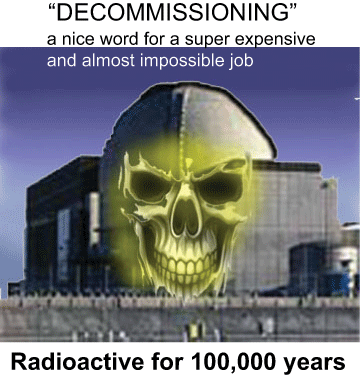
Decommissioning a plant is a decades-long process that does not necessarily immediately involve the most crucial step of tearing down the reactors and hauling away radioactive material.
“During the decommissioning of the Berkeley power station in southwest England, we’ve left the reactor building standing because it’s safer to remove the nuclear material in another 60 years,” Franklin said. “We’ve closed the doors on the reactor building until 2074.”
However, he acknowledged publicly visible gestures were important because they could help reassure local communities that the plant was actually being dismantled.
“A skyline change helps garner support for the decommissioning process and for difficult decisions, such as not tearing down and hauling away nuclear materials in reactor buildings,” he said.
“In one case, we destroyed the plant’s cooling towers, which were not actually a major hazard but could be seen for miles. If you live nearby and you see them come down, you feel progress is being made, and that’s more effective than simply telling people about the progress.”
Perhaps the biggest lesson the U.K. learned was that effective decommissioning starts with addressing the corporate and bureaucratic culture at a nuclear plant.
“Changing your culture from making something — electricity — to actually taking power stations down requires a huge cultural change on a nuclear site. That’s something we’re really working on sharing with Japanese nuclear operators,” Franklin said. http://www.japantimes.co.jp/news/2015/03/11/national/questions-remain-over-future-plan-for-japans-aging-nuclear-plants/#.VQH9CNKUcnk
No comments yet.
1 This Month



Tell the Ukrainian Government to Drop Prosecution of Peace Activist Yurii Sheliazhenko

Petition to revoke the licensing of the Near Surface Nuclear Disposal Facility (NSDF) at Chalk River. https://www.ourcommons.ca/petitions/en/Petition/Details?Petition=e-7247


of the week – STOP SMALL MODULAR REACTORS IN CANADA
To see nuclear-related stories in greater depth and intensity – go to https://nuclearinformation.wordpress.com
-
Archives
- March 2026 (222)
- February 2026 (268)
- January 2026 (308)
- December 2025 (358)
- November 2025 (359)
- October 2025 (376)
- September 2025 (258)
- August 2025 (319)
- July 2025 (230)
- June 2025 (348)
- May 2025 (261)
- April 2025 (305)
-
Categories
- 1
- 1 NUCLEAR ISSUES
- business and costs
- climate change
- culture and arts
- ENERGY
- environment
- health
- history
- indigenous issues
- Legal
- marketing of nuclear
- media
- opposition to nuclear
- PERSONAL STORIES
- politics
- politics international
- Religion and ethics
- safety
- secrets,lies and civil liberties
- spinbuster
- technology
- Uranium
- wastes
- weapons and war
- Women
- 2 WORLD
- ACTION
- AFRICA
- Atrocities
- AUSTRALIA
- Christina's notes
- Christina's themes
- culture and arts
- Events
- Fuk 2022
- Fuk 2023
- Fukushima 2017
- Fukushima 2018
- fukushima 2019
- Fukushima 2020
- Fukushima 2021
- general
- global warming
- Humour (God we need it)
- Nuclear
- RARE EARTHS
- Reference
- resources – print
- Resources -audiovicual
- Weekly Newsletter
- World
- World Nuclear
- YouTube
-
RSS
Entries RSS
Comments RSS
 nuclear-news
Leave a comment