Nuclear wastes out of control? Fukushima’s bags of radioactive trash pile up
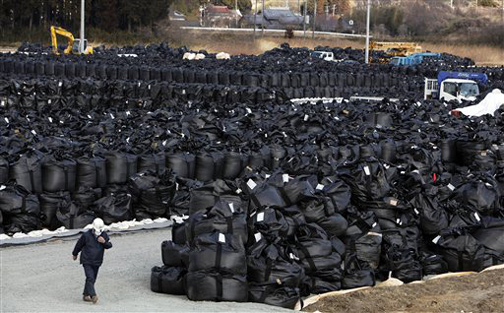
The fruits of the laborers’ efforts are stacked in those giant sacks—5.5 million of them and counting. They are spread out across Fukushima province, along roadsides, in parking lots and backyards. They are tagged and bar-coded so authorities know what’s inside and how radioactive it is – and when the bags might start to wear out.
As the bags pile up and workers fan out across the landscape, some locals are questioning the cost-benefit analysis.
Fukushima nuclear plant cleanup has cost $13 billion and counting After 4 years, Fukushima nuclear cleanup remains daunting, vast LA Times, By JULIE MAKINEN contact the reporter 12 Mar 15 “…..Karimata is in charge of the work here in an evacuation zone about 12 miles north of the Fukushima Dai-ichi nuclear plant—part of the most extensive, and expensive, nuclear cleanup ever attempted.
The scale and complexity of what Japan is trying to do in the aftermath of the 2011 meltdown at Fukushima is mind-boggling. Decontamination plans are being executed for 105 cities, towns and villages affected by the accident at Fukusima Dai-ichi, 140 miles northeast of Tokyo.
Many Japanese regard this massive undertaking as a solemn obligation to right a terrible wrong. Others, even some of the people directly affected, question whether it’s a quixotic waste of resources.
Karimata’s delegation marches up a side street to check on a brigade of laborers wearing gloves, masks, helmets and fluorescent vests with radiation detectors tucked in their chest pockets. Some are spreading fresh soil in the yard of an uninhabited home. Next door, workers are up on a scaffold, preparing to wipe down the roof and gutters.
Across the street, near a bamboo grove, two men are erecting a plastic frame to support a massive double-lined garbage bag about the size of a hot tub. Dozens of identical black sacks, each weighing about a ton and stuffed with radiation-contaminated soil, leaves, wood chippings and other debris, stretch out behind them, awaiting transport at some uncertain date to a yet-unspecified final resting place.
Four years after the Great Tohoku Earthquake shook northern Japan to its core, touched off a deadly tsunami and precipitated the Fukushima Dai-ichi disaster, hundreds of square miles remain off-limits for habitation due to radioactivity. Some 79,000 people still cannot return home.
But unlike the 1986 accident at Chernobyl, where authorities simply declared a 1,000 square-mile no-habitation zone, resettled 350,000 people and essentially decided to let the radiation dissipate over decades or centuries, Japan is attempting to make the Fukushima region livable again. It is an unprecedented effort.
The sheer manpower and money dedicated to the house-to-house effort is staggering: Continue reading
Japanese public to bear the costs of scrapping 5 old nuclear reactors

 Five ageing nuclear reactors to be scrapped in Japan Sun Daily, 12 March 2015 -TOKYO: Japanese power companies are expected to announce the decommissioning of five ageing nuclear reactors next week, local media reported Thursday.
Four operators – Kansai Electric Power Co, Japan Atomic Power Co, Chugoku Electric Power Co and Kyushu Electric Power Co – will decide on Wednesday to scrap the reactors, which went into service in the 1970s, Kyodo News agency reported without citing any sources.
The operators will avoid the cost of beefing up safety measures to meet higher standards following Japan’s worst nuclear accident in Fukushima prefecture in 2011, Kyodo said.
The Industry Ministry said in January that the cost of decommissioning reactors, which can run to hundreds of millions of dollars and take decades until the property is ready for other uses, should be met by the general public……..http://www.thesundaily.my/news/1353191
Prolonged exposure to radiation is taking health toll on Fukushima’s kids
 TV: Officials lying, many more kids getting cancer after Fukushima — Report: 1,200+ deaths from “illness caused by prolonged exposure” — Mom: “I’m really worried… children not the same… sick… nosebleeds, rashes.. white blood cells decreased” — Radiation by school 100 times normal (VIDEO) http://enenews.com/tv-fukushima-residents-govt-lying-im-really-worried-many-children-same-sick-nosebleeds-rashes-incredible-fatigue-white-blood-cells-decreased-radiation-levels-school-100-times-normal-video?utm_source=feedburner&utm_medium=email&utm_campaign=Feed%3A+ENENews+%28Energy+News%29
ABC (Australia), Mar 11, 2014 (emphasis added): Radiation levels posing cancer risks… Before the disaster, there was just one to two cases of thyroid cancers in a million Japanese children but now Fukushima has more than 100 confirmed or suspected cases, having tested about 300,000 children… It is expected that thyroid cancers could turn up about four to five years after a nuclear disaster… [Megumi] Muto said her daughter and son, like many other children, had not been the same since experiencing the Fukushima fallout. “They had rashes on their bodies then nose bleeds. My son’s white cells have decreased and they both haveincredible fatigue… both have multiple nodulesaround their thyroids. I’m really worried.”… Mutowanted to move her family out of Fukushima city but she said she could not afford to.
News 24 (SAPA), Mar 10, 2015: A total of 1232 deaths in Japan’s Fukushima prefecture over the past year were linked to the nuclear accidentfour years ago, up 18% from a year earlier, a news report said on Tuesday. A death is considered nuclear-related if is not directly resulting from a nuclear accident but is due from an illness caused by prolonged exposure. Namie town, close to the Fukushima Daiichi Nuclear Power Station, had the largest number of deaths at 359, followed by 291 in Tomioka town, which is also near the complex, the Tokyo Shimbun reported.
ABC (Australia) video transcript, Mar 11, 2014:
- Headline: Fukushima residents have taken cancer and radiation testing into their own hands, saying authorities are lying to them about the safety of their community.
- Matthew Carney, ABC correspondent: It’s a heartbreaking time for Megumi Muto. Her daughter is being tested to see if the lumps in her thyroid gland have grown… Megumi isconvinced exposure to high radiation levels after the Fukushima nuclear meltdowns is the cause.
- Megumi Muto, Fukushima mother (translated): I feel angry. I think the authorities hide the real dangers, and now many more children are being diagnosed.
- Carney: Many residents in Fukushima don’t trust the government or TEPCO.
- Muto: Since the disaster my kids have been sick with nosebleeds, rashes and lethargy. Fukushima used to be a safe… area, but not now.
ABC (Australia) audio transcript, Mar 11, 2014:
- Michael Brissenden, ABC: the issue of long term health implications like cancer are causing the greatest concern and controversy in Japan…
- Matthew Carney, ABC correspondent: [Fukushima residents say the local and central] governments failed to protect the children. And they do not trust what the government or TEPCO… are telling them about radiation levels and safety. They’re conducting their own radiation tests and near this school in Fukushima City, the monitor reads 3 mircosieverts an hour. That’s about 100 times the rate of Tokyo.
- Sumio Kunno, nuclear plant engineer: I have to investigate and inform the public of the facts… They’re still not decontaminating areas where children live or play.
Nuclear blackmail – South Korean computer hacker demands money

 Hacker demands money to withhold information on S. Korean nuclear reactors Korea Times, SEJONG, March 12 (Yonhap) — A hacker who had posted inside information on South Korea’s nuclear power plants made a fresh threat Thursday, demanding money in exchange for not handing over sensitive information to third countries.
Using an account under the name of the president of an anti-nuclear group in Hawaii, the hacker posted additional files on Twitter, which reportedly included documents concerning the country’s indigenous advanced power reactor 1400.
“Need money. Only need to meet some demands… Many countries from Northern Europe, Southeast Asia and South America are saying they will buy nuclear reactor information. Fear selling the entire information will undermine President Park (Geun-hye)’s efforts to export nuclear reactors,” the posting said.
The hacker did not say how much money he wanted but warned that South Korea will end up losing much more if it tries to save a few hundreds of millions of dollars…….The latest posting marked the sixth of its kind since Dec. 15…….
In the latest posting, the hacker “congratulated” the KHNP for finding 7,000 viruses but claimed 9,000 more were awaiting his or her order.
The information released Thursday reportedly included the transcript of a telephone conversation between President Park and the U.N. chief, Ban Ki-moon, on Jan. 1. http://www.koreatimesus.com/hacker-demands-money-to-withhold-information-on-s-korean-nuclear-reactors/
Nuclear power plants have no place in a modern Japan
Those who created the Fukushima Daiichi nuclear catastrophe know that their nuclear power plants have no place in a modern Japan. And they are fighting as hard as they can to stop clean energy progress and shore up their dirty-energy-based profits.
But, for the people of Japan, a majority of whom oppose any nuclear restart, there are massive opportunities on the horizon for a truly safe and clean future. And we, at Greenpeace, will stand with them – against the onslaught of the nuclear village – to ensure that the clean, renewable energy future becomes a reality.

A lesson from Fukushima: A safe, clean energy future will be nuclear-free, Greenpeace Kendra Ulrich – 11 March, 2015
“……Relying on nuclear to fulfill Japan’s climate obligations is betting the future of the planet and generations of people to come on a politician’s fantasy.
And, how “safe” and “clean” is this energy source, really? If we believe the nuke huggers, it is very safe – one catastrophic accident occurs only once every 250 years, they say.
However, it doesn’t take a nuclear scientist to tell you we’ve experienced a few more major accidents than that in the 70 years of nuclear programs, including the disaster at the Fukushima Daiichi power plant — with 3 reactors at the site experiencing core meltdowns; the catastrophic meltdown at Chernobyl; and the partial meltdowns at the Three Mile Island and Fermi 1 nuclear power plants in the US – just to name a few.
A logical person would look at this evidence, as well as the industry’s track record, and either revise their opinion or revise their prediction models. Probably both are in order.
Unfortunately, the industry, and many regulators, have continued to toe the “safety” line – while at the same time weakening reactor safety standards so that aging reactors can meet them. And the aging nuclear fleet in many parts of the world results in increased safety risks, as components degrade with time and wear.
If we are to discuss “safety” within the context of nuclear, it’s also important to broaden our perspective beyond a narrow focus on solely catastrophic accident risks at operating nuclear reactors, to major environmental and public safety risks imposed by the entire nuclear cycle. Continue reading
U.S. news media coverage of the Fukushima disaster largely minimized health risks to the general population.
 News coverage of Fukushima disaster minimized health risks to general population http://www.sciencedaily.com/releases/2015/03/150311124202.htm March 11, 2015 Source: American University
A new analysis by American University sociology professor Celine Marie Pascale finds that U.S. news media coverage of the disaster largely minimized health risks to the general population. Pascale analyzed more than 2,000 news articles from four major U.S. outlets following the disaster’s occurrence March 11, 2011 through the second anniversary on March 11, 2013. Only 6 percent of the coverage — 129 articles — focused on health risks to the public in Japan or elsewhere. Human risks were framed, instead, in terms of workers in the disabled nuclear plant.
Disproportionate access
“It’s shocking to see how few articles discussed risk to the general population, and when they did, they typically characterized risk as low,” said Pascale, who studies the social construction of risk and meanings of risk in the 21st century. “We see articles in prestigious news outlets claiming that radioactivity from cosmic rays and rocks is more dangerous than the radiation emanating from the collapsing Fukushima Daiichi nuclear plant.”
Pascale studied news articles, editorials, and letters from two newspapers, The Washington Post and The New York Times, and two nationally prominent online news sites, Politico and The Huffington Post. These four media outlets are not only among the most prominent in the United States, they are also among the most cited by television news and talk shows, by other newspapers and blogs and are often taken up in social media, Pascale said. In this sense, she added, understanding how risk is constructed in media gives insight into how national concerns and conversations get framed.
Pascale’s analysis identified three primary ways in which the news outlets minimized the risk posed by radioactive contamination to the general population. Articles made comparisons to mundane, low-level forms of radiation;defined the risks as unknowable, given the lack of long-term studies; and largely excluded concerns expressed by experts and residents who challenged the dominant narrative.
The research shows that corporations and government agencies had disproportionate access to framing the event in the media, Pascale says. Even years after the disaster, government and corporate spokespersons constituted the majority of voices published. News accounts about local impact — for example, parents organizing to protect their children from radiation in school lunches — were also scarce.
Globalization of risk
Pascale says her findings show the need for the public to be critical consumers of news; expert knowledge can be used to create misinformation and uncertainty — especially in the information vacuums that arise during disasters.
“The mainstream media — in print and online — did little to report on health risks to the general population or to challenge the narratives of public officials and their experts,” Pascale said. “Discourses of the risks surrounding disasters are political struggles to control the presence and meaning of events and their consequences. How knowledge about disasters is reported can have more to do with relations of power than it does with the material consequences to people’s lives.”
While it is clear that the Fukushima Daiichi nuclear meltdown was a consequence of an earthquake and tsunami, like all disasters, it was also the result of political, economic and social choices that created or exacerbated broad-scale risks. In the 21st century, there’s an increasing “globalization of risk,” Pascale argues. Major disasters have potentially large-scale and long-term consequences for people, environments, and economies.
“People’s understanding of disasters will continue to be constructed by media. How media members frame the presence of risk and the nature of disaster matters,” she said.
Story Source:
The above story is based on materials provided by American University. The original article was written by Rebecca Basu. Note: Materials may be edited for content and length.
France’s nuclear company AREVA – too big to fail?
 France’s nuclear love affair too strong to let Areva fail http://uk.reuters.com/article/2015/03/11/uk-france-nuclear-areva-idUKKBN0M71FF20150311 BY MICHEL ROSE AND GEERT DE CLERCQ PARIS (Reuters) – The future of France‘s nuclear industry has never looked bleaker, with a government pledging to wean the country off atomic power, cut-throat rivalry in world export markets and the debt of flagship nuclear group Areva in junk territory.
But even with a painful overhaul and lean years ahead for the nuclear sector, the fuel which after World War Two powered France’s rise to the Group of Seven nations remains the bedrock of its energy independence and is so strategically vital that Paris will not let Areva (AREVA.PA) fail.
That is the premise underpinning a new industrial strategy due to be announced by Areva and domestic utility EDF (EDF.PA) in coming months, while President Francois Hollande is softening his resolve to reduce the share of nuclear in France’s electricity mix.
“Neither the government nor EDF can afford to let Areva die,” said former Areva executive Bertrand Barre, who noted that U.S. nuclear giant Westinghouse suffered a 30-year order drought but survived – albeit as part of Japan‘s Toshiba. (6502.T)
Areva’s record 4.83 billion euro (3.4 billion pounds) 2014 loss underlined the troubles of a group which since its 2001 creation never managed to become a world leader in nuclear newbuild.
Over the last few years a series of shockwaves have jolted the case for nuclear: the 2011 Fukushima disaster; Germany‘s exit from nuclear; rising renewable energy output; and the U.S. shale gas revolution.
Already weakened by billions of euros lost on a fixed-price, turnkey reactor project in Finland and an African uranium mine, Areva had limited reserves to ride out the storm.
Hollande has charged Areva’s new management team, led by Philippe Varin, to work with EDF to come up with a new industrial and financial strategy by end July.
Details are scarce so far, but industry sources agree that one likely outcome is a deeper involvement of EDF, possibly a capital stake, in Areva’s reactor business and a possible sale of part of its uranium mines to Chinese investors.
Economy Minister Emmanuel Macron told Reuters on Monday the two firms could forge an industrial alliance and that EDF may consider a capital investment in Areva’s reactor business.
ROYAL “TURNAROUND”
At the same time, there has been a toning down of Hollande’s campaign promise to cut the share of nuclear power in France’s electricity generation from 75 percent to 50 percent by 2025.
“We never said we wanted to exit nuclear energy altogether. We want to exit the previous all-nuclear policy,” Energy Minister Segolene Royal said in January.
Despite repeated questions, including from Reuters, Royal has refused to commit to Hollande’s 2025 target, made during his election campaign, and has come out in support of building new nuclear plants to replace older ones, the first time for a member of this government.
It remains to be seen whether the target will survive Royal’s energy transition bill, which is currently going through parliament, but analysts notice a subtle shift.
Montpellier University professor Jacques Percebois said France realises that if it wants to sell reactors abroad, it needs to be careful about how it winds down nuclear at home.
“That is what is behind the turnaround that we are seeing now – including from Segolene Royal,” he said.
That turnaround would come at a political cost to Hollande, whom ecologists will accuse of breaking his promises. But with the Ukraine crisis pushing security of supply to the fore,France – which gets just 15 percent of its gas from Russia – suddenly feels quite comfortable about nuclear.
Even if it were to reach its 2025 target, France is so deep into nuclear that it is unlikely to want to spend much on German wind turbines or Chinese solar panels and will focus on saving the 220,000 jobs in its nuclear industry.
Half of EDF’s 58 reactors will reach their designed age limit of 40 years in the 2020s and the utility has estimated it will cost about 300 billion euros to modernise its fleet and replace it with new reactors from 2030 onwards.
AREVA’S FUTURE
This is a potential windfall for Areva, which will work on extending the lifespan of EDF’s nuclear fleet while it waits for France to start building new reactors again.
When it finishes the sole reactor it is building in France, Areva is expected to get a significant part of EDF’s 55 billion euro budget to extend the lifespan of its reactors.
It can also make money from countries getting out of nuclear altogether.
In Europe, where dozens of reactors will be dismantled in Germany, Britain, Belgium and other countries in the next decade, Areva is a top player in nuclear decommissioning, which already generates 500 million of its 8.3 billion euro revenue.
“Areva is well placed, as it is one of the few players with experience in decommissioning various types of nuclear installations, including reactors,” an Areva spokeswoman said.
The company has built nearly 100 reactors around the world, in France, Belgium, Germany, Switzerland, Spain and China and is servicing more than 250 of the 440 operating reactors worldwide.
More than half of these reactors are over 30 years old and 73 are more than 40 years old, IAEA data show.
“It’s a future engine of growth, even if it’s not revving up yet” said Jean-Marie Chevalier, a energy economics professor at Dauphine University in Paris.
(Editing by Mark John and Anna Willard)
Japan’s manufacturing industries have adjusted, and thrive, without nuclear power
Life without nukes: Japan Inc thrives, CNBC 12 Mar 15 Mia Tahara-Stubbs Tuesday, 10 Mar 2015 Japan’s economy is thriving despite the four-year shutdown of the country’s nuclear power stations following the massive earthquake and tsunami in March 2011, analysts say……..“Japanese manufacturers have adapted to the 30 percent electricity price increase by cutting back on energy consumption,” said Japan Research Institute (JRI) chief researcher Takumi Fujinami. “Higher prices haven’t had much of an effect on manufacturers’ bottom lines because electricity represents only around 5 percent of raw material costs.”
Toyota, for example, which generates around a fifth of sales from the two million cars it makes in Japan every year, is forecast to post a 15 percent on-year jump in operating profit to 2.78 trillion yen ($22.9 billion) this fiscal year – its second straight year of record profits.
Still, Fujinami noted that manufacturers need to plan for higher energy costs going forward.
“The days of cheaper electricity are over and probably won’t be coming back,” he said. “It’s time for the Japanese economy to make the transition to a less industrial, more service sector-oriented economy.”…….
Ahead of December’s snap elections, Japan’s big business lobby Keidanren called on Prime Minister Shinzo Abe’s government to “provide the general public with a lucid explanation of the necessity of nuclear power” in order to “accelerate the process for restarting nuclear power plants,” according to a policy proposal published in October.
Abe has responded to business demands, pledging to begin putting nuclear reactors back online without setting any firm dates, but public sentiment remains a hurdle.
Fifty-six percent of respondents in a nationwide Nikkei newspaper poll conducted in August were opposed restarting the reactors, in line with other regional polls.
“The fact that there is still not a single reactor running in the country, in spite of the strong desire of the political and economic elites to bring back nuclear energy, attests to the continuous obstacles public opinion presents,” said Sophia University professor of politics Koichi Nakano.
Voters remain worried because the Fukushima plant does not appear to be “under control.”
Tokyo Electric Power Company – the operator of the Fukushima Daiichi nuclear plant – confirmed those fears last month, admitting that highly radioactive material has been seeping into the sea for nearly a year.
“Fukushima is obviously not under control and it’s out of the question that other reactors are restarted before it is,” said Coalition Against Nukes representative and National Confederation of Trade Union executive committee member Kenichi Igarashi……..http://www.cnbc.com/id/102494249#.
Four years later – all Japan’s nuclear reactors remain closed
“Some people will suffer a great deal if the nuclear power plants are not restarted. And those people are extremely influential in the corridors of power, and Prime Minister Abe is their man,”
Japan’s Nuclear Reactors Remain Offline 4 Years After Fukushima Meltdown VOA, Brian Padden March 11, 2015 SEOUL— In Japan thousands of people are still homeless and all of the nation’s nuclear reactors are still offline, four years after a magnitude 9.0 earthquake and tsunami caused the world’s worst nuclear disaster since Chernobyl. Japanese Prime Minister Shinzo Abe has promised a five-year reconstruction plan for the areas still devastated by the disaster, but he remains a nuclear energy advocate despite strong public opposition.
More than 120,000 residents who lived within 20 kilometers of Japan’s Daiichi Nuclear Power Plant in Fukushima were evacuated in March of 2011 after the damaged nuclear plant started leaking radiation.
These nuclear refugees still cannot return home because of high radiation levels, and they still worry about suffering from long-term health implications like cancer due to the radiation exposure.
Professor Jeff Kingston, the director of Asian Studies at Temple University Japan, said they have come to symbolize the danger of nuclear power.
“These people all understand very well about the myth of safety that the government and utilities have propagated over preceding decades,” said Kingston.
Prime Minister Abe vowed this week to come up with a new-five year plan to rebuild the Pacific coastal region that was ravaged by the tsunami. The government has reportedly already spent $50 billion in the hardest hit areas.
Japan has allocated more than $15 billion for a project to lower radiation in towns near the plant where radioactive trash is being kept in 88,000 temporary storage facilities.
Tokyo also plans to build a more permanent nuclear storage facility near the plant, despite opposition from some residents.
After the Fukushima disaster, all of Japan’s 48 nuclear reactors were shut down. They remain closed because of safety concerns and because opinion polls indicate more than 60 percent of the public now oppose nuclear energy.
Yet Abe, who recently won re-election by a wide margin, remains a nuclear power supporter. Professor Kingston said the prime minister’s unpopular stand was somewhat calculated in that it garnered him the support of business leaders with vested interests in the nuclear industry.
“Some people will suffer a great deal if the nuclear power plants are not restarted. And those people are extremely influential in the corridors of power, and Prime Minister Abe is their man,” said Kingston…….http://www.voanews.com/content/japan-observes-anniversary-of-earthquake-tsunami-disaster/2675471.html
Japan must face the problems and politics of demolishing dead nuclear reactors
 Questions remain over future plan for Japan’s aging nuclear plants Japan Times, 12 Mar 15 BY ERIC JOHNSTON As the debate about what to do with Japan’s aging nuclear reactors intensifies, questions remain about the ramifications of decommissioning plants, and how to tear down the facilities in a way that’s efficient, affordable, safe, and that has the support of the local community.
In the United Kingdom, these concerns formed the basis of a policy that has led to the decommission of numerous power stations, two of which began operating in the 1950s……
Seven of Japan’s 48 commercial reactors are at least 40 years old — in principle their maximum operating life. Another five are at least 35 years old and their fate will have to be decided within the next few years.
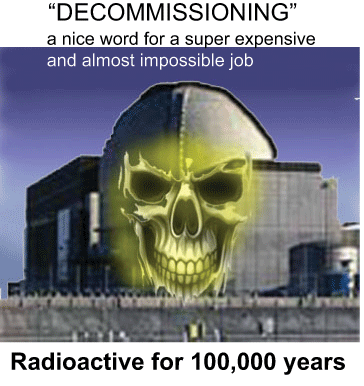
Kyushu Electric plans to decommission the 40-year-old Genkai No. 1 plant, while Kepco is expected to shut down the Mihama No. 1 and 2 reactors, both of which are over 40 years old. Chugoku Electric plans to decommission the 41-year-old Shimane No. 1 reactor, while the Tsuruga No. 1 reactor, which is 45 years old and run by Japan Atomic Power, will be closed.
Decommissioning a plant is a decades-long process that does not necessarily immediately involve the most crucial step of tearing down the reactors and hauling away radioactive material.
“During the decommissioning of the Berkeley power station in southwest England, we’ve left the reactor building standing because it’s safer to remove the nuclear material in another 60 years,” Franklin said. “We’ve closed the doors on the reactor building until 2074.”
However, he acknowledged publicly visible gestures were important because they could help reassure local communities that the plant was actually being dismantled.
“A skyline change helps garner support for the decommissioning process and for difficult decisions, such as not tearing down and hauling away nuclear materials in reactor buildings,” he said.
“In one case, we destroyed the plant’s cooling towers, which were not actually a major hazard but could be seen for miles. If you live nearby and you see them come down, you feel progress is being made, and that’s more effective than simply telling people about the progress.”
Perhaps the biggest lesson the U.K. learned was that effective decommissioning starts with addressing the corporate and bureaucratic culture at a nuclear plant.
“Changing your culture from making something — electricity — to actually taking power stations down requires a huge cultural change on a nuclear site. That’s something we’re really working on sharing with Japanese nuclear operators,” Franklin said. http://www.japantimes.co.jp/news/2015/03/11/national/questions-remain-over-future-plan-for-japans-aging-nuclear-plants/#.VQH9CNKUcnk
Pro nuclear signs to be removed from deserted town of Futaba
Deserted Fukushima town to remove pro-nuclear signs 7 News, Tokyo (AFP) 10 Mar 15 – A Japanese town that was evacuated after the 2011 Fukushima nuclear disaster has decided to remove street signs trumpeting the benefits of atomic power, an official said Tuesday.Deserted Futaba town, which plays host to the crippled Fukushima Dai-ichi nuclear power plant, is set to earmark cash to remove huge signboards erected in 1988 and 1991, a town official told AFP.
“Nuclear power: the energy for a bright future,” says one sign written in the style of a haiku poem at the entrance to the town. “Nuclear power: for development of our homeland, a prosperous future,” reads the other.
Futaba’s 6,300 residents were ordered to flee their homes in the days after reactors began melting down at Fukushima when an enormous tsunami swamped their cooling systems.
They are still unable to return because of fears over elevated levels of radiation that leaked from the plant, and many remain in poorly-constructed temporary homes…….
0,000 people remain displaced because of the no-go zone around the plant.
Scientists warn that it may be many years until it is safe to return and say that some areas may have to be abandoned forever.
Campaign groups say unemployment is high and levels of depression and other illness are far above normal in displaced communities. https://au.news.yahoo.com/world/a/26585240/deserted-fukushima-town-to-remove-pro-nuclear-signs/
A safe, clean energy future will be nuclear-free
A lesson from Fukushima: A safe, clean energy future will be nuclear-free, Greenpeace Kendra Ulrich – 11 March, 2015 Today, the 11th of March 2015, marks the fourth year since beginning of one of the world’s worst nuclear disasters: the triple reactor core meltdowns and catastrophic containment building failures at the Fukushima Daiichi nuclear power plant. It’s a nuclear crisis that, unfortunately, continues to unfold.
The widespread environmental contamination largely remains. Decontamination efforts are, many times, missing the government’s targets. Massive amounts of highly radioactive water flow into the ocean from the reactor site every day. The location of molten reactor cores in Units 1-3 remains unknown – which is a problem that requires massive amounts of cooling water every day to minimize the risk of another major radiation release.
In spite of these ongoing problems and the fact that many of the over 120,000 displaced nuclear refugees are still living in difficult evacuation conditions four years later, the Abe government in Japan is pushing to restart the country’s idled nuclear fleet.
Prime Minister Abe has been touting nuclear as a necessary part of the energy mix, needed for the country to meet its climate commitments. In reality though, it is highly unlikely that Japan will ever reach the 15-20% nuclear electricity targets that have been currently floated by a special task force of the Ministry of Economy, Trade, and Environment………….http://www.greenpeace.org/international/en/news/Blogs/nuclear-reaction/ZeroNuclear-Fukushima/blog/52296/
Film “Merchants of Doubt” under attack from climate sceptics
But behind the scenes, Fred Singer has lobbied fellow climate deniers to try to block the film, Merchants of Doubt, and raised the prospect of legal action against the filmmaker.
“It’s exactly what we talk about in the film. It’s a product of a playbook which is to go after the messengers and attack and try and change the conversation, and try to intimidate, and it is very effective,” said Robert Kenner, the filmmaker.
Since the film’s release, Kenner, and Naomi Oreskes, a Harvard professor and co-author of the book on which the documentary is based, have come under attack in climate denier blogs, and in email chains.
The backlash appears to have been initiated by Singer, 90, a Princeton-trained physicist who has a cameo in the film……http://www.theguardian.com/environment/2015/mar/11/climate-sceptics-attempt-to-block-merchants-of-doubt-film
USA kids educating Republican Senators on climate change
 A Bunch of 12-Year-Olds Are Schooling Republican Senators on Climate Change http://www.newrepublic.com/article/121257/poll-90-percent-12-year-olds-accept-climate-changeA group of kids hope to teach Republicans politicians a lesson about climate change on Tuesday. In an event organized by the advocacy group Avaaz, they will visit a dozen offices to ask senators—including Mitch McConnell, Marco Rubio, Ted Cruz, Rand Paul—to take a simple elementary school quiz on climate change science. Many of those senators would probably fail it. In the past, in response to questions about climate change, McConnell and Rubio have both told the press they are “not scientists.”
The senators could learn something from the six students, who come from Georgia, Florida, Nebraska, and North Carolina. “When our world’s top scientists at NASA release information stating that humans are impacting the climate, I tend to believe them more,” said Jack Levy, an 18-year-old student from Ft. Lauderdale, Florida. “Scientists have noticed that this was a problem for a really long time, like, maybe 20 years ago? Longer than I’ve been alive,” said Nadia Sheppard, a 16-year-old from North Carolina.
Or, the lawmakers could turn to practically any 12-year-old for an explanation. Avaaz, which helped organize the People’s Climate March in New York City last September, commissioned a poll from Ipsos on how 12-year-olds view climate change. Out of 1,002 eighth-grade students surveyed, 90 percent responded that climate change is real and it’s “significantly” driven by human activity.
The Senate voted in January on a series of amendments over whether climate change is real and driven by human activity. Only 50 percent voted to approve a Democratic amendment asserting that climate change is real and is significantly caused by human activity, a number that rose to 59 percent for a similar amendment that dropped the word “significantly.”
VIDEO: Nuclear refugees
VIDEO: Nuclear refugees http://www.dw.de/nuclear-refugees/av-18309870 This week Japan marked four years since a tsunami caused a nuclear disaster at Fukushima. The magnitude 9 earthquake which struck northeast Japan in March 2011 caused a humanitarian crisis and left thousands dead. But four years on, “nuclear refugees” from the surrounding villages are still living in temporary accommodation.
1 This Month



Tell the Ukrainian Government to Drop Prosecution of Peace Activist Yurii Sheliazhenko

Petition to revoke the licensing of the Near Surface Nuclear Disposal Facility (NSDF) at Chalk River. https://www.ourcommons.ca/petitions/en/Petition/Details?Petition=e-7247


of the week – STOP SMALL MODULAR REACTORS IN CANADA
To see nuclear-related stories in greater depth and intensity – go to https://nuclearinformation.wordpress.com
-
Archives
- March 2026 (222)
- February 2026 (268)
- January 2026 (308)
- December 2025 (358)
- November 2025 (359)
- October 2025 (376)
- September 2025 (258)
- August 2025 (319)
- July 2025 (230)
- June 2025 (348)
- May 2025 (261)
- April 2025 (305)
-
Categories
- 1
- 1 NUCLEAR ISSUES
- business and costs
- climate change
- culture and arts
- ENERGY
- environment
- health
- history
- indigenous issues
- Legal
- marketing of nuclear
- media
- opposition to nuclear
- PERSONAL STORIES
- politics
- politics international
- Religion and ethics
- safety
- secrets,lies and civil liberties
- spinbuster
- technology
- Uranium
- wastes
- weapons and war
- Women
- 2 WORLD
- ACTION
- AFRICA
- Atrocities
- AUSTRALIA
- Christina's notes
- Christina's themes
- culture and arts
- Events
- Fuk 2022
- Fuk 2023
- Fukushima 2017
- Fukushima 2018
- fukushima 2019
- Fukushima 2020
- Fukushima 2021
- general
- global warming
- Humour (God we need it)
- Nuclear
- RARE EARTHS
- Reference
- resources – print
- Resources -audiovicual
- Weekly Newsletter
- World
- World Nuclear
- YouTube
-
RSS
Entries RSS
Comments RSS
 nuclear-news