Time for an independent criminal investigation of radiation tragedies – Fukushima, Hanford and beyond
 Fukushima victims speak. Will anyone listen? Four years later, Japanese police and prosecutors have yet to conduct a thorough investigation March 11, 2015 Aljazeera by Trisha Pritikin @TrishaPritikin“…………..a public accounting of the tragedy is just as urgent not only to Fukushima victims but also to the disenfranchised victims of radiation exposure around the world.
Seeking accountability
I feel a personal connection to the downwind victims of Fukushima. I, too, have felt disempowered and invisible, longing to see those responsible for my radiation-induced health damage to finally be brought to justice. Just as Fukushima’s children could have been protected from thyroid cancer, thousands of people, including me, were exposed to radiation discharged decades ago from the (still leaking) Hanford nuclear weapon production facility near my childhood home in Richland, Washington. As in Richland, the children of Fukushima were not given potassium iodide tablets to block the uptake by our developing thyroid glands of radioiodine in contaminated milk and food — a simple protective measure understood since the dawn of the atomic age. Both Hanford and Fukushima communities put their trust in authorities who violated that trust and put their lives in danger.
I don’t want to see anyone else’s lives destroyed by radiation and nuclear catastrophes. A criminal investigation of Fukushima sets a precedent for governments and corporations around the world, declaring, “You are responsible for nuclear safety.”
Any nuclear disaster can have global health implications. This was demonstrated in reports of health damage across Europe after the Chernobyl nuclear disaster in Ukraine in 1986 and now in suspected damage to the marine ecosystem after Fukushima Daiichi, where 300 tons of radiation-contaminated water pours into the Pacific Ocean daily………
Victims speak
To bring global attention to their cause, in April 2015, Fukushima victims will publish an English translation of select statements from their complaint as a book, available to the English-speaking world, “Will You Still Say No Crime Was Committed?” Their goal, according to Ruiko Muto, the chairwoman of the Complainants for Criminal Prosecution of the Fukushima Nuclear Disaster, is to let the world “know that the Fukushima nuclear disaster has not been brought under control, that it continues to spread harm and that the nation of Japan is choosing to abandon the victims.”
The book’s personal stories are compelling. Their statements offer a rare glimpse into their deep sense of betrayal. They tell of mortgages still being paid on contaminated homes that they can never inhabit. Livelihoods have been lost, families torn apart. They are under constant stress, uncertain whether the food they are eating or the air that they breathe is poisoned, unable to trust the authorities to tell them the truth.
“With no one taking responsibility for the nuclear accident, what we have is a situation of paradise for the perpetrators, hell for the victims. I cannot go to my grave like this,” says complainant No. 48, age 68.
Through the English-language publication of their stories, grief-stricken Fukushima victims are now asking the English-speaking world to join in their battle for justice. These innocent victims of Fukushima Daiichi have reached across the Pacific to raise awareness and obtain our help.
Let’s add our voices to theirs.
Trisha Pritikin is a Hanford Downwinder, an attorney and an internationally recognized advocate on behalf of populations exposed to Hanford’s radiation releases. She blogs at www.trishapritikin.com. http://america.aljazeera.com/opinions/2015/3/fukushima-victims-speak-will-anyone-listen.html
Hinkley Nuclear Power Plant – Game Over?

 Hinkley Point: the Beginning of the End, Jonathon Porritt, 11 Mar 15 I’ve always said that the two proposed new reactors at Hinkley Point would never get built. Now I’m not just saying it: I’m absolutely convinced that they’ll never get built.
A couple of weeks ago, EdF formally confirmed that no decision would be taken on Hinkley Point before the General Election, and probably not before the end of the year. The reason it gave was that: “We are in the final phase of negotiations, but that phase can take a considerable amount of time, depending on the number of problems left to resolve.”
And that list of problems is daunting. First, it needs to be able to sign final deals with co-investors, including the Chinese, who are beginning to cut up rough; then it needs final confirmation from the European Commission and the UK Government for a whole load of issues regarding the waste transfer contract; it needs to finalise a £10bn loan guarantee from the Treasury; and, despite months of discussions, it needs to conclude negotiations with the UK Government regarding the subsidy contract.

You’ll notice that this list does not include any delays that may be caused by the Austrian Government challenging the EU’s decision to approve as ‘legal’ (within the EU’s state aid rules) the billions of pounds of subsidy that the UK Government will pump into the project. EdF doesn’t talk about that, as it still hopes that the Austrians will be ‘persuaded’ by the UK Government to withdraw its challenge.
And the UK Government is certainly intent on doing exactly that. Over the last few months, details have been trickling out about the retaliatory measures UK Ministers are now threatening in a demonstration of state bullying that beggars belief. A leaked memo showed UK ministers asserting that “the UK will take every opportunity to sue or damage Austria in the future.”
Which shows just how desperate the Coalition Government has become, having put all its notionally ‘low carbon’ eggs in the nuclear basket – a decision that has forced ministers to go to extraordinary lengths to get the Hinkley Point project over the line. Influential commentator Dr Philip Johnstone, Research Fellow at the Science Policy Research Unit, put it as follows:
“Every wish of the nuclear industry has been granted by the UK Government. The British planning system has been ‘streamlined’, with nuclear a key inspiration of the need to speed things up. The Government has created one of the best institutional contexts in the world for developing nuclear, with a new Office for Nuclear Regulation and the Office for Nuclear Development, and has ensured that nuclear regulators are equipped to pre-license designs for new build. As well as this, a strategic siting assessment and environmental assessment were carried out, further ‘streamlining’ the process of new nuclear construction. Electricity Market Reform has been brought in, where, despite being a mature technology, nuclear was granted Contracts for Difference at double the current market rate for the next 35 years.”
But none of that cuts much ice with the Austrians, and if their challenge proceeds, nobody quite knows how long a delay that might entail. It will certainly be years, not months……..
All this chaos and confusion must surely mean that, post Election, we might at last be able to get back to a serious debate about energy policy here in the UK, without Hinkley Point distorting every single aspect of today’s Electricity Market Reform, shadowing out every single policy alternative, and holding back the mindset andbehavioural revolutions amongst both business and the general public on which our energy future really depends.
We’ve already paid a very significant price for Labour’s sad surrender to the seductive lies of the nuclear industry, and for this Coalition Government’s near-incomprehensible decision to pursue the EPR reactor design for Hinkley Point. Between them, they’ve dug a hole already so deep that they have no idea what to do other than to keep on digging.
So let’s just hope that those Austrians stick to their guns with their legal challenge, for this is by far the longest and by far the most robust rope-ladder up which those benighted politicians – and ever-more benighted pro-nuclear greenies – will soon – ever so thankfully – be able to climb. http://www.jonathonporritt.com/blog/hinkley-point-beginning-end
Thousands of German anti nuclear protestors mark Fukushima nuclear accident anniversary
 German protesters call for end to nuclear power as they remember Fukushima EuroNews 11 Mar 15 Thousands of demonstrators have called for an end to nuclear energy during a rally in Neckarwestheim, in southern Germany.
They gathered in the town, home to a nuclear plant, to remember Japan’s Fukushima disaster four years ago.
Protesters chanted “switch off,” while holding banners reading “Fukushima out of control” and carrying mock coffins…….http://www.euronews.com/2015/03/08/german-protesters-call-for-end-to-nuclear-power-as-they-remember-fukushima/
Video: Fukushima had “meltdown, melt-through, & melt-out within days of quake”
 Video: Fukushima had “meltdown, melt-through, & melt-out within days of quake” — US Gov’t: Analysis says containment vessel fails after fuel melts through barrier — Experts: Corium may have melted out to reactor building, prepare for radiation doses over 200,000,000 microsieverts/hour http://enenews.com/video-fukushima-meltdown-melt-melt-days-quake-govt-analysis-shows-containment-vessel-failed-after-fuel-melted-barrier-experts-corium-melted-container-reactor-building-prepare-radiation-levels-20?utm_source=feedburner&utm_medium=email&utm_campaign=Feed%3A+ENENews+%28Energy+News%29
Jiji Press, Mar 5, 2015 (emphasis added): Where is the melted fuel in the stricken reactors at Fukushima No. 1? This remains a question… cosmic rays [are being used] to “see through” the reactors… [Prof. Fumihiko Takasaki of the High Energy Accelerator Research Organization calls the] nuclear disaster a “national crisis”… muon detectors were… placed last July at reactor No. 1… As detector units can’t be placed underground at reactor 1, any melted fuel in the underground part of the reactor will go undetected.
Science (AAAS), Mar 5, 2015: Fukushima Daiichi… won’t be truly safe until engineers can remove nuclear fuel… But first, they have to find that fuel… [TEPCO] thinks… fuel in the Unit 1… dropped to the bottom of the containment… engineers need much more detail about its location and condition… By the end of this month, Takasaki says, the detectors may have absorbed enough muons to confirm there is no fuel left in the reactor core… [Detectors]won’t be able to map fuel that may have flowed to the bottom of the containment vessel.
Wall St Journal: Fuel rods… melted fully out of their pressure vessel [says Tepco]… but it likely stopped as Tepco began [injecting] seawater [See: Tepco: We should have told public this sooner… water injections failed to cool melted fuel]… Edwin Lyman, a senior scientist with the Union of Concerned Scientists, says it remains unclear why the fuel rods didn’t also breach the containment wall. “Why this didn’t happen is still unknown”…
U.S. NRC — State-of-the-Art Reactor Consequence Analyses (SOARCA) Report (pdf), Oct 2012: Fukushima Daiichi… presented… many insights with potential parallels to SOARCA’s analysis of… Peach Bottom, a similarly designed plant… in the SOARCA scenarios, significant hydrogen release [begins with] failure of the containment pressure boundary, which… results from molten debris failing the drywell liner… (i.e., drywell liner melt-through)… TEPCO has announced… the fuel did not move laterally across the drywell floor [and melt through the liner]… In the analyses presented in this report, hydrogen [was] released via the failure of the drywell liner by melt-attack.
Argonne National Lab (USA), MCM (Switzerland), Sep 2014: location of 1F corium — Critical questions relate to the extent of core melt and the extent to which it has melted through RPV and penetrated into the primary containment… “hot particles”… may be throughout the reactor building [and] water collection system and even released to surroundings… Identification of hot particles… is going to be critical for safe decommissioning… [the equipment] must withstand extremely high radiation – perhaps up to greater than 200 Sv/hr.
More from MCM: Most molten core appears to be contained within the primary containment, although a very small extent of melt-through to… cannot be precluded.
Symposium sponsored by Consortium for Japan Relief — Chim Pom, published Feb 2015: “Media never reported that the whole process — meltdown, melt-through, and so-called melt-out — happened, was done within a few days after the earthquake.”
US Republican Senators undermine nuclear talks: reactions from Iran and White House
 Iran condemns ‘untrustworthy’ America as Senate letter casts doubt over nuclear deal Philip Hammond, the Foreign Secretary, warns that the letter from 47 Republican Senators “could become a spanner in the works” of nuclear talks Telegraph By David Blair, and Peter Foster in Washington 10 Mar 2015
Philip Hammond, the Foreign Secretary, warned that the letter “could become a spanner in the works” of the negotiations, due to resume on Monday, with an “unpredictable effect on opinion” inside Iran.
The US senators sent an unprecedented “open letter” to the “leaders of the Islamic Republic of Iran”, warning that a future US president might “revoke” any agreement on the country’s nuclear programme “with the stroke of a pen”. Continue reading
USA Republicans tried to derail Iran nuclear talks
Iran’s foreign minister, Mohammad Javad Zarif, also poured derision on the Republican letter in a statement expressing astonishment that members of Congress would seek to undermine a US administration by writing directly to a foreign power, and suggesting that the letter’s authors had much to learn about international and even US law.
However, the sharpest reaction to Monday’s open letter came from the White House. President Obama accused its 47 Republican signatories of “wanting to make common cause with the hardliners in Iran”.
The US vice-president, Joseph Biden, said the letter, drafted by Tom Cotton, a freshman senator from Arkansas, was “expressly designed to undercut a sitting president in the midst of sensitive international negotiations”.
It was “beneath the dignity of the institution I revere”, Biden said in a statement. Continue reading
AREVA lost $5.6 billion in 2014, ( total market capitalization of $3.5 billion!)
 France’s Areva Lost $5.6 Billion In 2014 – Is This The End? http://oilprice.com/Alternative-Energy/Nuclear-Power/Frances-Areva-Lost-5.6-Billion-In-2014-Is-This-The-End.html By Nick Cunningham, 08 March 2015
Could France, a heavyweight in nuclear power, begin to see its position crumble?
Areva, France’s iconic nuclear power builder, reported a massive financial loss for 2014. The state-owned company revealed that it lost 4.9 billion euros ($5.6 billion) in 2014, an enormous decline from the 500 million euro loss it posted the previous year.
Weighing on the company is its much-heralded rector in Finland. The Olkiluoto 3 unit under construction in Finland was supposed to be completed in 2009, but it has since turned into a nightmare. Billed as the first Generation III+ pressurized water reactor – dubbed the Evolutionary Power Reactor (EPR) by Areva – the project was intended to demonstrate nuclear technology that had advanced well beyond the designs seen in today’s operational power plants, which were built in the 1970’s. Now expected to be completed in 2018, the decade of delay coulddouble the reactor’s eventual total cost.
Also, Areva is building another reactor in Normandy that has suffered a similar fate. The Flamanville 3 is several years behind schedule – it may not come into operation until 2016 or 2017 after an original start date of 2012. That reactor, which will be operated by fellow state-owned nuclear operator EDF, has also seen its costs skyrocket because of the delays.
While Areva’s $5.6 billion loss may be shocking at first glance, it looks even worse when compared to the company’s total market capitalization of $3.5 billion. In other words, Areva lost more money in 2014 than the company is worth in its entirety. Despite what appears to be an obvious need for injection of cash to keep the company afloat, France’s energy minister Segolene Royal said that it is “too early” to discuss such a measure, although she added that “all solutions are being looked at.”
The delays from multiple projects have one thing in common – they are using Areva’s EPR design, which has proven to be far more complex than anticipated. That raises serious questions about Areva’s future as a leading nuclear power company. “The EPR is a rotten design that they should have given up on a long time ago,” Steve Thomas, a professor at the University of Greenwich in Britain, told the New York Times last year. Areva’s share price has plummeted over the last year as it became clear the company was quickly burning through cash.
Compounding Areva’s problems is the fact that the west is no longer building nuclear reactors, aside from a few projects in the U.S. Even worse, France, which is the second largest generator of nuclear power in the world (and the leader in terms of percentage of total electricity from nuclear power), is considering a transition away from nuclear power.
French President Francois Hollande has pledge to cut France’s reliance on nuclear power by one-third by 2025. That is easier said than done for a nation that gets 75 percent of its electricity from nuclear. The French National Assembly approved a bill late last year that would slash nuclear’s share down to 50 percent over the next decade, but the Senate is trying to water down the bill. While the outcome is uncertain, what is clear is the fact that France – a global champion in nuclear power – is set to shrink its nuclear energy sector.
To make matters worse, a few safety issues have cropped up in recent weeks that could amount to a significant blow for nuclear power in Europe. A leak at the Fessenheim plant on the border with Germany and Switzerland was discovered in late February, forcing the plant’s temporary closure. This is the same plant that President Hollande specifically pledged to close during his 2012 presidential campaign.
And in neighboring Belgium, cracks have formed in the walls of the pressure vessels at several plants, raising alarm about their safety. The cracks at Belgium’s Doel 3 and Tihange 2 point to a potentially larger problem. Experts fear “material fatigue,” the possibility that radiation is wearing down the materials much quicker than expected. Such a development, if true, “could be a problem for the entire global nuclear industry,” said Jan Bens, general director of the Belgian Federal Agency for Nuclear Control (FANC), according to Deutsche Welle.
Aging European nuclear power plants, potentially presenting serious safety concerns, could well be slated for closure in the coming years. With France’s nuclear champion, Areva, unable to build suitable replacements, France is quickly seeing its position as a global leader in nuclear power slip.
Japan’s piles of radioactive trash
Radioactive Fukushima, Asia One Reuters, Mar 11, 2015 “…..Today, four years after the disaster, residents are torn over government’s plan to build a radioactive waste storage site in the shadow of the wrecked nuclear plant, reported Reuters.
Norio Kimura, 49, who lost his father, wife and daughter in the tsunami, walks to where his house used to stand before it was washed away by massive waves.
Kimura knows the brokers are circling, ready to offer a deal for his land to build the waste storage facility.
He has vowed not take it.
“I can’t believe they’re going to dump their trash here after all we’ve been put through,” he told Reuters.
Japan has allocated more than US$15 billion (S$20.7 billion) to an unprecedented project to lower radiation in towns around Fukushima. Every day teams of workers blast roads with water, scrub down houses, cut branches and scrape contaminated soil off farmland.
That irradiated trash now sits in blue and black plastic sacks across Fukushima, piled up in abandoned rice paddies, parking lots and even residents’ backyards.

Tokyo plans to build a more permanent storage facility over the coming years in now-abandoned towns close to the Fukushima nuclear plant – but like Kimura, many locals are angry that the government is set to park 30 million tons of radioactive debris on their former doorstep.
According to Reuters, some 2,300 residents who own plots of land in Futaba and Okuma which the government needs for the waste plant face what many describe as an impossible choice. The storage site will be built if the government can lease or buy enough land – whatever concerns the last hold-outs may have.
– See more at: http://news.asiaone.com/news/asia/radioactive-fukushima#sthash.gzfTklgA.dpuf
China’s slow nuclear start: approves first nuclear project since Fukushima
China approves first nuclear project since Fukushima http://www.reuters.com/article/2015/03/10/china-nuclear-approval-idUSL4N0WC3N620150310 China has given the go-ahead for the launch of a major domestic nuclear power project, marking the first such approval since a temporary freeze on new construction following Japan’s Fukushima disaster.
China General Nuclear Power Group has received state approval to build two one-gigawatt (GW) reactors in the second phase of a project called Hongyanhe in the northeastern province of Liaoning, the Xinhua news agency reported on Tuesday.
The project will use what the company calls home-grown “third-generation” reactor technology, dubbed ACPR1000, the report said, citing Yang Xiaofeng, general manager of the Hongyanhe project.
China froze new construction and implemented a year-long safety review after the Fukushima disaster in 2011.
While it lifted the construction ban at the end 2012, China has been slow to approve new nuclear projects. Beijing has promised to stick to the highest safety standards, using third generation reactors.
In an estimated $100 billion expansion programme, China aims to raise its domestic nuclear power capacity to 58 GWs by 2020 from 20.3 GW at the end of 2014. Nuclear capacity would still only meet 3 percent of China’s total electricity needs by 2020.
 China is also seeking to export its home-grown third-generation reactors, such as Hualong 1 and CAP1400, to an overseas market potentially worth hundreds of billions of dollars.
But industry executives and analysts say it faces a major obstacle: it needs to show it can build and safely operate these reactors at home first.
China General Nuclear is the state-owned parent of CGN Power , which raised $3.2 billion in an initial public offering in Hong Kong in December. (Reporting by Charlie Zhu in Hong Kong and David Stanway in Beijing; editing by David Clarke)
Video: ‘Nuclear power and humans cannot coexist’
 Fukushima, Japan four years on: ‘Nuclear power and humans cannot coexist’ – video http://www.theguardian.com/environment/video/2015/mar/10/fukushima-japan-nuclear-video Richard Sprenger Justin McCurry, Michael Condon,Ken Macfarlaneand Michael Tait,
Richard Sprenger,Justin McCurry, Michael Condon,Ken Macfarlaneand Michael Tait,theguardian.com On 11 March 2011, the strongest earthquake in Japan’s history caused a giant tsunami that killed more than 18,000 people along the country’s north-east coast. It also triggered a triple meltdown at the Fukushima Daiichi nuclear power plant that will take four decades to clean up at a cost of tens of billions of dollars. As Japan prepares to mark the fourth anniversary of the 3/11 disaster, the Guardian talks to key figures from the most critical days of the Fukushima crisis and to some of the tens of thousands forced to evacuate their irradiated communities and who continue to live in nuclear limbo
1,232 deaths in 2014 in Fukushima Prefecture linked to nuclear disaster
Deaths tied to Fukushima nuclear disaster up 18% Press TV 11 Mar 15 A fresh report in Japan shows the number of deaths by radiation from the country’s Fukushima nuclear power plant disaster in 2011 increased by 18 percent last year.
The report published on Tuesday by the Japanese newspaper Tokyo Shimbunsaid figures from authorities in Fukushima Prefecture showed a total of 1,232 deaths in 2014 were linked to the nuclear disaster.
The highest number of fatalities occurred in the town of Namie near the Fukushima Daiichi Nuclear Power Station, with 359 deaths, followed by 291 cases in Tomioka town also near the plant.
Nuclear radiation exposure can cause serious health problems. The first signs of nuclear radiation exposure are nausea and vomiting.
Exposure increases the probability of developing some other diseases, mainly cancer, tumors, and genetic disorders……..http://www.presstv.ir/Detail/2015/03/10/401156/Deaths-tied-to-Fukushima-disaster-up-18
Pressure on sick sailors, cover-up of radiation effects on USS Ronald Reagan
 Fukushima Coverup: Sick US Navy Sailors’ Class Action Law Suit, Government Doctors Bury Truth about Fukushima Radiation By David Gutierrez Global Research, March 10, 2015 U.S. Navy sailors exposed to radioactive fallout from the Fukushima nuclear disaster have been falling ill, even as the Defense Department insists that they were not exposed to dangerous levels of radiation. Many of the sailors have now joined in a class action lawsuit against Fukushima operators and builders Tokyo Electric Power Company (Tepco), Toshiba, Hitachi, Ebasco and General Electric.
Even if they wanted to — which many do not — the sailors would be unable to sue the Navy. According to a Supreme Court ruling from the 1950s known as the Feres Doctrine, soldiers cannot sue the government for injuries resulting directly from their military service.
Mocked and attacked
On March 11, 2011, a massive earthquake and tsunami triggered multiple meltdowns at the Fukushima Daiichi nuclear power plant in Japan. It was the worst nuclear disaster in history, releasing twice as much radioactive material as the 1986 Chernobyl disaster.
That same day, the aircraft carrier USS Ronald Reagan was redirected to the coast of Japan to participate in relief work for tsunami survivors. When sailors from the ship later began to fall ill, Congress asked the Defense Department for a report on the issue. The Pentagon report concluded that the sailors had not been exposed to enough radiation or contaminated water to cause health effects.
Yet in the four years since the disaster, at least 500 sailors have fallen ill, and 247 of them have joined the class-action suit. The 100-page legal complaint chronicles their symptoms: an airplane mechanic suffering from unexplained muscle wasting; a woman whose baby was born ill; a sailor told his health problems must be genetic, even though his identical twin is perfectly healthy; and case after case of cancer, internal bleeding, abscesses, thyroid dysfunction and birth defects.
The defendants initially claimed that they could not be sued in a U.S. court, so plaintiffs’ attorney Paul Garner asked the sailors to come to a court hearing in San Diego, to offer moral support.
Nearly all of them refused, for fear of public attack. Initial plaintiff Lindsey Cooper, for example, had already been mocked by atomic energy experts on CNN and by conservative radio hosts. Others were afraid of being perceived as anti-military, or un-American.
Powerful interests at stake…….http://www.globalresearch.ca/cover-up-us-navy-sailors-disappear-as-government-doctors-bury-rruth-about-fukushima-radiation/5435745
Make public the Terms of Reference fo investigation of Nuclear Energy Corporation of South Africa (Necsa).
 DA: Gordon Mackay calls for terms of reference of Necsa task team to be made public http://www.polity.org.za/article/da-gordon-mackay-calls-for-terms-of-reference-of-necsa-task-team-to-be-made-public-2015-02-27 The DA has in its possession documents that present a prima facie case of widespread maladministration, a flagrant disregard for due process, and potential fraud being perpetrated at the Nuclear Energy Corporation of South Africa (Necsa).
In terms of the Public Finance Management Act and the Prevention and Combating of Corrupt Activities Act, Necsa is compelled to institute an independent forensic investigation with proper terms of reference.
On 20 February, Minister of Energy, Tina Joemat-Pettersson, appointed a Department of Energy (DoE) Task Team to conduct a thorough investigation into the affairs of the Necsa Board.
While there is a genuine case for an investigation into NECSA, we are concerned that the Task Team’s terms of reference, its composition and the complete scope of its investigation are yet to be made public.
This follows allegations that the Task Team is being used as a smoke screen by the Minister to protect the politically connected CEO, Phumzile Tshelane.
It is reported that on 28 January Mr Tshelane, upon suspension pending a disciplinary inquiry into his actions, contacted the President’s Nuclear Advisor, Senti Thobejane, to intervene regarding his suspension. A board meeting – that was opened by the Minister but led by Thobejane – was hastily called on 2 February. At this board meeting, Thobejane asked the board to stay disciplinary proceedings against Tshelane. The Minister, after giving a directive that the CEO must return to his normal duties, announced the appointment of the Task Team.
This is tantamount to the Board being asked to ignore their fiduciary duty.
I will therefore be writing to the Minister requesting that all relevant details of the Task Team be made public without delay. Until this information is released publicly, the independence of such a Task Team remains questionable. The report must be made public and tabled in Parliament so the true intentions of the probe can be thoroughly interrogated.
If political interference has been used to protect close allies of President Zuma, appropriate remedial steps – which could include dismissal and possibly jail time – must be instituted.
New book: “FUKUSHIMA: Dispossession or Denuclearization?
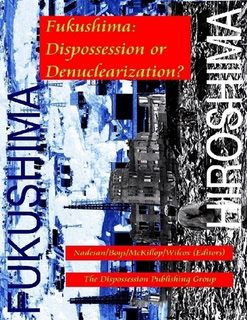 The Fukushima Syndrome – Diagnosing Nuclear Madness PlanetarianPerspectives.net March 6, 2015
The Nuclear Energy Paradigm “Has No Clothes.”
An important new book strips it bare.
By James Heddle
A Review of “FUKUSHIMA: Dispossession or Denuclearization?”
The Dispossession Publishing Group, 2014
Edited by Majia Nadesan, Antony Boys, Andrew McKillop and Richard Wilcox
Contributors – Harvey Wasserman, Christopher Busby, Paul Langley, Adam Broinowski, Christian Lystback, The Fukushima Five.
Reviewer’s note:
As Fukushima continues to pour its genotoxic effluent into the planetary biosphere four years on and counting, a recent BBC article tells us that the global proliferation of nuclear reactors is now at an all-time historic high with 70 reactors under construction and 500 on order in countries around the world. We have the spectacle of Nobel laureate and Nuclear-Salesman-in-Chief Obama sealing a new nukes deal with nuclear-armed India, sanctioning non-nuclear Iran for even thinking about developing nuclear energy, risking nuclear war with Russia over Ukraine, and ordering a $30 billion upgrade in the US nuclear arsenal (even as he lays flowers on Gandhi’s grave). Are decision-makers madmen and morons? How to explain this lemming rush to oblivion…or worse: a malformed genetic future distorted by massive global radioactive pollution. This review and the book it treats look at some of the forces and factors shaping the delusional worldview driving this societal madness……http://www.planetarianperspectives.net/?p=1925#comment-50051
New Report: State of Affairs and Ongoing Challenges of the Fukushima Nuclear Disaster
Greetings! This is Komei Hosokawa, secretary general of the Citizens’ Commission on Nuclear Energy (CCNE), Japan.
I am pleased to inform you that a special English edition of the CCNE’s report will be launched on the occasion of the 4th anniversary of the beginning of the Fukushima nuclear disaster and also on the occasion of the United Nation’s 3rd World Conference on Disaster Risk Reduction (WCDRR), to be held in Sendai, Japan, not very far from Fukushima.
The report, entitled The State of Affairs and Ongoing Challenges of the Fukushima Nuclear Disaster: a Civil Society Response Towards Recovery, intends to answer questions such as:
- – What have been the impacts of the Fukushima nuclear disaster?
- – What is the current condition of the victims of the nuclear disaster?
- – What is going on at the nuclear plant site and what risks still exist?
- – What mistakes did authorities make in response to the nuclear disaster?
- – What countermeasures are now necessary to cope with the situation?
A PDF is already available for download from the CCNE website (www.ccnejapan.com/eng/policy_outline_0-2.pdf ).
This special edition is a provisional and partial translation of the comprehensive Japanese report, Our Path to a Nuclear-Free Japan: Policy Outline for a Nuclear Phaseout, published in April 2014 by the Citizens’ Commission on Nuclear Energy (CCNE), Tokyo. The full report comprises seven chapters, of which the first three chapters have been translated into English to meet the special interests of the WCDRR delegates as well as experts on disaster control and prevention tasks worldwide.
The translated chapters are as follows:
Prologue: Why Should We Aim for a Nuclear-Free Society?
Chapter 1: An Overview of the Damage Caused by the Fukushima Nuclear
Power Plant Accident and the “Restoration of Humanity”
Chapter 2: The Actual State of the Fukushima Daiichi Nuclear Power Plant
Reactors and Issues Surrounding the Accident Settlement
Update information has been added to help readers understand more recent developments in the issues.
The remaining chapters deal with radioactive waste issues (Chapter 3), regulation standards, seismological issues and contingency planning (Chapter 4), financial considerations and sustainability issues (Chapter 5), and the democratic process towards the energy shift (Chapter 6). The full English edition will appear by July 2015. An executive summary in English covering all the chapters is already available at the CCNE website ( www.ccnejapan.com/?p=2048 ).
The Japanese Government and the organisers of WCDRR 2015 are inclined to exclude topics related to the nuclear disaster from the conference agenda. This avoidance is quite inappropriate, unprofessional and unethical, given that the convention this time is being held in the region severely affected by the Great East Japan Earthquake of 2011, which resulted in an unprecedented complex disaster of quake, flood and radioactive fallout. Even after four years now, more than 120 thousand people are still in exile from the nuclear disaster exclusion zones. It should also be reminded that the state of nuclear emergency declared by the Japanese Government in March 2011 has not yet been lifted. The disaster is far from over; the victims need care and support; and the Fukushima Daiichi plant is still in the middle of the hard struggle to bring the accident to an end (the question being when and how).
I hope the CCNE report will give you a clear idea about the actual state of affairs of the Fukushima nuclear disaster. Please circulate widely; for more information, contact me or the CCNE secretariat in Tokyo ( email@ccnejapan.com ).
- Hosokawa, MA, PhD
Professor, Dept of Environmental & Social Research,
Kyoto Seika University, 606-8588 Japan
Co-chair, Greenpeace Japan, Inc.
http://www.greenpeace.org/japan
Co-chair, Pacific-Asia Resource Center (PARC)
http://en.parc-jp.org:8080/en
Chief Secretary, Citizens’ Commission on Nuclear Energy (CCNE)
http://www.ccnejapan.com/?p=2048
Editor, MagpieNews, Nukes Headliner from Japan
1 This Month



Tell the Ukrainian Government to Drop Prosecution of Peace Activist Yurii Sheliazhenko

Petition to revoke the licensing of the Near Surface Nuclear Disposal Facility (NSDF) at Chalk River. https://www.ourcommons.ca/petitions/en/Petition/Details?Petition=e-7247


of the week – STOP SMALL MODULAR REACTORS IN CANADA
To see nuclear-related stories in greater depth and intensity – go to https://nuclearinformation.wordpress.com
-
Archives
- March 2026 (222)
- February 2026 (268)
- January 2026 (308)
- December 2025 (358)
- November 2025 (359)
- October 2025 (376)
- September 2025 (258)
- August 2025 (319)
- July 2025 (230)
- June 2025 (348)
- May 2025 (261)
- April 2025 (305)
-
Categories
- 1
- 1 NUCLEAR ISSUES
- business and costs
- climate change
- culture and arts
- ENERGY
- environment
- health
- history
- indigenous issues
- Legal
- marketing of nuclear
- media
- opposition to nuclear
- PERSONAL STORIES
- politics
- politics international
- Religion and ethics
- safety
- secrets,lies and civil liberties
- spinbuster
- technology
- Uranium
- wastes
- weapons and war
- Women
- 2 WORLD
- ACTION
- AFRICA
- Atrocities
- AUSTRALIA
- Christina's notes
- Christina's themes
- culture and arts
- Events
- Fuk 2022
- Fuk 2023
- Fukushima 2017
- Fukushima 2018
- fukushima 2019
- Fukushima 2020
- Fukushima 2021
- general
- global warming
- Humour (God we need it)
- Nuclear
- RARE EARTHS
- Reference
- resources – print
- Resources -audiovicual
- Weekly Newsletter
- World
- World Nuclear
- YouTube
-
RSS
Entries RSS
Comments RSS
 nuclear-news