Tawian has serious problems in its nuclear waste management

 Questions raised over nuclear waste management, Taipei Times By Tang Chia-ling / Staff reporter 9 Mar 15 The Atomic Energy Council (AEC) has detected greater-than-class-C (GTCC) nuclear waste at the nuclear-waste storage facility on Orchid Island (Lanyu, 蘭嶼) in Taitung County, despite the facility being designed for only low-radioactive materials, raising questions over the management of nuclear waste.
The council originally ordered Taiwan Power Co (Taipower, 台電) to introduce new rules on nuclear-waste classification by the end of last year, after it discovered the GTCC nuclear waste on the outlying island.
However, Taipower has failed to meet the deadline due to technical difficulties in compiling a nuclear-waste inventory, so the deadline has been extended, the council said.
According to the US Nuclear Regulatory Commission classification system, nuclear waste with a concentration of cesium-137 or strontium-90 greater than 4,600 and 7,000 curies per cubic meter respectively, or with a concentration of nickel-63 greater than 700 curies per cubic meter, is considered GTCC waste.
Citing a report by the Institute of Energy Research, Yang Mu-huo (楊木火), adviser to Democratic Progressive Party (DPP) Legislator Chen Ou-po (陳歐珀), said GTCC waste is mainly made up of components of decommissioned nuclear reactors and resins derived during the maintenance of nuclear power plants.
Class B nuclear waste is required to be stored in containers for 300 years, while class C waste needs to be stored for 500 years. GTCC waste is generally unacceptable for near-ground storage and requires a special disposal plan, the report shows.
Yang questioned why storage canisters designed for storage of up to 100 years had been used for the waste on Orchid Island and why authorities did not propose a special disposal plan for the GTCC materials……..http://www.taipeitimes.com/News/front/archives/2015/03/09/2003613111
South African government keeps public in the dark on costs of its nuclear energy plan
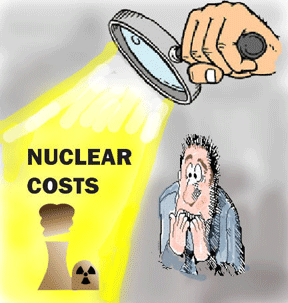
 How will South Africa’s new nuclear power stations be paid for?, My Broadband, 9 Mar 15 If the government is so determined to pursue nuclear power stations, why was no mention of the financing for this included in the minister of finance’s budget speech? By Chris Yelland – March 8, 2015 The South African government has committed itself, by means of its Nuclear Energy Policy and Integrated Resource Plan, to an energy mix consisting of coal, gas, hydro, nuclear, solar and wind.
Yet, if the government is so determined to pursue nuclear power stations, why was no mention of the financing for this included in the minister of finance’s budget speech?
One would expect that since government wants to use nuclear power to address the shortage of electricity in South Africa, and in the light of high-level delegations which have signed inter-governmental agreements regarding nuclear power, that this expenditure would have been a focus in the energy portion of this year’s budget speech.
This was, however, not the case. Instead, the public was told that the electricity levy will be increased by a whopping 57% from 3,5 to 5,5 c/kWh, and that Eskom would receive additional equity to the tune of R23-billion in three tranches.
The public was also told that although the extra 2 c/kWh levy would be removed in time, a carbon tax can be expected soon. The fact that the R23-billion would be in the form of additional equity means that Eskom will not have repay the money.
This additional backing is meant to prop up the power utility’s balance sheet which should make it easier for the utility to borrow money on the open market.
Economists have pointed out however, that it will be impossible for Eskom to borrow money to build a fleet of nuclear power stations because of the vast amount of money needed. The capital cost of a nuclear power station is extremely high.
So who will fund these nuclear power plants? It has been suggested that the country which builds the stations will fund it, so-called vendor funding, and that South Africa would repay the debt over time as it sells the electricity generated by the plants over a lengthy period.
But surely that will make electricity very expensive because of the large debt and the interest incurred……..
In 2013; the South African government’s estimate was $6500/kW; and recent reports show that a Hungarian nuclear power station, built by the Russians, cost $7000/kW, while the French-built nuclear power station at Hinckley Point, UK, cost $7900/kW. The figures quoted are for the new-build costs alone and do not include operating costs or interest.
Despite the high cost of nuclear power stations, and the obvious fact that South Africa cannot afford such an enormous outlay, the departments of energy, public enterprises, and trade and industry all appear to be in favour of this form of generation.
How much electricity does South Africa the country actually need? Eskom’s website shows an existing total generation capacity of 42 000 MW excluding the additional power from IPPs.
The renewable energy independent power producers (REIPPs) have already added 1500 MW to the grid, and an additional 2500 MW is expected soon…….
South Africa may have more power capacity than it needs at exorbitant cost to the country’s economy. Expensive electricity will result in the country’s manufacturing sector losing its competitive advantage which will mitigate against growth and job creation.
At the same time the drive towards energy efficiency, which, according to the budget speech will be rewarded by an energy-efficiency savings incentive, set to increase by 111% to 95 c/kWh, will surely motivate people to use less electricity……..http://mybroadband.co.za/news/energy/121180-how-will-south-africas-new-nuclear-power-stations-be-paid-for.html
We need a democratically controlled, people-focused clean energy system built from the grassroots up.
In January this year, the energy researcher Jeremy Leggett made a bold claim. He told the Guardian newspaper that we should expect a major oil firm to turn its back on fossil fuels soon and shift to renewable energy. ‘One of the oil companies will break ranks,’ he said, ‘and this time it is going to stick.’1
Leggett points to the collapsed oil price, the falling costs of renewable-energy generation and potential government action on climate change as key factors that could persuade an oil corporation to jump ship. His comments were excitedly shared online by anti-fossil fuel campaigners.
But hang on a minute. Would this really be good news? To avoid catastrophic global climate change, we need to leave at least 80 per cent of known fossil fuels in the ground, and renewable energy will have a major part to play in that. But do we want our new, clean energy system to be owned and operated by the same corporations that have got us into our current mess? Do we trust the likes of BP, Exxon and Total to develop renewables in a fair and sustainable way?
To answer this question, we don’t need to look far. All over the world, companies and governments that have grown rich on our current fossil-fuelled system are doing their best to slow down, interfere with, co-opt and control the growth of renewable energy. We need to fight back with a different vision: of a democratically controlled, people-focused clean energy system built from the grassroots up.
A renewables revolution? Continue reading
South Carlina lawmakers want no more nuclear waste into the State
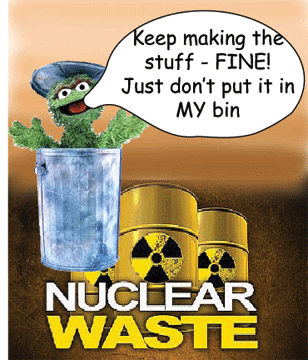 Courson, Lourie: SC has borne heavy burden on nation’s nuclear waste; no more, The State, South Carolina BY JOHN COURSON AND JOEL LOURIE March 8, 2015 COLUMBIA, SC — Barnwell County bore the burden of burying the nation’s low-level nuclear waste for decades. Beginning in 1971 as a modest 10-20 acre landfill, it was taking all of the nation’s radioactive, commercial waste eight years later.
To reduce South Carolina’s burden, Gov. Richard A. Riley brought eight states together in 1982 to form the Southeast Low Level Nuclear Waste Compact, and Barnwell was slated to close when North Carolina opened a successor site in 1992. When political pressure delayed North Carolina’s site selection, Gov. Carroll A. Campbell extended the closing to 1996.
When North Carolina again defaulted, a proviso was slipped in an appropriations bill to withdraw South Carolina from the compact and re-open Barnwell to the nation. Despite polls showing that 75 percent of the public wanted Barnwell closed, the waste stream increased, along with the dollars………
Barnwell’s limited remaining space should be preserved for South Carolina’s own future disposal needs and those of our compact partners. If revenues from reduced volumes of waste being buried are insufficient to operate the site, operating plans and disposal rates should be revised.
South Carolina has borne its fair share of waste, both nuclear and hazardous. The idea of changing the compact law to allow more dangerous nuclear material to be buried at Barnwell in order to increase revenues is short-sighted. With a modern site now opened in west Texas by Waste Control Specialists, it’s also unnecessary for the industry.
Given South Carolina’s unfortunate legacy at Pinewood, our job is to reduce South Carolina’s waste burden, not add to it. In our view, the Atlantic Compact is working. We understand that an effort will be made in the General Assembly to alter the compact to allow for all states to again have access to Barnwell for their low-level nuclear waste. As members of the Senate and original members of the 2000 Nuclear Waste Task Force, we will vigorously oppose such efforts. We never want South Carolina to again receive the dubious sobriquet of being the nation’s dumping ground for nuclear and hazardous waste.
Sen. Courson is a Columbia Republican, and Sen. Lourie is a Columbia Democrat; contact them atjoellourie@scsenate.gov or johncourson@scsenate.gov. http://www.thestate.com/2015/03/08/4031605/courson-lourie-sc-has-borne-heavy.html
Big utilities fight back against rooftop solar
“Independent studies show that distributed solar benefits all ratepayers by preventing the need to build new, expensive power plants or transmission lines,” said Matthew Kasper, a fellow at the Energy & Policy Institute, a pro-solar think tank. “Utilities make their money by building big, new infrastructure projects and then sending ratepayers the bill, which is exactly why utilities want to eliminate solar.”
“It’s really about utilities’ fear that solar customers are taking away demand,” said Angela Navarro, an energy expert with the Southern Environmental Law Center. “These customers are installing solar at their own cost and providing a valuable resource: additional electricity for the grid at the times when the utilities need it most. And it’s all carbon-free.”.

 Utilities wage campaign against rooftop solar WP By Joby Warrick March 7 Three years ago, the nation’s top utility executives gathered at a Colorado resort to hear warnings about a grave new threat to operators of America’s electric grid: not superstorms or cyberattacks, but rooftop solar panels.
If demand for residential solar continued to soar, traditional utilities could soon face serious problems, from “declining retail sales” and a “loss of customers” to “potential obsolescence,” according to a presentation prepared for the group. “Industry must prepare an action plan to address the challenges,” it said.
The warning, delivered to a private meeting of the utility industry’s main trade association, became a call to arms for electricity providers in nearly every corner of the nation. Three years later, the industry and its fossil-fuel supporters are waging a determined campaign to stop a home-solar insurgency that is rattling the boardrooms of the country’s government-regulated electric monopolies.
The campaign’s first phase—an industry push for state laws raising prices for solar customers—failed spectacularly in legislatures around the country, due in part to surprisingly strong support for solar energy from conservatives and evangelicals in traditionally “red states.” But more recently, the battle has shifted to public utility commissions, where industry backers have mounted a more successful push for fee hikes that could put solar panels out of reach for many potential customers. Continue reading
Renewable energy development could be taken over by the same old neocolonial racist corporations
 Whose renewable future? New Internationalist MARCH 2015 Is big business poised to capture the renewables revolution? Danny Chivers draws up the battle lines.
“………. What are we up against?
Let’s not kid ourselves. The fossil fuel industry’s main response to clean energy is to try to squash it. Selling the highly concentrated energy in oil, coal and gas is far more profitable in the short term than the slow-release, distributed energy from wind or solar power – especially when you factor in generous government fossil fuel subsidies, an international energy infrastructure already set up to use these fuels, and free rein to pump carbon pollution into the air at little or no cost. Whether it’s funding pro-fossil politicians, forging cosy links with officials or pouring money into anti-renewable front groups, the big oil, gas and coal companies are working hard to keep society hooked on their highly profitable products, and prevent alternatives from getting off the ground.6
There are exceptions to this rule. If those alternatives can provide decent short-term returns or access to new subsidies without disrupting the existing energy markets, then the big players might be tempted to step in. This is why the likes of BP, Shell and Exxon have moved into liquid biofuels, and why major power plants like Drax in Britain are starting to mix large quantities of woodfuel in with their coal supply.
We need a democratically controlled, people-focused clean energy system
Industrial biofuels and wood-fired power stations – along with the continued destruction caused by large hydropower dams – provide perfect examples of what can happen if supposedly ‘renewable’ energy sources are exploited for maximum profit, without proper consideration for people and the environment. Energy crops and hydroelectricity may both be sustainable on a small, local, carefully managed scale – but the current profit-driven rush to turn food crops and forests into fuel is leading to hunger, land grabs and deforestation; while megadams threaten huge areas of natural habitat along with the homes, lands and livelihoods of hundreds of thousands of people.
These projects should act as a stark warning. Wind and solar power are still relatively small industries on a global scale, but are growing fast. These technologies are far less destructive than fossil fuels, but that doesn’t mean they’re impact-free – especially if they develop to the scale we need for a fossil-free future. Will they be carefully manufactured in renewably powered workshops with strict respect for workers’ rights and environmental standards; using largely recycled materials, and built as part of community-run, co-operatively owned and democratic energy schemes which benefit the communities where they are sited? Or will they be churned out in nightmarish sweatshop conditions, using minerals from exploitative mining projects and sited in giant energy parks on cleared rainforest land from which the residents have been forcibly evicted?
It could go either way. Renewables could transform our energy system, with solar panels particularly well-suited for decentralized use: 85 per cent of today’s solar panels are spread over millions of rooftops, with only 15 per cent in solar parks. Increased access to and control over energy could empower millions of people, improving lives and livelihoods and boosting the political and social influence of marginalized communities.
Unfortunately, the risks are also clear. Wind and solar generators require a significant amount of building material and land space. Though requiring less than 1 per cent of the extraction needed to keep pulling coal, oil and gas out of the ground, ramping up renewables will mean a significant spike in demand for steel, cement, aluminium and copper that could have serious local impacts around the world if not carefully managed. Wind power, unlike solar, is far more efficient when built on a large scale; big wind farms typically require levels of capital investment that are out of the reach of community groups. They’re more likely to be installed by governments or large utility companies such as E.ON. Seventy-five per cent of all wind turbines are manufactured by just 10 companies.
The Desertec initiative gives us an example of what a profit-driven, centralized solar energy future might look like. We shouldn’t be surprised to see it develop along the same neo-colonial and racist lines as our current fossil fuel industry, where the rights of Indigenous peoples and communities of colour around the world are trampled in the pursuit of ‘cheap’ energy for the industrialized nations…….” http://newint.org/features/2015/03/01/renewable-energy-keynote/
1 This Month



Tell the Ukrainian Government to Drop Prosecution of Peace Activist Yurii Sheliazhenko

Petition to revoke the licensing of the Near Surface Nuclear Disposal Facility (NSDF) at Chalk River. https://www.ourcommons.ca/petitions/en/Petition/Details?Petition=e-7247


of the week – STOP SMALL MODULAR REACTORS IN CANADA
To see nuclear-related stories in greater depth and intensity – go to https://nuclearinformation.wordpress.com
-
Archives
- March 2026 (222)
- February 2026 (268)
- January 2026 (308)
- December 2025 (358)
- November 2025 (359)
- October 2025 (376)
- September 2025 (258)
- August 2025 (319)
- July 2025 (230)
- June 2025 (348)
- May 2025 (261)
- April 2025 (305)
-
Categories
- 1
- 1 NUCLEAR ISSUES
- business and costs
- climate change
- culture and arts
- ENERGY
- environment
- health
- history
- indigenous issues
- Legal
- marketing of nuclear
- media
- opposition to nuclear
- PERSONAL STORIES
- politics
- politics international
- Religion and ethics
- safety
- secrets,lies and civil liberties
- spinbuster
- technology
- Uranium
- wastes
- weapons and war
- Women
- 2 WORLD
- ACTION
- AFRICA
- Atrocities
- AUSTRALIA
- Christina's notes
- Christina's themes
- culture and arts
- Events
- Fuk 2022
- Fuk 2023
- Fukushima 2017
- Fukushima 2018
- fukushima 2019
- Fukushima 2020
- Fukushima 2021
- general
- global warming
- Humour (God we need it)
- Nuclear
- RARE EARTHS
- Reference
- resources – print
- Resources -audiovicual
- Weekly Newsletter
- World
- World Nuclear
- YouTube
-
RSS
Entries RSS
Comments RSS
 nuclear-news