 we will need to reduce the power and influence of the fossil fuel companies, kicking their representatives out of government and moving subsidies away from polluting fuels and towards clean energy. Divestment campaigns shouldn’t just call for an end to fossil fuel funding but galvanize a shift in public investments into cleaner alternatives: not corporate renewable schemes but community energy, sustainable local transport and energy efficiency projects.
We can’t just sit back and expect the falling price of solar and wind to sweep away the old energy order. Renewable energy could be a powerful tool for dismantling the current failed system – but we need to use it wisely, and not let it fall into the wrong hands!
 Whose renewable future? New Internationalist MARCH 2015 Is big business poised to capture the renewables revolution? Danny Chivers draws up the battle lines. “……..This increasing reliance on companies, not governments, as providers of energy services and infrastructure is driven by a global economic system based on market ‘liberalization’, profit maximization and endless growth. It’s a trend that we need to reverse if we want renewable energy truly to be a force for good.
Luckily, alternative models are appearing all over the world. Renewable energy co-operatives have hundreds of thousands of members and are building and installing their own solar, wind and small-scale hydro projects from Indonesia to Costa Rica. Continue reading
Thousands of Germans rally in anti-nuclear protest, remembering Fukushima
 VIDEO: German protesters call for end to nuclear power as they remember Fukushima http://www.euronews.com/2015/03/08/german-protesters-call-for-end-to-nuclear-power-as-they-remember-fukushima/Thousands of demonstrators have called for an end to nuclear energy during a rally in Neckarwestheim, in southern Germany.
They gathered in the town, home to a nuclear plant, to remember Japan’s Fukushima disaster four years ago.
Protesters chanted “switch off,” while holding banners reading “Fukushima out of control” and carrying mock coffins.
An earthquake and tsunami struck the Fukushima Daiichi plant, 220 kilometres northeast of Tokyo, in March 2011. It sparked nuclear meltdowns, forcing more than 160-thousand residents to flee from nearby towns and contaminating water, food and air.
Massive buildup of radioactive debris at Fukushima No 1 nuclear plant
FOUR YEARS AFTER: Radioactive debris continues to stack up at Fukushima No. 1 nuclear plant http://ajw.asahi.com/article/0311disaster/fukushima/AJ201503080013 March 08, 2015 By HIROMI KUMAI/ Staff Writer
FUTABA, Fukushima Prefecture–With nowhere to put it, refuse and debris contaminated with radioactive materials continue to pile up at the crippled Fukushima No. 1 nuclear power plant here.
A total of 258,300 cubic meters of radioactive debris was produced from the March 2011 accident to the end of this January in the plant, where decommissioning work is under way.
The amount is equivalent to the capacity of about 650 25-meter-long swimming pools.
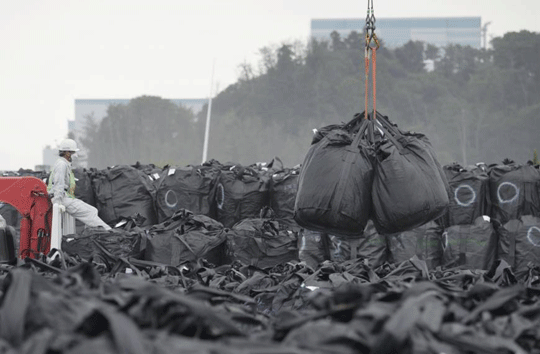
Of the 258,300 cubic meters, 178,600 cubic meters were mainly debris that had been scattered around reactor buildings, wood refuse produced in the work in the plant and protective suits used by workers, according to the plant’s operator, Tokyo Electric Power Co.
The remaining 79,700 cubic meters were trees that were felled to create space for tanks storing radioactive water. There were also 1,846 objects that absorbed radioactive materials from contaminated water.
According to the road map worked out by the government and TEPCO, the basic plan for disposing of the radioactive waste will be released in fiscal 2017.
Worldwide effect of Fukushima radioactive plume
 UCLA Researchers: Fukushima “not only affecting that local area, but also worldwide” — Gov’t Expert: “Immediately the Iodine-131 plume moved eastward reaching US West Coast [then] covering entire northern hemisphere… Significant concern on the safety of the population and environment worldwide” (VIDEO) http://enenews.com/ucla-researchers-fukushima-only-affecting-local-area-worldwide-govt-expert-immediately-iodine-131-plume-moved-eastward-reaching-west-coast-covering-entire-northern-hemisphere-early-april-posing-sig?utm_source=feedburner&utm_medium=email&utm_campaign=Feed%3A+ENENews+%28Energy+News%29 8 March 15
In the Fukushima Disaster Zone with UCLA researchers, Mar 3, 2015: Four years after Fukushima disaster, some areas remain untouched, clocks recording the exact time that the tsunami swept through. Access is highly restricted but two UCLA researchers were recently given permission to document the disaster zone. — at 3:45 in — “With this study I think that’s what we’re trying to explore — is that once a nuclear catastrophe strikes, it’s not only affecting that local area, but also worldwide.”
Atmospheric dispersion of Iodine-131 released after the Fukushima event, by Giuseppe A. Marzo, ENEA (Italian National agency for new technologies, Energy and sustainable economic development), 2014: From March 12, 2011, a significant amount of radioactive material… discharged into the atmosphere… Total emission of 131I has been estimated in [128** petabecquerels (PBq)], while 133Xe, and 137Cs total emissions have been estimated in [15,300 PBq and 36.6 PBq], respectively. In this work the global atmospheric dispersion of 131I released by the Fukushima accident is carried out, focusing on this specific radionuclide due to its radiological relevance in terms of consequences on the human health… Figure 1 summarizes the simulation results. It illustrates the radioactivity concentration due to 131I released into the atmosphere at specific times and integrated over the total atmospheric column. Immediately after the initial release on March 12, the plume moved eastward reaching the United States west coast on [March 15 at 10:00p PST]… In early April the plume extended over the entire northern hemisphere… A significant accidental event occurred at the Fukushima NPPs… volatile radionuclides such as 131I were transported away from the source posing significant concern on the safety of the population and the environment worldwide… the atmospheric dispersion of 131I [was] covering the entire northern hemisphere by early April…
**According to a document released by TEPCO, “Our result shows a higher I-131 amount (500PBq) compared to the result obtained from a thirdparty organization (120-200PBq).”
Japanese government to start campaign to encourage hosting of nuclear wastes

 Government to start campaign on nuclear waste disposal sites , Japan Times, 9 Mar 15 KYODO The government plans to launch a campaign in major cities to promote the need for permanent disposal facilities for high-level nuclear waste from power plants, sources close to the matter said Saturday.
Prime Minister Shinzo Abe’s administration is looking to restart nuclear plants shut after the Fukushima disaster, and has faced criticism over promoting nuclear power without resolving where the waste will ultimately be disposed.
Symposiums are planned for Sapporo, Sendai, Tokyo, Nagoya, Osaka, Fukuoka and roughly four other cities, hosted by the Ministry of Economy, Trade and Industry and the Nuclear Waste Management Organization of Japan, which was previously solely responsible for the disposal plan……..
The government is also considering launching an information campaign on social networking services, with the details to be discussed at a METI task force meeting set for Tuesday, the sources said.
The current disposal policy, adopted in 2008, calls for waste to be vitrified and placed in facilities deep underground. Revisions to the policy at the end of the month are expected to include the selection of candidate sites on scientific grounds, without waiting for local authorities to volunteer to host the facilities. http://www.japantimes.co.jp/news/2015/03/08/national/government-start-campaign-nuclear-waste-disposal-sites/#.VPy51tKUcnk
Canada’s nuclear company Lavalin led Canada to the top of the World Bank’s Corrupt Companies Blacklist
 Extraordinary that South Australia should look to Canada, of all countries, for advice on how to set up a nuclear industry?
Canada’s Corrupt Corporations: World Bank’s Corrupt Companies Blacklist, Dominated By Canada By Global Research News, January 05, 2015 The Huffington Post Canada has the dubious honour of being home to the largest number of firms on a World Bank blacklist of corrupt companies.
 But virtually all of that can be attributed to one Canadian company — SNC Lavalin, the construction and engineering giant whose name is becoming a paragon of Canadian corruption.
Of the more than 600 companies now listed as barred from doing business with the World Bank over corruption, 117 are Canadian, the most of any one country. And of those, 115 represent SNC-Lavalin and its subsidiaries, the Financial Post reports.
Among the listed SNC subsidiaries are Candu Energy, which designs CANDU nuclear reactors, and Evergreen Rapid Transit Holdings, the SNC-Lavalin company established to build Vancouver’s new Sky Train line.
The World Bank’s head of corruption investigations, James David Fielder, told the paper the SNC subsidiaries’ inclusion was due to “a World Bank investigation relating to the Padma Bridge project in Bangladesh where World Bank investigators closely cooperated with the Royal Canadian Mounted Police in an effort to promote collective action against corruption.”……
Bangladesh is not the only place where SNC-Lavalin is alleged to have engaged in bribery.
The company’s former CEO, Pierre Duhaime, was arrested last year on corruption charges related to $56 million in “questionable payments” believed linked to some of the company’s overseas operations. Duhaime was arrested again earlier this year in connection with allegations of corruption surrounding a contract to build a new facility for the McGill University Health Centre (MUHC) in Montreal.
SNC-Lavalin’s links to the former Gadhafi regime in Libya are said to have been so close that the company offered one of the dictator’s sons a vice-president position in 2008, according to news reports.
SNC-Lavalin is also alleged to have been engaged in corrupt practices in Algeria. http://www.globalresearch.ca/canadas-corrupt-corporations-world-banks-corrupt-companies-blacklist-dominated-by-canada/5422924
German Chancellor Angela Merkel to Japan to discuss renewable energy co-operation
 Merkel to discuss Germany’s nuclear exit, cooperation on renewable energy during Japan trip, Fox Business, March 07, 2015 BERLIN – German Chancellor Angela Merkel says she plans to use her upcoming trip to Japan to discuss how Berlin and Tokyo can cooperate to expand the use of renewable energy.
Merkel will visit Japan on Monday and Tuesday as part of a series of bilateral meetings with G-7 leaders ahead of a June summit in Germany.
Germany sped up its exit from nuclear energy after Japan’s Fukushima nuclear disaster in March 2011.
Merkel said in a weekly online address Saturday that Germany was “now strongly emphasizing renewable energy. And I believe Japan should go down this road too — and it is.”….http://www.foxbusiness.com/markets/2015/03/07/merkel-to-discuss-germany-nuclear-exit-cooperation-on-renewable-energy-during/
Arnie Gunderson and Ian Fairlie to speak in Cumbria on 11 March, about nuclear plans

 Arnie Gundersen and Ian Fairlie, Keswick Reminder https://mariannewildart.wordpress.com/2015/03/07/we-need-to-talk-about-moorside-letter-in-the-keswick-reminder/ Rod & Jill Donington-Smith
In West Cumbria we already host Sellafield, one of the most hazardous sites in the world. It is now proposed that three new nuclear power plants are to be built next door at Moorside and the threat of a Geological Disposal Facility (GDF) being imposed on us still remains.
On Wednesday 11 March at 7.30 Arnie Gunderson and Ian Fairlie, two
internationally respected authorities on the nuclear industry, will be
speaking at the Skiddaw Hotel about the Moorside project and the Waste
Isolation Pilot Project near Carlsbad in New Mexico, which is very relevant
to Cumbrians as it is the only GDF currently in operation anywhere in the
world. It has had its problems with canisters containing waste exploding and
roofs collapsing.
Whether you agree with these possible developments or not, this should be an
interesting evening and certainly you can guarantee that more detailed
information will be available than would be published by the Nuclear
industry itself through its mouth piece the “Britain’s Energy Coast”
publication.
“Fukushima. Another look” exhibition in Kyiv , Japan
 Japanese photographer shows alternative view on Fukushima disaster, Kyiv Post March 7, 2015, | Museums — by Victoria Petrenko Kazuma Obara, a Japanese photo artist, had his exhibition on Fukushima disaster opened at the Kyiv History Museum on March 4. Obara, 30, reveals the real stories of the liquidators of the nuclear power plant accident, while also plans to launch a special photo project on Chornobyl……“I was very shocked when I met the workers of Fukushima nuclear power plant for the first time and heard their stories,” he says…….
On March 11 at 7 p.m. Obara will give a lecture at the Kyiv History Museum. Called “Liquidators in Fukushima”, it is free of charge. Seats are limited, to reserve call (044) 520 28 27.
Kyiv Post staff writer Victoria Petrenko can be reached at petrenko@kyivpost.com. http://www.kyivpost.com/guide/museums/japanese-photographer-shows-alternative-view-on-fukushima-disaster-382825.html
China’s wind power developing fast, much greater capacity than its nuclear power
 China’s wind farms can now produce more energy than all of America’s nuclear plants Quartz, 9 Mar 15 China is building more than a third of the world’s nuclear reactors currently under construction, and has plans to triple its nuclear power capacity by 2020. That has some observers worried about the country’s opaque and politicized nuclear safety regulations.

Despite the government’s ambitious goals to keep developing its nuclear energy capacity, for the foreseeable future, nuclear is unlikely to match wind in China.
Technical delays, safety concerns, hamper China’s ambition to sell nuclear reactors to the world
 RPT-“Made in China” nuclear reactors a tough sell in global market Mar 8, 2015 By Charlie Zhu and David Stanway (Reuters) – As China signs global deals to export its nuclear power technology, it faces a huge obstacle: it still needs to show it can build and safely operate these reactors at home……..
Premier Li Keqiang told an annual parliamentary meeting this week that the China aimed to increase its share of global sales in a range of advanced industries, including implementing major projects in nuclear power. And in a sign of progress on exporting its own nuclear technology, China signed a preliminary agreement last month to sell its flagship Hualong 1 reactor to Argentina.
But despite state media describing the deal as the model’s “maiden voyage”, China has not yet built Hualong 1, raising questions about the country’s capacity to deliver reactors for the global market.
“Our fatal weakness is our management standards are not high enough. There is a big gap with international standards,” said Xu Lianyi, a senior expert at China’s State Nuclear Power Technology Corp (SNPTC), referring to the challenges China faces expanding its nuclear power sector.
SNPTC, which was set up to receive technology transferred from Westinghouse Electric Co., is trying to develop another reactor ultimately targeted at the world market. Although China has operated Western-designed reactors at home for more than 20 years, it will need to convince buyers of the reliability of its own technology, particularly given a chequered reputation on industrial standards and safety in some other areas such as mining.
China’s first Hualong 1 project, in Fujian province, may not be completed until 2020, assuming it breaks ground this year and construction goes smoothly, said Li Ning, dean of the School of Energy Research at Xiamen University…….
Beijing has promised to stick to the highest safety standards, using so-called “third generation” reactors like Hualong 1 and CAP1400, another home-grown model identified for future export. Due to be based on technology transferred from Westinghouse, the launch of CAP1400 will depend on the completion of a pilot Westinghouse third-generation reactor in Zhejiang province, which is facing a three-year delay because of technological problems……
Under a hotly-fought multibillion-dollar nuclear power deal struck with Pittsburgh-based Westinghouse, China secured a significant technology transfer agreement in 2007. China has been absorbing and localising the technology to develop the CAP1400 and says it has full intellectual property rights on the model and Hualong 1.
The Beijing office of Westinghouse, which is now controlled by Japan’s Toshiba Corp, did not immediately respond to requests for comment.
While technology rights may not stoke tensions, Beijing’s pledge to aid the overseas expansion of Chinese firms risks raising the hackles of competitors if sectors like nuclear are deemed unfairly subsidised…….
an official at the China National Nuclear Corporation, which is leading efforts to export Hualong 1 to Argentina, said China still has “huge amounts of work to do” before it can become a nuclear powerhouse, including rolling out Hualong I at home. The official declined to be named because he was not authorised to speak to the media…….http://www.reuters.com/article/2015/03/08/china-nuclear-idUSL4N0WA0T620150308
Nestle wants ground-water because it is relatively free of nuclear-caused tritium contamination?
 From a Contributor, 9 March 15 The real reason Nestle wants in on this source is because all fresh surface water on this planet has become polluted with tritium (radioactive hydrogen) from nuclear explosions, and nuclear reactors which leak it all the time.
Nuclear facilities have no known method of containing and managing tritium Nuclear accidents like at Fukushima, Chernobyl, TMI etc are still poisoning the planet with escaping tritium. The do not know how to effectively contain it nor can our municipal water treatment plans filter tritium, now radioactive water, out of the water.
Nestle is looking to corner the ground water because it is relatively tritium free. I think it should be given free to all pregnant mothers everywhere because tritium is teratogenic.
Outrage boils over as B.C. government plans to sell groundwater for $2.25 per million litres BY DAN FUMANO, THE PROVINCE
More than 82,000 people have signed a petition against the government’s plans to sell B.C.’s water for $2.25 per million litres.
“It is outrageous,” says the online petition from SumOfUs.org, that corporations can buy water “for next to nothing.”
B.C.’s Water Sustainability Act (WSA), which comes into effect next January and replaces the province’s century-old water legislation, has been heralded as a major step forward. But politicians and experts are raising doubts over whether the newly announced water fees may be too low to cover the cost of the program, asking if the act simply won’t be implemented properly, or if taxpayers could end up picking up the bill.
Last month, the government unveiled the new water pricing structure, which will include, for the first time in B.C.’s history, groundwater being regulated and subject to fees and rentals.
Critics said that, while it’s a step in the right direction, the prices are still not close to capturing the resource’s value….
water rates for industrial users, which are a fraction of what some provinces charge, are “like a giveaway” to corporations, critics say……http://www.leaderpost.com/news/Outrage+boils+over+plans+sell+groundwater+million+litres/10865416/story.html
Former Japanese Prime Minister Naoto Kan talks to Green Cross in Paris
Former Japanese PM Naoto Kan in Paris for Green Cross nuclear debate , Green Cross 05/03/2015 The conference, “Four years after the Fukushima catastrophe: lessons learned”, was addressed by former Japanese Prime Minister Naoto Kan. Kan led his country through the terrible events that followed the earthquake and tsunami on 11 March, 2011 and has since become a committed anti-nuclear activist.
“Before the accident, my political position was favourable to the continued development of nuclear power, so long as the necessary precautions were taken – I even promoted the technology abroad,” said Kan. “But afterwards my thinking changed completely. For the rest of my mandate I committed to reducing Japan’s reliance on nuclear energy and developed laws to promote energy efficiency and renewable energy. Just like atomic bombs, nuclear energy is a technology we cannot entirely control. The experts tell us there is no such thing as a zero-risk nuclear power station. Effectively, natural disasters are always a possibility and should that risk be manifested all we can do is try to manage the consequences.”
Adam Koniuszewski, Chief Operating Officer of Green Cross International, put the discussion into the context of Green Cross’ work, starting in 1993, with the victims of such disasters as the Chernobyl meltdown.
“The founding president of Green Cross, Mikhail Gorbachev, and Prime Minister Naoto Kan share the sad experience of having both led their country through major nuclear disasters,” said Koniuszewski. “Our local presence and ongoing activities to help the communities impacted by radioactive contamination in Chernobyl and Fukushima gives us first-hand experience of the human and environmental consequences of nuclear disasters. This is why we are demanding more transparency and better governance around nuclear power and the risks involved, and a better assessment of its mounting costs. New plants are plagued with delays and cost overruns; the management of nuclear waste in increasingly burdensome and the cost of decommissioning plants is escalating. In the meantime renewable energy solutions are getting cheaper. Over the last five years the cost for utility scale solar has declined by 78 per cent, and by for wind by 58 per cent.”…….
Kan had some closing thoughts, encouraging France to take the upcoming opportunity provided by ParisClimat 2015 to start moving away from nuclear power. He also recommended a much more comprehensive, transparent and democratic approach to preparing for a possible nuclear catastrophe.
“Zero-risk does not exist, and cost-effectiveness is a meaningless concern when weighed against the trauma and impact of a nuclear disaster,” said Kan.
Furthermore, Japan’s experience shows that nuclear power is not nearly as indispensable as its supporters claim. Following the Fukushima disaster, all of Japan’s nuclear reactors – providing 25 per cent of the country’s electricity – were shut down. In response, Japan managed to reduce national consumption from 65GW to 50GW and, as systems are built back up, many people are looking much more seriously at the opportunity to switch to increasingly attractive and cost effective renewable solutions. So far, local communities have taken the lead in putting renewable power sources in place. http://www.gcint.org/news/former-japanese-pm-naoto-kan-paris-green-cross-nuclear-debate
The danger of big corporations controlling renewable energy systems
Whose renewable future? New Internationalist MARCH 2015 Is big business poised to capture the renewables revolution? Danny Chivers draws up the battle lines.
 “……Who has power over power?
As wind and solar technology gets cheaper – and if low oil prices and increasing climate regulation and extraction costs make fossil fuels less profitable – we can expect more and bigger corporate players to move into the sector, including existing oil and gas corporations.
Energy supply in many countries is already in the hands of privatized utility companies, thanks to decades of privatization driven by neoliberal Northern governments and institutions like the World Bank. This has led to rising energy bills and the continuing failure to supply grid electricity to harder-to-reach (and thus less profitable) rural communities. Around 1.3 billion people worldwide still have no access to electricity, while many others struggle to afford it.
There are vital battles still to be fought over the ownership, control of and access to renewable energy. Who will pay for and own the building materials, the factories, the technical knowledge, the site of installation, the equipment and the energy it produces? The more democratic control that can be exerted over each stage of this process, the greater our chances of creating low-impact, climate-friendly energy systems that supply affordable energy to all. We also need the transition to be a fair one that retrains and transfers workers from the fossil energy sector; this will only happen if the voices of workers carry more weight in the process than the desires of the energy companies.
It’s hard to imagine the big privatized companies voluntarily working to reduce energy consumption in the North; it’s equally hard to envision them supporting a phase-out of fossil fuels as renewables expand, or supporting policies to provide affordable energy to those most in need. These companies have been driving our civilization towards a cliff edge, and now they are eyeing up the keys to our shiny, new, renewably powered electric bus……… http://newint.org/features/2015/03/01/renewable-energy-keynote/
Japan should not be complacent about Tokyo’s risk of another nuclear catastrophe
 The ongoing fallout from Japan’s nuclear meltdown, East Asia Forum 7 March 2015 Simon Avenell, ANU
Four years after the earthquake and tsunami of March 2011, Japan’s leaders and citizens still face many complex challenges. Among these, none is more complicated than the issue of nuclear power.
Concerns remain about the containment of radioactive waste and the progress of decommissioning the crippled Fukushima Daiichi Power Plant. Periodic media reports of radioactive water spilling into the Pacific Ocean have not inspired confidence. Instead, they directly undermine Prime Minister Shinzo Abe’s strong desire to restart Japan’s 54 nuclear reactors, which have been offline since the disaster.
There is still controversy about how to dispose of contaminated topsoil and other radioactive material scattered around Fukushima. Locals want their land decontaminated and habitable, and very few communities want a stockpile of radioactive waste in their backyard.
The level of uncertainty was patently obvious when the Science Council of Japan proposed that the radioactive waste material be stored at an above-ground facility for 50 years while officials and citizens devised a better option. But it has been difficult to find a locality willing to accept this material even in the short-term. Only in late February 2015 did Fukushima Governor Masao Uchibori finally agree to establish interim storage facilities in the towns of Futaba and Okuma. The radioactive waste is to be permanently disposed of ‘outside the prefecture’ in 30 years’ time……..
Farmers whose lands were contaminated with radioactive fallout must make difficult decisions. Cleaning contaminated topsoil and foliage is an expensive undertaking and does not guarantee the elimination of radioactive hotspots. Some farmers are retooling and moving into other forms of agriculture (such as greenhouse production), but this can be costly and time-consuming and is not easy for elderly, established farmers. Younger farmers with families must also weigh up the health risks of taking their children back into areas deemed decontaminated.
But even if agricultural operations begin to revive, convincing consumers that Fukushima produce — rice, fruit, and seafood — is safe will not be easy. Advertising campaigns publicising the rigorous testing procedures for Fukushima produce run the risk of fuelling consumer concern rather than mitigating it.
Community rebuilding and restoration challenges also remain. In late 2014, around 90,000 people whose homes were destroyed in the disaster were living in temporary housing. A similar number were living in public and privately owned apartments financed by municipal governments, taking the total number of displaced persons to around 180,000……..
now scientists are predicting a similar calamity for the Tokyo region.
If such a disaster were to occur, the knock-on effects for the economy and society could be catastrophic. Tohoku certainly proved that even seismologists can miss the ‘big one’, but it’s the after effects that have demanded a serious rethinking of Tokyo’s disaster preparedness. Scientists are saying there is a 70 per cent chance that a magnitude 7.0 or higher quake will hit Tokyo by 2016 and a 98 per cent chance it will hit in the next 30 years.
Whether or not this eventuates, Tohoku and the disaster at Fukushima Daiichi should be a warning about the dangers of complacency.
Simon Avenell is Associate Professor in History and an Australian Research Council Fellow at The Australian National University.http://www.eastasiaforum.org/2015/03/07/the-ongoing-fallout-from-japans-nuclear-meltdown/
1 This Month

10 March A LIVE WEBINAR THE REAL EFFECTS OF NUCLEAR POWER
What the Industry Isn’t Telling Us
1:00 PM Mountain, 2 pm Central, 3 pm Eastern. Live on the Keepers of the Water Facebook page

18 March Webinar @ 1 PM EST: An Assessment of SMR Projects: The Case of Canada
register for the zoom:
https://us02web.zoom.us/webinar/register/WN_o8BIIOUvQ2ONJR1nta65DQ#/registration


of the week – STOP SMALL MODULAR REACTORS IN CANADA
To see nuclear-related stories in greater depth and intensity – go to https://nuclearinformation.wordpress.com
-
Archives
- March 2026 (54)
- February 2026 (268)
- January 2026 (308)
- December 2025 (358)
- November 2025 (359)
- October 2025 (376)
- September 2025 (258)
- August 2025 (319)
- July 2025 (230)
- June 2025 (348)
- May 2025 (261)
- April 2025 (305)
-
Categories
- 1
- 1 NUCLEAR ISSUES
- business and costs
- climate change
- culture and arts
- ENERGY
- environment
- health
- history
- indigenous issues
- Legal
- marketing of nuclear
- media
- opposition to nuclear
- PERSONAL STORIES
- politics
- politics international
- Religion and ethics
- safety
- secrets,lies and civil liberties
- spinbuster
- technology
- Uranium
- wastes
- weapons and war
- Women
- 2 WORLD
- ACTION
- AFRICA
- Atrocities
- AUSTRALIA
- Christina's notes
- Christina's themes
- culture and arts
- Events
- Fuk 2022
- Fuk 2023
- Fukushima 2017
- Fukushima 2018
- fukushima 2019
- Fukushima 2020
- Fukushima 2021
- general
- global warming
- Humour (God we need it)
- Nuclear
- RARE EARTHS
- Reference
- resources – print
- Resources -audiovicual
- Weekly Newsletter
- World
- World Nuclear
- YouTube
-
RSS
Entries RSS
Comments RSS
 nuclear-news