CT scans; the radiation riks should be weighed up – especially for children
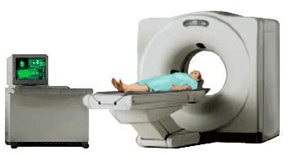 Imaging Tests: Weighing the Radiation Risk http://health.usnews.com/health-news/patient-advice/articles/2015/03/06/imaging-tests-weighing-the-radiation-risk Ask if that CT scan – for you or your child – is really needed. You walk into the emergency room, clutching your right side in pain. When the ER doctor examines your belly, she suspects you have appendicitis. But she wants to confirm the diagnosis before sending you for surgery. Or maybe your son falls off the high playground bars, and while he has a good-sized bump on his head, he seems otherwise fine. Should either of you have a computed tomography exam – a CT scan? As with any medical test or procedure, there’s a risk-benefit balance to consider.
Radiation Risk
Some 75 million CT scans are done each year in the United States – and they’re great diagnostic tools. A CT exam uses a specialized type of X-ray and a rotating scanner to take a variety of images from different angles around your body. CT exams rapidly produce clear, detailed, cross-sectional pictures. They facilitate diagnosis and treatment of trauma, cancers, cardiovascular disease, infections and congenital conditions, some life-threatening.
But the test itself may pose a health risk. CT scans use ionizing radiation, a known (although relatively weak) carcinogen. Research suggests that CT scans may raise cancer risk – although it would still be very low – particularly in childhood. In addition, studies find radiation doses used in CT vary widely among facilities, even for the same procedure on similar patients.
Rebecca Smith-Bindman, a physician and professor of radiology and biomedical imaging at the University of California–San Francisco, has published a number of papers on CT safety issues, dose variations and the notable rise in CT scans performed.
The increased exposure is a concern because of the high radiation dosage used, Smith-Bindman says: Compared to a standard chest X-ray, the radiation dose for a chest CT scan involves radiation that’s 500 times higher or more.
Magnetic resonance imaging and ultrasound exams don’t use ionizing radiation and are considered safer. MRI uses a magnetic field and high-frequency radio waves, while ultrasound uses sound waves to create images.
CT Conversation
Debra Ritzwoller of Colorado is the mother of a teenage cancer survivor. Her daughter, now 16, just marked her three-year anniversary of completing treatment for a rare solid tumor.
Ritzwoller, a health economist who does cancer-related research. was concerned about “surveillance” CT scans, used to monitor cancer survivors for relapse or recurrence. There’s little evidence to support the effectiveness or value of regular surveillance CTs, Ritzwoller says. So she had a conversation with her daughter’s oncologist. This led to her daughter’s surveillance exams being switched from CTs to ultrasounds.
Don’t hesitate to ask about alternatives, she advises, like using blood tests to monitor patients for cancer markers instead of (not in addition to) CT scans. “I would express concern about radiation exposure,” she says. “That’s a good way to start the conversation.”
Smaller Bodies, Lower Doses
A 2012 study of British children showed evidence of a CT radiation-cancer link, and a 2013 study of U.S. children found having these tests in childhood brings a significant increase in risk of developing a cancer such as leukemia or a solid tumor.
Diana Miglioretti, a professor of biostatistics at the UC Davis School of Medicine and lead author of the U.S. study, found CT imaging “doubled in the younger kids and tripled in the older kids” over a 10-year period, after which the rate of usage stabilized.
A striking study finding was the large inconsistency in radiation exposure. “Children who get an abdomen CT can get a very different dose depending on where they go and who does the exam,” she says. Because of their smaller size, children require lower radiation doses for CTs to produce diagnostic-quality images.
Based on current CT use and looking at the five most common pediatric CT exams performed combined – of the head, abdomen, pelvis, chest or spine – the researchers estimated that if about 4 million CTs were performed, that would cause 4,800 cancers.
The type of cancer was related to the body part on which the CT was done. For example, leukemia risk was highest for head CTs, especially for children under 5, Miglioretti says, because of the active bone marrow in their skulls.
Still, the risk for an individual patient of developing cancer from a CT radiation exposure “is very, very low,” she notes. “So if the physician says an exam’s medically necessary – then yes, you should definitely do the exam.”
No comments yet.
1 This Month



Tell the Ukrainian Government to Drop Prosecution of Peace Activist Yurii Sheliazhenko

Petition to revoke the licensing of the Near Surface Nuclear Disposal Facility (NSDF) at Chalk River. https://www.ourcommons.ca/petitions/en/Petition/Details?Petition=e-7247


of the week – STOP SMALL MODULAR REACTORS IN CANADA
To see nuclear-related stories in greater depth and intensity – go to https://nuclearinformation.wordpress.com
-
Archives
- March 2026 (222)
- February 2026 (268)
- January 2026 (308)
- December 2025 (358)
- November 2025 (359)
- October 2025 (376)
- September 2025 (258)
- August 2025 (319)
- July 2025 (230)
- June 2025 (348)
- May 2025 (261)
- April 2025 (305)
-
Categories
- 1
- 1 NUCLEAR ISSUES
- business and costs
- climate change
- culture and arts
- ENERGY
- environment
- health
- history
- indigenous issues
- Legal
- marketing of nuclear
- media
- opposition to nuclear
- PERSONAL STORIES
- politics
- politics international
- Religion and ethics
- safety
- secrets,lies and civil liberties
- spinbuster
- technology
- Uranium
- wastes
- weapons and war
- Women
- 2 WORLD
- ACTION
- AFRICA
- Atrocities
- AUSTRALIA
- Christina's notes
- Christina's themes
- culture and arts
- Events
- Fuk 2022
- Fuk 2023
- Fukushima 2017
- Fukushima 2018
- fukushima 2019
- Fukushima 2020
- Fukushima 2021
- general
- global warming
- Humour (God we need it)
- Nuclear
- RARE EARTHS
- Reference
- resources – print
- Resources -audiovicual
- Weekly Newsletter
- World
- World Nuclear
- YouTube
-
RSS
Entries RSS
Comments RSS
 nuclear-news
Leave a comment