A swamp of radioactive material around crippled Fukushima nuclear facility
Area around Fukushima plant is now a ‘swamp of radioactive material’ Friday, August 01, 2014 by: David Gutierrez, staff writer(NaturalNews) Speaking on a radio program, Kyoto University assistant professor Hiroaki Koide commented that the Fukushima Daiichi nuclear power plant has become like a swamp filled with radioactive material.
Koide was referring to the fact that, ever since the meltdowns triggered by a March 2011 earthquake and tsunami, the Tokyo Electric Power Company (TEPCO) has been relying on a constant influx of water to keep the plant cool. The process of flowing past the reactors renders the water radioactive, however, so radioactive water has been accumulating at the plant for years. In that time, multiple leaks have caused the contaminated water to spill into the surrounding area, creating a sort of radioactive swamp…… : http://www.naturalnews.com/046266_Fukushima_radioactive_material_contamination.html#ixzz3TZCDovhe
Stop nuclear wastes coming to Idaho – former governors to take legal action
 Former Idaho Governors Aim to Stop Nuclear Waste Shipments MagicValley.com KEITH RIDLER Associated Press OISE (AP) 5 Mar 15 | Former Idaho Govs. Phil Batt and Cecil Andrus have filed a notice of their
intent to sue the federal government over proposed shipments of spent commercial nuclear fuel rods to Idaho.
The former governors sent the notice Thursday to the U.S. Department of Energy seeking to halt the shipments scheduled to arrive in June and December at the Idaho National Laboratory in eastern Idaho.
Batt, a Republican, and Andrus, a Democrat, both fought commercial nuclear waste shipments during their terms that spanned portions of the 1970s, 1980s and 1990s, culminating with a 1995 agreement, often called the Batt Agreement. That agreement bans commercial nuclear waste shipments and requires cleanup of nuclear waste stored at the Idaho National Laboratory.
Specifically, the governors contend in the possible lawsuit that the Department of Energy will be violating federal environmental laws by shipping the waste to Idaho………http://magicvalley.com/news/local/govt-and-politics/update-former-idaho-governors-aim-to-stop-nuclear-waste-shipments/article_433b083e-c369-11e4-926a-83ba5c8b914a.html
Say NO to nuclear waste importing to Idaho
Say no to nuclear waste http://www.spokesman.com/stories/2015/mar/05/say-no-to-nuclear-waste/ Gail Spaulding Gov. Butch Otter and Attorney General Lawrence Wasden in January agreed to welcome huge quantities of dangerous nuclear waste into  from other locations, to be received in June 2015 and again in January 2016. In doing so, they threw Idaho and its human residents, visitors, animals, birds, fish, land, forests, rivers, creeks, ponds, campgrounds, farms, crops, real estate, cattle and aquifer into eons of radioactive ravaging.
Please express your awareness and opposition to such a vastly contaminating, damaging and unhealthy plan by emailing Otter right away (online search takes you to his website and email link), and learn more and how to protect Idaho from becoming a nuclear waste dump now and for thousands of future years by connecting with the Snake River Alliance atwww.snakeriveralliance.org, or call them at (208) 344-9161.
There is hope for stopping the receipt of harmful nuclear waste if we act together now so that Idaho can be a safe, healthy, enjoyable, prosperous and refreshing place for life to thrive. And Psalm 46:1 offers the encouragement that “God is our refuge and strength, a very present help in trouble.”
One way to dispose of SOME of the nuclear waste burden
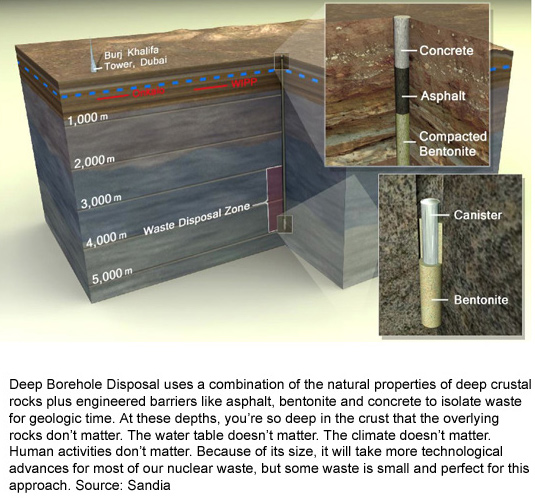
 Can’t We Just Throw Our Nuclear Waste Down A Deep Hole? http://www.forbes.com/sites/jamesconca/2015/03/05/cant-we-just-throw-our-nuclear-waste-down-a-deep-hole/ James Conca 5 Mar 15 Um…yes, we can. It’s called Deep Borehole Disposal and is pretty easy for some nuclear waste. Especially some highly radioactive materials that have sat in some fairly small capsules for almost 40 years.
This was exactly the topic of discussion in Washington this week when Secretary of Energy Ernest Moniz answered questions from Rep. Dan Newhouse (R-WA) at a House Science, Space and Technology committee hearing (Tri-City Herald).
The answer from Moniz was positive. He discussed a pilot project that would demonstrate the idea of deep borehole disposal using these capsules.
Deep borehole disposal is simple. Drill a very deep hole – 3 miles or so – put the waste in it and fill it up with some special layers, but mainly crushed rock and cement. As geologists, we know how many millions of years it takes for anything to get up from that depth in the Earth’s crust.
As long as you don’t put it under an active volcano!
The nice thing about deep borehole disposal is that it doesn’t matter where you put it in the country. At that depth, you’re so deep in the crust that the overlying rocks don’t matter. The water table doesn’t matter. The climate doesn’t matter. Human activities don’t matter.
But why these capsules? Because the material, cesium-137 and strontium-90 chloride salts (137CsCl and 90SrCl2), is in an easy waste form compared to that sludgy gooey stuff that makes up most of the tank waste left over from weapons production. These capsules are dry solid material in relatively small containers – less than 3-inches in diameter and only 2-feet long – very small compared to the large spent fuel assemblies and high-level waste glass logs usually discussed in geologic disposal plans.
Deep borehole disposal for the larger waste containers is trickier and more expensive because we haven’t yet drilled large-diameter holes that deep. Like all technological advances, we will (Sandia National Labs; Ethan Bates et al 2014). But these capsules are less than 3-inches wide, and we’ve drilled 6 and 8 inch holes that deep many times, so nothing really new needs to be developed for this project.
There are 1,936 capsules filled with radioactive 137CsCl and 90SrCl2 that are stored underwater at the Waste Encapsulation Storage Facility at DOE’s Hanford site in Washington State. Because these radionuclides, left over from plutonium production for weapons, are the primary heat-generator in nuclear waste, they were separated from the rest of the waste almost 40 years ago to reduce heat in the tanks, as well as to use in research.
But there is a time-sensitive nature to these capsules. Although CsCl doesn’t melt until 645°C (1,193°F), it goes through a bizarre solid-state phase change at 450°C (842°F). This means that without melting it’s atoms change their arrangement in space from one structure to another with a very different density. So as the temperature changes across this boundary, the material swells and shrinks. And that tends to degrade the containers it’s in.
The existing containers are beginning to get a little degraded, so best to get rid of them as soon as possible. They’re small, so deep borehole disposal would be cheap and easy.
Since there isn’t much of this boutique nuclear waste, only 5 cubic yards, and it’s in a great form, this is a perfect opportunity to demonstrate deep borehole disposal and clean out this facility.
Like all really hot nuclear waste, these capsules were destined for the proposed deep geologic nuclear waste repository at Yucca Mountain, Nevada, which was halted in 2010. Since a new permanent federal repository for high-level waste won’t be chosen for decades, we need to rethink our nuclear disposal program.
And this is a good idea, one of the few looked at by thePresident’s Blue Ribbon Commission on America’s Nuclear Future that was formed to come up with a new strategy in the wake of Yucca Mountain’s closure. Their recommendations were basically to pick disposal options suited to the waste and the need. And to get everyone to buy off on them before you start!
These capsules “could be very well suited perhaps for much earlier disposal through a borehole approach,” Moniz said. “We have to drill — we have to do the demonstration project, do the science, which is what we want to do in 2016.”
Budget proposal documents show $2 million for technology development to support plans in fiscal 2016 for what is anticipated to be a multi-year test using a non-radioactive waste substitute. Since Yucca Mountain was projected to cost over $200 billion, this is a steal.
The test would demonstrate technology for sealing the borehole, tools to characterize waste in the borehole and controls on waste isolation. DOE has also sought communities interested in being the site for the borehole test.
Progress in Tesla’s $5B solar-powered Gigafactory in Nevada
Construction of Tesla’s $5B solar-powered Gigafactory in Nevada is progressing nicely, Tree Hugger Michael Graham Richard (@Michael_GR) February 26, 2015
3,000 construction jobs for 3 years To change the world of transportation and leave oil behind in favor of clean sources of energy, you need batteries. Lots of them. Cheaply. That’s what Tesla is trying to do with its Gigafactory project — make as many advanced lithium-ion batteries in one location as the whole world is making today, driving down costs by at least 30%. This Gigafactory will be making 50 GWh of battery capacity per year by 2020, enough for 500,000 Tesla cars (mostly the cheaper upcoming Model 3), and the whole factory will be powered by clean energy. This is a $5 billion investment that will create 6,500 on-site jobs……http://www.treehugger.com/cars/construction-tesla-5-billion-solar-powered-gigafactory-nevada-progressing-nicely.html
South Korea marketing nuclear reactors to Saudi Arabia
 Saudi Arabia, South Korea sign MOU on nuclear power Wed Mar 4, 2015 Reuters) – Saudi Arabia and South Korea have signed a memorandum of understanding (MOU) to cooperate on the development of nuclear energy, Saudi state news agency SPA said, building on a deal signed in 2011.
South Korean President Park Geun-hye met with Saudi Arabia’s King Salman on Tuesday in Riyadh during an official visit, SPA said.
The MOU calls for South Korean firms to help build at least two small-to-medium sized nuclear reactors in Saudi Arabia, the South Korean presidential office said in a statement.
“If the two units go ahead, the cost of the contract will be (near) $2 billion,” the statement said……http://www.reuters.com/article/2015/03/04/saudi-south-korea-nuclear-idUSL5N0W61GM20150304
Potential for growth in Japan’s solar industry
Key Japanese takeaways from PV Expo, Japan solar
Panasonic is hoping its new home energy management system products will educate consumers and their families on energy use, in turn driving wider social acceptance of the technologies and their uses. PV Tech Andy Colthorpe. 5 Mar 15
As regular readers of the site will have seen already, PV Tech was at Tokyo’s PV Expo last week. Japan has been relatively ambitious with regards to solar for many years, even ahead of the introduction of the feed-in tariff (FiT) in July 2012. Thin-film manufacturer turned vertically integrated solar services provider Solar Frontier, for instance, was established as a subsidiary of petrochemical company Showa Shell in response to the OPEC oil price shock of the 1970s.
The boom that came with the introduction of the feed-in tariff (FiT), however, turned this primary focus on R&D into the development of enough gigawatts of utility-scale PV to put Japan in the top two or three solar nations on the planet in terms of deployment.
Much has been made of the grid connection and land shortage issues now facing utility-scale solar in particular, not least by PV Tech. There is an understanding that once the currently existing pipeline of projects is deployed, Japanese utility-scale PV, or megasolar as it is known in the country, will cease to go ahead in any significant numbers. That said, the pipeline stands at more than 50GW, which is a lot of solar in anyone’s book. Project investment and project rights trading are keeping the megasolar sector busy along with actual construction and design activities.
Beyond that, of course, it will be all about the diversification of the maturing industry, whether Japan’s commercial rooftop sector will pick up where megasolar left off, and whether Japanese households will keep installing their own systems. The former remains to be seen, while the forthcoming energy market deregulation process and the activities of both solar energy services companies and their partners in the house construction industry could drive the latter to new heights……http://www.pv-tech.org/editors_blog/key_japanese_takeaways_from_pv_expo_tokyo
1 This Month



Tell the Ukrainian Government to Drop Prosecution of Peace Activist Yurii Sheliazhenko

Petition to revoke the licensing of the Near Surface Nuclear Disposal Facility (NSDF) at Chalk River. https://www.ourcommons.ca/petitions/en/Petition/Details?Petition=e-7247


of the week – STOP SMALL MODULAR REACTORS IN CANADA
To see nuclear-related stories in greater depth and intensity – go to https://nuclearinformation.wordpress.com
-
Archives
- March 2026 (217)
- February 2026 (268)
- January 2026 (308)
- December 2025 (358)
- November 2025 (359)
- October 2025 (376)
- September 2025 (258)
- August 2025 (319)
- July 2025 (230)
- June 2025 (348)
- May 2025 (261)
- April 2025 (305)
-
Categories
- 1
- 1 NUCLEAR ISSUES
- business and costs
- climate change
- culture and arts
- ENERGY
- environment
- health
- history
- indigenous issues
- Legal
- marketing of nuclear
- media
- opposition to nuclear
- PERSONAL STORIES
- politics
- politics international
- Religion and ethics
- safety
- secrets,lies and civil liberties
- spinbuster
- technology
- Uranium
- wastes
- weapons and war
- Women
- 2 WORLD
- ACTION
- AFRICA
- Atrocities
- AUSTRALIA
- Christina's notes
- Christina's themes
- culture and arts
- Events
- Fuk 2022
- Fuk 2023
- Fukushima 2017
- Fukushima 2018
- fukushima 2019
- Fukushima 2020
- Fukushima 2021
- general
- global warming
- Humour (God we need it)
- Nuclear
- RARE EARTHS
- Reference
- resources – print
- Resources -audiovicual
- Weekly Newsletter
- World
- World Nuclear
- YouTube
-
RSS
Entries RSS
Comments RSS
 nuclear-news