If a nuclear warhead detonated above midtown Manhattan?
What would happen if an 800-kiloton nuclear warhead detonated above midtown Manhattan? Bulletin of the Atomic Scientists, 25 Feb 15 Steven StarrLynn EdenTheodore A. Postol Russian intercontinental ballistic missiles are believed to carry a total of approximately 1,000 strategic nuclear warheads that can hit the US less than 30 minutes after being launched. Of this total, about 700 warheads are rated at 800 kilotons; that is, each has the explosive power of 800,000 tons of TNT. What follows is a description of the consequences of the detonation of a single such warhead over midtown Manhattan, in the heart of New York City.

The initial fireball. The warhead would probably be detonated slightly more than a mile above the city, to maximize the damage created by its blast wave. Within a few tenths of millionths of a second after detonation, the center of the warhead would reach a temperature of roughly 200 million degrees Fahrenheit (about 100 million degrees Celsius), or about four to five times the temperature at the center of the sun.
A ball of superheated air would form, initiallly expanding outward at millions of miles per hour. It would act like a fast-moving piston on the surrounding air, compressing it at the edge of the fireball and creating a shockwave of vast size and power.
After one second, the fireball would be roughly a mile in diameter. It would have cooled from its initial temperature of many millions of degrees to about 16,000 degrees Fahrenheit, roughly 4,000 degrees hotter than the surface of the sun.
On a clear day with average weather conditions, the enormous heat and light from the fireball would almost instantly ignite fires over a total area of about 100 square miles.
Hurricane of fire. Within seconds after the detonation, fires set within a few miles of the fireball would burn violently. These fires would force gigantic masses of heated air to rise, drawing cooler air from surrounding areas toward the center of the fire zone from all directions.
As the massive winds drove flames into areas where fires had not yet fully developed,the fires set by the detonation would begin to merge. Within tens of minutes of the detonation, fires from near and far would joinhave formed a single, gigantic fire. The energy released by this mass fire would be 15 to 50 times greater than the energy produced by the nuclear detonation……….
No survivors. Within tens of minutes, everything within approximately five to seven miles of Midtown Manhattan would be engulfed by a gigantic firestorm. The fire zone would cover a total area of 90 to 152 square miles (230 to 389 square kilometers). The firestorm would rage for three to six hours. Air temperatures in the fire zone would likely average 400 to 500 degrees Fahrenheit (200 to 260 Celsius).
After the fire burned out, the street pavement would be so hot that even tracked vehicles could not pass over it for days. Buried, unburned material from collapsed buildings throughout the fire zone could burst into flames when exposed to air—months after the firestorm had ended.
Those who tried to escape through the streets would have been incinerated by the hurricane-force winds filled with firebrands and flames. Even those able to find shelter in the lower-level sub-basements of massive buildings would likely suffocate from fire-generated gases or be cooked alive as their shelters heated to oven-like conditions.
The fire would extinguish all life and destroy almost everything else.Tens of miles downwind of the area of immediate destruction, radioactive fallout would begin to arrive within a few hours of the detonation.
But that is another story.
Editor’s note: This article is adapted from “City on Fire” by Lynn Eden, originally published in the January 2004 issue of the Bulletin of the Atomic Scientists. http://thebulletin.org/what-would-happen-if-800-kiloton-nuclear-warhead-detonated-above-midtown-manhattan8023
Dr Helen Caldicott on The Medical Implications of the Nuclear Age – 27 February
 The Medical Implications of the Nuclear Age http://www.helencaldicott.com/medical-implications-nuclear-age/ by Ricky Onsman January 22, 2015 The Department of Environmental Sciences at Rutgers, The State University of New Jersey, is hosting a seminar and book signing by Dr Caldicott on Friday February 27 2015.
1:30 P.M. – Alampi Room
Marine Sciences Bldg., 71 Dudley Road, New Brunswick, NJ
Refreshments served at 1:15 pm
Host: Prof. Alan Robock, robock@envsci.rutgers.edu, 848-932-5751
Website: Environmental Sciences Seminarshttp://www.envsci.rutgers.edu/info/seminar/seminar.shtml
“The medical dangers of the nuclear fuel chain begin at uranium mining and end with either a massive nuclear power plant meltdown, a nuclear war or the many diseases and mutations in animals, plants and humans that will arise from the inevitable leakage of radioactive waste and the subsequent pollution of food chains for virtually infinity. I will walk people through this highly complex issue so that they have a deeper understanding of the genetic and carcinogenic dangers of the nuclear age.”
CRISIS WITHOUT END and NUCLEAR POWER IS NOT THE ANSWER will be available for sale and signing after the talk.
The long and tortuous process of ridding the world of nuclear weapons
As long as any state has nuclear weapons, others will want them. As long as they exist, they will be used again someday, if not by design and intent, then through miscalculation, accident, rogue launch or system malfunction. Any such use anywhere could spell catastrophe for the planet.
The only guarantee of zero nuclear weapons risk, therefore, is to move to zero nuclear weapons possession by a carefully managed process.
 Belling the nuclear wildcat, Japan Times, 26 Feb 15 BY RAMESH THAKUR
“………..The peoples of the world recognize the dangers of nuclear arsenals. Curiously, however, their concerns and fears find little reflection in the media coverage or in governments’ policy priorities. Continue reading
The massive costs and massive dangers of hosting a radioactive nuclear trash dump
 Inside the race for Canada’s nuclear waste: 11 towns vie to host deep burial site Canada’s nuclear waste will be deadly for 400,000 years. What town would like the honour of hosting it?CHARLES WILKINS TheGlobe and Mail Feb. 26 2015,

“If I piled any quantity of shit out there and left it with no disposal plan, I’d be shut down and condemned within weeks. And here’s an industry with the capacity for global devastation, with no permanent plan for their garbage, the most dangerous stuff on Earth, and they’re allowed to keep producing it indefinitely.”
There is in fact a plan for that waste. A federally mandated body, the Nuclear Waste Management Organization (NWMO), wants to bury it in what the nuclear industry calls a Deep Geological Repository, or DGR. First, though, the organization must complete its quest—in effect, a competition, although the NWMO doesn’t see it that way—to find a municipality that will serve as a “willing host” for the repository. Among the contenders for the distinction are the municipalities of Huron-Kinloss, South Bruce and Central Huron, all of them close neighbours to Fran and Tony McQuail.
If it doesn’t seem like a competition any municipality would want to win, consider that spending on the project will likely run as high as $24 billion. And, the construction phase aside, the jobs involved are not the sort that will last only until another, perhaps cheaper, location is found. According to the NWMO’s plan, 400,000 years or more will pass between the point at which the waste is buried and the happy day when any sort of safety sticker is likely to be affixed to the vast toxic grave.
One morning in October, 1957, the principal of Keyes Public School in Deep River, Ontario, came into our Grade 5 classroom and declared that we, the children of the town, had “nothing to be afraid of.” We were to pay no attention to rumours that the reactors at nearby Chalk River would be among the Soviet Union’s first targets should the Cold War suddenly heat up.
Because we had older siblings ever willing to heighten our appreciation of reality, we already knew that if the reactors got hit, the explosion would be the equivalent of a thousand, maybe a million, H-bombs. We knew, too, that Deep River was located exactly seven miles from the reactors because that was the minimum distance at which human life would be spared if the plant ever got hit.
Mercifully, the missiles never came. And the plant never blew.
Others did: Three Mile Island (1979), Chernobyl (1986), Fukushima (2011).
Most of the reactor stories we heard as kids turned out to be fables. Yet more than half a century later, they remain bristling little allegories not just of the risks of splitting the atom but of the doggedness of those who continue to tell us we have “nothing to fear” from an industry that in 1945 said hello to humanity by incinerating 80,000 citizens of Hiroshima…….http://www.theglobeandmail.com/report-on-business/rob-magazine/inside-the-race-for-canadas-nuclear-waste/article23178848/
India-Pakistan tensions – how easily a terror attack could trigger nuclear war
Major terror attack against India could trigger nuclear war: experts http://www.deccanchronicle.com/150226/world-neighbours/article/major-terror-attack-against-india-could-trigger-nuclear-war-experts PTI | February 26, 2015, Washington: Pakistan may use nuclear weapons against India if the latter goes for a large scale military assault against it in retaliation for a major terror attack emanating from across the border, two top American experts have warned US lawmakers.
Given the presence of a strong government in New Delhi and the pressure on it from Indian citizens in the event of a repeat of 26/11 type terror attack, the ties between the two neighbours have greater danger of escalating towards a devastating nuclear warfare, in particular from Pakistan.
Such a dangerous scenario can only be avoided by the US working with Islamabad to ensure that there is no further large scale terror attack on India emanating from Pakistan, two top American experts. George Perkovich and Ashley Tellis, told members of the powerful Senate Armed Services Committe and Sub committee on Strategic Forces during a hearing yesterday. Continue reading
Effect of ionising radiation on health, shown through Baby Tooth Survey
 They found that the radioactive strontium-90 levels in the baby teeth of children born from 1945 to 1965 had risen 100-fold and that the level of strontium-90 rose and fell in correlation with atomic bomb tests.
Early results from the Baby Tooth Survey, and a U. S. Public Health Service study that showed an alarming rise in the percentage of underweight live births and of childhood cancer, helped persuade President John F. Kennedy to negotiate a treaty with the Soviet Union to end above-ground testing of atomic bombs in 1963.
St. Louis Baby Tooth Survey, 1959-1970, Washington University School of Dental Medicine Though many members of the group were vocally against nuclear testing, CNI never took an official position for or against the testing of nuclear weapons. Scientific facts were assembled, studied by the Committee and its Scientific Advisory Group, and then made available to the public through regular bulletins, newsletters, and a speaker’s bureau…. Continue reading
Washington State Senator Sharon Brown enthusiastically pushing for Small Modular Nuclear Reactors
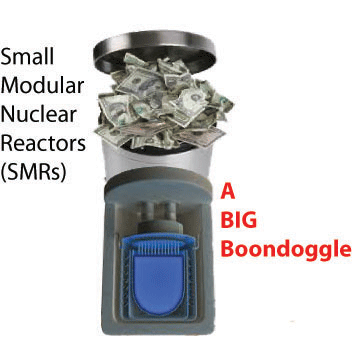 Nuclear Advocate Pushes For Modular Reactor Presence In Washington State http://www.icontact-archive.com/uY4CWN-9Ks3su6iHyVeY7nHzrprAq8_d?w=1 Feb 25 2015 A state senator in Washington, Sharon Brown, R-Kennewick, is promoting nuclear energy with a focus on technology that has yet to be put into operation.
Bills that Brown have sponsored nudge the state towards acceptance of modular, factory-built nuclear reactors, The Olympian reported Tuesday.
Brown has called for a relatively modest $176,000 study to identify sites for nuclear power reactors that are in frequent discussions, but have yet to be built – reactors with a generation capacity of 300 MW or less.
In neighboring Oregon, NuScale Power is developing reactors that will built in one location and shipped by truck or rail to their final destination
“We need to make sure we’re not left behind,” said Brown at a hearing Tuesday. She also said, “It’s really important that as a state we get our arms around small nuclear reactors.”
Brown, who is pushing the state to nudge the federal government on construction of a federal waste repository, has sponsored other nuclear power-friendly bills that cleared a critical deadline last week. These include a bill to provide sales tax relief for small reactor production and one that mandates the Commerce Department support small reactors development for commercial use.
She has also sponsored measures that would allow energy from modular reactors to count as part of the state’s renewable energy targets, although these initiatives have strong opposition from environment groups.
The initiatives follow up on a previous state study, completed in September, that said a modular reactor facility was feasible for the Hanford Site nuclear facility.
Giant craters appearing in Siberia – result of thawing permafrost, due to global warming?
 The Siberian crater saga is more widespread — and scarier — than anyone thought WP, By Terrence McCoy February 26 In the middle of last summer came news of a bizarre occurrence no one could explain. Seemingly out of nowhere, a massive crater appeared in one of the planet’s most inhospitable lands. Early estimates said the crater, nestled in a land called “the ends of the Earth” where temperatures can sink far below zero, yawned nearly 100 feet in diameter.
The saga deepened. The Siberian crater wasn’t alone. There were two more, ratcheting up the tension in a drama that hit its climax as a probable explanation surfaced. Global warming had thawed the permafrost, which had caused methane trapped inside the icy ground to explode. “Gas pressure increased until it was high enough to push away the overlaying layers in a powerful injection, forming the crater,” one German scientist said at the time.
[Scientists may have cracked the giant Siberian crater mystery — and the news isn’t good]
Now, however, researchers fear there are more craters than anyone knew — and the repercussions could be huge. Russian scientists have now spotted a total of seven craters, five of which are in the Yamal Peninsula. Two of those holes have since turned into lakes. And one giant crater is rimmed by a ring of at least 20 mini-craters, the Siberian Times reported. Dozens more Siberian craters are likely still out there, said Moscow scientist Vasily Bogoyavlensky of the Oil and Gas Research Institute, calling for an “urgent” investigation.
He fears that if temperatures continue to rise — and they were five degrees higher than average in 2012 and 2013 — more craters will emerge in an area awash in gas fields vital to the national economy. “It is important not to scare people, but to understand that it is a very serious problem and we must research this,” he told the Siberian Times. “… We must research this phenomenon urgently, to prevent possible disasters.”……..http://www.washingtonpost.com/news/morning-mix/wp/2015/02/26/the-siberian-crater-problem-is-more-widespread-and-scarier-than-anyone-thought/?tid=hpModule_9d3add6c-8a79-11e2-98d9-3012c1cd8d1e&hpid=z16
The ever-accumulating tonnage of Canada’s radioactive trash
the Nuclear Waste Management Organization (NWMO), wants to bury it in what the nuclear industry calls a Deep Geological Repository, or DGR
“Finally,” says Eugene Bourgeois, whose idyllic property lies within a kilometre of the Bruce Power reactors, “it has to be impervious to the potential ignorance or delinquency of people, perhaps ‘peopleoids,’ more than a quarter-million years from now”—which is to say, peopleoids who likely will have no notion even of the languages in which the safety code and signage of the DGR were written.
At the same time, the site can’t be too remote. It must be serviced by roads and rail, so that waste can be brought in, and must have a sufficient population that the thousands of folks who will build the facility and the hundreds who will be employed there long-term will have a place to live

Inside the race for Canada’s nuclear waste: 11 towns vie to host deep burial site Canada’s nuclear waste will be deadly for 400,000 years. What town would like the honour of hosting it? CHARLES WILKINS TheGlobe and Mail Feb. 26 2015,
……..the Western Waste Management Facility, where Ontario Power Generation stores much of its share of the 48,000 tonnes of waste that have accumulated in Canada during the past 65 years and that the company and other nuclear-power producers hope will eventually be lowered into the national DGR (Deep Geological Repository)
The ever-accumulating tonnage, which in the wrong hands could provide payloads for thousands of atomic bombs, is entombed in a thousand snow-white containers (a half-inch of steel atop reinforced concrete), each the size of, say, a Lincoln Navigator set on end and weighing 70 tonnes……..
The $24-billion cost of a deep repository—to be paid by the producers (hence ultimately their customers) out of a fund that now stands at less than $3 billion—sounds like a lot for the existing quantity of nuclear-fuel waste in the country. NWMO spokesman Mike Krizanc visualizes Canada’s 48,000-tonne waste pile as “enough to cover six NHL-sized hockey rinks to the top of the boards.”
The discrepancy is explained by toxicity. According to Gordon Edwards, a mathematician who has critiqued the nuclear industry for decades as president of the Canadian Coalition for Nuclear Responsibility, irradiated—that is, used—nuclear fuel is “millions of times more radioactive and deadly than when the unirradiated fuel was placed in the reactors.” Studies have connected the various isotopes contained in the waste to cancer, immune system damage and genetic mutation. Those six hockey rinks are enough, say nuclear detractors, that if the waste is buried in the wrong place, or in the wrong way, it could ruin our water, render the landscape useless for agriculture, or, in a darker scenario, render it useless for human habitation…… Continue reading
SNC Lavalin Nuclear and Ontario Power Generation (OPG) in court over costs of Darlington nuclear rebuild
 We’ll see SNC Lavalin Nuclear in court http://www.cleanairalliance.org/bulletins Angela Bischoff 24 Feb 15 In March 2011, the Ontario Clean Air Alliance (OCAA) filed a Freedom of Information (FOI) request to obtain details of the contract between Aecon Construction, SNC Lavalin Nuclear and Ontario Power Generation (OPG) for the re-building of four reactors at the Darlington Nuclear Station on Lake Ontario.
Aecon Construction and SNC Lavalin, not surprisingly, are not keen to reveal just how rich this mega contract is and refused to provide the information. However, the the Information and Privacy Commissioner of Ontario (IPC) ruled that the companies should provide relevant details, a decision Aecon and SNC then appealed to the Superior Court.
 The companies are insisting that they were “confused” by the Freedom of Information request process, which the Privacy Commissioner’s counsel notes is rather odd, considering that these “are multi-billion dollar companies that have access to a wealth of internal and external legal resources [and] have a history of being involved in access to information requests in other Canadian jurisdictions.“
The companies are also trying to use another technicality to shield the details of the deal, including whether it allows cost overruns to be passed onto taxpayers and ratepayers. They are insisting that contracts are not covered by FOI legislation because they represent information provided by one party to another. The Commissioner’s counsel strongly disagrees in her response, citing an explanation from the Government of Canada:
“.. . The intention of Parliament in exempting financial and commercial information from disclosure applies to confidential information submitted to the government, not negotiated amounts for goods or services. Otherwise, every contract amount with the government would be exempt from disclosure, and the public would have no access to this important information …”
Given the long history of secret deals in Ontario’s nuclear power sector that have led to massive cost overruns – and massive debt for Ontario taxpayers and ratepayers – the OCAA believes the public has every right to know more about the deal struck between OPG and these two construction and engineering giants. We would like to thank the Information and Privacy Commissioner for robustly defending our right to see this information.
We’re hoping we won’t have to repeat this difficult and time consuming exercise with another secret nuclear deal – an agreement to rebuild reactors at the Bruce Nuclear Station. Instead of forcing public interest groups to file freedom of information requests after the fact, the government should walk its talk on openness and transparency by sending any proposed Bruce Deal to the Ontario Energy Board for a full public review.
Please join us to observe the proceedings as well as to show your support for greater transparency in government decision making this coming Monday :
- Monday March 2, 10 a.m.(come at any time during the day)
- Osgoode Hall, 130 Queen St. West (NE corner of Queen/University), in Courtroom # 3 (on 2ndfloor), entrance off Queen St., Toronto
A little sunshine can keep everyone healthier.
p.s. Our Ontario budget proposal to take a pass on rebuilding the Darlington Nuclear Plant in favour of importing lower-cost water power from Quebec has clearly made some vested interests in the Ontario nuclear industry very nervous. Our proposal on the government’s budget consultation website has suddenly been inundated with “thumbs down” votes. This orchestrated campaign to deep six our idea just shows how the nuclear industry really can’t compete with our highly sensible proposal. Don’t let them get away with it! Give our idea a thumbs up right now.
White Elephant CANDU nuclear technology sold to scandal-plagued engineering firm SNC Lavalin.
Inside the race for Canada’s nuclear waste: 11 towns vie to host deep burial site Canada’s nuclear waste will be deadly for 400,000 years. What town would like the honour of hosting it?CHARLES WILKINS TheGlobe and Mail Feb. 26 2015,
…….So accustomed have we become to such power, we have largely stopped thinking about its uncomfortable truths: For example, that Canada’s signature nuclear technology, the CANDU reactor, seeded proliferation of atomic weapons in Pakistan and India.
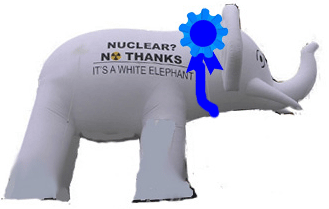 Or that the supposedly world-beating CANDU turned out to be a financial white elephant: The CANDU’s creator, Atomic Energy of Canada Ltd., devoured billions in subsidies before the CANDU technology was finally sold for a pittance to scandal-plagued engineering firm SNC Lavalin.
Nuclear power is said to be cheap—but only if one doesn’t count costs that either have been offloaded or are yet to be fully funded, such as accident liability, waste management and the debts incurred in reactor construction. Moreover, the industry has a history of wild cost overruns: The bill for creating Ontario’s Darlington facility during the 1980s climbed from a projected $3.9 billion to more than $14 billion………http://www.theglobeandmail.com/report-on-business/rob-magazine/inside-the-race-for-canadas-nuclear-waste/article23178848/
Abandoning plans for nuclear power – the “only safe option” – Naoto Kan tells Wales
Former Japanese PM warns against Welsh nuclear site renewal By Daily Wales correspondent, 25 Feb 15
The former Prime Minister of Japan has used a visit to Wales to urge the UK Government to scrap its commitment to nuclear energy. He is using the tour to send out a message to the UK Government that the safety risks posed by nuclear energy are simply not worth taking.
He said:
“What occurred in Fukushima in 2011 was caused by humans, not a natural disaster. It is clear to me that what caused this catastrophe was our commitment to an unsafe and expensive technology that is not compatible with life on this planet.
“The only safe option when it comes to nuclear power is to abandon your plans for nuclear power. It simply is not worth the risk………
Mr Kan’s visit to Wales has been supported by Welsh anti-nuclear campaign group, People Against Wylfa B (PAWB), Friends of the Earth Cymru, CND Cymru and Welsh language campaign group, Cymdeithas yr Iaith.
http://dailywales.net/2015/02/25/former-japanese-pm-warns-against-welsh-nuclear-site-renewal/
Fukushima’s Unit 2 nuclear reactor’s meltdown was far worse than initially assumed
 “.SimplyInfo.org Fukushima Daiichi Unit 2 Report 2015 (Excellent graphics)
By The SimplyInfo Research Team
Dean Wilkie – Author
Edano San – Author
Peter Melzer PhD – Author
Nancy Foust – Editor
February 23, 2015
During the early events of the Fukushima Daiichi disaster unit 2 was given little attention in public facing information. It also appears that many of the outcomes from unit 2 may have been credited as being caused by other units a the plant or considered of unknown origin. Unit 2 may have been much worse in actuality than the public was being told and a larger contributor to the crisis. We reviewed multiple timelines and documentation sources of the events at Fukushima Daiichi and those specific to unit 2. This provided a clearer picture of what larger events may have been associated with unit 2′s event and the magnitude of the events inside unit 2. These events compared to the existing research into reactor failure modes and meltdown behaviors found that the events closely matched the expected outcomes………Unit 2′s meltdown and post meltdown progression was well anticipated by TEPCO based on their actions and their failure time estimates. TEPCO opened the torus vent line to the environment and left it open for 2.5 hours while fuel was likely already outside of the vessel and in the containment drywell, giving a clear route between corium and the environment. This action may have been unavoidable based on the available data from unit 2 in order to avoid a much larger containment failure that could not have been closed. It may have been the lesser of two bad options.
The available data and visual evidence for unit 2 show that contaminated water and fuel may have found a route out of the building through the basemat area. This highly radioactive water has shown up in the unit 2 turbine building basement and in the unit 2 trenches at the sea front, indicating the highly contaminated water may be flowing outside of the reactor building and in a manner quite different from the other two damaged units. If this is further confirmed to be the case, this may be a significant contributor to the ongoing highly radioactive water leaks that have defied efforts to block them.
Unit 2′s containment failure via the containment cap gasket continued to contribute a large percentage of the radiation escaping into the air at the plant even a year after the meltdowns. While the other two units have been admitted to have some failure or leakage from their reactor wells, unit 2 appears to be the major contributor to airborne releases via this route and continued to do so.
Newer information such as the failure of seawater injections to reach the RPV further ads to the growing body of information that indicates unit 2′s meltdown was far worse than initially assumed. Many early estimates of the extent of unit 2′s meltdowns were dependent on the assumption that water reached the melting fuel in quantities large enough to cool or cover the melted fuel. This newer understanding of the water injection shows those early estimates to be incorrect and that unit 2′s meltdown was much more severe than initially assumed. The timing of major events at the plant that tie to events at unit 2 and TEPCO’s increasing alarm over the degrading conditions of the plant indicates that unit 2 may have posed an even larger threat than the other two units at the plant. The chance event of the blow out panel dislodging early in the series of events may have helped unit 2 avoid a hydrogen explosion as seen at the other units. The actual meltdown and the extent of the damage at unit 2 may have been worse in many ways. http://www.fukuleaks.org/web/?p=14318
Expanding nuclear power is simply unaffordable
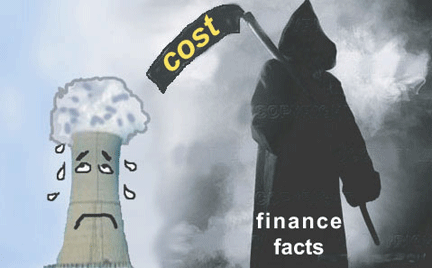 We Can’t Afford to Expand Nuclear Power http://www.usnews.com/debate-club/should-nuclear-power-be-expanded/we-cant-afford-to-expand-nuclear-power By Tyson Slocum We haven’t expanded our nuclear fleet in the past 40 years because the daunting financial costs and massive risks make it unaffordable and unsuitable to meet America’s future energy needs. Despite the successful efforts of nuclear company lobbyists to secure generous public subsidies, only one new facility—in Georgia—is under construction in the U.S. Efficiency measures, as well as cleaner and safer technologies—such as wind and solar power—are competing and winning against nuclear power. And that’s a great thing if you care about sustainable, healthy communities.
Perhaps the most compelling reason new reactors should not be built is that we can’t handle the ones we’ve got. Our existing fleet of reactors is plagued with a host of issues, including tritium leaks, overconsumption of water in drought-stricken areas, outdated evacuation plans for growing populations, inadequate decommission funds, a rapidly retiring professional labor force, and mounting stockpiles of radioactive waste.
Instead of looking to a failed technology of the past, we should be investing in modern, clean technologies that don’t saddle our future with insurmountable issues.
Potential for transforming relationships with Iran, with nuclear talks, says EU Foreign-Policy Chief
 EU Foreign-Policy Chief Sees Progress on Iran Nuclear Talks Mogherini says an accord could transform ties with Tehran WSJ By LAURENCE NORMANFeb. 26, 2015 BRUSSELS—Nuclear talks between Iran and six major powers are getting close to agreement after more than a decade of diplomacy, the European Union’s foreign-policy chief Federica Mogherini said in an interview with The Wall Street Journal on Thursday.
Senior U.S. officials on Monday said there was progress during weekend discussions as Iran and the six powers—the U.S., France, Germany, the U.K., Russia and China—seek to agree on the framework of a final agreement by the end of March. The deadline for the full, detailed agreement is June 30.
U.S. Secretary of State John Kerry said this week that the six powers should know soon whether a deal was attainable. However, officials have warned that significant gaps remain in the diplomacy, which aims to ensure Tehran can’t quickly amass enough material for a nuclear bomb in return for phasing out tough international sanctions.
Asked if she believed the two sides were coming close to a deal, Ms. Mogherini said, “Yes, we are getting close.”…..http://www.wsj.com/articles/iran-six-powers-near-nuclear-deal-1424975896
1 This Month



Tell the Ukrainian Government to Drop Prosecution of Peace Activist Yurii Sheliazhenko

Petition to revoke the licensing of the Near Surface Nuclear Disposal Facility (NSDF) at Chalk River. https://www.ourcommons.ca/petitions/en/Petition/Details?Petition=e-7247


of the week – STOP SMALL MODULAR REACTORS IN CANADA
To see nuclear-related stories in greater depth and intensity – go to https://nuclearinformation.wordpress.com
-
Archives
- March 2026 (222)
- February 2026 (268)
- January 2026 (308)
- December 2025 (358)
- November 2025 (359)
- October 2025 (376)
- September 2025 (258)
- August 2025 (319)
- July 2025 (230)
- June 2025 (348)
- May 2025 (261)
- April 2025 (305)
-
Categories
- 1
- 1 NUCLEAR ISSUES
- business and costs
- climate change
- culture and arts
- ENERGY
- environment
- health
- history
- indigenous issues
- Legal
- marketing of nuclear
- media
- opposition to nuclear
- PERSONAL STORIES
- politics
- politics international
- Religion and ethics
- safety
- secrets,lies and civil liberties
- spinbuster
- technology
- Uranium
- wastes
- weapons and war
- Women
- 2 WORLD
- ACTION
- AFRICA
- Atrocities
- AUSTRALIA
- Christina's notes
- Christina's themes
- culture and arts
- Events
- Fuk 2022
- Fuk 2023
- Fukushima 2017
- Fukushima 2018
- fukushima 2019
- Fukushima 2020
- Fukushima 2021
- general
- global warming
- Humour (God we need it)
- Nuclear
- RARE EARTHS
- Reference
- resources – print
- Resources -audiovicual
- Weekly Newsletter
- World
- World Nuclear
- YouTube
-
RSS
Entries RSS
Comments RSS
 nuclear-news