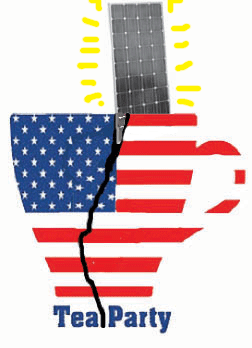
USA’s Tea Party – 85 groups join movement for solar energy!
Floridians for Solar Choice, the group behind the initiative, is an inchoate alliance of libertarians, Christian Coalition conservatives, liberal environmentalists, and eighty-five Tea Party groups
 Greening the Tea Party, New Yorker BY CAROLYN KORMANN 18 Feb 15 The solar-energy business is booming. The average cost of installing solar panels has dropped by half since 2010, and a new solar electric system is now installed somewhere in the United States every four minutes.
The growth extends well beyond the rooftops of American homes and small businesses; last week, Apple announced that it is investing in an eight-hundred-and-fifty-million-dollar solar farm in Monterey County, California, which it says will power its operations in the state by the end of 2016. Although solar is still small, supplying less than one per cent of the country’s electricity, its growth has alarmed the energy industry’s old guard—coal, oil, and utility companies.
Working primarily through conservative advocacy groups such as the American Legislative Exchange Council ALEC), which lobbies at the state level, and Americans for Prosperity (A.F.P.), which was founded by Charles and David Koch, the billionaire industrialists, this coalition is doing its best to weaken the nascent industry, particularly rooftop solar. In a curious twist, however, ALEC and A.F.P. have found themselves butting heads with—and even losing battles to—tough-minded, pro-solar branches of the Tea Party.
Dooley led a fight to persuade Georgia’s all-Republican utility commission to require Georgia Power to buy more of its energy from solar sources……..
Solar is prospering in spite of these efforts, and not only among wealthy liberals in California. According to the Center for American Progress, a liberal think tank, the majority of solar-equipped households in New York and Massachusetts are located in neighborhoods with a median income of between forty and ninety thousand dollars…
…In Georgia, thanks in part to Dooley’s efforts, the State Senate is likely to pass a bill that will make rooftop solar easier and cheaper for residents to install. (The House just passed it unanimously.) “Georgia is the new sunshine state,” Dooley told me happily. When we spoke, she was driving to the old sunshine state, Florida, which has notably limited options or incentives for solar investors. Dooley is helping lead the launch of a major ballot initiative that would amend that state’s constitution to allow individuals and businesses with solar panels to sell the power that they generate directly to their tenants or neighbors. (Current law permits only utility companies to sell electricity.)
Floridians for Solar Choice, the group behind the initiative, is an inchoate alliance of libertarians, Christian Coalition conservatives, liberal environmentalists, and eighty-five Tea Party groups—Dooley’s people. They need to collect seven hundred thousand signatures by next February to get the measure on the ballot the following November. The stakes in Florida are high, and Dooley and her colleagues expect substantial resistance from the utility companies and their allies. Last fall, however, a Republican pollster found that seventy-four per cent of Floridians support the goals of the ballot measure. “I’ve got other states saying, ‘Please help us,’ ” Dooley told me. “But Florida is ground zero. http://www.newyorker.com/tech/elements/green-tea-party-solar
No comments yet.
1 This Month



Tell the Ukrainian Government to Drop Prosecution of Peace Activist Yurii Sheliazhenko

Petition to revoke the licensing of the Near Surface Nuclear Disposal Facility (NSDF) at Chalk River. https://www.ourcommons.ca/petitions/en/Petition/Details?Petition=e-7247


of the week – STOP SMALL MODULAR REACTORS IN CANADA
To see nuclear-related stories in greater depth and intensity – go to https://nuclearinformation.wordpress.com
-
Archives
- March 2026 (222)
- February 2026 (268)
- January 2026 (308)
- December 2025 (358)
- November 2025 (359)
- October 2025 (376)
- September 2025 (258)
- August 2025 (319)
- July 2025 (230)
- June 2025 (348)
- May 2025 (261)
- April 2025 (305)
-
Categories
- 1
- 1 NUCLEAR ISSUES
- business and costs
- climate change
- culture and arts
- ENERGY
- environment
- health
- history
- indigenous issues
- Legal
- marketing of nuclear
- media
- opposition to nuclear
- PERSONAL STORIES
- politics
- politics international
- Religion and ethics
- safety
- secrets,lies and civil liberties
- spinbuster
- technology
- Uranium
- wastes
- weapons and war
- Women
- 2 WORLD
- ACTION
- AFRICA
- Atrocities
- AUSTRALIA
- Christina's notes
- Christina's themes
- culture and arts
- Events
- Fuk 2022
- Fuk 2023
- Fukushima 2017
- Fukushima 2018
- fukushima 2019
- Fukushima 2020
- Fukushima 2021
- general
- global warming
- Humour (God we need it)
- Nuclear
- RARE EARTHS
- Reference
- resources – print
- Resources -audiovicual
- Weekly Newsletter
- World
- World Nuclear
- YouTube
-
RSS
Entries RSS
Comments RSS
 nuclear-news
Leave a comment