Time for global inspection of nuclear reactors – urged by Belgian nuclear regulator
 4514865 18 February 2015 The Belgian Federal Agency for Nuclear Control has called for thorough inspections of nuclear plants worldwide following detection of multiple cracks in critical components of two reactors in Belgium.
Belgian Federal Agency for Nuclear Control director-general Jans Bens has urged for careful inspection of all the 430 nuclear facilities globally.
Steel nuclear reactor pressure vessels in Doel 3 and Tihange 2 plants were found to be affected in 2012, which had been dismissed as manufacturing defects by the operator of the reactors, Electrabel.
Further tests in 2014 at the facilities indicated advanced embrittlement of the sample steel vessels.
Operations at both the facilities stopped in March 2014.
Unexpected cracking in the vessels can be caused due to corrosion from normal operation.
The presence of highly radioactive nuclear fuel cores in the vessels raises the risk of accidents during malfunction, and it is assumed that this could be an issue with all nuclear power generation facilities worldwide.
Greenpeace Belgium energy campaigner Eloi Glorieux said: “What we are seeing in Belgium is potentially devastating for nuclear reactors globally due to the increased risk of a catastrophic failure.
“Nuclear regulators worldwide must require reactor inspections as soon as possible, and no later than the next scheduled maintenance shutdown. If damage is discovered, the reactors must remain shut down until and unless safety and pressure vessel integrity can be guaranteed. The nuclear industry, already in crisis, is faced with an ageing nuclear reactor fleet at increasing risk of severe disaster.”
The 435 commercial nuclear reactors operational across the world had an average age of around 29 years old.
Out of the operational nuclear reactors, nearly 170 reactors have been functioning for 30 years or more, and 39 reactors are aged above 40 years.
US Navy knew that sailors on USS Reagan received dangerous radiation
 Documents Say Navy Knew Fukushima Dangerously Contaminated the USS Reagan http://ecowatch.com/2014/02/26/navy-knew-fukushima-contaminated-uss-reagan/Harvey Wasserman | February 26, 2014
A stunning new report indicates the U.S. Navy knew that sailors from the nuclear-powered USS Ronald Reagan took major radiation hits from the Fukushima atomic power plant after its meltdowns and explosions nearly three years ago.
International concern that Japan’s nuclear regulator will lose its independence from government

 Japan nuclear regulator advisers fear loss of its ‘essential’ independence TOKYO Wed Feb 18, 2015 (Reuters) by Aaron Sheldrick; and Kentaro Hamada – International advisers to Japan’s atomic regulator have raised concern a mandatory review of its performance could lead to a loss of independence for the body, which was set up in the wake of the 2011 Fukushima nuclear disaster.
A lack of independent regulatory oversight of Tokyo Electric Power Co’s Fukushima Daiichi nuclear station north of Tokyo was to blame for the meltdowns after an earthquake and tsunami, an official inquiry into the disaster found.
After the disaster, the Nuclear Regulation Authority (NRA) was created under the environment ministry with more autonomy but legislation provided for a review after three years of operation with a proviso to consider placing it under the Cabinet Office, involving closer political oversight.
While welcoming a review of the NRA, the advisers, who include the chairman of the International Atomic Energy Agency’s International Nuclear Safety Group, Richard Meserve, were concerned about political interference, they said in a document dated Wednesday and posted on the regulator’s website.
“We … are concerned about any transfer of authority that would serve to compromise the regulator’s independence,” the document said…….
The review of NRA operations started in September but no decisions have been made on whether the Cabinet Office will assume oversight……
The Cabinet Office coordinates planning and policy on issues of crucial national importance and works as the “place of wisdom” in support of the Prime Minister and Cabinet, according to its website.
Prime Minister Shinzo Abe is a strong proponent of nuclear power and wants to restart reactors that pass the new safety regime, after all units were shut down gradually in the wake of the Fukushima crisis, the worst nuclear disaster since Chernobyl in 1986……http://www.reuters.com/article/2015/02/18/us-japan-nuclear-concerns-idUSKBN0LM0I420150218
Australian reporter tours crumbling Fukushima nuclear plant
Entry to closed areas would lead to instant death
The only way TEPCO can control the meltdowns in 1, 2 and 3 is to pump water in to cool them, but the water becomes highly radioactive and mixes with the massive amount of groundwater that flows into the reactors from the surrounding hills.
Locals distrust TEPCO, say future is ‘hopeless’

Inside Fukushima: ABC tours crippled power plant as Japan prepares to restart nuclear industry http://www.abc.net.au/news/2015-02-18/japan-prepares-to-restart-their-nuclear-power-program/6142528 Exclusive by North Asia correspondent Matthew Carney Almost four years after the Fukushima disaster, Japan is about to restart its nuclear industry.
The 2011 meltdowns at the tsunami-hit plant prompted a shutdown of all Japan’s nuclear power stations and saw the power station’s operator TEPCO accused of cover-ups and gross negligence.
TEPCO says radiation levels at Fukushima have significantly decreased and major steps have been taken to decommission the molten reactors.
Others say the plant cannot be fixed and thousands of people will never be allowed to return to their homes because of high radiation.
With vacuum-sealed protection gear and special breathing apparatus, TEPCO gave the ABC an exclusive tour of the crippled plant. Continue reading
Israel accused by USA of using ‘leaks’ to misrepresent Iran nuclear talks
 Iran nuclear talks: US accuses Israel of ‘leaks’ The US has accused Israel of selectively leaking information from the Iran nuclear talks to misrepresent its position in the negotiations. BBC News, 19 Feb 15
White House spokesman Josh Earnest said that Israel was “cherry-picking” information and using it out of context.
Six world powers want Iran to curb its nuclear programme in return for the lifting of sanctions.
Negotiations with Iran are due to begin again on Friday.
Iranian officials said that US Secretary of State John Kerry will also be travelling to Geneva this weekend for two days of talks with Iran’s foreign minister.
‘Selective sharing’
On Wednesday, Mr Earnest that the US was mindful of keeping negotiations private because of selective leaks on the part of Israel.
“There’s no question that some of the things that the Israelis have said in characterising our negotiating position have not been accurate,” he said.
State Department spokeswoman Jen Psaki confirmed that there was a “selective sharing” of information.
“I think it’s safe to say that not everything you’re hearing from the Israeli government is an accurate reflection of the details of the talks,” she said.
Unnamed US officials told The Associated Press news agency that politically motivated leaks from Israeli officials had made it impossible for the US to continue to share all details of the talks. The accusations come less than two weeks before Israeli Prime Minister Benjamin Netanyahu is due to address a joint session of the US Congress on the threat from Iran.
There has been increasingly strained ties between the US and Israel over the nuclear deal with Iran……..http://www.bbc.com/news/world-middle-east-31538531
Worker deaths at Fukushima nuclear plant
Professor: Fukushima workers told us about “all of the deaths” happening at nuclear plant — We stayed at their dormitory and “learned a lot about what’s going on there, it really is not pretty” — Instructor who was with him on trip weeps while topic is discussed (VIDEO) http://enenews.com/professor-fukushima-workers-revealed-all-deaths-happened-nuclear-plant-stayed-dormitory-learned-lot-about-whats-going-really-pretty-instructor-during-trip-weeps-during-conversation-video?utm_source=feedburner&utm_medium=email&utm_campaign=Feed%3A+ENENews+%28Energy+News%29
Wesleyan University, Feb. 3, 2015 (at 12:45 in):
- William Johnston, Professor of History and East Asian Studies at Wesleyan University, Feb 3, 2015: [Eiko Otake, Visiting Artist at Wesleyan’s College of East Asian Studies, and I] hopped on the train in Tokyo… then rented a car… and we went to the town of Hirono, which is fairly close to the Daiichi reactors… Eiko found a place for us to stay there which was basically a dormitory for these workers. That opened up a whole other world to us. We sat down and had dinner, and we talked…. It was fascinating… we learned a heck of a lot about what was going on there.
- Eiko Otake: (sobbing) Oh God…
- Johnston: It really is not pretty. All of the deaths which have happened with subcontractors, which allows Tepco — which basically owns the place, manages it, but they work through subcontractors – and then when somebody dies, Tepco can say, “None of our men have died, of course not.”… In summer time we also learned of other things that were going on, but we couldn’t get the same lodging.
Asahi Shimbun, Feb 17, 2015: [TEPCO] submitted its plan to provide wide-ranging training programs for workers [after] a string of accidents, some of them fatal… Nine serious accidents occurred between March 2014 and January 2015, resulting in two deaths and eight serious injuries. The labor ministry ordered TEPCO to develop measures to prevent similar incidents following the death of a 55-year-old worker in January… [TEPCO] submitted the plans on Feb. 16 to the labor ministry… outlining countermeasures against occupational injuries and deaths. The report attributed the accidents to tight schedules and a lack of experience… a TEPCO official vowed that the utility would proceed with decommissioning the reactors with the highest priority on safety, saying, “We will ascertain (the pressure on the workers imposed by tight deadlines) by enhancing communication.”… “We have to prevent a situation in which workers feel it is no longer safe to work at the Fukushima plant,” a TEPCO official said. The plant operator also intends to accelerate decommissioning and improve efficiency… so employees will be able to work longer at the plant site before reaching the annual radiation exposure limit of 50 millisieverts.
AFP, Feb 17. 2015: In its preliminary report issued yesterday the IAEA also said it “strongly encourages Tepco… to reinforce safety leadership and safety culture” at the plant, where some 7,000 workers are engaged. One man died there in January after falling into a water tank. “There is still some room to enhance this interaction between radiation safety and labour safety through more integrated plans,” [an IAEA official] said.
Watch the discussion with Prof. Johnston and Eiko Otake here
California court and regulators reject clean energy, choose gas to replace San Onofre nuclear power
San Onofre was retired in 2013 because of a botched replacement generator project. Environmentalists warn that new investments in natural gas plants will undermine California’s aggressive goals for reducing greenhouse gas emissions linked to global warming.
One of the successor plants, the Pio Pico Energy Center southeast of San Diego in Otay Mesa, is slated for construction starting March 9 after the California Supreme Court declined to hear a challenge by environmental groups. Opponents contend the plant, capable of powering nearly 200,000 homes at a time, is not needed to meet San Diego’s energy needs.
………SDG&E is seeking authorization for the Carlsbad Energy Center at the same time it evaluates the new bids. The overlapping quests for a new energy source in the San Diego area are the peculiar outcome of a race by grid operators to find an appropriate replacement for nuclear power. State law requires consideration of clean energy solutions, like solar power and conservation schemes that reduce peak electricity demands, before new fossil fuel burning power plants are commissioned…….http://www.utsandiego.com/news/2015/feb/19/natural-gas-replaces-nuclear/
AUDIO: Mary Olson talks about increased risks to women from ionising radiation
 AUDIO: NUCLEAR HOTSEAT #191: NIRS’ MARY OLSON ON “ATOMIC EGGS,” INCREASED FEMALE VULNERABILITY TO RADIATION http://www.nuclearhotseat.com/2426/ FEBRUARY 17, 2015
INTERVIEW:
Mary Olson, Director of the Southeast Office for Nuclear Information and Resource Service, or NIRS, on the greater danger faced by women and girls to exposure to nuclear radiation, including trans-generational DNA damage and a phenomenon she labels“Atomic Eggs.”
Nuclear Regulatory Commission to take over environmental review of Yucca project
 Energy Secretary Ernest Moniz recently reiterated that Yucca Mountain doesn’t have public support and is not a workable solution, a point that three Nevada lawmakers — Senate Democratic Leader Harry Reid and Republicans Sen. Dean Heller of Nevada and Gov. Brian Sandoval — hammered home in a letter to The Washington Post this week.
“If Yucca Mountain has taught us anything, it is that continuing to try to force the repository on Nevada only gets the nation further away from a real solution,” the senators and Sandoval wrote.
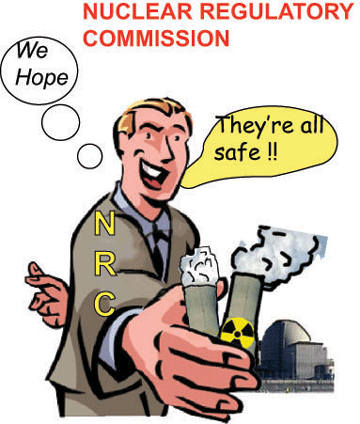 NRC will complete environmental review of Yucca project — chairman http://www.eenews.net/stories/1060013577 Hannah Northey, E&E reporter Greenwire: Tuesday, February 17, 2015 The Nuclear Regulatory Commission intends to complete an environmental review of the contentious waste repository under Yucca Mountain in Nevada because the Energy Department has refused to do so, the NRC’s chairman said today.
“The decision is we will do that since [the Department of Energy] told us they won’t be doing it,” NRC Chairman Stephen Burns told reporters at the Platts 11th Annual Nuclear Energy Conference in Washington, D.C., today. “We have the funds that are left over from the carryover for high-level waste, will cover the preparation of the supplemental [environmental impact statement].” Continue reading
Nuclear power is a hot political issue in South Korea
The main opposition New Politics Alliance for Democracy, which has more than 40% of the seats in the national parliament, has taken a negative stance on the use of nuclear power. In 2013, the alliance specified a “zero-nuclear” goal in its basic policy.
If the nuclear commission overturns the judgment about the safety of the Wolsong reactor, opposition parties and civic groups will certainly gather momentum.

 Debate heats up over aging nuclear reactor http://asia.nikkei.com/print/article/76444 KENTARO OGURA, Nikkei staff writer EOUL — Nuclear power is generating intense debate in South Korea.
At the center of the storm is the Wolsong No. 1 nuclear reactor in the city of Gyeongju, which is now offline as it reached the end of its 30-year design life. Some say it should be allowed to resume operations.
If its restart is not approved, the reactor will become the first such facility in South Korea to be decommissioned.
The Nuclear Safety and Security Commission has already delayed a decision on the issue twice — on Jan. 15 and Feb. 12. Attention is now focused on the South Korean nuclear watchdog’s next meeting, scheduled for Feb. 26.
The nuclear commission is acting on an application for an extension of the nuclear reactor’s operational life span, which was filed by Korea Hydro & Nuclear Power, a subsidiary of Korea Electric Power.
Mixed results Continue reading
Japan highway to open near Fukushima, with no exits allowed
Highway to Open Near Fukushima Nuclear Plant; No Exits Allowed http://blogs.wsj.com/japanrealtime/2015/02/19/highway-to-open-near-fukushima-nuclear-plant-no-exits-allowed/East Nippon Expressway Co. said it will open the complete Joban Expressway on March 1. The highway, most sections of which were already in operation, runs northeast from Saitama prefecture north of Tokyo through the Tohoku region in northern Japan. The final portion to be finished will pass through the towns of Okuma and Futaba in Fukushima prefecture where the crippled Fukushima Daiichi nuclear power plant is located.
Here are five numbers to know about the Joban Expressway.
14.3 Kilometers
Completion of the expressway was substantially delayed by the nuclear accident triggered by the earthquake and tsunami in March 2011. The final section is located between the Joban Tomioka interchange and Namie interchange, and is 14.3 kilometers (about nine miles)long. The entire Joban Expressway is approximately 300 kilometers.
Six Kilometers
The closest the expressway gets to the Fukushima Daiichi nuclear power plant is approximately six kilometers. While drivers can ride on the expressway without any special permit, they are not allowed to make detours or get off the road.
Six Radiation Counters
According to a spokesman at East Nippon Expressway Co., there are six radiation counters set up outdoors alongside the road in the 14.3 kilometer section. On Tuesday, the counters showed 5.5 microsieverts per hour. Radiation exposure during a commercial flight between Frankfurt and Singapore is 39 microsieverts, according to the Australian nuclear safety agency.
0.2 Microsieverts
According to a test conducted by the government, a driver inside a car traveling at 70 kilometers per hour would be exposed to 0.2 microsieverts of radiation during a one-way trip on the 14.3 kilometer section. That’s about 1/300 of the radiation exposure during a chest X-ray, the government said.
15 Centimeters
Special measures were taken to decrease the level of radiation in the 14.3 kilometer section. For example, slopes around the expressway and the shoulder of the road have been paved with additional thickness to about 15 centimeters to prevent any seeping of contaminated soil or water from the ground.
Changing jet stream due to global warming?
Jet streams exist because of differences in air temperature. In the case of the polar jet stream, which is responsible for most of the weather we experience around the middle-latitudes of the northern hemisphere, it’s the cold Arctic butting against warmer areas to the south that drives it. (A more in-depth explanation can be found here.) Anything that affects that temperature difference will affect the jet stream.
This is where climate change comes in: the Arctic is warming much faster than elsewhere. That Arctic/mid-latitude temperature difference, consequently, is getting smaller. And the smaller differential in temperatures is causing the west-to-east winds in the jet to weaken.
Strong jets tend to blow straight west to east; weaker jets tend to wander more in a drunken north/south path, increasing the likelihood of wavy patterns like the one we’ve seen almost non-stop since last winter.
When the jet stream’s waves grow larger, they tend to move eastward more slowly, which means the weather they generate also moves more slowly, creating more persistent weather patterns.
NASA Jet Stream Animation
At least, that’s the theory. Proving it is not easy because other changes are happening in the climate system simultaneously. Some are natural fluctuations, such as El Niño, and others are related to increasing greenhouse gases.
We do know, however, that the Arctic is changing in a wholesale way and at a pace that makes even Arctic scientists queasy. Take sea ice, for example. In only 30 years, its volume has declined by about 60%, which is causing ripple effects throughout the ocean, atmosphere, and ecosystem, both within the Arctic and beyond. I’ve been studying the Arctic atmosphere and sea ice my entire career and I never imagined I’d see the region change so much and so fast……..
Several groups around the globe, including my colleagues and me, are trying to understand the linkages between rapid Arctic warming and changes in weather patterns.
A number of recent studies have found what appears to be a solid connection between sea-ice loss in an area north of western Russia during the fall and a rash of abnormally cold winters in central Asia. The loss of sea ice favors a northward bulge in the jet stream, which strengthens surface high pressure to the east. That shift pumps cold Arctic air southward into central Asia.
Other studies suggest that Arctic warming in summer leads to a split jet stream – or two separated rivers of wind – which tends to trap the waves. Those stationary waves cause weather conditions to remain “stuck” for long periods, increasing the likelihood of extreme heat waves, droughts and flooding events in Eurasia and North America……..https://theconversation.com/a-melting-arctic-and-weird-weather-the-plot-thickens-37314
USA’s Tea Party – 85 groups join movement for solar energy!
Floridians for Solar Choice, the group behind the initiative, is an inchoate alliance of libertarians, Christian Coalition conservatives, liberal environmentalists, and eighty-five Tea Party groups
 Greening the Tea Party, New Yorker BY CAROLYN KORMANN 18 Feb 15 The solar-energy business is booming. The average cost of installing solar panels has dropped by half since 2010, and a new solar electric system is now installed somewhere in the United States every four minutes.
The growth extends well beyond the rooftops of American homes and small businesses; last week, Apple announced that it is investing in an eight-hundred-and-fifty-million-dollar solar farm in Monterey County, California, which it says will power its operations in the state by the end of 2016. Although solar is still small, supplying less than one per cent of the country’s electricity, its growth has alarmed the energy industry’s old guard—coal, oil, and utility companies. Continue reading
Nuclear industry revving up campaign to win public support and public money
 NRC will complete environmental review of Yucca project — chairman http://www.eenews.net/stories/1060013577 “……..’Right-sizing’ the NRC Burns is taking the agency’s reins at a critical time for both the NRC and the U.S. nuclear industry, which has embarked on a public campaign to tout the financial and climate benefits of reactors struggling in competitive power markets.
The industry is facing stiff competition from cheap gas, weak demand in the power markets, and new safety regulations after the 2011 Fukushima Daiichi nuclear disaster in Japan. While five new reactors are under construction and the NRC staff today recommended that another project move forward at DTE Energy Co.’s Fermi nuclear plant in southeastern Michigan, the industry has seen a recent spate of plant closures in California, Wisconsin, Florida and Vermont.
Touching on those closures, a number of executives from nuclear giants Exelon Corp. and FirstEnergy Corp. spoke at the conference about the need for market fixes to bolster struggling reactors.
Donald Moul, vice president of commodity operations for FirstEnergy Solutions, said at least 40,000 megawatts of baseload power — mostly older coal plants but also reactors — could be forced to prematurely retire in the Midwest and Mid-Atlantic, and grid operators and U.S. EPA need to do more to credit reactors under its Clean Power Plan. Moul said nuclear plants are facing a “lack of revenue certainty,” and their closure will only make it more difficult for states to comply with the Obama administration’s climate goals.
David Brown, senior vice president of government affairs for Exelon, the nation’s largest operator of commercial reactors, said there are no “silver bullets,” but market reforms in the PJM Interconnection are a “big start.” On the state level, Brown said, Illinois has developed a handful of options, and a low-carbon energy standard is most likely to gain traction.
“A lot of people thought [EPA’s Clean Power Plan] would be a real savior for the industry, but … that rulemaking was off the mark,” Brown said.
Burns signaled that the NRC in coming weeks and months intends to slim down to match a declining lot of license applications.
NRC senior staff, he said, is focused on “right-sizing” the agency — streamlining operations, making more timely decisions and establishing clearer agencywide priorities through a program dubbed “Project AIM 2020” that began last year.
NRC commissioners will be briefed on staff’s recommendations for slimming the agency tomorrow, and the proposal will be made public soon, he added.
Burns also noted that the agency’s fiscal 2016 budget proposal reflects a reduction of 140 full-time workers and of $27.3 million from the prior year’s request. Burns said the agency’s fiscal 2015 fee rule — expected in coming months — will also likely reflect a dip in licensee fees.
“No organization can remain static,” Burns said.
Twitter: @HMNorthey | Email: hnorthey@eenews.net
California’s solar industry boosting jobs
Report: California adds nearly 7,500 solar jobs to its nation-leading total http://www.sacbee.com/news/business/article10468988.html BY MARK GLOVER MGLOVER@SACBEE.COM 02/16/2015
California’s solar industry added nearly 7,500 jobs in 2014, boosting its nation-leading total to 54,690, according to a new report by the Washington, D.C.-based Solar Foundation.
That represented a 15.8 percent gain over 47,223 reported in 2013. Nearly 60 percent of the current jobs are in the solar installation sector, according to the report.
Massachusetts was a distant second in the 2014 job rankings, with 9,400 solar industry jobs.
“California’s solar industry has once again proven to be a powerful engine of economic growth and job creation,” Andrea Luecke, foundation president and executive director, said in a statement accompanying the figures.
The report also noted that California is projected to add nearly 10,000 more solar industry jobs in 2015.
The foundation said there were 2,094 solar companies in California as of November 2014, also No. 1 nationally. The Golden State also topped the nation in the number homes powered by solar energy, at more than 2.38 million.
Nationally, the foundation said 173,807 held jobs in the solar industry near the end of 2014, up 21.8 percent from the previous year.
1 This Month



Tell the Ukrainian Government to Drop Prosecution of Peace Activist Yurii Sheliazhenko

Petition to revoke the licensing of the Near Surface Nuclear Disposal Facility (NSDF) at Chalk River. https://www.ourcommons.ca/petitions/en/Petition/Details?Petition=e-7247


of the week – STOP SMALL MODULAR REACTORS IN CANADA
To see nuclear-related stories in greater depth and intensity – go to https://nuclearinformation.wordpress.com
-
Archives
- March 2026 (222)
- February 2026 (268)
- January 2026 (308)
- December 2025 (358)
- November 2025 (359)
- October 2025 (376)
- September 2025 (258)
- August 2025 (319)
- July 2025 (230)
- June 2025 (348)
- May 2025 (261)
- April 2025 (305)
-
Categories
- 1
- 1 NUCLEAR ISSUES
- business and costs
- climate change
- culture and arts
- ENERGY
- environment
- health
- history
- indigenous issues
- Legal
- marketing of nuclear
- media
- opposition to nuclear
- PERSONAL STORIES
- politics
- politics international
- Religion and ethics
- safety
- secrets,lies and civil liberties
- spinbuster
- technology
- Uranium
- wastes
- weapons and war
- Women
- 2 WORLD
- ACTION
- AFRICA
- Atrocities
- AUSTRALIA
- Christina's notes
- Christina's themes
- culture and arts
- Events
- Fuk 2022
- Fuk 2023
- Fukushima 2017
- Fukushima 2018
- fukushima 2019
- Fukushima 2020
- Fukushima 2021
- general
- global warming
- Humour (God we need it)
- Nuclear
- RARE EARTHS
- Reference
- resources – print
- Resources -audiovicual
- Weekly Newsletter
- World
- World Nuclear
- YouTube
-
RSS
Entries RSS
Comments RSS
 nuclear-news