Now danger of nuclear war is higher than during the Cold War
Nuclear Specter Returns: “Threat of War Is Higher Than In The Cold War”, Prison Planet, Markus Becker Der Spiegel February 14, 2015 The Ukraine crisis has dramatically worsened relations between NATO and Russia. With cooperation on nuclear security now suspended and the lack of a “red telephone,” experts at the Munich Security Conference warn any escalation in tensions could grow deadly.
The scientists had no idea that their experiment could spell the end of civilization. On Jan. 25, 1995, Norwegian and American researchers fired a rocket into the skies of northwestern Norway to study the Northern Lights. But the four-stage rocket flew directly through the same corridor that American Minuteman III missiles, equipped with nuclear warheads, would use to travel from the United States to Moscow.
The rocket’s speed and flight pattern very closely matched what the Russians expected from a Trident missile that would be fired from a US submarine and detonated at high altitude, with the aim of blinding the Russian early-warning system to prepare for a large-scale nuclear attack by the United States. The Russian military was placed on high alert, and then President Boris Yeltsin activated the keys to launch nuclear weapons. He had less than 10 minutes to decide whether to issue the order to fire.
Yeltsin left the Russian missiles in their silos, probably in part because relations between Russian and the United States were relatively trusting in 1995. But if a similar incident occurred today, as US arms expert Theodore Postol warned recently, it could quite possibly lead to nuclear catastrophe.
Deep Mistrust
“Five or six minutes can be enough time, if you have trust, if you have communication and if you can put this machinery immediately to work,” former Russian Foreign Minister Igor Ivanov said on the sidelines of last weekend’s Munich Security Conference. Unfortunately, he argued, this machinery works very poorly today, and there is great mistrust.
When asked what would happen today if the 1995 missile incident happened again, Ivanov responded, “I cannot be sure if the right decision would be taken.”
Deep mistrust has developed between the West and Russia, and it is having a massive effect on cooperation on security matters.
In November 2014, the Russians announced that they would boycott the 2016 Nuclear Security Summit in the United States. In December, the US Congress voted, for the first time in 25 years, not to approve funding to safeguard nuclear materials in the Russian Federation. A few days later, the Russians terminated cooperation in almost all aspects of nuclear security. The two sides had cooperated successfully for almost two decades. But that is now a thing of the past.
Instead, Russia and the United States are investing giant sums of money to modernize their nuclear arsenals, and NATO recently announced that it was rethinking its nuclear strategy. At the same time, risky encounters between Eastern and Western troops, especially in the air, are becoming more and more common, a report by the European Leadership Network (ELN) recently concluded.
Civilian pilots don’t know how to deal with this,” explains ELN Chair Des Browne, a former British defense minister. “One of these incidents could easily escalate. We need to find a mechanism in which we can talk at the highest level.”
Brown, together with Ivanov and former US Senator Sam Nunn, the grandfather of international disarmament policy, published an analysis last week. The trio recommends “that reliable communication channels exist in the event of serious incidents.” In other words, these channels currently do not exist.Recently Philip Breedlove, the head of NATO Allied Command Operations in Europe, even called for a new “red telephone,” alluding to the direct teletype connection established in 1963 between the United States and the Soviet Union after the Cuban missile crisis. A direct line had been set up between NATO and the Russian military’s general staff in February 2013, but it was cut as a result of the Ukraine crisis.
‘A Very Dangerous Situation’
“Trust has been eroded to the point of almost being destroyed,” said Nunn. “You got a war going on right in the middle of Europe. You got a breakdown of the conventional forces treaty, you got the INF (Intermediate-Range Nuclear Forces) treaty under great strain, you got tactical nuclear weapons all over Europe. It’s a very dangerous situation.”
In late January, the Bulletin of the Atomic Scientists set its “Doomsday Clock” to three minutes to midnight. The last time it was set to that time was in 1983, “when US-Soviet relations were at their iciest point,” as the group of scientists explained. The only other time when the situation was even worse was in 1953, when the clock was set to two minutes to midnight. Unchecked climate change and the “nuclear arms race resulting from modernization of huge arsenals” pose “extraordinary and undeniable threats to the continued existence of humanity,” the group’s statement read.
The current rhetoric coming from the rivals in the East and West seems poorly suited to reducing the threat. …….
Higher Risks with Hybrid Warfare
“It (hybrid warfare) makes everything more dangerous,” said Nunn, “It makes tactical nuclear weapons more dangerous, and it makes weapons material more dangerous.”……http://www.prisonplanet.com/nuclear-specter-returns-threat-of-war-is-higher-than-in-the-cold-war.html
US assistance to Israel to plan development of hydrogen bomb
 US helped Israel with H-bomb – 1980s report declassified, RT.com February 13, 2015 20:22
Israelis are “developing the kind of codes which will enable them to make hydrogen bombs. That is, codes which detail fission and fusion processes on a microscopic and macroscopic level,” said the report, the release of which comes before Israeli Prime Minister Binyamin Netanyahu’s March 3 speech in front of the US Congress in which he will oppose any deal that allows Iran’s legal nuclear program to persist.
“I am struck by the degree of cooperation on specialized war making devices between Israel and the US,” Roger Mattson, a formerly of the Atomic Energy Commission’s technical staff,said of the report, according to Courthouse News.
The report’s release earlier this week was initiated by a Freedom of Information Act request made three years ago by Grant Smith, director of the Washington think tank Institute for Research: Middle Eastern Policy. Smith filed a lawsuit in September in order to compel the Pentagon to substantially address the request.
“It’s our basic position that in 1987 the Department of Defense discovered that Israel had a nuclear weapons program, detailed it and then has covered it up for 25 years in violation of the Symington and Glenn amendments, costing taxpayers $86 billion,” Smith said during a hearing in late 2014 before Judge Tanya Chutkan in US District Court for the District of Columbia.
Smith described in his federal court complaint how those federal laws were violated by the US in the midst of Israel’s budding nuclear program.
“The Symington Amendment to the Foreign Assistance Act of 1961 prohibits most U.S. foreign aid to any country found trafficking in nuclear enrichment equipment or technology outside international safeguards,” Smith wrote.
“The Glenn Amendment of 1977 calls for an end to U.S. foreign aid to countries that import nuclear reprocessing technology.”
In November, Judge Chutkan asked government lawyers resistant to the report’s release why it had taken years for the government to prepare the report for public consumption.
“I’d like to know what is taking so long for a 386-page document. The document was located some time ago,” Chutkan said, according to Courthouse News Service.
“I’ve reviewed my share of documents in my career. It should not take that long to review that document and decide what needs to be redacted.”
The government’s representatives in the case — Special Assistant US Attorney Laura Jennings and Defense Department counsel Mark Herrington — initially said confidentiality agreements required a“line by line” review of the Defense Department’s report. They later shifted, arguing that its release is optional and not mandatory, as “diplomatic relations dictate that DoD seeks Israel’s review.”
Smith and the US agreed that the government would redact sections of the report on NATO countries, though the passages on Israel remain intact……..
Tehran’s nuclear program is legal under the terms of the Nuclear Non-Proliferation Treaty, to which Israel is one of the few United Nations members that is not a signatory. http://rt.com/usa/232203-us-israel-nuclear-weapon/
“Not in Our Name”: the film exposes corporate control of the media
Not In Our Name by Chris Hill KickStarter, 15 Feb 15 A film telling how a nation went to war with its own veterans and scientists, and kept its head in the tar sands on climate change.
About this project
How many wrong decisions can one nation endure? Every week there’s a new story that shows a shocking lack in judgment or ethics on the part of the government. It’s open season on the environment, on science, on the rights of veterans, and it shames us all.
Media in disarray
Cuts to investigative journalism by most media outlets (including Canada’s CBC, which has been decimated by recent government funding cuts) are allowing many stories to remain under-covered, or untold altogether.
Media consolidation has meant there are fewer voices reporting, with ever-tightening restrictions on what they can say. This is a critical threat to democracy, and it’s the principal motivation for this film. Independent voices must pick up the slack.
Science Abandoned
The Canadian tradition of being at the forefront of scientific research and innovation, critical to the nation’s prosperity, has been all but abandoned. The Harper government has pulled the plug on any science that doesn’t conform to its specific oil and gas agenda, and it has effectively muzzled scientists by forbidding them from speaking out to the press.
Critical programs that monitored the melting arctic, smoke stack emissions, food inspections, water quality, oil spills and climate change have been systematically dismantled.
Hundreds of the world’s scientists have written an open letter to the Harper government, voicing concerns over the inability to conduct basic research environmental and health issues, and other areas of science that should contribute to the public good.
It is a frivolous waste of taxpayers’ dollars to fund research only to have it repressed, causing decisions to be made without adequate data and information. This puts our citizens at risk, as it leaves us flying blind amid the dangers of increasing pollution and climate change.and other environmental hazards.
Our tradition of scientific prowess and innovation has been flushed down the toilet because of what scientific research is revealing — the effects of our own country’s destructive policies.
Canada at war with its own veterans…..since 2006 there has been an erosion of funding for veterans. The closure of nine offices has resulted in many veterans’ having to drive for as long as eight hours to receive support. The Harper government has also prioritized pageantryand photo ops over services to veterans. Lump sum payments have replaced lifelong pensions, leaving our soldiers with less. …..
Tar sands = climate change
Stephen Harper was in New York on September 21 of this year, but decided not to attend the UN Climate Change Conference. It may have had something to do with the fact that Canada is listed 58th out of 61 on the list of countries dealing with the issue. Other studies have placed us dead last. Or that we conceal emissions data and ignore or remove environmental protections. Or that from Kyoto to Copenhagen, Canada has been a saboteur when it comes to dealing with CO2 reduction, and is commonly referred to internationally as a carbon criminal. …….
“Not in Our Name”: the film
“Not in Our Name” (NION) will explore the axis of Industry, Media, and Government, which prioritizes corporate interests over the people’s. The film will show how similar tactics are being employed in the US, Britain, Australia…leaders administering the instructions of the multinational corporations who bought them. They count the profits while we, society and the environment count the cost.
If we don’t vigorously confront their stranglehold on our governments, we will have forever crossed the Rubicon, and there will be no turning back……..
Timeline
The film will be released a month before the Canadian federal election in October, 2015. Because of the timeliness of the issues, this release date will help with promotion of the film. But more importantly, we hope to make sure that people are aware of the truth about this government, one that is not acting in the best interests of the people it was elected to serve.
We plan to submit NION to festivals around the world, and to seek as many viewing platforms as our resources will allow. ……https://www.kickstarter.com/projects/1916096034/not-in-our-name
The Nuclear Transformation of the World Health Organisation (includes VIDEO)
 The Nuclear Transformation of the World Health Organisation (includes VIDEO) https://tekknorg.wordpress.com/2013/08/19/the-nuclear-transformation-of-the-world-health-organistion/
August 19, 2013 by Mikkai “In the report which it submitted to the WHO in 1958, the study group on the mental health issues raised by the use of atomic energy stated that the most satisfactory solution for the future peaceful use of atomic energy would be for a new generation that had learned to accept ignorance and uncertainty as a fact of life to emerge.”
How the UN works: “know thine enemy” or at least who it is. SOURCE:http://www.chernobylcongress.org/fileadmin/user_upload/pdfs/Baverstock_How_the_UN_works.pdf
“it is recognized by the World Health Organization that the International Atomic Energy Agency has the primary responsibility for encouraging, assisting and coordinating research and development and practical application of atomic energy for peaceful uses throughout the world without prejudice to the right of the World Health Organization to concern itself with promoting, developing, assisting and coordinating international health work, including research, in all its aspects. ”SOURCE:http://www.iaea.org/Publications/Documents/Infcircs/Others/inf20.shtml#note_c
1957: World Health Organisation Report: Effect of Radiation on Human Heredityhttp://whqlibdoc.who.int/publications/1948-60/9241560231_%28part1%29.pdf
1959; World Health Organisation Report: Effect of Radiation on Human Heredity:http://whqlibdoc.who.int/trs/WHO_TRS_166.pdf
Crumbling Davis-Besse Nuclear Plant to be kept alive by Ohio public $billions?
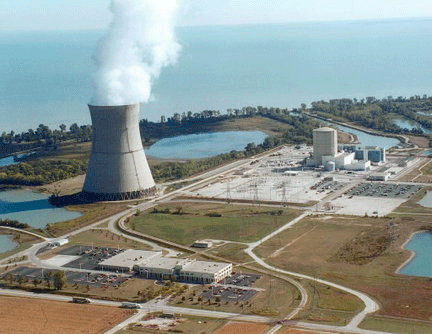 Will Ohioans Be Forced to Pay the Bill to Keep the Crumbling Davis-Besse Nuke Plant Alive? http://ecowatch.com/2015/02/14/ohioans-pay-bill-keep-davis-besse-alive/
Now the plant’s owners are asking the Ohio Public Utilities Commission to force the public to pay billions of dollars over the next 15 years to subsidize reactor operations.
But Davis-Besse’s astonishing history of near-miss disasters defies belief. Its shoddy construction, continual operator error and relentless owner incompetence would not be believed as fiction, let alone as the stark realities of a large commercial reactor operating in a heavily populated area.
Time and again Davis-Besse has come within a fraction of an inch and an hour of crisis management time. Today its critical shield wall is literally crumbing, with new cracks opening up every time the northern Ohio weather freezes (like this week).
The company’s owners have blacked out the entire Northeast including 50 million customers—the largest such disaster in world history.
They allowed boric acid to eat within 3/16th of an inch of a Chernobyl-scale disaster that would’ve permanently irradiated the Great Lakes region. They have set the record for fines by the Nuclear Regulatory Commission, and continue to drain billions of ratepayer dollars from Ohio’s bleeding economy.
Now they want those ratepayers to fork over billions more to keep this reactor running beyond the brink.
Hear about Davis-Besse’s astonishing story, by listening to this incredible hour-long interview with local attorney Terry Lodge and Kevin Kamps of Beyond Nuclear, along with Tim Judson of the Nuclear Information and Resource Service, three of the key expert activists working to get Davis-Besse shutdown.
Many wild stories have been told about atomic power over the decades, but it’s hard to top the true tales from Davis-Besse. In this case, hearing is believing—and holding your head in dismay:
Those of you who want Davis-Besse shut can write the Public Utilities Commission of Ohio at docketing@puc.state.oh.us. Use this label in the subject line of the email, as well as the body of the email message, so PUCO can route the public comments to the correct proceeding: OPPOSITION COMMENT UNDER CASE # 14-1297-EL-SSO.
Vulture Capitalist Paul Singer funds climate denialism
Bjorn Lomborg Think Tank Funder Revealed As Billionaire Republican ‘Vulture Capitalist’ Paul Singer DESMOGBLOG, GRAHAM READFEARN, 9 FEB 15, A billionaire “vulture capitalist” and major backer of the US Republican Party is a major funder of the think tank of Danish climate science contrarian and fossil fuels advocateBjørn Lomborg, DeSmogBlog has found.
New York-based hedge fund manager Paul Singer’s charitable foundation gave $200,000 to Lomborg’s Copenhagen Consensus Center (CCC) in 2013, latest US tax disclosures reveal.
The grant to Lomborg’s think tank is revealed in the tax form of the Paul E. Singer Foundation covering that foundation’s activities between December 2012 and November 2013.
Singer, described as a “passionate defender of the 1%”, has emerged as a major force in the Republican party in recent years and was a key backer and influencer during Mitt Romney’s failed tilt at the Presidency.
The $200,000 grant represented almost one third of the $621,057 in donations declared by the Copenhagen Consensus Center in 2013……..
Lomborg, a Danish political scientist, is often cited on lists of the world’s most influential people.
He writes extensively on climate change and energy issues with his columns appearing in many of the world’s biggest news outlets.
The CCC think tank produces reports that consistently argue that cutting greenhouse gas emissions and increasing the roll-out of current renewable energy technologies should be low priorities for policy makers.
Most recently, Lomborg wrote a column for the Wall Street Journal arguing climate change was not the urgent problem that many thought.
He wrote that “the narrative that the world’s climate is changing from bad to worse is unhelpful alarmism”.
Lomborg argues the poorest countries need fossil fuels to lift themselves out of poverty – a position that gained support from the world’s richest man, Bill Gates.
At a G20 side event in Brisbane last year, Lomborg appeared at an event sponsored by the world’s largest private coal company, Peabody Energy, where he again argued that the world’s poor needed fossil fuels.
The CCC’s keystone project is the Post 2015 Consensus that is trying to influence the formulation of the next set of global development goals being discussed by the United Nations. Those goals will replace the millennium development goals.
Lomborg’s CCC think tank was registered as a not-for-profit in the US in 2008 and has attracted almost $5 million in donations since then. In 2013, the CCCpaid Lomborg, its founder and president, $200,484 for his work. The previous year Lomborg was paid $775,000……
he discovery of support from Paul Singer comes after a DeSmogBlog investigation last year found that CCC’s early funders included conservative think tanks with links to the network of organisations funded by the Koch brothers, who have pushed millions into organisations denying climate science and blocking action to cut fossil fuel emissions.
In the 2014 US political spending cycle, data presented by OpenSecrets shows Singer spent $9.4 million influencing Republicans – the biggest disclosed individual spender on the conservative side of US politics.
Singer, whose Elliott Management hedge fund manages about $25 billion in assets, has been branded a “vulture capitalist” enterprise due to investment strategies employed by his firm that targets foreign economies in trouble……
As well as the generosity shown to Bjorn Lomborg’s think tank, Singer’s foundation gave $500,000 to the Manhattan Institute for Policy Research, where Singer is chairman of the board of trustees.
The Manhattan Institute is also known for downplaying the impacts of climate change while promoting fossil fuels.
In October 2014, Manhattan senior fellow Robert Bryce wrote a report Not Beyond Coal arguing that the future for the coal industry was bright and the fossil fuel was “essential” for addressing poverty in developing countries — a position identical to that pushed by Lomborg.
Bryce also attacks the wind industry claiming it cannot cut emissions, describing wind turbines as “climate change scarecrows”. In testimony to theUS Senate Environment and Public Works Committee in February 2014, Bryce said wind turbines were “slaughtering wildlife” ………http://www.desmogblog.com/2015/02/09/exclusive-bjorn-lomborg-think-tank-funder-revealed-billionaire-republican-vulture-capitalist-paul-singer
Climate Crocks exposes paid climate denialist “Big Green Radicals’
— Climate Denial Crock of the Week, Climate Crocks, with Peter Sinclair Thanks Dr. Evil! Fossil Fuel Propaganda Misfire Goes Viral
February 12, 2015 Every once in a while we can pull back the curtain and get a good look at the evil elves and Madison Avenue Orcs deployed by the fossil fuel barons. Look hard, climate deniers. This is the man pulling your strings.
Posted by a front group called the “Environmental Policy Alliance”, this corporate forged “viral” video popped up a couple days ago. Had to check and make sure this wasn’t a joke, but it’s real. …..
Big Green Radicals is a front group operated by the PR firm Berman & Co. Berman & Co. operates a network of dozens of front groups, attack-dog web sites, and alleged think tanks that work to counteract minimum wage campaigns, keep wages low for restaurant workers, and to block legislation on food safety, secondhand cigarette smoke, drunk driving, and more.
Big Green Radicals describes itself as “a project of the Environmental Policy Alliance (EPA), which exists to educate the public about the real agenda of well-funded environmental activist groups” according its website. “The EPA receives support from individuals, businesses, and foundations.”
Richard Berman is the type of corporate hit man that Aaron Eckhart played in “Thank You For Smoking” – amoral, vicious, and dishonest. PR guys like him usually don’t make the headlines, preferring to remain the man behind the curtain – but a few months ago he showed up in the New York Times, because recommendations he made in a presentation were so vile and offensive that even members of the oil industry audience were disgusted.
If the oil and gas industry wants to prevent its opponents from slowing its efforts to drill in more places, it must be prepared to employ tactics like digging up embarrassing tidbits about environmentalists and liberal celebrities, a veteran Washington political consultant told a room full of industry executives in a speech that was secretly recorded.
The blunt advice from the consultant, Richard Berman, the founder and chief executive of the Washington-based Berman & Company consulting firm, came as Mr. Berman solicited up to $3 million from oil and gas industry executives to finance an advertising and public relations campaign called Big Green Radicals.
The company executives, Mr. Berman said in his speech, must be willing to exploit emotions like fear, greed and anger and turn them against the environmental groups. And major corporations secretly financing such a campaign should not worry about offending the general public because “you can either win ugly or lose pretty,” he said.
“Think of this as an endless war,” Mr. Berman told the crowd at the June event in Colorado Springs, sponsored by the Western Energy Alliance, a group whose members include Devon Energy, Halliburton and Anadarko Petroleum, which specialize in extracting oil and gas through hydraulic fracturing, also known as fracking. “And you have to budget for it.”
What Mr. Berman did not know — and what could now complicate his task of marginalizing environmental groups that want to impose limits on fracking — is that one of the energy industry executives recorded his remarks and was offended by them.
“That you have to play dirty to win,” said the executive, who provided a copy of the recording and the meeting agenda to The New York Times under the condition that his identity not be revealed. “It just left a bad taste in my mouth.”
Pdf of Berman’s presentation here.
Speaking of bad taste, “60 Minutes” profiled Berman as an attack dog for the purveyors of poisonous junk food, and he was proud enough of that to post it on his own Youtube channel,
Berman was paid well by Philip Morris (PM)…. has worked for companies that privatize the profits and socialize the costs. He attacked fine scientists like Steve Schneider (Stanford) and Stan Glantz (UCSF)……….
http://climatecrocks.com/2015/02/12/thanks-dr-evil-fossil-fuel-propaganda-misfire-goes-viral/
Doubts on future of S Korea’s Wolsong-1 nuclear reactor
Fate of Wolsong-1 nuclear reactor up in the air , Jorea Times,
|
Film: Nuclear Nation 2
Berlin Film Review: ‘Nuclear Nation II’ The devastating fallout of Japan’s nuclear disaster shows little sign of improvement in Atsushi Funabashi’s follow-up to ‘Nuclear Nation.’
Variety, Maggie Lee
@maggiesama 15 Feb 15
The fire in Rossing uranium mine
Inferno engulfs Rössing uranium mine February 13th, 2015 | by New Era Staff Reporter By Eveline de KlerkWALVIS BAY – Rio Tinto Rössing uranium mine was dealt a heavy blow yesterday at around lunchtime when a massive fire broke out at the mine.
The fire started at the final product recovery (FPR) plant of the mine, where uranium oxide is packed for export.
Although the fire was contained about two hours later, fears of a possible radiation leak and or radiation exposure was a huge concern among some employees, especially those directly employed at FPR.
Some employees of the mine yesterday said they were worried about radiation leakage although the mine’s emergency service responded quickly and evacuated all workers to designated assembly points on time.
“The fire happened very quickly and spread rapidly within the recovery plant and our guys had to call the fire brigades from Swakopmund and Arandis to assist. Our only worry now is the possibility of a radiation leakage as this is the final plant where we pack uranium,” one miner said.
When asked about the cause of the fire and the possibility of a radiation leakage, the public relations officer of the mine, Botha Ellis, said the mine’s management was assessing and monitoring the situation……..http://www.newera.com.na/2015/02/13/inferno-engulfs-rossing-uranium/
Community renewable energy for Britain
 Buy into renewables! New Internationalist,
One way to decrease this demand is to use household or community-owned renewables instead of commercial energy plants for power.
At the moment, this is rare in Britain, because the cheap bank loans which could fund renewable energy aren’t made available to individuals or community groups (while fossil fuel investors have no problem getting hold of them).
Community projects often cost under $15 million, and ‘at that level, banks aren’t really interested,’ explains Emma Bridge, chief executive of community generator association, Community Energy England (CEE).
Crowd-sourcing and community funding schemes such as Trillion Fund can pay for some renewables, but when it comes to bigger renewable projects, current laws don’t give communities much in the way of rights to buy and profit from them.
Renewables face not only a funding problem, but a legal problem too, especially in places where laws don’t allow members of the public to buy shares in private power plants.
The ‘right to invest’ clause in the most recent version of the Infrastructure Bill (currently working its way through parliament) only lets the public ask for 5-per-cent ownership on large wind-turbine projects, even when they are in public backyards.
Lord Cameron of Dillington’s remark when debating the bill was that 10-per-cent public wind-turbine ownership would let members of the activist public stop wind-turbine construction.
In Denmark, where there is currently a fracking ban in place, the opposite is true. Most of Denmark’s wind-power energy source is community-owned and wind power provides most of the country’s power on some days.
Profits from wind-energy bills go towards local community funds, thanks to a law requiring up to 20-per-cent public ownership of wind turbines.
‘For a long time, Britain has been one of the worst-performing countries in Europe when it comes to utilizing renewable energy,’ says Paul Monaghan, sustainability advisor at Co-operative Energy.
The British consumer-managed energy supplier thinks 25 per cent should be the minimum amount of public ownership offered for larger renewable power projects.
Instead, the government will soon remove British landowners’ right to prevent frackers from trespassing beneath homes.
Allowing more public ownership of renewables can be seen as a way of safeguarding public access to electricity and water in the face of fracking and dwindling traditional oil and gas reserves. http://newint.org/blog/2015/02/13/buy-renewables/#sthash.0uTfDW2S.dpuf
Nuclear nonproliferation is under threat
Nuclear nonproliferation is under threat, and so is American national security WP By Rebecca Davis Gibbons February 14 The newly released 2015 National Security Strategy (NSS), the aspirational security blueprint for the final years of the Obama administration, refers to the risk of nuclear proliferation and nuclear material no fewer than eight times in its 29 pages of text. The key passage on Page 11 reads “no threat poses as grave a danger to our security and well-being as the potential use of nuclear weapons and materials by irresponsible states or terrorists.” One of the greatest tools the United States has to combat this threat is the nuclear non-proliferation regime. However, shifting global power could threaten the nonproliferation regime architecture in ways that could have serious long-term security consequences.
The Treaty on the Non-Proliferation of Nuclear Weapons, or the NPT, is the cornerstone of the nuclear nonproliferation regime, a set of treaties, agreements, and norms aimed at curtailing the spread of nuclear weapons and dangerous nuclear materials. It was this very architecture—the NPT, International Atomic Energy Agency (IAEA) safeguards, IAEA inspections, IAEA referrals to the U.N. Security Council, and six rounds of sanctions — that brought Iran to the negotiating table, and which remains the most viable way to approach nuclear proliferation peacefully. . ……http://www.washingtonpost.com/blogs/monkey-cage/wp/2015/02/14/the-2015-national-security-strategy-and-the-future-of-nuclear-nonproliferation/
The world’s oceans in trouble: it’s US
How we ruined the oceans The Week, 14 Feb 15
How does global warming affect fish? As the oceans heat up, many species are migrating to cooler waters to survive. Some inevitably will fail in these new habitats. Warmer temperatures also make coral reefs more vulnerable to “bleaching,” a chemical process that drains the organisms of their brilliant colors and leads to their death. Other problems are caused directly by the burning of fossil fuels. With oceans absorbing a quarter of the world’s CO2 emissions, they have become 30 percent more acidic, causing inhibited shell growth in coral and crustaceans and reproductive disorders in fish. Power plant emissions — especially from burning coal — put tons of highly toxic mercury in the air, which settles into the ocean. The mercury is taken up by sea creatures and concentrated in predatory species. A recent study found that mercury levels in Pacific yellowfin tuna have been rising at a rate of 3.8 percent a year since 1998. “If it keeps going like that,” says co-author Carl Lamborg, eventually almost “every kind of fish is going to be potentially hazardous.”
What about plastic?
Our oceans contain an estimated 5.25 trillion pieces of plastic — most of them less than 5 millimeters wide — weighing a total of 269,000 tons. ……..
Why aren’t we doing more?
Like global warming, the plight of our oceans is an issue that affects every country in the world. But with each government beholden to its own voters — and its own fishing, plastic, and energy lobbies — it’s almost impossible to achieve any consensus. Ecologists insist it’s not too late to solve the problems affecting our oceans. Some schemes, such as the introduction of “safe zones” where fish can naturally replenish, have worked on a small scale and could be expanded. The authors of the Sciencestudy say it’s possible to reverse the current crisis, but political will is required. “The next several decades,” they say, “will be those in which we choose the fate of the future of marine wildlife.”
The dangers of a fishy diet
For decades, doctors and health officials have encouraged people to eat as much seafood as possible because of fish’s high levels of omega-3 fatty acids, which are good for heart and brain health. But in recent years that recommendation has been tempered, as emissions from factories and power plants have pushed mercury concentrations in oceans and fish up to potentially dangerous levels. Mercury is highly toxic and can cause neurological damage and accumulate in organs; in children and fetuses, it can lead to long-term cognitive disorders. Last year, the FDA updated its advice on fish to say that pregnant women and children should avoid eating tilefish, shark, swordfish, and king mackerel, and limit their consumption of white tuna — all of which contain particularly high levels of mercury because they’re at the top of the food chain. Consumer Reportsrecently criticized the FDA guidelines on fish consumption as inadequate, saying that anyone who eats 24 ounces or more of fish per week — or about six servings — “should steer clear of high-mercury choices,” and warning people not to eat canned tuna or sushi made from tuna. http://www.theweek.com/articles/538881/ruined-oceans
1 This Month



Tell the Ukrainian Government to Drop Prosecution of Peace Activist Yurii Sheliazhenko

Petition to revoke the licensing of the Near Surface Nuclear Disposal Facility (NSDF) at Chalk River. https://www.ourcommons.ca/petitions/en/Petition/Details?Petition=e-7247


of the week – STOP SMALL MODULAR REACTORS IN CANADA
To see nuclear-related stories in greater depth and intensity – go to https://nuclearinformation.wordpress.com
-
Archives
- March 2026 (212)
- February 2026 (268)
- January 2026 (308)
- December 2025 (358)
- November 2025 (359)
- October 2025 (376)
- September 2025 (258)
- August 2025 (319)
- July 2025 (230)
- June 2025 (348)
- May 2025 (261)
- April 2025 (305)
-
Categories
- 1
- 1 NUCLEAR ISSUES
- business and costs
- climate change
- culture and arts
- ENERGY
- environment
- health
- history
- indigenous issues
- Legal
- marketing of nuclear
- media
- opposition to nuclear
- PERSONAL STORIES
- politics
- politics international
- Religion and ethics
- safety
- secrets,lies and civil liberties
- spinbuster
- technology
- Uranium
- wastes
- weapons and war
- Women
- 2 WORLD
- ACTION
- AFRICA
- Atrocities
- AUSTRALIA
- Christina's notes
- Christina's themes
- culture and arts
- Events
- Fuk 2022
- Fuk 2023
- Fukushima 2017
- Fukushima 2018
- fukushima 2019
- Fukushima 2020
- Fukushima 2021
- general
- global warming
- Humour (God we need it)
- Nuclear
- RARE EARTHS
- Reference
- resources – print
- Resources -audiovicual
- Weekly Newsletter
- World
- World Nuclear
- YouTube
-
RSS
Entries RSS
Comments RSS
 nuclear-news