USA – India agreement raises danger of nuclear weapons proliferation and nuclear war
 Even more serious has been the deal’s impact on the nuclear arms race between India and Pakistan……..
By granting India access to uranium, the deal allows India to divert its indigenously-mined uranium to military applications without detracting fuel from the civilian program. To get uranium to India, the U.S. pressured members of 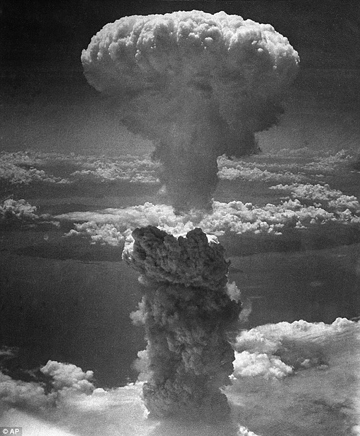 the Nuclear Suppliers Group to “[ease] long-standing restrictions on nuclear trade with India.” Since then, Australia has committed to providing India with uranium
The international community would do best if it encouraged and helped India and Pakistan to settle their differences and accede to the NPT – and if no nation provided either of them with new nuclear technology or fuel until they scale back their military nuclear programs………
The Darker Side of the U.S.-India Nuclear Deal The recent “breakthrough” is cause more for concern than it is for celebration. The Diplomat By Amitai Etzioni February 13, 2015 The American media is gushing about improvements to the United States-India relationship in the wake of President Barack Obama’s January visit to India. Among the achievements stemming from the visit is what the media had called a “breakthrough” that paved the way for implementing the two nations’ civilian nuclear cooperation deal. However, examining the reasons why this deal was first struck, its components, and its side effects suggests that it is a cause more for concern than for celebration.
The U.S. long considered India to be the leader of the non-aligned camp and held that it was tilting toward the USSR and, later, toward Russia. India purchased most of its weapons from Russia, and it had a pseudo-socialist economic regime. The U.S. tilted toward Pakistan throughout the Cold War and in the years that followed. However, following the rise of China, the George W. Bush administration decided to lure India into the West’s camp and draw on it to help contain China. Bush therefore offered India civil nuclear technology and access to uranium, the fuel it needed for nuclear power reactors. The Indian government agreed to sign a 123 Agreement (or the U.S.-India Civil Nuclear Agreement), but the deal ran into considerable opposition within India. Hence the resulting impasse, which Obama has now helped resolve.
A variety of considerations drove Indian opposition to the deal, including concerns about liability, threats to Indian sovereignty, and the prospect of Washington enjoying heightened leverage over New Delhi. Critics in the West correctly raised other concerns. First, the deal violated the spirit if not the letter of the Non-Proliferation Treaty (NPT). The NPT has successfully discouraged several nations that had considered developing nuclear weapons and has even led a few of them to cancel programs that were already underway. This success was achieved in part through a twofold promise: that those nations that possess nuclear weapons will gradually give them up, and that these same nations will refuse to share nuclear technology and fuel with countries that refuse to sign the NPT. Two nations, India and Pakistan (and, by implication, Israel), openly defied the NPT. Hence the Bush administration’s deal with India was and is viewed as a major blow to the NPT regime.
Even more serious has been the deal’s impact on the nuclear arms race between India and Pakistan……..
By granting India access to uranium, the deal allows India to divert its indigenously-mined uranium to military applications without detracting fuel from the civilian program. To get uranium to India, the U.S. pressured members of the Nuclear Suppliers Group to “[ease] long-standing restrictions on nuclear trade with India.” Since then, Australia has committed to providing India with uranium, and India has also received uranium from France, Russia, and Kazakhstan and struck supply agreements with Mongolia, Argentina and Namibia.
Following the deal, Pakistan ramped up its production of uranium and plutonium and, it seems, its nuclear weapons arsenal. Given that both nations have already come close to nuclear blows – the two countries nearly engaged in a war over Kashmir, which has been described as “one of the tensest nuclear standoffs between India and Pakistan since independence in 1947” – such a nuclear arms race is particularly troubling…….
It would be best for everyone involved to put the U.S.-India Civil Nuclear Agreement on ice. The international community would do best if it encouraged and helped India and Pakistan to settle their differences and accede to the NPT – and if no nation provided either of them with new nuclear technology or fuel until they scale back their military nuclear programs………
Amitai Etzioni is a University Professor at The George Washington University and the author of many books, the most recent of which is The New Normal. To read more of his work, follow him on Twitter or Facebook or visit the ICPS website. http://thediplomat.com/2015/02/the-darker-side-of-the-u-s-india-nuclear-deal/
No comments yet.
1 This Month

of the week – Shut Down Drone Warfare!


Tell the Ukrainian Government to Drop Prosecution of Peace Activist Yurii Sheliazhenko

Petition to revoke the licensing of the Near Surface Nuclear Disposal Facility (NSDF) at Chalk River. https://www.ourcommons.ca/petitions/en/Petition/Details?Petition=e-7247
To see nuclear-related stories in greater depth and intensity – go to https://nuclearinformation.wordpress.com
-
Archives
- March 2026 (237)
- February 2026 (268)
- January 2026 (308)
- December 2025 (358)
- November 2025 (359)
- October 2025 (376)
- September 2025 (257)
- August 2025 (319)
- July 2025 (230)
- June 2025 (348)
- May 2025 (261)
- April 2025 (305)
-
Categories
- 1
- 1 NUCLEAR ISSUES
- business and costs
- climate change
- culture and arts
- ENERGY
- environment
- health
- history
- indigenous issues
- Legal
- marketing of nuclear
- media
- opposition to nuclear
- PERSONAL STORIES
- politics
- politics international
- Religion and ethics
- safety
- secrets,lies and civil liberties
- spinbuster
- technology
- Uranium
- wastes
- weapons and war
- Women
- 2 WORLD
- ACTION
- AFRICA
- Atrocities
- AUSTRALIA
- Christina's notes
- Christina's themes
- culture and arts
- Events
- Fuk 2022
- Fuk 2023
- Fukushima 2017
- Fukushima 2018
- fukushima 2019
- Fukushima 2020
- Fukushima 2021
- general
- global warming
- Humour (God we need it)
- Nuclear
- RARE EARTHS
- Reference
- resources – print
- Resources -audiovicual
- Weekly Newsletter
- World
- World Nuclear
- YouTube
-
RSS
Entries RSS
Comments RSS
 nuclear-news
Leave a comment