Sending more nuclear weapons to Europe is the wrong move
 The Wrong Move: Adding Nuclear Weapons to the Russia-Ukraine Conflict Defense One, FEBRUARY 9, 2015 BY LT. GEN. ROBERT GARDGREG TERRYN
Despite the wishes of two key Congressmen, more nuclear weapons in Eastern Europe is a bad idea.
You may have missed it, but last month two key members of Congress asked the military to move additional U.S. nuclear weapons and dual-capable aircraft into Eastern Europe. Reps. Mike Rogers, R-Ala., chairman of the House Armed Services Subcommittee on Strategic Forces, and Mike Turner, R-Ohio, chairman of the Tactical Air and Land Forces Subcommittee, sent a joint letter to Defense Secretary Chuck Hagel and Secretary of State John Kerry advocating the addition of new sites in Eastern Europe for the deployment of additional U.S. nuclear weapons and dual-capable aircraft.
In their letter, the two chairmen extend a Russian statement claiming its sovereign “right” to deploy nuclear weapons in Crimea to an “intention” to do so. They also assert Russian “moves to deploy nuclear-capable Iskander short-range ballistic missiles as well as nuclear-capable Backfire bombers in the illegally occupied territory [Crimea].”
There is no evidence that Russia has taken or is preparing to take any of these actions; but the letter alleges that they pose a new military threat to U.S. allies and our forces in Europe, and that the U.S. must respond “to change President [Vladimir] Putin’s calculus.”
Fortunately, nuclear weapons have played no overt role in Russia’s annexation of Crimea or its ongoing aggression in eastern Ukraine. And while the U.S. and its European allies must react, introducing a nuclear confrontation into the already dangerous situation is more likely to cause Putin to respond in kind than to change his calculus. Declared U.S. policy is to reduce the role of nuclear weapons in our national security, not to employ them in hopes of intimidating a hostile head of state……..
Deploying additional U.S. tactical nuclear weapons to Europe would make them more vulnerable to a Russian preemptive attack, even with conventional weapons, in the event of an escalating crisis. Also, it is well-known that Russia possesses a far larger stockpile of tactical nuclear weapons than the U.S.has in its inventory. Russia could be tempted to employ its tactical nuclear weapons superiority to take out the U.S.weapons deployed in Europe in the mistaken belief that it could confine the conflict to Western Europe. ……
Deploying additional U.S. tactical nuclear weapons and more dual-capable aircraft in Europe provides no advantage: It would be an expensive initiative that would add nothing to our security, divert funds from higher priority defense expenditures, likely provoke Russia to deploy nuclear weapons in Crimea, increase the possibility of nuclear war, and be divisive amongst our NATO allies http://www.defenseone.com/ideas/2015/02/wrong-move-adding-nuclear-weapons-russia-ukraine-conflict/104940/
Book “The Globalization of War” by Michel Chossudovsky
 “The Globalization of War” by Michel Chossudovsky http://tv.globalresearch.ca/2015/02/globalization-war-michel-chossudovsky
Michel Chossudovsky
James Corbett
Buy the book here: https://store.globalresearch.ca/
From the outset of the post World War II period to the present, America’s s global military design has been one of world conquest. War and globalization are intricately related. Militarization supports powerful economic interests. America’s “Long War” is geared towards worldwide corporate expansion and the conquest of new economic frontiers.
The concept of the “Long War” is an integral part of U.S. military doctrine. Its ideological underpinnings are intended to camouflage the hegemonic project of World conquest. Its implementation relies on a global alliance of 28 NATO member states.
In turn, the U.S. as well as NATO have established beyond the “Atlantic Region” a network of bilateral military alliances with “partner” countries directed against Russia, China, Iran and North Korea. What we are dealing with is a formidable military force, deployed in all major regions of the World.
Fukushima nuclear danger exceeds that of Chernobyl
 Gundersen: New data shows Fukushima exceeds Chernobyl… Plumes seen emanating from both the Unit 3 fuel pool & reactor — Nuke Engineer: Broken fuel rods are above all 3 melted down reactors — Gov’t Experts: Unit 3 explosion may have damaged spent fuel & released even more radioactive material (VIDEO) http://enenews.com/gundersen-new-studies-show-fukushima-releases-exceed-chernobyl-nuclear-engineer-broken-spent-fuel-rods-above-all-3-reactors-melted-down-govt-experts-explosion-unit-3-damaged-stored-spent-fuel-re?utm_source=feedburner&utm_medium=email&utm_campaign=Feed%3A+ENENews+%28Energy+News%29
Arnie Gundersen, nuclear expert and chief engineer at Fairewinds, Jan 29, 2015 (emphasis added): Recent scientific studies from Japan show that 75% of the radiation created by the meltdowns was released more than 5 days after the catastrophe… This data… shows that the total gaseous and liquid radioactive releases from the Fukushima Daiichi meltdown exceedthe radiation released during and after the Chernobyl meltdown — while Fukushima Daiichi radioactivity continues to bleed into the Pacific Ocean… I first spoke to the NRC’s Advisory Committee on Reactor Safeguards in 2010 to share my evidence-based calculations showing that containments would likely leak significant amounts of radioactivity during a nuclear power failure… [They] informed me that, the nuclear industry and NRC simply assume that containments will never leak during nuclear emergencies… Unfortunately, those 3 explosions at Fukushima Daiichi prove that containment systems really do fail… How do we know?… First, you can see the violent explosions and the detonation shock wave on TV and video. The secondpicture though shows there are 2 distinct plumes exiting Unit 3 — one plume emanates from the spent fuel pool, but the other is directly over the reactor vessel… Third, TEPCO itself has admitted that hot gases raging at 250*F were released from the containment… No, it is not steam, because steam only exists at 212*F under normal atmospheric pressure.
Idaho National Laboratory Site’s Environmental Surveillance, Education and Research Program — Annual Site Environmental Report for 2011 (pdf): … [3 of Fukushima Daiichi’s] reactor cores overheated and melted, releasing hydrogen gas and fission products into their reactor containment structures… multiple hydrogen deflagrations occurred that damaged the containment structures and allowed more radioactive material to be released. It is possible that the large hydrogen explosion in Unit 3 may have damaged stored spent fuel and caused the release of additional radioactive material. The Fukushima reactor accident in Japan resulted in the release and global dispersal of radioactive contaminants. These contaminants were transported in air across the Pacific Ocean to the United States…
Radio VR, Aug 23, 2014: Thomas Drolet, who is Chairman, CEO and President at GreenWell Renewable Power Corporation [said] “As a technician and nuclear reactor engineer I can say that they will eventually succeed [at Fukushima Daiichi]“… The reactor itself is by far “the most difficult issue,” Mr, Drolet states. Each of the three damaged reactors has two main areas ofbroken fuel: in the spent fuel base, which is up high, and the reactor core. “Slowly and identically they have to remove that fuel, some of it damaged, some of it whole”…
Threat to Europe of wildfires causing release of Chernobyl radiation
 Ukrainian Wildfires May Bring Chernobyl’s Radiation Back To Life http://www.gizmodo.com.au/2015/02/ukrainian-wildfires-may-bring-chernobyls-radiation-back-to-life/
The original disaster saw 85 petabecquerels of radioactive caesium released, and best estimates predict that between 2 and 8 petabecquerels still lie in the upper surface of soil around Chernobyl. It was hoped that it would gradually sink into the earth, but the thick, abandoned forest picks that up the radiation, dead leaves return it to the top surface of the soil, and so the cycle continues. Now, forest fires — more severe because of thick vegetation present — can release larger amounts of radiation to the surrounding than expected.
In fact, analysis of satellite images of forest fires in 2002, 2008 and 2010, and measurements of radioactive caesium-137 deposited on the area, by researchers at the Norwegian Institute for Air Research quantify that effect. They reveal that those three fires alone released as much as 0.5 petabecquerels in their smoke. The radiation spread across Euope, even reaching Italy and Scandinavia.The releases are, arguably, small when averaged over entire populations. It’s estimated that the fires likely gave people in nearby Kiev a 10 microsievert dose of radiation, which is only 1 per cent of the permitted yearly dose. But it’s also noted by the researchers that the fires also likely dump radioactive strontium, plutonium and americium too, often unevenly. That can directly affect people, or work its way into the food chain.
Perhaps worst of all, models created by the researchers suggest that forest wildfires in the exclusion zone won’t peak until between 2023 and 2036, well ahead of the point by which radiation will have decayed away. It’s currently not clear what Ukraine officials will do about the threats — indeed, it has plenty else to worry about right now — but currently, it looks like wildfires could resurrect Chernobyl’s radiation across the rest of Europe if something isn’t done to stop it. [Ecological Monographs via New Scientist]
Westinghouse cagey about paying more for delays in new nuclear power
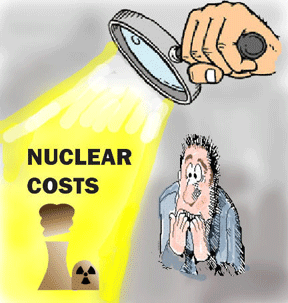 Will Westinghouse pay for another nuclear delay? Power Source, February 10, 2015 A strange argument went down on Dec. 16 among electric utility Georgia Power and its regulator, the Georgia Public Service Commission, and entangled local nuclear firm Westinghouse Electric Co.
Cranberry-based Westinghouse and its partners in the construction of the first two AP1000 reactors in the United States had, up to that point, resisted telling Georgia Power when the project would be completed. The company provided a list of activities planned through December 2015, but would not forecast further, Georgia Power told the commission.
The utility tried time and again to obtain an integrated project schedule, it told regulators. Already, the project originally set to be completed by April 2016 was 21 months behind.
The regulators, in turn, wondered who’s running the show — the utility that hired the consortium of nuclear builders for an estimated $14 billion project or its contractors.
When Westinghouse and its main construction partner, Chicago Bridge & Iron, finally submitted the long sought-after document in January, they revealed another 18-month delay, projecting the first plant would be ready for service in mid-2019 and the second in 2020.
Georgia Power has placed the estimated cost of the delay at $720 million, or $40 million a month. That’s on top of more than $1 billion in delay- and design-related costs that the two sides have been suing each other over since 2012.
The utility hasn’t agreed to the new dates, its parent company, Atlanta-based Southern Co. said in a public filing Jan. 29. Nor does it believe that Westinghouse and its partners have done everything possible to mitigate the delay. And, as has been the pattern with cost overruns in the project, Southern Co. told investors it expects the latest expenses to become part of the lawsuit.
The company’s CEO Tom Fanning said on Bloomberg Television last week, “Southern Co. won’t absorb those costs. The contractors will.”
Chicago Bridge & Iron has denied that claim. Westinghouse declined to address the comment………..
The likelihood of delays is so ingrained in nuclear construction that the Public Service Commission requires its analysts to continuously update the cost of potential delays spanning as many as four years.
Deviating from original construction schedules and budgets has been the norm for all past nuclear construction projects in this country, one of the main criticisms of undertaking such efforts.
As a result, a lot is seen as riding on the Vogtle construction. With cheap natural gas flooding U.S. markets, nuclear has to prove there’s an economic advantage to investing in such capital-heavy construction instead of throwing up a couple of natural gas power plants in a few years’ time at a fraction of the cost……..http://powersource.post-gazette.com/powersource/companies-powersource/2015/02/10/Will-Westinghouse-pay-for-another-nuclear-delay/stories/201502100014
A field guide to “nuclear environmentalists”
 Former Nuclear Regulatory Commissioner and state regulator Peter Bradford sees the finance issue as the nuclear industry’s Kryptonite.
“Trying to solve climate change with nuclear is like trying to solve world hunger with caviar,” he said
Straight.com. Peter Dykstra, 9 Feb 15 “…In recent years, some major science and environmental players have come forward to endorse nuclear power. Former EPA administrator and Obama climate czar Carol Browner is one of the glitziest.
Browner signed up for the newest and shiniest effort to sell nuke plants, the year-old Nuclear Matters, founded by electric giant Exelon in 2014.
Nuclear Matters is run by public relations agency Sloane & Associates. Critics call it a nuclear front group, but Sloane prefers to bill it as “starting a national conversation on nuclear power,” and adds that other utilities, nuke builders and suppliers have joined Exelon as sponsors.
The group recruited several other bipartisan political heavyweights as paid spokespeople but none that are catnip for the environmental community, where opposition to nuclear power is the rule, not the exception.
So when Nuclear Matters hauled in Browner as a spokesperson of its Leadership Council last year, she was a big catch.
Browner said she typically devotes a few hours a week to Nuclear Matters and is compensated for her time, but neither she nor Nuclear Matters will discuss her fee. Continue reading
For the first time, radioactive strontium found in Vermont Yankee Nuclear plant groundwater
 State Finds Radioactive Material In Vermont Yankee Groundwater, VPR, By JOHN DILLON • FEB 9, 2015 The Vermont Health Department says for the first time it has found the radioactive isotope Strontium-90 in ground water at the Vermont Yankee nuclear plant in Vernon……..While the health department says there is no immediate risk to health, Commissioner Harry Chen says the discovery shows the need for the state to closely monitor the site now and in the future……
Vermont Yankee shut down at the end of December and is now beginning the decades-long decommissioning process. http://digital.vpr.net/post/state-finds-radioactive-material-vermont-yankee-groundwater
Nuclear power agreement between Russia and Egypt
 Cairo and Kremlin agree on building a nuclear power plant, DW, 10 Feb 15
Officials from Egypt and Russia have signed agreements to boost economic and industrial ties during Putin’s visit to Cairo. The two countries plan to build a nuclear power station, Egypt’s President El-Sissi says. Russia’s president, Vladimir Putin, wrapped up his two-day visit with Egyptian counterpart Abdel-Fattah el-Sissi in Cairo on Tuesday, after both countries signed a memorandum of understanding to build Egypt’s first nuclear power plant together. The power plant is expected to be made with the latest technology and have four separate blocks providing 1200 megawatts of energy each, according to Sergey Kirienko, the director general of the Russian atomic energy corporation Rosatom.
President Putin stressed that “if definite decisions are made, it would not be simply about building a nuclear power plant, but about creating a whole new nuclear industry in Egypt.”
He also stressed that Moscow had only signed a memorandum of understanding on the construction, meaning that the deal had not yet been finalized…….http://www.dw.de/cairo-and-kremlin-agree-on-building-a-nuclear-power-plant/a-18248404
Vermont’s largest city , Burlington, now on 100% renewable energy
Burlington, Vermont Now Runs on 100 Percent Renewable Energy, Triple Pundit, Leon Kaye | Monday February 9th, Burlington, Vermont, has been making waves for becoming the first city in the U.S. to be powered 100 percent by renewables. (Some may say Greenburg, Kansas was the first, but we are talking about a town of 800 people versus 42,000 in Burlington.) Reliant on coal a generation ago, Vermont’s largest city has slowly revamped its energy portfolio, culminating in the purchase of a hydropower plant late last year.
This milestone may not be surprising considering Vermont’s progressive politics and buy-in from residents who overall supported the plan of the local utility,Burlington Electric. But the fact that Burlington has been able to do this without raising rates since 2009 — while saving the city about $20 million over the next 20 years — creates a case study for communities that are interested in investing in renewables but skittish about making such an aggressive move………http://www.triplepundit.com/2015/02/burlington-vermont-runs-100-renewable-energy
Uranium company Cameco continues to get miserable results
 Uranium Producer Cameco Looks Depleted Full-Year Results Lowest Since 2006, WSJ, By SPENCER JAKAB Feb. 8, 2015 Customers shutting down in droves? Environmentalists creating headaches? Low cost competitors flooding the market? Nuke ‘em. ……
he nearly two-thirds decline in Cameco’s U.S.-listed share price since February 2011 is about more than a delayed earnings bonanza. Furthermore, fluctuations in uranium’s thinly traded spot market should be viewed cautiously.
Not only do utilities in Japan and elsewhere have substantial inventory on hand but other sources of uranium supply hang over the market. These include low-cost mines in Kazakhstan that now supply around 40% of the market as well as nuclear fuel derived from nonmine sources such as the waste “tailings” of previously processed uranium.
Assuming analysts’ 2018 scenario plays out in terms of output and prices, Cameco now fetches just under 10 times that year’s consensus forecast earnings according to FactSet—hardly a bargain in today’s depressed mining landscape. The cloud hanging over Cameco may not dissipate soon.http://www.wsj.com/articles/uranium-producer-cameco-looks-depleted-ahead-of-the-tape-1423421905
AUDIO: Marshall Islands loses nuclear lawsuit against USA
| AUDIO: Marshall Islands loses nuclear lawsuit against USA http://www.radioaustralia.net.au/international/radio/program/pacific-beat/marshall-islands-loses-nuclear-lawsuit-against-usa/1413323 |
The United States has dismissed a nuclear disarmament lawsuit brought about by Marshall Islands. Last month, the case was tentatively dismissed, but a decision last week has ruled the case had no grounds and any action by the courts would violate the “separation of powers” doctrine.
Meanwhile, the court battle to get a naturalised Marshall Islands citizen onto the ballot for the US elections in November will make its way to the High Court next week.
Editor of the Marshall Islands Journal Giff Johnson says the fight for nuclear disarmament may not be over in the US just yet.
Presenter: Richard Ewart
Speaker: Giff Johnson, Editor, Marshall Islands Journal
Israel way behind in renewable energy
Israel lags in recycling and renewable energy
Israel near bottom of OECD recycling and renewable energy rankings; has largest per capita public water usage.
1 This Month

of the week – Shut Down Drone Warfare!


Tell the Ukrainian Government to Drop Prosecution of Peace Activist Yurii Sheliazhenko

Petition to revoke the licensing of the Near Surface Nuclear Disposal Facility (NSDF) at Chalk River. https://www.ourcommons.ca/petitions/en/Petition/Details?Petition=e-7247
To see nuclear-related stories in greater depth and intensity – go to https://nuclearinformation.wordpress.com
-
Archives
- April 2026 (68)
- March 2026 (251)
- February 2026 (268)
- January 2026 (308)
- December 2025 (358)
- November 2025 (359)
- October 2025 (376)
- September 2025 (257)
- August 2025 (319)
- July 2025 (230)
- June 2025 (348)
- May 2025 (261)
-
Categories
- 1
- 1 NUCLEAR ISSUES
- business and costs
- climate change
- culture and arts
- ENERGY
- environment
- health
- history
- indigenous issues
- Legal
- marketing of nuclear
- media
- opposition to nuclear
- PERSONAL STORIES
- politics
- politics international
- Religion and ethics
- safety
- secrets,lies and civil liberties
- spinbuster
- technology
- Uranium
- wastes
- weapons and war
- Women
- 2 WORLD
- ACTION
- AFRICA
- Atrocities
- AUSTRALIA
- Christina's notes
- Christina's themes
- culture and arts
- Events
- Fuk 2022
- Fuk 2023
- Fukushima 2017
- Fukushima 2018
- fukushima 2019
- Fukushima 2020
- Fukushima 2021
- general
- global warming
- Humour (God we need it)
- Nuclear
- RARE EARTHS
- Reference
- resources – print
- Resources -audiovicual
- Weekly Newsletter
- World
- World Nuclear
- YouTube
-
RSS
Entries RSS
Comments RSS
 nuclear-news