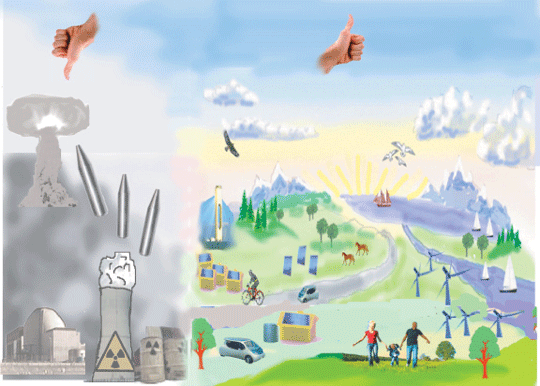
 The war on solar, which is real, is really a war over what kind of energy system we will have in the 21st century. Will it be the 21st century model we at GreenWorld and NIRS advocate, based on clean renewable energy, distributed generation and the rest? Or will it be a continuation of the 20th century model of large baseload power plants, whether they be coal or nuclear? That’s the fundamental issue and how it is resolved may well determine the future of our planet.
 Clean energy vs nuclear: the battle intensifies http://safeenergy.org/2015/02/06/clean-energy-vs-nuclear/ Michael Mariotte February 6, 2015
In theory, the USA’s “all of the above” energy policy has a certain amount of appeal: why should government pick winners and losers? Why not–since no one knows the future–as a matter of policy pursue all energy sources?
One obvious issue is the availability of sufficient resources to effectively support all energy sources.
But there is a much more fundamental problem that makes “all of the above” a PR tagline, not a real energy policy: some energy sources are simply incompatible with others.
Specifically, the 20th century “baseload” power approach of electricity generation and distribution–reliant on large nuclear and coal plants–does not work in a 21st century energy system based on clean, distributed generation, energy efficiency, and a smart grid.
That’s a problem, especially for those who want to end fossil fuels and view both nuclear power and renewables as having a role to play in fighting climate change. The choice isn’t clean energy versus coal; it’s clean energy versus fossil fuels and nuclear because the baseload power model–which is the only model in which nuclear works–prevents the integration of all but a small percentage of renewables into the grid.
Germany and some other European countries already have reached that point. And some U.S. states are getting there rapidly.
Naive nuclear backers may not understand this reality, but the nuclear utilities (which are the same, by the way, as the fossil fuel utilities) do understand it. That’s why the nuclear industry isn’t going after natural gas, which is its main competitor in many locations at the moment. Instead, as this long and well-done article, titled Why the nuclear industry targets renewables instead of gas, from Midwest Energy News points out, the nuclear industry is going after renewables–and in a big way.
Others, focused more on fossil fuels, have noticed the same trend from the flip side. The Institute for Energy Economics and Financial Analysis (IEEFA) this week points out that while the media has been obsessed with the notion of a “war on coal,” the real war going on is the war on solar power. While IEEFA takes on the issue from the viewpoint of the fossil fuel industry going after solar, remember: the nuclear and fossil fuel utilities are one and the same. Continue reading
Nuclear supplier nations not happy with India’s Liability Law
The nuclear ‘breakthrough’ is mostly hype: http://economictimes.indiatimes.com/news/politics-and-nation/the-nuclear-breakthrough-is-mostly-hype-swaminathan-sa-aiyar/articleshow/46162264.cms Swaminathan SA Aiyar 8 Feb, 2015 ndian officials say the Obama visit broke a seven-year logjam in nuclear cooperation, opening the way for US firms to set up nuclear power plants in India.
The Modi-Obama meeting whipped up a lot of fizz and optimism. Problem: the key issue is not political at all but commercial. The entities that must be convinced are not US presidents but heads of nuclear corporations like GE and Toshiba-Westinghouse. And no corporation so far is convinced that India’s nuclear liability law has ceased to be a hurdle.

An Indo-US agreement was indeed reached on a completely separate issue — tracking the movement of US nuclear materials to ensure India did not divert these to military use. This was an additional roadblock in case of the US. But overcoming this does not settle the much bigger roadblock — unlimited liability — that all four supplier nations are complaining about.
For investors – the ‘nuclear renaissance’ is all but dead
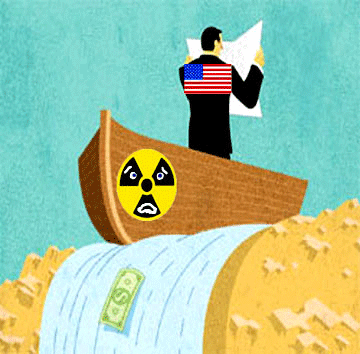 Nuclear Energy Renaissance Takes Another Blow and May Never Recover, The Motley Fool By Travis Hoium February 7, 2015 The nuclear renaissance some people hoped for took another big step backward this week when the Vogtle Nuclear Power Plant said it would be delayed another 18 months and cost at least $720 more than the $14.5 billion previously expected.
Nearly every nuclear plant that’s been proposed in the U.S. in the last decade has run into major cost overruns and delays, and without government support, the nuclear renaissance may already be dead. But the latest delay casts a shadow over an energy source that’s becoming increasing uncompetitive in today’s energy landscape.
What happened at Vogtle
The latest news from Southern Co.‘s (NYSE: SO ) subsidiary Georgia Power is that the Vogtle Plant will now be delayed until mid-2019 for the first reactor, and mid-2020 for the second. Costs could pile up to $720 million and could be as much as $1 billion.
Contractors Westinghouse Electric Co. and Chicago Bridge & Iron Co. alerted Southern Co. of the delays, adding to a long list of delays for Westinghouse plants that were supposed to help revitalize nuclear power in the U.S. Worse yet, it’s ratepayers, not Southern Co.’s shareholders, who will be footing most of the bill for this project, even if it’s never completed.
The kick in the gut to ratepayers
If you live in Georgia, the delay and additional cost will affect you more than you think. Under a plan called construction work in progress, or CWIP, Georgia Power gets to charge customers for the Vogtle plant before it’s even finished. Yes, today customers are paying an average of $6.60 per month for a plant that isn’t likely to produce any power until at least 2019. It’s a sweet deal for utilities, but one that’s becoming increasingly problematic for consumers.
What CWIP does is transfer the risk from the company building the nuclear plant to ratepayers. If the project is delayed or costs more than expected, Georgia Power still makes its money unless regulators intervene. In fact, without CWIP, we may not even be talking about nuclear plants being built in the U.S. If utilities had to take on the risk of nuclear themselves, they wouldn’t do it, something we’re already seeing across the country.
Nuclear energy’s problem in the U.S.
This isn’t the only nuclear plant running into these kind of issues. NRG Energy (NYSE: NRG ) abandoned a potential expansion of South Texas Nuclear Generating Station because of rising costs for nuclear plants and low cost natural gas. The project is still moving forward with regulatory approval, which partner Toshiba is funding, but it’s doubtful the plant will ever be built.
Duke Energy (NYSE: DUK ) canceled the Levy Nuclear Plant because of rising costs, but under CWIP, it still gets to keep a profit of about $150 million. Even Entergy closed the Vermont Yankee nuclear plant late last year because it wasn’t cost effective. Whether it’s new plants or upgrades to old plants, it’s costs that are sinking nuclear in the U.S. today.
In an analysis of the unsubsidized levelized cost of energy for various energy sources, investment bank Lazard found that nuclear energy would cost between 9.2 cents and 13.2 cents per kW-hr. Compare that to 6.1-8.7 cents/kW-hr for natural gas, 7.2-8.6 cents/kW-hr for utility scale solar, and 3.7-8.1 cents/kW-hr for wind energy.
Nuclear energy is also losing based on recent trends. The cost of solar and wind energy are falling rapidly, which is why over half of all energy generation installed in each of the last two years was solar or wind energy.
The nuclear renaissance is all but dead
Setbacks like the Vogtle Nuclear Plant faced this week have become all too predictable in the nuclear industry, and they’re the reason a nuclear renaissance is unlikely in the U.S. Costs have simply gotten too high, and low costs from competing energy sources like natural gas, solar, and wind will keep the industry from ever taking off.
For investors, the lesson comes down to where the energy industry and its costs are trending. Nuclear energy may seem like a great idea on the surface, but if costs are continually rising, it’s an energy source that’s doomed in this country. Solar energy, on the other hand, is cutting costs by double-digit percentage points per year and is now less costly than nuclear on a per kW-hr basis. Maybe it’s time to look at alternative energy more seriously, something utilities are already doing……….http://www.fool.com/investing/general/2015/02/07/nuclear-energy-renaissance-takes-another-blow-and.aspx
Chicago Mayor Rahm Emanuel joins coalition for renewable energy, and against nuclear
 Emanuel lines up with Exelon critics to push clean-power agenda, Crains, Chicago Business 4 Feb 15 By STEVE DANIELS Chicago Mayor Rahm Emanuel is joining a new coalition of environmentalists, renewable energy companies and labor leaders to lobby Springfield for stronger policies favoring wind and solar power, as well as energy efficiency.
The Illinois Clean Jobs Coalition, whose formation was announced today at Testa Foods on the Southwest Side, notably didn’t include Exelon, the state’s largest power generator, which is preparing to lobby state lawmakers for a financial rescue plan for its six nuclear plants in Illinois.
Emanuel’s unusual participation in the group potentially sets up the mayor as a political foe of Exelon, which in the past has counted on Chicago politicians, notably Emanuel’s predecessor, Richard M. Daley, for political support at the state level.
Speaking at a press conference, Emanuel endorsed the group’s call to boost the state’s already-ambitious renewable energy goal to 35 percent of the power generated in the state by 2030. Current state law calls for 25 percent renewable power by 2025.
The coalition also wants state lawmakers to boost energy efficiency standards to a 20 percent reduction in power consumption by 2025. State law now calls for annual improvements in efficiency, with a mandate to cut power consumption by 2 percent this year.
Finally, the group calls for “market-based strategies” to reduce carbon. One way to do that would be with a new system of charging carbon emitters for the pollution they generate. “A new revenue stream could be used to invest in areas such as workforce development, low-income bill assistance and research and development into new clean energy technology,” the coalition says in a statement.
Adoption of this agenda will create tens of thousands of jobs in Illinois over the next decade, the group claimed……….http://www.chicagobusiness.com/article/20150204/NEWS11/150209897/emanuel-lines-up-with-anti-exelon-crowd-to-push-clean-power-agenda
India nuclear deal protects USA nuclear companies from legal action after accidents
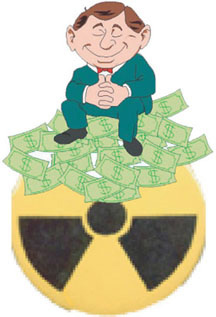 Suppliers Can’t Be Sued For Accidents, Operators Can: Details of Nuclear Deal With US NDTV NEW DELHI, 8 Feb 15 : The Indian government has released details of its nuclear agreement, which was sealed in meetings between India and the US, during US President Barack Obama’s recent visit to India.
Here are some of the points, which have been made public by the Ministry of External Affairs:
- On the controversial issue of tracking of supplied nuclear fissile material by the US, India has refused, saying it will only go by IAEA safeguards.
- In case of a nuclear accident, the victims cannot sue the suppliers for damage. It is only the operators of a plant who can be taken to court…….
Arnold Schwarzenegger speaks out for green energy and action on climate change
Schwarzenegger calls for climate action, http://www.heraldsun.com.au/news/breaking-news/schwarzenegger-calls-for-climate-action/story-fni0xqll-1227212488918?nk=12eb6391f5cbbe65f220fb12fca19ba4for AAP FEBRUARY 09, 2015 FORMER California governor and Hollywood star Arnold Schwarzenegger is calling for more to be done to combat climate change, saying it is “the issue of our time”.
SPEAKING on Sunday to a small group at the Munich security conference, where he introduced a new policy paper The Future of Energy, Schwarzenegger said his experience in California was that the adoption of green energy creates jobs and leads to energy independence.
He applauded formal efforts to come to new agreements to reduce carbon emissions and fight global warming, but says there is no need for governments to wait for summits. He says “we should be fighting climate change right now”.Schwarzenegger says the issue shouldn’t be politicised and people should work together on solutions. He says “we all breathe the same air”.
Book: RIGHT OF BOOM The Aftermath of Nuclear Terrorism
 When nuclear terrorists strike Business Standard Max Boot February 8, 2015
Benjamin E Schwartz
The Overlook Press
Nuclear terrorism has long been a staple of movies and television shows. But typically, Hollywood productions end with the bomb being defused. What would happen if heroes didn’t save the day and the United States experienced the worst 24 hours in its history?
That is the important question Benjamin E Schwartz, a career government official who has worked at the Departments of State, Defense and Energy, sets out to answer in his clunkily titled first book, Right of Boom. (“Right of boom” is government-speak for “after an explosion”.) His analysis begins with a fictional narrative that unfolds in a flat, matter-of-fact tone: “On an otherwise calm and uneventful morning, a small nuclear weapon explodes in downtown Washington, D.C. … The casualty count rises to over a hundred thousand, and the destruction is measured in hundreds of billions of dollars.”…….
1 This Month
Chernobyl: The Lost Tapes – A good documentary on Chernobyl on SBS available On Demand for the next 3 weeks– https://www.sbs.com.au/ondemand/tv-program/chernobyl-the-lost-tapes/2352741955560

of the week–London Campaign for Nuclear Disarmament

Tell the Ukrainian Government to Drop Prosecution of Peace Activist Yurii Sheliazhenko
To see nuclear-related stories in greater depth and intensity – go to https://nuclearinformation.wordpress.com
-
Archives
- April 2026 (114)
- March 2026 (251)
- February 2026 (268)
- January 2026 (308)
- December 2025 (358)
- November 2025 (359)
- October 2025 (376)
- September 2025 (257)
- August 2025 (319)
- July 2025 (230)
- June 2025 (348)
- May 2025 (261)
-
Categories
- 1
- 1 NUCLEAR ISSUES
- business and costs
- climate change
- culture and arts
- ENERGY
- environment
- health
- history
- indigenous issues
- Legal
- marketing of nuclear
- media
- opposition to nuclear
- PERSONAL STORIES
- politics
- politics international
- Religion and ethics
- safety
- secrets,lies and civil liberties
- spinbuster
- technology
- Uranium
- wastes
- weapons and war
- Women
- 2 WORLD
- ACTION
- AFRICA
- Atrocities
- AUSTRALIA
- Christina's notes
- Christina's themes
- culture and arts
- Events
- Fuk 2022
- Fuk 2023
- Fukushima 2017
- Fukushima 2018
- fukushima 2019
- Fukushima 2020
- Fukushima 2021
- general
- global warming
- Humour (God we need it)
- Nuclear
- RARE EARTHS
- Reference
- resources – print
- Resources -audiovicual
- Weekly Newsletter
- World
- World Nuclear
- YouTube
-
RSS
Entries RSS
Comments RSS
 nuclear-news