Nuclear power , highly subsidised, but still not cost-effective or compatible with a clean energy future.
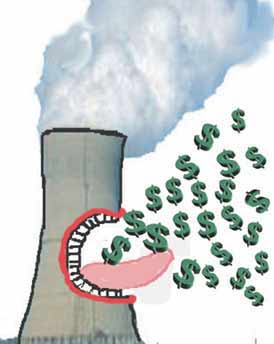 Let’s not forget, either, that nuclear power has some of the largest per kilowatt-hour subsidies of any electricity source.
Big, Expensive Power Plants Undermine a Clean Energy Future http://cleantechnica.com/2015/02/04/big-expensive-power-plants-undermine-clean-energy-future/ February 4th, 2015 by John Farrell – (excellent charts and diagrams) Originally published on ilsr.org.
With the rich history of cost overruns in the nuclear industry, Xcel Energy and Minnesota regulators shouldn’t have been surprised when the retrofit cost for the Monticello nuclear power plant ballooned to more than twice the original estimate. Regulators asked tough questions last year about whether the cost overruns were the responsibility of poor management and the definitive answer came back this week: yes.
This example only reinforces why nuclear power (and other large-scale power generation) isn’t cost-effective or compatible with a clean energy future.
Nuclear is Expensive The Minnesota nuclear problem actually starts in 2005, when Xcel Energy applied to extend the life of the Monticello power plant beyond its initial 40-year license. The Public Utilities Commission ignored evidence suggesting that the use of a wind and natural gas hybrid system could replace Monticello’s output more cost-effectively than continuing operation of the nuclear plant. Among the data ignored were the potential economic value of community-based wind power, the value of capturing the federal Production Tax Credit for wind energy production, and the high capacity factor of modern wind turbines. (They also ignored an earlier study from the state’s Department of Commerce on the relatively low cost – $6 per customer per year – of closing down the state’s other nuclear plant, Prairie Island).
The massive cost overrun of the Monticello retrofit – $665 million compared to an initial estimate of $320 million – doubles down on the mistake to extend the power plant’s life. Alone, it’s enough money to install over 400 megawatts of new wind power. When coupled with investments in energy efficiency – itself the lowest cost electricity resource – the money spent to extend the life of Xcel’s nuclear reactor could have purchased cleaner and less expensive power from other sources. [The following chart illustrates the competitive clean alternatives to extending the life of this nuclear power plant.]
The story isn’t much better for new reactors added to existing power plants. Georgia Power’s Vogtle expansion, for example, is $900 million (6%) over budget through 2014 (and it justslipped again this week), with the estimated operation date already delayed by nearly two years, until 2018 (plenty of time to balloon the budget!). You’d think the utility learned a lesson when the original project went 1200% percent over budget!
Let’s not forget, either, that nuclear power has some of the largest per kilowatt-hour subsidies of any electricity source.
As the Pittsburgh Post-Gazette said, “a new nuclear project may be the hardest large-scale construction venture to keep on schedule and on budget, because of the cost, the regulations, and the infrequency of such events.” Compare that with solar power, with prices falling 50% in five years and new installations completed every 2.5 minutes.
A Poor Fit for a 21st Century Grid
Nuclear power is an expensive energy source, especially because it’s such a poor fit for a 21st century grid system. In a grid centered on distributed renewable energy resources, the best energy supply is one that is flexible (can rapidly change output to match grid demands). As a “baseload” resource, nuclear is the least flexible electricity supply, with nuclear power plants requiring very stable output around the clock.
Nuclear power plants have some flexibility, but only if they’re already operating at 50-60% of capacity. Below that level, they have to be shut down as renewable energy resources grow.
Nuclear energy had its heyday when advocates believed it would be “too cheap to meter,” but the cost and operational parameters of large-scale power plants do not align with the needs of a modern electricity grid. Maybe the future will look more like the miniaturization of nuclear power in Isaac Asimov’s sci-fi novel Foundation, but until then, using already-available and cost-effective distributed renewable energy makes more sense.
This article originally posted at ilsr.org. For timely updates, follow John Farrell on Twitter or get theDemocratic Energy weekly update.
No comments yet.
1 This Month



Tell the Ukrainian Government to Drop Prosecution of Peace Activist Yurii Sheliazhenko

Petition to revoke the licensing of the Near Surface Nuclear Disposal Facility (NSDF) at Chalk River. https://www.ourcommons.ca/petitions/en/Petition/Details?Petition=e-7247


of the week – STOP SMALL MODULAR REACTORS IN CANADA
To see nuclear-related stories in greater depth and intensity – go to https://nuclearinformation.wordpress.com
-
Archives
- March 2026 (222)
- February 2026 (268)
- January 2026 (308)
- December 2025 (358)
- November 2025 (359)
- October 2025 (376)
- September 2025 (258)
- August 2025 (319)
- July 2025 (230)
- June 2025 (348)
- May 2025 (261)
- April 2025 (305)
-
Categories
- 1
- 1 NUCLEAR ISSUES
- business and costs
- climate change
- culture and arts
- ENERGY
- environment
- health
- history
- indigenous issues
- Legal
- marketing of nuclear
- media
- opposition to nuclear
- PERSONAL STORIES
- politics
- politics international
- Religion and ethics
- safety
- secrets,lies and civil liberties
- spinbuster
- technology
- Uranium
- wastes
- weapons and war
- Women
- 2 WORLD
- ACTION
- AFRICA
- Atrocities
- AUSTRALIA
- Christina's notes
- Christina's themes
- culture and arts
- Events
- Fuk 2022
- Fuk 2023
- Fukushima 2017
- Fukushima 2018
- fukushima 2019
- Fukushima 2020
- Fukushima 2021
- general
- global warming
- Humour (God we need it)
- Nuclear
- RARE EARTHS
- Reference
- resources – print
- Resources -audiovicual
- Weekly Newsletter
- World
- World Nuclear
- YouTube
-
RSS
Entries RSS
Comments RSS
 nuclear-news
Leave a comment