Nuclear power makes worse the global water supply crisis that is being caused by global warming
 World has not woken up to water crisis caused by climate change: IPCC head, Planet Ark, 04-Feb-15 INDIA Author: Nita Bhalla Water scarcity could lead to conflict between communities and nations as the world is still not fully aware of the water crisis many countries face as a result of climate change, the head of the U.N. panel of climate scientists warned on Tuesday.
The latest report from the U.N. Intergovernmental Panel on Climate Change (IPCC) predicts a rise in global temperature of between 0.3 and 4.8 degrees Celsius (0.5 to 8.6 Fahrenheit) by the late 21st century.
Countries such as India are likely to be hit hard by global warming, which will bring more freak weather such as droughts that will lead to serious water shortages and affect agricultural output and food security.
“Unfortunately, the world has not really woken up to the reality of what we are going to face in terms of the crises as far as water is concerned,” IPCC Chair Rajendra Pachauri told participants at a conference on water security.

“If you look at agricultural products, if you look at animal protein – the demand for which is growing – that’s highly water intensive. At the same time, on the supply side, there are going to be several constraints. Firstly because there are going to be profound changes in the water cycle due to climate change.”
Development experts around the world have become increasingly concerned about water security in recent years.
More frequent floods and droughts caused by climate change, pollution of rivers and lakes, urbanization, over-extraction of ground water and expanding populations mean that many nations such as India face serious water shortages.
In addition, the demand for more power by countries like India to fuel their economic growth has resulted in a need to harness more water for hydropower dams and nuclear plants……….http://planetark.org/enviro-news/item/72777
Nuclear power is simply NOT “low carbon”
Greenhouse gases are emitted in all stages of the lifecycle of a nuclear reactor: construction, operation, fuel production, dismantling and waste disposal. Leaving out any of these five stages will bias estimates towards lower values.
The last two contributions, dismantling and waste disposal are particularly difficult to estimate. Not many commercial reactors have been fully decommissioned. Also there is still no scientific or political consensus on the approach to be used for the long-term storage of waste.
The fuel preparation contribution is also problematic. Considerable amounts of carbon are released in the mining, milling and separation of the uranium from the ore. Also the carbon emitted is very dependent on the concentration of uranium in the ore.
It’s important to appreciate that these three problematic contributions, fuel production, dismantling and waste disposal are either non-existent or small contributions in the case of electricity generation by renewable technologies. Estimates of the carbon footprint of renewably generated electricity therefore should be much more reliable than those for nuclear.

But what is the carbon footprint of nuclear power? I have trawled the literature and found that there is no scientific consensus on the lifetime carbon emissions of nuclear electricity.
Remarkably, half of the most rigorous published analyses have a carbon footprint for nuclear power above the limit recommended by the UK government’s official climate change advisor, the Committee on Climate Change (CCC).
According to the CCC, if we are to avoid the worst effects of climate change, by 2030 all electricity should be generated with less than 50 grams of carbon dioxide emitted for each kilowatt-hour (50 gCO2/kWh).
Since all new generators have lifetimes well over 20 years, I believe this limit should be imposed on all new electricity supply systems here and now – and all the more so for those with lifetimes spanning many decades.
Note that thanks to long construction times for the EPR design and a forthcoming legal challenge, it’s entirely possible that the planned Hinkley C reactor will not be completed until 2030 or beyond. It will then be subsidised for the first 35 years of its projected 60 year lifetime – taking us through until 2090.
What is the carbon footprint of renewable electricity? Continue reading
China organising itself to market nuclear reactors to other countries
 China nuclear power firms to merge in bid to boost global clout By Pete Sweeney and Charlie Zhu Feb 4 (Reuters) – China Power Investment Corp is merging with the State Nuclear Power Technology
 Corp, as Beijing drives consolidation in its rapidly expanding nuclear power sector with the aim of eventually exporting reactors.
The Chinese power producer currently controls about a tenth of China’s nuclear power market, while the State Nuclear Power Technology Corp was formed in 2007 to handle nuclear technology transferred from U.S.-based Westinghouse Electric Co.
A merger between the two would create a firm with total assets of more than 600 billionyuan ($96 billion), industry experts estimate.
“The merger will help them expand in China, and the overseas market in the long run,” said Francois Morin, Beijing-based China director of World Nuclear Association……..
China, which now primarily provides financing and construction services to nuclear power projects overseas, is expected by some experts to start exporting reactors after 2020 and become a major exporter by 2030 when it has fully digested foreign technology and developed its domestic industry.
The global nuclear market is currently dominated by firms such as France’s Areva, Russia’s Rosatom State Nuclear Energy Corp and Japan’s Toshiba Corp, which controls Westinghouse………Westinghouse Electric Co has already handed over most of the intellectual property for its AP1000 reactor design to the State Nuclear Power Technology Corp……..http://www.reuters.com/article/2015/02/04/china-nuclear-ma-idUSL4N0VE05Q20150204
Will USA nuclear companies really be able to sell their reactors to India?

 Is the India nuclear agreement really the ‘breakthrough’ Obama promised? WP, By Annie Gowen and Steven Mufson February 4 NEW DELHI — President Obama stood alongside Prime Minister Narendra Modi in India’s capital just days ago and announced a “breakthrough understanding” that the two countries hoped would pave the way for U.S. firms to sell nuclear reactors to India.
But analysts and experts familiar with the negotiations say that the legal issues remain so complex that private U.S. companies may continue to shy away from new deals in India, despite the developing country’s fast-growing and dire power needs.
So far, the details of the agreement have been sketchy at best……….
 Analysts say the real test will be whether the two U.S.-Japanese companies sign commercial contracts with the Nuclear Power Corporation of India……..
The key issue will be whether the conflict between international and Indian law can be waved away by a memorandum from India’s attorney general. The memorandum would have to say that the 2010 liability law “doesn’t mean what it says,” said a Washington lawyer familiar with the issues, speaking on the condition of anonymity to protect his professional relationships.
A second obstacle has been the requirement in the Hyde Act of 2006 that the Indian government and an independent auditor annually provide information about the form, amounts and location of any uranium supplied to India to make sure it is not diverted for military use……..
India is a special case — and nonproliferation experts have special concerns about it. India’s first nuclear reactor dates to 1956; the country has 21 reactors at seven power plant sites.
The United States and Canada withdrew support for the nuclear program after the country exploded a nuclear device in 1974, and the United States and Japan imposed sanctions after the 1998 tests.
Members of Congress will want to be sure that India cannot skirt the Bush-era legislation and did not simply wear down American negotiators to achieve the present agreement………
Even if the thorny details of the liability question are worked out — a big “if,” analysts say — American companies still face the political realities of India. Although the government concedes that nuclear power must remain part of the country’s energy mix, particularly to counter rising greenhouse gas emissions, nuclear power plants remain unpopular with local residents, and acquiring land to build plants can take years.
In the end, said M.K. Bhadrakumar, a former Indian ambassador who is now an analyst, the “breakthrough” touted by Obama and Modi may end up being more of a diplomatic success than a commercial breakthrough………http://www.washingtonpost.com/world/is-the-india-nuclear-agreement-really-the-breakthrough-obama-promised/2015/02/04/bc0b0dd2-abc1-11e4-8876-460b1144cbc1_story.html
Nuclear weapons have not kept safe the world’s nuclear states – President Rouhani
 Iran’s president accuses nuclear powers of hypocrisy, Guardian 5 Feb 15, Hassan Rouhani says Iran doesn’t need bomb and that weapons have not kept world’s nuclear states safe Iran’s president Hassan Rouhani has berated the world’s nuclear powers, saying atomic weapons have not kept them safe and reiterating that his country is not seeking the bomb.
Rouhani, in an unusually fiery speech, avoided explicit mention of ongoing nuclear talks between the west and Iran, but accused atomic-armed states of hypocrisy.
“They tell us: ‘We don’t want Iran to make atomic bombs’, you who have made atomic bombs,” Rouhani said in Isfahan on Wednesday, a city 400km (250 miles) south of the capital, Tehran.
He then took aim at Israel, which has never acknowledged that it has nuclear weapons, dubbing the state a “criminal”.
“Have you managed to bring about security for yourselves with atomic bombs? Have you managed to create security for the usurper Israel?” Rouhani said.
“We don’t need an atomic bomb. We have a great, self-sacrificing and unified nation,” he said, referring to Monday’s launch of an observation satellite into space by Iran……….http://www.theguardian.com/world/2015/feb/05/iran-doesnt-need-an-atomic-bomb-rouhani-nuclear-weapons
Activists unite to fight the ‘vampire’ technologies of fracking and nuclear
 Anti-Fracking and No Nukes Activists Join Forces Demanding Renewable Energy Revolution
These two vampire technologies suck the energy out of our planet while permanently poisoning our air, water, food and livelihoods.
The human movements fighting them have been largely separate over the years.
No more.
In the wake of Fukushima, the global campaign to bury atomic power has gained enormous strength. All Japan’s 54 reactors remain shut. Germany is amping up its renewable energy generation with a goal of 80 percent or more by 2050. Four U.S. reactors under construction are far over budget and behind schedule. Five old ones have closed in the last two years.
In New England and elsewhere, as the old nukes go down, safe energy activists shift their attention to the deadly realities of fossil fuel extraction.
The issues are familiar. Fracking in particular poisons our water and spews out huge quantities of lethal radiation. Ironically, in Ohio and elsewhere, the seismic instability it creates threatens atomic reactors still in operation.
In California, the burgeoning movement to shut the two remaining nukes at Diablo Canyon has run parallel with the powerful grassroots opposition to fracking. In both cases, water issues in this drought-plagued state have moved front and center.
Now the gap is being bridged. In a passionate hour-long dialog on saving our Earth, long-time anti-fracking activist David Braun speaks with Linda Seeley of the San Luis Obispo Mothers for Peace, the legendary grassroots group that has fought Diablo Canyon for more than four decades.
In their Solartopian radio conversation, and in a call to convene this coming spring, we see the seeds of an intertwined alliance that can help save our Earth: http://prn.fm/solartopia-green-power-wellness-hour-02-03-15/
Nuclear power , highly subsidised, but still not cost-effective or compatible with a clean energy future.
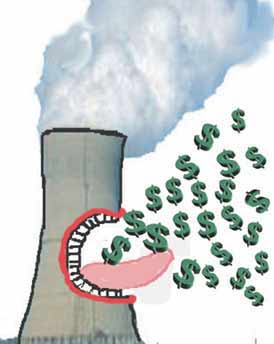 Let’s not forget, either, that nuclear power has some of the largest per kilowatt-hour subsidies of any electricity source.
Big, Expensive Power Plants Undermine a Clean Energy Future http://cleantechnica.com/2015/02/04/big-expensive-power-plants-undermine-clean-energy-future/ February 4th, 2015 by John Farrell – (excellent charts and diagrams) Originally published on ilsr.org.
With the rich history of cost overruns in the nuclear industry, Xcel Energy and Minnesota regulators shouldn’t have been surprised when the retrofit cost for the Monticello nuclear power plant ballooned to more than twice the original estimate. Regulators asked tough questions last year about whether the cost overruns were the responsibility of poor management and the definitive answer came back this week: yes.
This example only reinforces why nuclear power (and other large-scale power generation) isn’t cost-effective or compatible with a clean energy future. Continue reading
Entergy Corp cannot stop hearings on summer closing of Indian Point nuclear facility – judge rules
 Judge allows hearings on summer closings of New York nuclear plant Planet Ark 05-Feb-15 USA Scott DiSavino A judge in New York has ruled Entergy Corp cannot stop hearings on the state’s plan to shut the company’s Indian Point nuclear power plant for part of the summer to protect fish in the Hudson River.
In a ruling late Tuesday, an administrative law judge at the state Department of Environmental Conservation (DEC) rejected Entergy’s latest attempt to stop the state from shutting the plant, at least for part of the summer.
The ruling was the latest salvo in an eight-year battle between Entergy, which wants to run Indian Point for another 20 years, and the state, which wants the plant shut……….
The judge, Maria Villa, made the ruling on Entergy’s attempt to quash the DEC’s 2013 proposal that Indian Point shut for at least 42 days each year, between May 10 and Aug. 10, during prime fish migrations……
The hearings are expected to continue through 2015.
Indian Point withdraws up to 2.5 billion gallons of water a day from the Hudson to cool equipment, and then discharges it back into the river a little warmer than before.
Environmental groups and the DEC have long argued Indian Point’s water intake system kills about a billion fish, fish eggs and larvae each year, and that the plant should install cooling towers to reduce the use of river water by recycling it……..http://planetark.org/enviro-news/item/72785
The true carbon footprint of nuclear power – the ‘Third Generation’ reactor at Hinkley Point C?

As we have seen, the EPR’s very high cost suggests considerably higher emissions in the construction stage. So too does the fact that, over its projected 60-year lifetime, it will be using uranium from very low quality ores.
The likely delay due to the Austrian appeal against the European Commission’s decision on the EPR subsidy offers an opportunity for a full, independent and peer reviewed assessment of the environmental impact of this complex and expensive new technology.
“………..Using 0.005% ore, nuclear has higher carbon emissions than gas
Nuclear fuel preparation begins with the mining of uranium containing ores, followed by the crushing of the ore then extraction of the uranium from the powdered ore chemically. All three stages take a lot of energy, most of which comes from fossil fuels. The inescapable fact is that the lower the concentration of uranium in the ore, the higher the fossil fuel energy required to extract uranium.
Table 12 in the Berteen paper confirms the van Leeuwen result that for ore with uranium concentration around 0.01% the carbon footprint of nuclear electricity could be as high as that of electricity generation from natural gas.
This remarkable observation has been further confirmed in a report from the Austrian Institute of Ecology by Andrea Wallner and co-workers. They also point out that using ore with uranium concentration around 0.01% could result in more energy being input to prepare the fuel, build the reactor and so on, than will be generated by the reactor in its lifetime.
According to figures van Leeuwen has compiled from the WISE Uranium Project around 37% of the identified uranium reserves have an ore grade below 0.05%.
A conservative estimate for the future LCA of nuclear power for power stations intended to continue operating into the 2090s and beyond would assume the lowest uranium concentration currently in proven sources, which is 0.005%.
On the basis that the high concentration ores are the easiest to find and exploit, this low concentration is likely to be more typical of yet to be discovered deposits.
Using 0.005% concentration uranium ores, the van Leeuwen, Berteen and Wallner analyses agree a nuclear reactor will have a carbon footprint larger than a natural gas electricity generator. Also, it is unlikely to produce any net electricity over its lifecycle.
What is the carbon footprint of the ‘Third Generation’ reactor at Hinkley Point C? Continue reading
Complicated nuclear weapons problems for USA’s new secretary of defense-in-waiting
 VOICE The Nuclear Trials of Ashton Carter The new secretary of defense-in-waiting faces some complicated decisions when it comes to the modernization of America’s nuclear triad. FP, BY JEFFREY LEWIS FEBRUARY 5, 2015
“………Carter inherits a mess. In November, the Pentagon received two reviews of the Department of Defense’s nuclear enterprise. Outgoing Secretary of Defense Chuck Hagel pledged more money and high-level attention to the nuclear mission after a series of embarrassing stories that undermine public confidence in the stewardship of the nation’s nuclear stockpile. Implementing those changes will land in Carter’s lap.
It will not be an easy task. The pair of reviews were, depending on how one counts them, the ninth and tenth separate review ordered to stop the series of humiliations visited upon the nation’s nuclear stewards in the past seven years.
A partial list of embarrassing stories includes: the so-called “munitions transfer incident” in which six nuclear weapons were mistakenly flown across the country; an accidental shipment of Minuteman III nosecones to Taiwan; the removal of the commander of the intercontinental ballistic missile (ICBM) force for an epic bender involving a Beatles cover band at a Mexican restaurant in Moscow; the reprimand of the number two official at U.S. Strategic Command who is the subject of a criminal probe involving gambling with fake casino chips; the court-marshal of a launch officerinvolved with a drug ring — as well as a plethora of other embarrassments ranging from widespread cheating on examinations, poor marks in unit assessments, and violations of security procedures including launch officerssleeping with the door to the command capsule propped…….
American nuclear posture has remained essentially unchanged since the Cold War. There was, during the early years of the Clinton administration, a brief moment when something different seemed possible. The Clinton administration undertook a comprehensive review of defense policy after the end of the Cold War called the Bottom-Up Review. As a kind of complement, the administration also conducted the first Nuclear Posture Review (NPR). ……..
 The problem is that just outside of 10 years, the United States will be simultaneously purchasing the following systems:
- A new ballistic missile submarine (called SSBN-X) with procurement stretching overFY21-35. Cost: $77-102 billion.
- A new ICBM, with procurement stretching over FY 2027-2034. Cost: $80-120 billion.
- A new long-range strike bomber (LRS-B) that will be in service “by the mid-2020s” with procurement stretching into the 2030s. Cost: $55 billion, plus a few tens of billion in R&D.
- A new long-range standoff cruise missile (LRSO) that no one thinks will survive austerity.Cost: $20-30 billion, including that of a new warhead.
Oh, and let’s not forget that the Air Force will also be spending between $8-10 billion per year through 2037 on procuring F-35 aircraft.
People who don’t want to admit that the current nuclear modernization plan is impossible like to imply that my estimates are somehow off. That’s what I don’t make my own estimates. I am simply curating the estimates by the Department of Defense, the services, or independent government entities like Government Accountability Office or Congressional Budget Office. (Go ahead, click on the links.) When you put the plans next to one another, it is immediately clear there isn’t enough money.
Defense Department officials are already calling this period in the late 2020s a “modernization mountain” — a period when the United States will be attempting to simultaneously replace all three legs of the triad, in addition to purchasing new fighters. I have already written that I think our effort to climb the modernization mountain ends like Jon Krakauer’s Into Thin Air. ……..https://foreignpolicy.com/2015/02/05/nuclear-triad-modernization-strategic-defense-ashton-carter-pentagon/
Fossil fuel company executives just do not care about the planet’s future
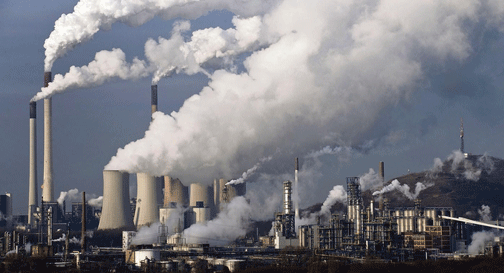 Fossil fuel companies are the greatest threat to life’s party – not greens People who argue it’s a good idea to respect nature’s thresholds get labelled spoilsports, but the real party-poopers are those who recognise no limits at all Guardian, Andrew Simms, 5 Feb 15 22 months and counting
“Will we go ahead?” asked Shell CEO, Ben van Beurden, rhetorically, about the oil company’s plans to drill in the Arctic. “Yes if we can. I’d be so disappointed if we wouldn’t.” Van Beurden had the grace to concede that his plans “divide society,” but he seemed unable to comprehend that they might condemn it.
From new research showing that recent sea level rise is “far worse than previously thought”, to updated confirmation of how far we are transgressing our planetary environmental boundaries, an almost daily accumulation of evidence seems unable still to connect van Beurden’s words to their full implication.
What if, instead, he had said to the press conference gathered to hear Shell’s quarterly financial results a few days ago: “We wish to inform you that our business plan is to destabilise permanently the climate on which you, your families and society depend.”
Harsh? Perhaps, but their strategy will end the party for the rest of us, so that their corporate party might continue. In fact, it seems that extreme weather in the form of drought is already breaking hearts in Brazil by forcing cities to cancel carnival, the greatest party of all.
It’s ironic. Those who argue it’s a good idea to respect nature’s various thresholds (like not making farming so toxic that you poison the bees who kindly pollinate our food crops) traditionally get labelled as fun-free spoilsports. But it seems it’s those who recognise no limits at all who represent the greatest threat to life’s party.
While the global industrial exploitation of nature drives a mass extinction event on land and sea, it becomes ever clearer that our own well-being is dependent on the general condition of the environment. Our health, both physiological and psychological, is deeply connected to and relies on the diversity of life.
Now, a new global calculator developed by the Department of Energy and Climate Change, suggests a course of action to prevent irreversible warming that could be as good for the web of life as it is for our quality of life. Radical changes to farming, transport, food and fuel will be needed, but it envisages a world of spreading forest canopies, clean, quiet electric transport and healthy, increasingly vegetarian diets. With such a potential win-win, why would anyone choose bad times with business as usual? The status quo is tenacious.
If you look at the UK’s biggest lobbying groups at the centre of European power in Brussels, their scale seems to be in direct proportion to the damage they do and how likely they are to resist progressive change. Oil, finance and aviation are all in the top five. And, even as the economics of fracking and remote oil exploration, such as in the Arctic, have fallen apart, their lobbies remain persistent and audacious. How else could a Conservative party, which extols the notion of an English person’s home being their castle, be persuaded to promote changes in the trespass law to allow fracking firms to drill beneath homes without the owners’ permission?
Logic, consistency and science become inconvenient to indefensible positions. When the US Senate last month voted on whether climate change was real and caused by human activities it was creating future folklore. Accepting the first, but not the second proposition, the Senate put its debate on a par with the famous, and now seen as absurd, 1925 Scopes ‘Monkey’ case in theUS, which effectively put the theory of evolution on trial………http://www.theguardian.com/environment/blog/2015/feb/04/fossil-fuel-companies-are-the-greatest-threat-to-lifes-party-not-greens
Roodfop solar will get a boost from high efficiency concentrating solar cells
High efficiency concentrating solar cells move to the rooftop, EurekAlert, 5 Feb 15 ULTRA-HIGH EFFICIENCY SOLAR CELLS SIMILAR TO THOSE USED IN SPACE MAY NOW BE POSSIBLE ON YOUR ROOFTOP THANKS TO A NEW MICROSCALE SOLAR CONCENTRATION TECHNOLOGY DEVELOPED BY AN INTERNATIONAL TEAM OF RESEARCHERS.
“Concentrating photovoltaic (CPV) systems leverage the cost of high efficiency multi-junction solar cells by using inexpensive optics to concentrate sunlight onto them,” said Noel C. Giebink, assistant professor of electrical engineering, Penn State. “Current CPV systems are the size of billboards and have to be pointed very accurately to track the sun throughout the day. But, you can’t put a system like this on your roof, which is where the majority of solar panels throughout the world are installed.”
Giebink notes that the falling cost of typical silicon solar cells is making them a smaller and smaller fraction of the overall cost of solar electricity, which also includes “soft” costs like permitting, wiring, installation and maintenance that have remained fixed over time. Improving cell efficiency from about 20 percent for silicon toward greater than 40 percent with multi-junction CPV is important because increasing the power generated by a given system reduces the overall cost of the electricity that it generates………http://www.eurekalert.org/pub_releases/2015-02/ps-hec020515.php
1 This Month

18 March Webinar @ 1 PM EST: An Assessment of SMR Projects: The Case of Canada
register for the zoom:
https://us02web.zoom.us/webinar/register/WN_o8BIIOUvQ2ONJR1nta65DQ#/registration

of the week – STOP SMALL MODULAR REACTORS IN CANADA
To see nuclear-related stories in greater depth and intensity – go to https://nuclearinformation.wordpress.com
-
Archives
- February 2026 (256)
- January 2026 (308)
- December 2025 (358)
- November 2025 (359)
- October 2025 (376)
- September 2025 (258)
- August 2025 (319)
- July 2025 (230)
- June 2025 (348)
- May 2025 (261)
- April 2025 (305)
- March 2025 (319)
-
Categories
- 1
- 1 NUCLEAR ISSUES
- business and costs
- climate change
- culture and arts
- ENERGY
- environment
- health
- history
- indigenous issues
- Legal
- marketing of nuclear
- media
- opposition to nuclear
- PERSONAL STORIES
- politics
- politics international
- Religion and ethics
- safety
- secrets,lies and civil liberties
- spinbuster
- technology
- Uranium
- wastes
- weapons and war
- Women
- 2 WORLD
- ACTION
- AFRICA
- Atrocities
- AUSTRALIA
- Christina's notes
- Christina's themes
- culture and arts
- Events
- Fuk 2022
- Fuk 2023
- Fukushima 2017
- Fukushima 2018
- fukushima 2019
- Fukushima 2020
- Fukushima 2021
- general
- global warming
- Humour (God we need it)
- Nuclear
- RARE EARTHS
- Reference
- resources – print
- Resources -audiovicual
- Weekly Newsletter
- World
- World Nuclear
- YouTube
-
RSS
Entries RSS
Comments RSS
 nuclear-news